Jun 11, 2014 | Advocacy, Non-legal submissions
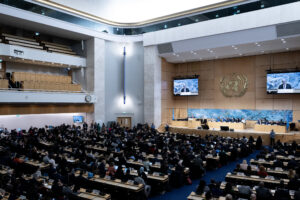
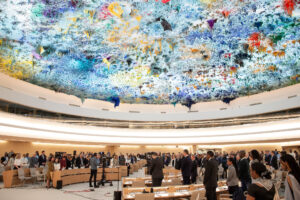
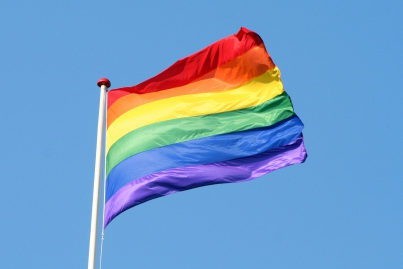
The ICJ, together with the International Lesbian and Gay Association (ILGA) and on behalf of ARC International, today delivered an oral statement to the Human Rights Council during an interactive dialogue with the UN Special Rapporteur on peaceful assembly and association.
The report of the Special Rapporteur addressed challenges faced by groups at risk, including lesbian, gay, bisexual, transgender and intersex persons.
The statement welcomed the report by the Special Rapporteur.
It referred to the Nigerian Same Sex Marriage (Prohibition) Act (which in fact criminalizes a much broader range of human rights-protected activities than its title would necessarily suggest), Uganda’s Anti-Homosexuality Act, and Ukraine’s draft law on “propaganda of homosexual relations”. All of these laws impede freedom of peaceful assembly of LGBTI persons. The Nigerian law also interferes with freedom of association, as it bans registration, funding and activities of “gay” organizations.
It also referred to Russia’s ban on “propaganda of non-traditional sexual relations”.
It emphasised the detrimental impact of such laws on the work of LGBTI human rights defenders and the activities of health care providers. It stressed that laws directly targeting the freedom of peaceful assembly or association of LGBTI individuals solely because of their sexual orientation or gender identity are inconsistent with international human rights law.
UN-HRC26-AssociationLGBTI-OralStatement-advocay-non legal submission-2014 (full text in pdf)
The report of the Special Rapporteur is available here.
Jun 11, 2014 | Events
The ICJ’s Senior Legal Adviser on women’s human rights participated in a panel discussion on ‘Gains, gaps and challenges in addressing violence against women’, convened on 10 June 2014 in the margins of the Human Rights Council’s 26th regular session in Geneva.
The event was co-sponsored by the Office of the High Commissioner for Human Rights (OHCHR) and the Permanent Missions of Canada and Chile and was moderated by Jane Connors, Chief of the OHCHR Special Procedures Branch. Panelists included Rashida Manjoo, Special Rapporteur on violence against women; Her Excellency Elisa Goldberg, Ambassador of Canada; Her Excellency Marta Maurás Peréz, Ambassador of Chile; and Leah Hoctor, ICJ Senior Legal Adviser.
The ICJ’s intervention focussed on remaining challenges, including the lack of prompt and effective investigations into allegations of violence against women (VAW); systemic failures in some States’ implementation of their due diligence obligations; and a series of disconnects at the international level pertaining to the link between VAW and other forms of discrimination and rights violations that women face, the lack of a holistic conceptualisation and treatment of VAW, and the insufficient integration of legal and normative progress in the discussions and approach of international fora.
Jun 11, 2014 | Events
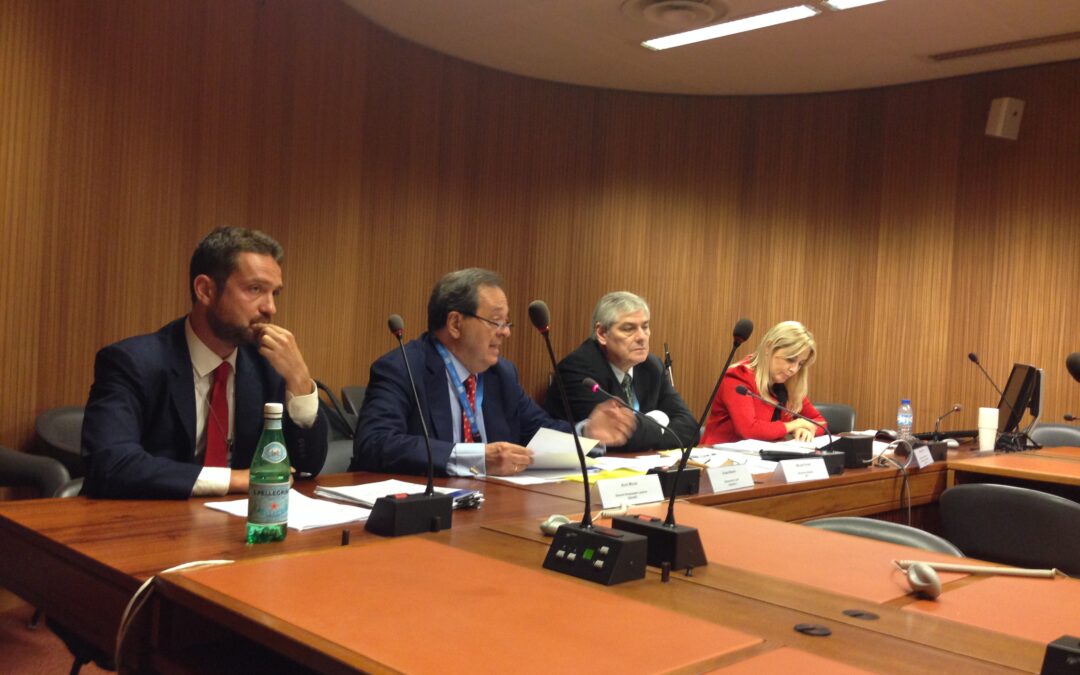
The ICJ and the International Bar Association (IBA) co-sponsored a side event to the 26th session of the Human Rights Council, on Wednesday 11 June 2014, on Strengthening the Rule of Law in Venezuela.
Apr 25, 2014 | News
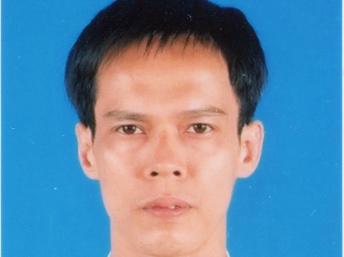
The ICJ today called on the government of Viet Nam to immediately return human rights defender Pham Chi Dung’s passport so he can travel to the United States to testify before Congress later this month.

Apr 3, 2014 | Advocacy, Legal submissions
The ICJ today made a further submission to the UN Working Group on Arbitrary Detention.
The ICJ submission addressed a number of issues for a draft set of “Basic Principles and Guidelines” on the right of anyone deprived of liberty to challenge the lawfulness of his or her detention, and the right of victims of arbitrary or unlawful detention to an effective remedy.
The document supplements an earlier submission by ICJ, delivered in November 2013, and responds to a number of questions raised by members of the Working Group when the ICJ appeared before it in its November session. The new submission addresses the following issues:
- The ability of persons other than the detained individual and his or her lawyer to initiate proceedings challenging the detention.
- Entitlement of a detained person to disclosure by the government of information relevant to their detention, in the context of challenging the lawfulness of the detention.
- The right of the detained individual physically to appear before the court.
- The scope of the obligation to provide compensation to victims of arbitrary or otherwise unlawful detention, apart from particular treaty provisions.
- Whether, in terms of the right to remedy and challenge, any distinction is to be drawn between the criminal justice system and other forms of detention such as detention of migrants, detention on psychiatric and various existing administrative regimes.
- Military courts and the right to challenge the lawfulness of detention.
- Whether exceptions to the right to challenge lawfulness of detention before a court exist, under customary international law.
The United Nations Working Group on Arbitrary Detention, which will next meet in Geneva 22 April to 1 May 2014, was requested by the Human Rights Council to prepare the draft “Principles and Guidelines” before the end of 2015. The Working Group is presently developing a first draft. A stakeholder consultation on the draft is contemplated for September 2014.
The new supplemental submission may be downloaded in PDF here: ICJ-Advocacy-WGADhabeas-2ndSubmission-03042014
The earlier submission may be downloaded here.