Oct 11, 2023 | Advocacy, News
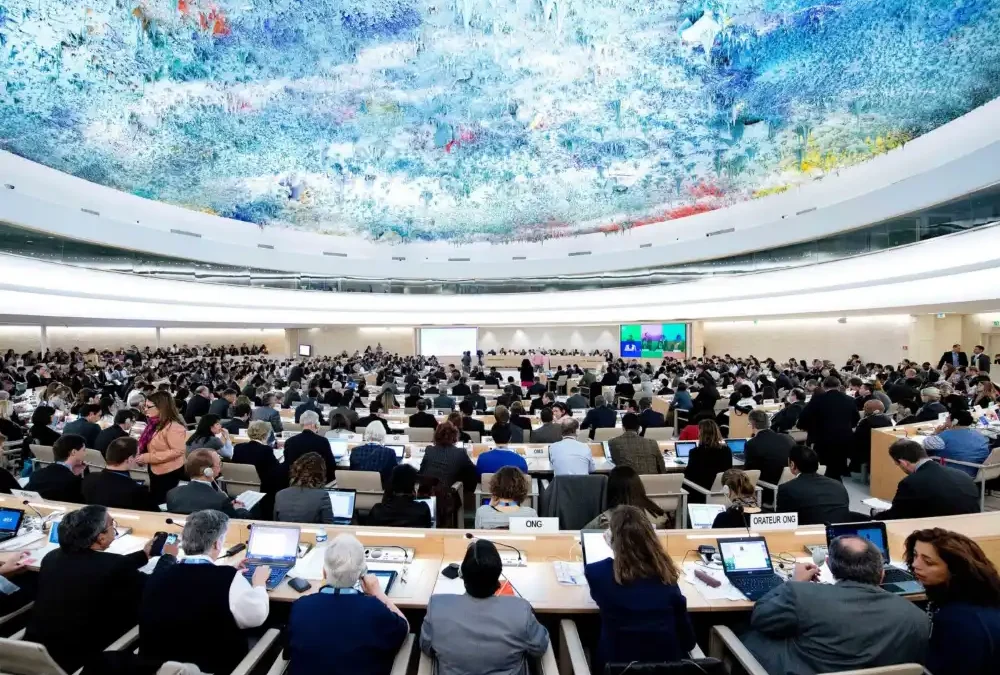
The International Commission of Jurists (ICJ) called the Human Rights Council’s (HRC) attention to the entrenched pattern of human rights violations in Cambodia, and called on the HRC to adopt a resolution to extend the Special Rapporteur’s mandate and ensure it has adequate resources and support.
Oral statement of the International Commission of Jurists (ICJ) during the Interactive Dialogue with the Special Rapporteur on the situation of human rights in Cambodia
“Madam Vice President,
The International Commission of Jurists (ICJ) concurs with the Special Rapporteur’s assessment that Cambodia has largely failed to implement the 20 human rights-related benchmarks proposed in his previous report to this Council.
In the lead-up to the national elections, there was a rapid escalation of the human rights and rule of law crisis in Cambodia. Human rights defenders and political opponents were convicted based on non-human rights compliant laws for exercising their right to freedom of expression, both online and offline, with new draconian laws on cybercrime and cybersecurity being drafted and considered.
The authorities have arbitrarily revoked licenses and blocked online access to independent media outlets without due process. The government at the highest level has employed rhetoric, reproduced online, to threaten and incite violence against political opponents with impunity, with credible reports of actual physical violence as an apparent consequence.
This systematic disregard for Cambodia’s international human rights obligations has been further exacerbated by the absence of an independent and impartial judiciary. The convictions of human rights defenders and political opponents were frequently accompanied by massive fair trial violations, including the effective application of a presumption of guilt.
It is imperative that the Council responds decisively to reverse this entrenched pattern of human rights violations in Cambodia by adopting a resolution to extend the Special Rapporteur’s mandate and ensuring it has adequate resources and support.
Thank you.”
Contact
Sandra Epal Ratjen, ICJ UN Representative and Senior Legal Adviser, e: sandra.epal@icj.org
Daron Tan, ICJ Associate International Legal Adviser, e: daron.tan@icj.org
Sep 22, 2023 | Advocacy, News
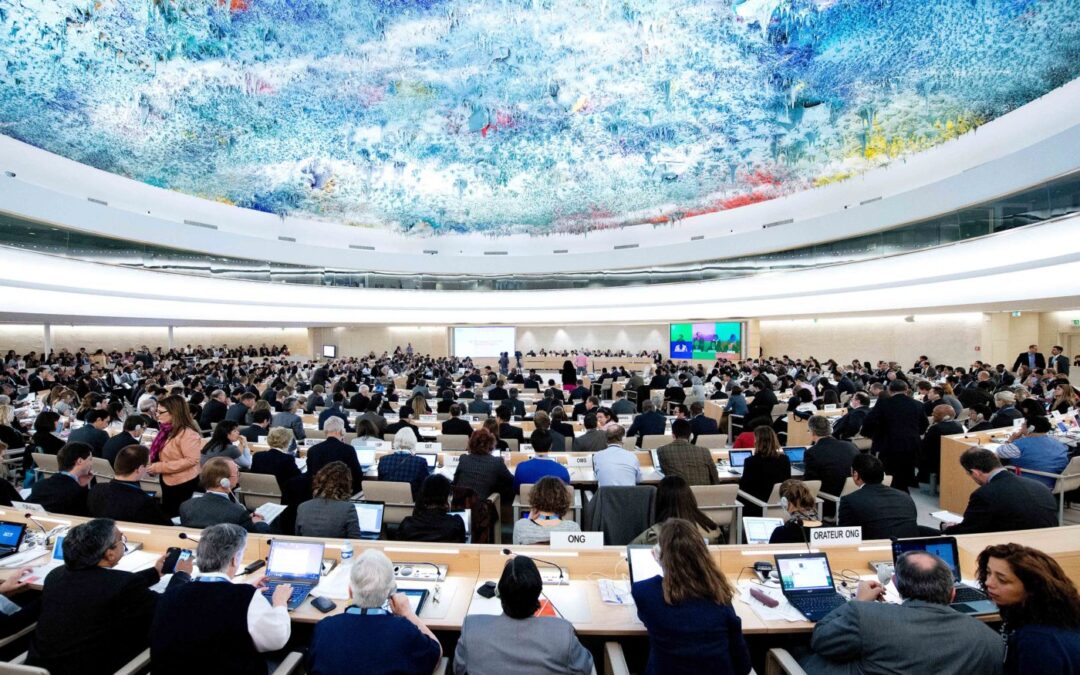
The International Commission of Jurists (ICJ) and International Bar Association Human Rights Institute (IBAHRI) called the Human Rights Council’s attention to the serious abuses amounting to crimes under international law linked to mercenary activities in the Sahel region of Africa, including allegations of unlawful killings, torture and ill-treatment, rape and other sexual violence, and enforced disappearances. Read the full statement below.
Oral Statement of the ICJ and the IBAHRI on the recruitment and activities of mercenaries and private military and security companies
“Mr President,
The International Commission of Jurists (ICJ) and the International Bar Association Human Rights Institute (IBAHRI) deplore the practices of predatory recruitment of people usually in vulnerable situations, such as detainees, and the harsh and risky conditions of service they endure as described in the report of the Working Group on the Use of Mercenaries (A/HRC/54/29).
The report describes opaque and deceitful contract terms, and orders to take direct part in hostilities in foreign countries without their prior consent. These practices sometimes amount to forced labour and debt bondage, in addition to human trafficking.
We remind the States with jurisdiction over persons and practices of their obligation to protect the human rights of persons in such vulnerable situations. ICJ and IBAHRI especially calls this Council’s attention to the serious abuses amounting to crimes under international law linked to mercenary activities in the Sahel region of Africa, including allegations of unlawful killings, torture and ill-treatment, rape and other sexual violence, and enforced disappearances.
We are deeply concerned at repeated allegations that some of these serious human rights abuses are committed by the so-called Wagner Group and call States concerned to promptly, thoroughly and impartially investigate these allegations and bring the perpetrators to justice.
ICJ and IBAHRI support the Working Group’s recommendations for renewal of the mandate of the Intergovernmental Working Group on an international regulatory framework on private military and security companies and call all States to constructively participate in its work (para. 42 g).
Thank you.”
For more information, contact:
Carlos Lopez Hurtado, ICJ Senior Legal Adviser, e: carlos.lopez@icj.org
Sep 15, 2023 | Advocacy, Human Rights Council, News, Statements, Work with the UN
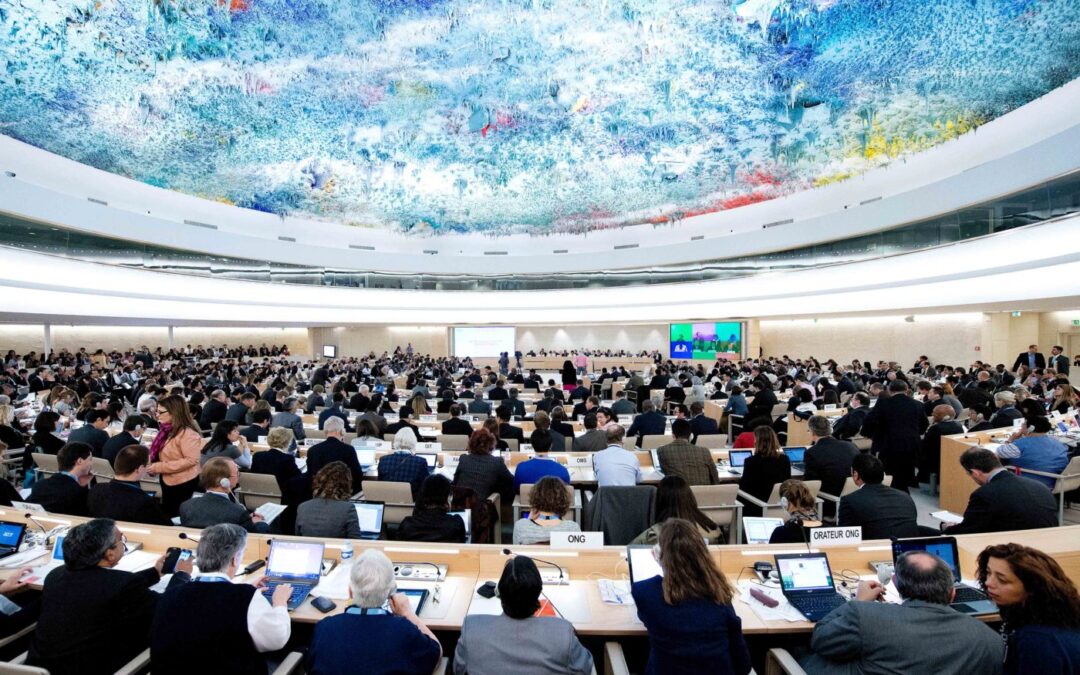
The ICJ welcomes the last report of Mr. Fabian Salvioli as he ends his 6-year tenure as the UN Special Rapporteur on truth, justice, reparation and guarantees of non-recurrence. The report, presented to the UN Human Rights Council (HRC) on 14 September 2023, compiles and analyses existing international standards under the five pillars of transitional justice: truth, justice, reparation, memorialization and guarantees of non-recurrence.
Jul 19, 2023 | Advocacy, Human Rights Council, News, Non-legal submissions, Universal Periodic Review
On 18 July 2023, the International Commission of Jurists (ICJ) and the Extra-Territorial Obligation Watch Coalition (ETO Watch Coalition) filed a joint submission to the UN Human Rights Council Working Group on the Universal Periodic Review (UPR) ahead of its review of China’s human rights record in early 2024.
Apr 13, 2023 | Advocacy, News
The statement is available in Arabic here.
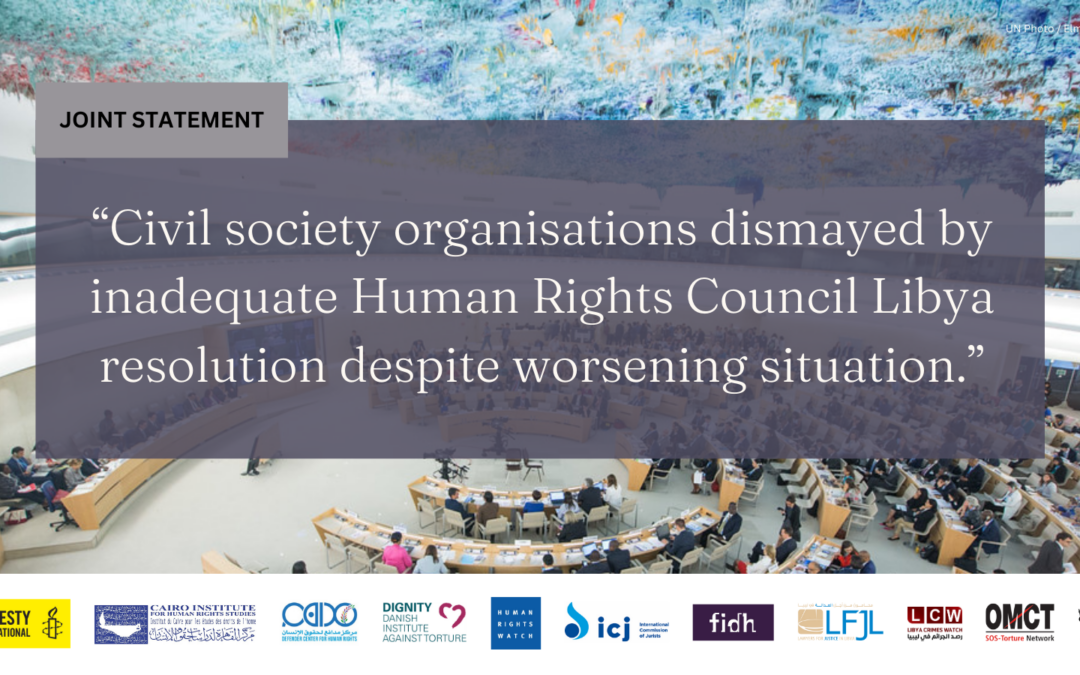
“Civil society organisations dismayed by inadequate Human Rights Council Libya resolution despite worsening situation”
On 4 April, the UN Human Rights Council (HRC) adopted resolution 52/L.33 on “Technical assistance and capacity-building to improve human rights in Libya” that fails to establish a mechanism to follow-up on the work of the UN Independent Fact-Finding Mission (FFM). The 52nd session of the HRC marked the end of the FFM’s mandate.