Nov 5, 2013 | Advocacy, Non-legal submissions
The ICJ has called on States that are candidates for membership to the UN Human Rights Council to do more to respect human rights at home and at the international level.
On 12 November, the United Nations General Assembly will elect 14 new members to the Human Rights Council.
The ICJ added its name to a joint letter, delivered by International Service for Human Rights on behalf of 40 NGOs from all regions of the world, emphasising the need for candidate states to uphold the highest standards of respect for human rights, the fullest cooperation with the Human Rights Council, and to refrain from impeding the access of individuals and civil society to international human rights mechanisms.
HRC-GAElections-JointNGOLetter-NonLegalSubmission-2013 (download joint open letter in PDF)

Oct 4, 2013 | Events
On 2 and 3 October 2013, the Office of the High Commissioner for Human Rights held a workshop on business and gender with the Human Rights Council’s Working Group on Discrimination against Women.
The ICJ participated in the workshop, addressing some of the ways in which business actors may be involved in women’s rights abuses and how States may fail to discharge due diligence obligations in this context. The ICJ’s presentation had a particular focus on accountability and the right to redress, and also explained the relevance to those issues of States’ extraterritorial obligations in respect of economic, social and cultural rights.
ProgrammeAgenda-BusinessAndGenderWorkshop (download the programme agenda for the workshop)
Sep 12, 2013 | News
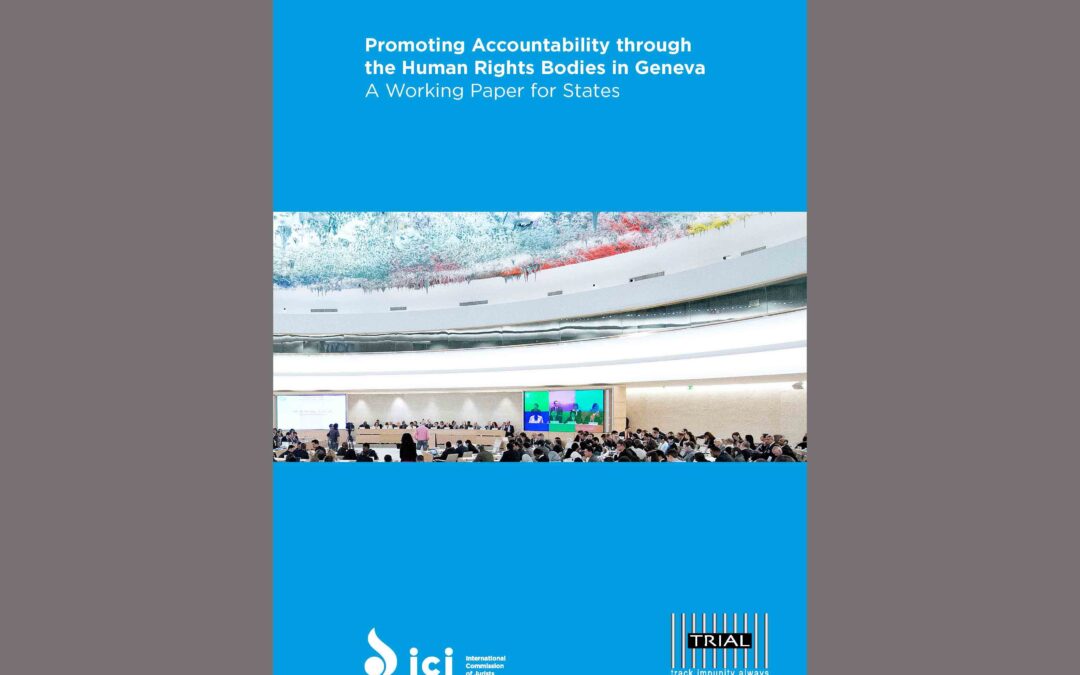
Yesterday, during the 24th session of the UN Human Rights Council, the ICJ and TRIAL (Swiss Association against Impunity) jointly held a parallel event on promoting accountability through human rights mechanisms in Geneva.
The event was co-sponsored by the Permanent Missions of Switzerland, Estonia and Costa Rica to the United Nations Office at Geneva.
A corresponding report produced by ICJ and TRIAL was also launched at this event in two versions, one aimed at civil society and another aimed at States.
Panellists at this event included Ian Seiderman of the ICJ, Gabriella Citroni of TRIAL and Theo van Boven, former Special Rapporteur on torture and other cruel, inhuman or degrading treatment or punishment and ICJ Honorary Commissioner.
Mona Rishmawi of the Office of the High Commissioner for Human Rights (OHCHR) chaired the event.
The main topic of this event was the ICJ-TRIAL report, which reviews the legal framework for promoting accountability and suggests possible action by civil society and States to engage with the human rights mechanisms in Geneva to better promote and achieve accountability for human rights violations.
The role of national mechanisms, such as national human rights institutions, working in cooperation with the UN mechanisms was also highlighted.
The report focuses specifically on the Human Rights Council and its subsidiary bodies, such as the Universal Periodic Review and the special procedures mechanisms.
OHCHR’s role was further emphasised in regards to sharing best practices as well as ensuring follow-up to issues of accountability as they come to the attention to the UN.

Aug 22, 2013 | Advocacy, Non-legal submissions
With other nongovernmental organizations, the ICJ calls on the Human Rights Council to select candidates for Special Procedure mandates on the basis of technical, professional and other objective requirements.
Ahead of the 24th session of the Human Rights Council (9 to 27 September 2013), several NGOs, including the ICJ, today joined in submitting written statements to the UN concerning the selection of candidates for membership in the Working Group on Arbitrary Detention and the Working Group on Enforced and Involuntary Disappearances and for the mandate-holder of the Special Rapporteur on the situation of human rights defenders. The statements identify a checklist intended as an interpretive aid for the selection of candidates based on qualifications and skills; relevant expertise; established competence; and flexibility and availability of time.
HRC24-JointWrittenStatement-SelectionCriteriaWGAD-NonLegalSubmission-2013 (download full statement concerning selection criteria for the Working Group on Arbitrary Detention)
HRC24-JointWrittenStatement-SelectionCriteriaWGEID-NonLegalSubmission-2013 (download full statement concerning selection criteria for the Working Group on Enforced and Involuntary Disappearances)
HRC24-JointWrittenStatement-SelectionCriteriaSRHRDs-NonLegalSubmission-2013 (download full statement concerning selection criteria for the Special Rapporteur on the situation of human rights defenders)
Jun 24, 2013 | News
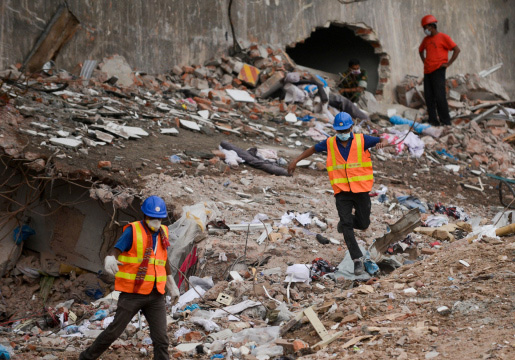
The recent Rana Plaza building disaster, in Bangladesh, could, and should, have been averted if the government had performed its obligation to adequately protect the workers, the ICJ said today.
“The Rana Plaza collapse, which killed 1,131 workers and injured close to 2,500 others, is the most recent in a long list of industrial disasters brought about by the government’s failure to regulate and monitor workplace conditions and sanction private entities violating the law,” said Sheila Varadan, ICJ Legal Advisor on South Asia. “To single out and focus solely on the role of multi-national companies does not reflect the full picture.”
“While the ICJ does not minimize the responsibility of private enterprises, unless the underlying systemic issues such as institutional weaknesses, corruption and lack of enforcement are addressed, such tragedies will continue to happen,” Varadan added.
Litigation is a vital tool to ensure accountability, remedy and reparations, where government agencies fail in their essential functions.
The Bangladesh Legal Aid and Services Trust (BLAST), a leading national human rights organization, has been petitioning the Supreme Court over the past decade, obtaining orders against government agencies and seeking compensation for victims and their families in work-related disasters.
“The government of Bangladesh must take active measures to ensure its regulatory framework is adequate and effective; its laws are rigorously enforced; and victims are adequately compensated,” Varadan also said. “Failing to do so not only violates Bangladeshi law but is also in breach of Bangladesh’s obligations to protect human rights under international law.”
CONTACT:
Sheila Varadan, ICJ Legal Advisor, South Asia Programme (Bangkok), t: +66 857200723; email: sheila.varadan(at)icj.org
Sam Zarifi, ICJ Asia-Pacific Regional Director, (Bangkok), t:+66 807819002; email: sam.zarifi(at)icj.org
Bangladesh-Rana Plaza-Public interest litigation-backgrounder-featured article-2013 (full text in pdf)
Bangladesh-WGBHR5-OralStatement-LegalSubmission-2013 (full statement to the Working Group on Business and Human Rights)