Oct 16, 2017 | Advocacy
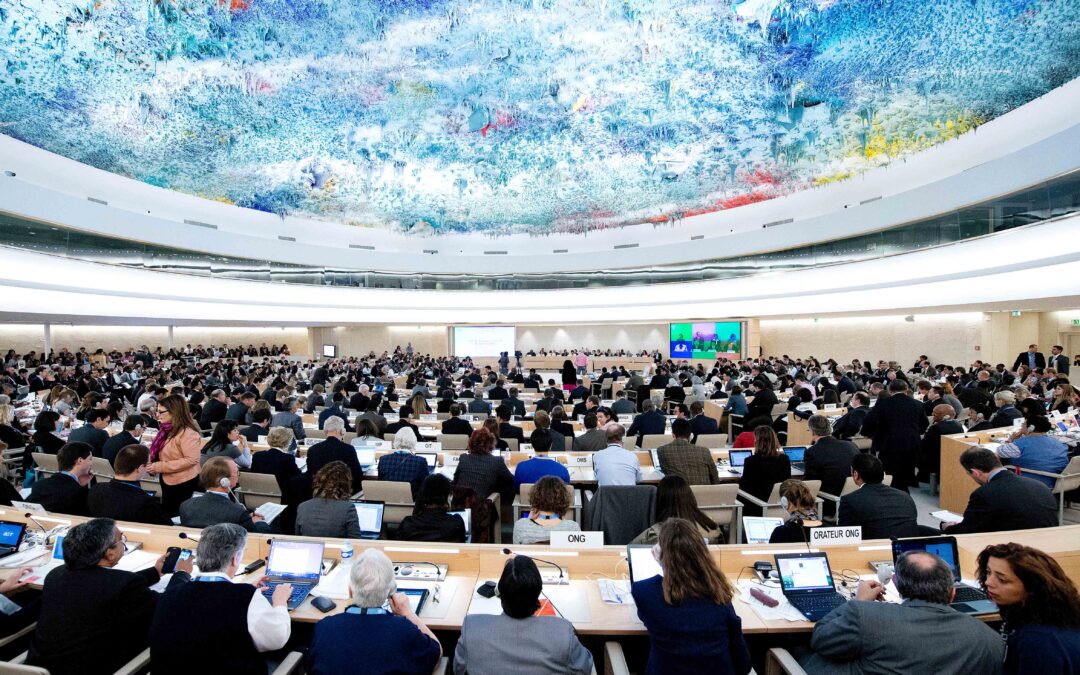
The ICJ, Amnesty International and Human Rights Watch are urging Pakistan to take immediate steps towards meeting “the highest standards in the promotion and protection of human rights,” following the country’s election to the Human Rights Council.
Today, the UN General Assembly selected 15 states to serve as members of the UN Human Rights Council from January 2018 to December 2020.
From the Asia-Pacific region, Nepal, Qatar, Afghanistan and Pakistan were selected out of five candidates.
To secure the UN Human Rights Council membership, Pakistan pledged its commitment to the promotion and protection of human rights.
However, the pledge failed to address directly many of the most serious human rights issues facing Pakistan, including enforced disappearances, the use of the death penalty, blasphemy laws, the country’s use of military courts, women’s rights including the right to education, and threats to the work of human rights defenders, lawyers and journalists.
According to UN General Assembly Resolution 60/251, “members elected to the Council shall uphold the highest standards in the promotion and protection of human rights.” The Resolution also provides that, “when electing members of the Council, Member States shall take into account the contribution of candidates to the promotion and protection of human rights and their voluntary pledges and commitments made thereto.”
Pakistan’s abuses have been highlighted by various national and international human rights organizations, UN treaty-monitoring bodies, and special procedures of the UN Human Rights Council.
Pakistan has affirmed in its election pledge that it is “firmly resolved to uphold, promote and safeguard universal human rights and fundamental freedoms for all.”
Given the pressing human rights issues in the country, the ICJ, Amnesty International, and Human Rights Watch urge Pakistan to take the necessary action to fulfill these responsibilities.
Contact
Frederick Rawski (Bangkok), ICJ Asia Pacific Regional Director, e: frederick.rawski(a)icj.org
Reema Omer (London), ICJ International Legal Adviser, South Asia t: +447889565691; e: reema.omer(a)icj.org
Download
The full statement with additional information: Pakistan-ElectiontoHRC-Advocacy-2017-ENG (in PDF)
Oct 16, 2017 | News
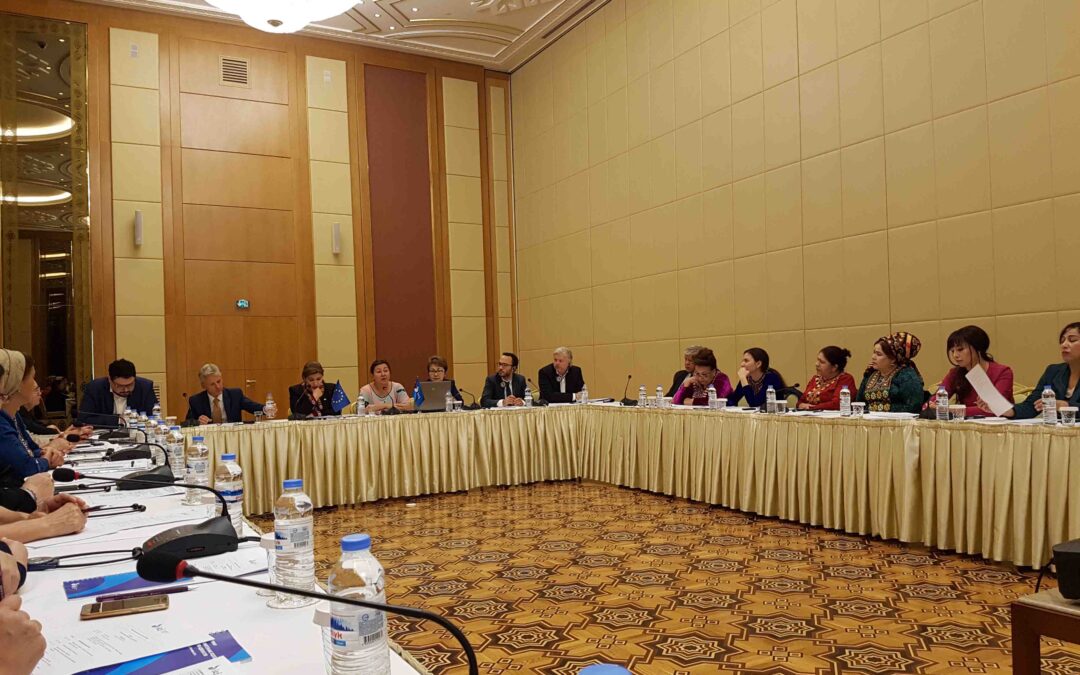
Today, the ICJ holds a seminar in Turkmenistan, on “Comparative perspectives on the role of lawyers”.
The event organized in Ashgabat, with support of the EU Liaison Office in Turkmenistan, provides an important opportunity to discuss the questions of organization of an independent legal profession and the ethics of lawyers in the countries of the EU and Central Asia.
“Along with judges and prosecutors, lawyers are key participants in the administration of justice. Ensuring fair trial rights is intrinsically linked with the right to legal assistance by lawyers who are able to perform their duties independently and with full respect of profession’s ethical standards,” said Temur Shakirov, ICJ Europe Programme Legal Adviser.
“To achieve this they organize themselves through associations of lawyers,” he added.
The workshop takes a comparative approach and looks into the role of lawyers in several jurisdictions, including the organisation of the legal profession as well as the professional standards for lawyers in Germany, Switzerland, Kazakhstan and Uzbekistan.
The speakers will also discuss international standards on the role of lawyers and their ethics.
Gulnora Ishankhanova, an ICJ Commissioner, will represent the ICJ along with other experts, including senior lawyers from the ICJ network.
They will present comparative national perspectives on the role of lawyers in their respective countries, placing them in the context of global and regional standards.
Representatives of lawyers’ associations in Turkmenistan will present the experience of Turkmenistan.
Oct 10, 2017 | News
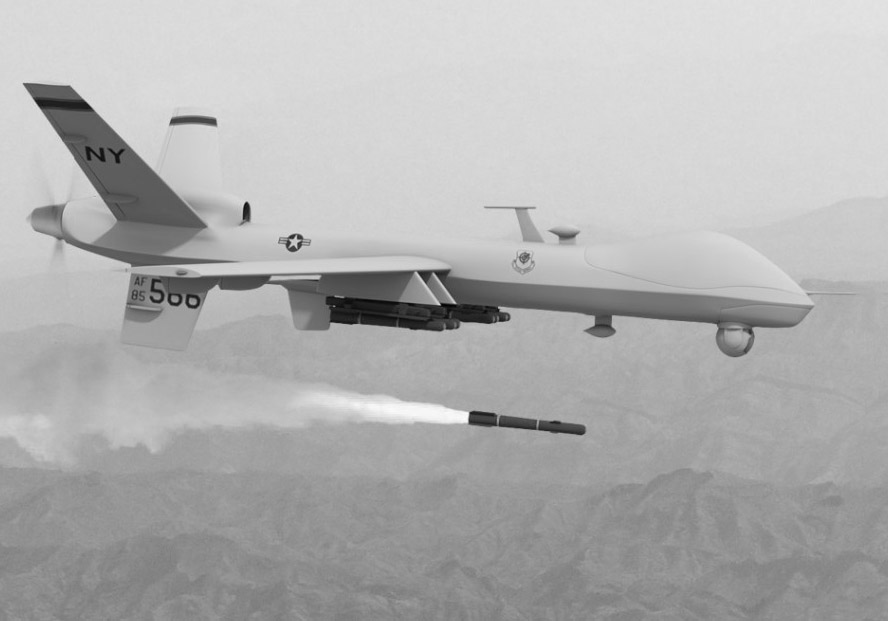
At UN General Assembly First Committee, over 40 organisations from across the world endorsed a statement calling on states to take concerted action to address harm from armed drones and work towards agreement on the limits of the acceptable use of these technologies.
Few states have raised this issue at the First Committee recently, despite the urgent need to address the peace and security implications of armed drones.
Universal-dronesstatement-advocacy-2017-ENG (full pdf)
Oct 9, 2017 | Events, News
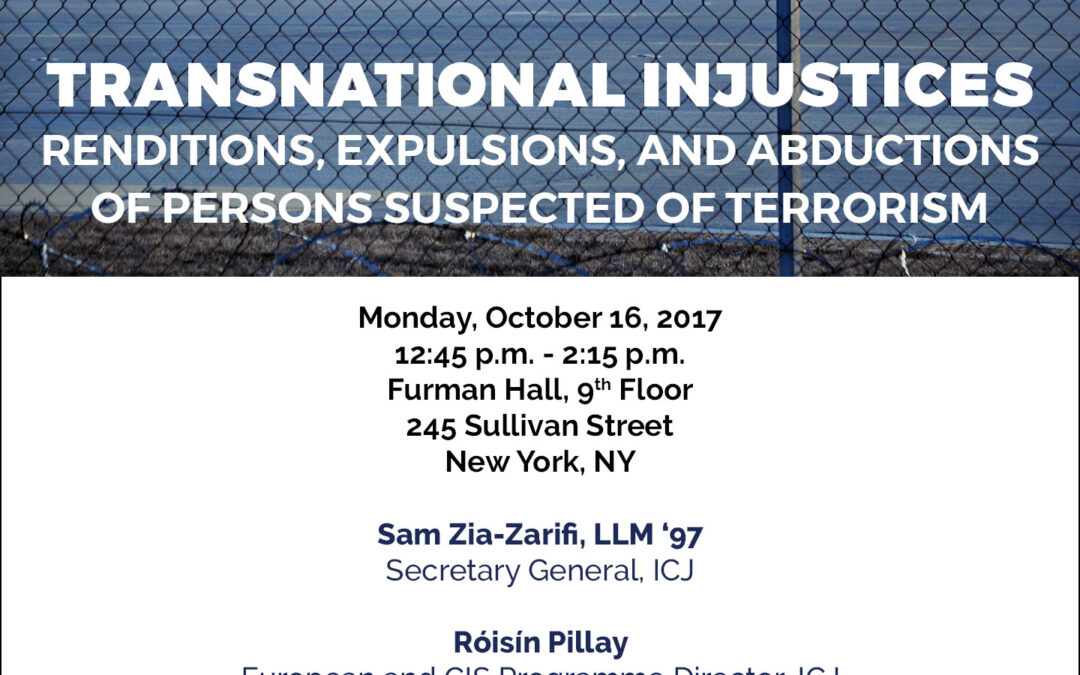
The ICJ, the Center for Human Rights and Global Justice and Amnesty International invite you today to an event to discuss challenges in prevention of, and accountability for, violations of human rights in the US-led rendition system, and in transfers of suspects in the CIS region.
Join us for a moderated discussion marking the U.S. launch of the International Commission of Jurists’ report, Transnational Injustices: National Security Transfers and International Law.
Panelists will discuss the ongoing practice of states unlawfully rendering people accused of terrorism, particularly in Russia and Central Asia, and explore the extent to which the impact of the CIA’s notorious extraordinary renditions can still be felt today.
When: Monday, October 16, 2017 – 12:45 pm to 2:15 pm
Where: Lester Pollack Colloquium Room – Furman Hall, 9th Floor, NYU School of Law – 245 Sullivan Street, New York City
RSVP here
Refreshments will be served
Speakers:
- Sam Zia-Zarifi, Secretary General, ICJ
- Róisín Pillay, European and CIS Programme Director, ICJ
- Margaret Satterthwaite, JD ’99, Professor of Clinical Law, NYU School of Law
Moderated by Julia Hall, Expert on Counter-Terrorism and Human Rights, Amnesty International
A flyer for this event is available in PDF format by clicking here.
Oct 6, 2017 | Advocacy, Cases, Legal submissions
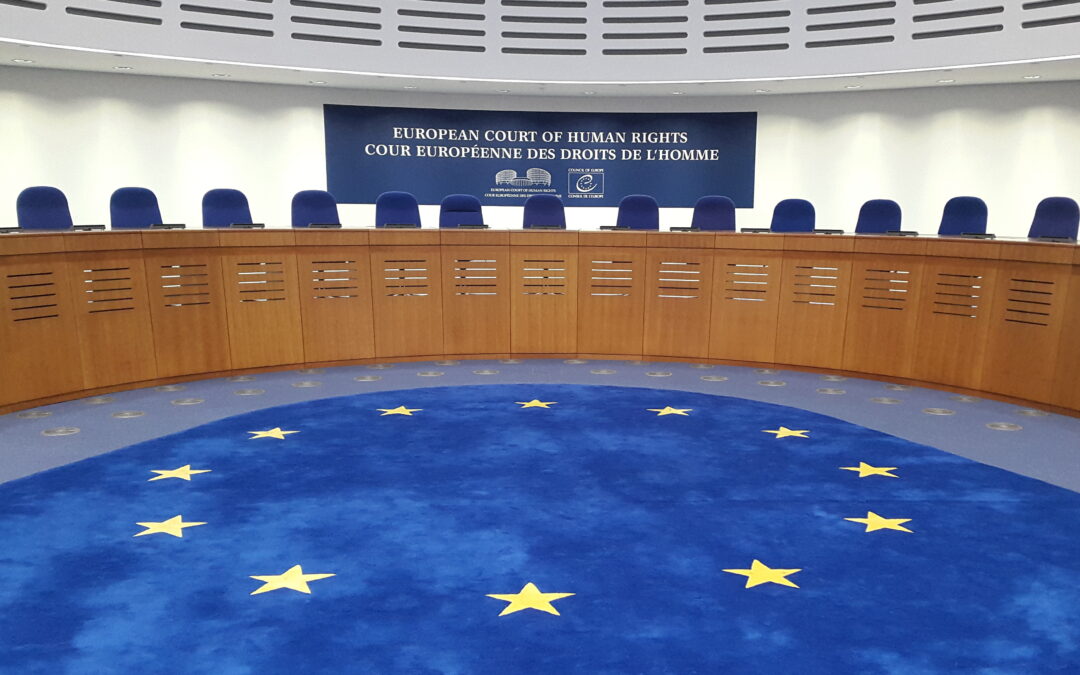
The ICJ and other human rights organisations intervened before the European Court of Human Rights in a case challenging the returns of migrants and refugees from Greece under the EU-Turkey deal.
The ICJ, the AIRE Centre, the European Council on Refugees and Exiles and the Dutch Council for Refugees have submitted a third party intervention before the European Court of Human Rights in the case of J.B. v. Greece. The case concerns the decision of Greek authorities to return a Syrian refugee to Turkey under the legal assumption that Turkey is a safe third country for refugees, that has been introduced following the EU-Turkey deal reached in reaction to the “refugee crisis”.
The interveners challenge the implementation of the rule of safe third country in these situations with regard to Greece’s obligations under the European Convention on Human Rights (ECHR). Specifically, the intervention focuses on:
- The principle of non-refoulement under the ECHR;
- The safe third country concept in international refugee law and EU law;
- The respect of the right to an effective remedy in cases of returns to Turkey under the safe third country rule.
Greece-JB_v_Greece-ECtHR-amicus-ICJ&others-final-eng-2017 (download the intervention)