Jul 10, 2020 | Advocacy, News, Non-legal submissions
Today, the ICJ submitted a report to the UN Human Rights Council Working Group on the Universal Periodic Review (UPR) ahead of the review of Nepal’s human rights record in January-February 2021.
In the submission, the ICJ, Advocacy Forum – Nepal (AF), Terai Human Rights Defenders Alliance (THRD Alliance) & University of Passau, provided information and analysis to assist the Working Group to make recommendations to the Government of Nepal to take measures to prevent acts of torture and ill-treatment; to implement a human rights compliant legal framework for accountability and remedy and reparation for victims; and institute other measures to comply with its international obligations, including ratification of international human rights instruments.
In light of the concerns set out above, the ICJ, AF and THRD Alliance call upon the UPR Working Group and the Human Rights Council to recommend the following to Government of Nepal:
- Ensure that the law criminalizing torture is consistent with international law, through the passage of an anti-torture law, and/or through amendment to the current Penal Code, including that the:
-
- Definition of torture in national law is in line with the CAT and other international treaty provisions;
- Statutory limitation or prescription periods for the filing of complaints or cases of torture or other ill- treatment be removed;
- Penalties for torture are commensurate to the gravity of the offence;
- Definition of reparation encompasses restitution, compensation, rehabilitation (including medical and psychological care, as well as legal and social services), and guarantees of non-repetition;
- Independent mechanisms for the regular monitoring of places of detention are established, or existing mechanisms adequately supported.
- Ensure that all allegations of torture are registered, investigated and prosecuted by an independent and impartial investigative body;
- Ensure that all detainees have access to legal representation;
- Collect and publicize data on allegations of torture and ill-treatment, including prosecutions and any measures, including disciplinary measures, taken against perpetrators;
- Establish an independent police service commission or equivalent body to ensure fair and transparent appointment, promotion, transfer of police officers and to oversee disciplinary complaints against the police;
- Establish a consistent system of documentation in each police station and at any detention facilities, in particular, concerning the entry into and release of detainees from custody, as well as the procedure during interrogations;
- Systematize human rights education and training in police training programmes, including medico-legal training (based on Istanbul Protocol);
- Ensure that victims are adequately involved in criminal proceedings, in accordance with international standards developed for this purpose;
- Ratify OPCAT and establish a national preventative mechanism that complies with its requirements; become a party to other core human rights treaties to which Nepal is not yet a party;
- Accept the requests to visit Nepal from UN special procedures, including the Working Group on Enforced and Involuntary Disappearances, the Special Rapporteur on Torture, Special Rapporteur on extrajudicial, summary or arbitrary executions and the Special Rapporteur on the promotion of truth, justice, reparation and guarantees of non-recurrence.
Download
Nepal-UPR-Submission-2020-ENG (PDF)
Contact
Frederick Rawski, ICJ Asia and Pacific Regional Director, e: frederick.rawski(a)icj.org
Jul 10, 2020 | Advocacy, News, Non-legal submissions
Today, the ICJ submitted a report to the UN Human Rights Council Working Group on the Universal Periodic Review (UPR) ahead of the review of Myanmar’s human rights record in January-February 2021.
The ICJ stressed the lack of accountability and redress for victims – and the resulting continued culture of impunity – for widespread gross human rights violations constituting crimes under international law in Myanmar, particularly those involving members of Myanmar’s Defence Services.
Certain provisions under the 2008 Myanmar Constitution as well as national laws such as the 1959 Defence Services Act and 1995 Myanmar Police Force Maintenance of Discipline Law shield security forces from public criminal prosecutions in civilian courts. Closed court martial proceedings also deny victims and their families the right to truth about human rights violations.
The Myanmar National Human Rights Commission (MNHRC), Myanmar’s national human rights institution with the mandate to investigate allegations of human rights violations, has not initiated any substantive or credible investigation into allegations of widespread and systematic human rights violations perpetrated in recent years by soldiers against persons from ethnic minorities, despite being recorded in detail in the reports of the UN Independent International Fact-Finding Mission on Myanmar and the UN Special Rapporteur on the situation of human rights in Myanmar.
Rather than strengthen the role of civilian courts and the MNHRC, Myanmar has set up ad hoc commissions of inquiry to investigate such incidents. However, these inquiries have a recommendatory mandate and an unclear relationship with the judiciary. The full report of the findings of these commissions are generally not publicly disclosed. Against this backdrop, Myanmar has ceased cooperation with the UN Special Rapporteur for Myanmar and rejected other UN and international accountability mandates.
In light of this, the ICJ recommended the following actions, among others:
- For the MNHRC to investigate all allegations of gross human rights violations, especially including crimes under international law;
- For the Parliament to repeal or amend the 1959 Defence Services Act to bring it in line with international human rights law and standards and ensure that gross human rights violations and serious international humanitarian law violations perpetrated by soldiers can only be prosecuted in civilian courts;
- For the Union Government to publish the full report of the findings of ad hoc commissions of inquiry, such as that of the Independent Commission of Enquiry;
- For the Union Government to issue an open invitation to and cooperate with the Special Rapporteur on the situation of human rights in Myanmar, the Office of the High Commissioner for Human Rights as well as the UN Independent Investigative Mechanism on Myanmar; and
- For the Union Government to cooperate with the International Criminal Court.
The ICJ also called for Myanmar to become a party to key human rights treaties, such as the International Covenant on Civil and Political Rights, that the State committed – yet failed – to accede to in its previous UPR cycle.
Download
Myanmar-UPR-Submission-2020-ENG (PDF)
Contact
Jenny Domino, ICJ Associate Legal Adviser, e: jenny.domino@icj.org
Kingsley Abbott, Coordinator of the ICJ’s Global Accountability Initiative, e: kingsley.abbott(a)icj.org
Jul 9, 2020 | Advocacy, Non-legal submissions
The ICJ filed a submission to the Human Rights Council’s Working Group on the Universal Periodic Review in advance of its review of Lebanon’s human rights record between January and February 2021.
Information provided in the submission was based on a number of recent ICJ publications, including on the independence of the judiciary; military courts; gender-based violence; and a forthcoming publication on the human rights of refugees and migrants in Lebanon.
In the submission, the ICJ drew the attention of the Working Group to the following concerns with respect to Lebanon:
- The independence of the judiciary and the use and jurisdiction of military courts;
- The obstacles that continue to impede women’s and girls’ access to justice for sexual and gender-based violence (SGBV); and
- The inadequate framework and practices undermining migrants’ and refugees’ rights.
The ICJ called on the Working Group and Human Rights Council to urge the Lebanese authorities to take the following actions:
With regard to the independence of the judiciary and the use and jurisdiction of military courts:
- End executive control and undue influence over the judiciary, including by divesting the Minister of Justice of any role in the selection, appointment, promotion, transfer, secondment or any other aspects of the management of the career of judges;
- Ensure that the High Judicial Council is independent from the executive, including by amending its composition to ensure that the majority of members are judges elected by their peers, and that it is pluralistic, gender and minority representative, competent to decide on all issues relating to the career of judges, and empowered to uphold the independence of the judiciary;
- Ensure that military courts have no jurisdiction to try civilians, and that such jurisdiction is restricted to military personnel over alleged breaches of military discipline or ordinary crimes not involving the commission of human rights violations, to the exclusion of human rights violations and crimes under international law.
With regard to women’s access to justice for SGBV:
- Repeal all discriminatory provisions against women, particularly those in the Criminal Code, the Nationality Code and Personal Status Laws;
- Adopt a unified civil Personal Status Law for all religious groups, where all customs discriminating against women and girls are overridden in accordance with article 2(f) of CEDAW; and ensure that issues related to divorce, inheritance and custody are adjudicated before ordinary courts consistent with international standards;
- Amend Law No. 293/2014 on the protection of women and other family members from domestic violence (Law No. 293/14) and the Criminal Code to ensure that it criminalizes all forms of SGBV, including by properly defining rape as a type of sexual assault characterized by a physical invasion of a sexual nature without consent or under coercive circumstances, and ensure that marital and all other acts of rape be criminalized; and, to this end, abolish provisions of Law No. 293/14 providing for a religion-based claim to marital rights;
- Amend the Criminal Code, the Code of Criminal Procedure and Law No. 293/14 to include gender-sensitive investigations and evidence-gathering procedures in order to enable women to report violence against them, and take effective steps to address the social and practical factors that continue to impede women’s access to justice, such as gender-based stereotypes and prejudices that operate in society and in the justice system;
- Remove obstacles related to gender stereotypes, economic and social realities that continue to impede access to justice in SGBV cases, including by ensuring that where law enforcement officers fail to ensure an effective investigation into an incident of SGBV, their omissions be actionable as a breach of their duties and subject to disciplinary measures as appropriate;
- Provide routine capacity building training to justice sector actors on the application of international human rights law, including CEDAW and related jurisprudence.
With regard to the treatment of refugees and migrants:
- Become a party to the 1951 UN Refugee Convention and its 1967 Protocol, and pass legislation to adequately protect the human rights of refugees, asylum seekers, stateless people and migrants, in compliance with Lebanon’s international obligations;
- Amend the 1962 Law on the Entry, Stay in and Exit from Lebanon (Law 1962) to ensure full compliance with these obligations, and that people entitled to international protection, chiefly refugees, asylum seekers, and stateless individuals, are not penalized, automatically arrested or deported for their “illegal” entry and stay in the country;
- Ensure that no individual is deprived of their liberty solely on the grounds of their immigration status, and, to this end, amend articles 32 and 36 of Law 1962; until then, provide automatic, periodic judicial review of the lawfulness, necessity and proportionality of any immigration-related detention;
- Strictly comply with Lebanon’s non-refoulement obligations, including by ensuring that no individual is transferred to a country where they face a real risk of persecution or other forms of serious harm; that nobody is forcibly returned without an individualized, fair and effective procedure guaranteeing due process; and by establishing a moratorium on all removals to Syria.
Lebanon-UPR Submission-Advocacy-Non Legal submission-2020-ENG (full submission, in PDF)
Jul 7, 2020 | Advocacy, Non-legal submissions
The ICJ, along with other NGOs, made a joint submission in response to the call for written contributions in advance of the General Assembly’s review of the UN human rights treaty body system and of the effectiveness of the measures taken to strengthen the system in Resolution 68/268 (2014).
The submission reiterates the ICJ’s strong commitment to the treaty body system, and reiterates that it is essential that UN Member States adequately support this key component of the UN’s human rights architecture.
Download the submission here: Universal-NGO response to TBSP cofacs questions-Advocacy-non legal submissions-2020-ENG

Jul 3, 2020 | Advocacy, News
The ICJ published a legal memorandum concluding that the Ministry of Transport and Communications (MOTC) Order to block access to specific websites is not compliant with international human rights law.
The legal memorandum also sets out various remedial options under Myanmar law to question the lawfulness of the Order.
The ICJ focused its human rights analysis on the rights to freedom of expression and access to information and the right to health, which includes access to health information. These rights are well established under general and customary international law. The right to health is guaranteed under the International Covenant on Economic, Social and Cultural Rights (ICESCR) and the Convention on the Rights of the Child, to which Myanmar is a party.
The MOTC, presumably invoking Section 77 of the Telecommunications Law, ordered telecommunication service providers in March 2020 to take down 2,147 websites found by it to have disseminated “fake news,” adult content, and child sexual abuse content. It is not clear if any of the information under sanction relates to COVID-19, although the pandemic was mentioned elsewhere in one mobile service provider’s press release. Immediately after the release of the MOTC Order, it was discovered that the ban included ethnic news media websites, such as Rakhine-based Development Media Group and Narinjara News, thereby prompting speculation as to the true reasons behind the ban.
The ICJ emphasized the following in the legal memorandum:
- Blocking access to specific websites engages a wide range of human rights concerns, including but not limited to the person’s right to freedom of expression and right of access to information protected under Article 19 of the International Covenant on Civil and Political Rights and customary international law. While lack of transparency about the State rationale and evidence was an obstacle to a full analysis, the permissible conditions that would justify sweeping limitations on this right do not appear to have been met.
- In the context of the COVID-19 pandemic, the MOTC Order also undermines the right to health of all persons in Myanmar. The right to health guaranteed under the ICESCR is reserved to all persons without discrimination and includes access to health information. The MOTC Order effectively hinders access to health information by blocking legitimate sources of information.
- To challenge the MOTC Order, the following domestic legal remedies are available: (i) filing a complaint with the Myanmar National Human Rights Commission; (ii) filing an application for a constitutional writ before the Union Supreme Court and/or (iii) filing a declaration suit under the Specific Relief Act.
Download
Myanmar-Memo-on-MOTC-Order-Legal-Memorandum-2020-ENG (PDF)
Contact
Jenny Domino, ICJ Associate Legal Adviser, e: jenny.domino(a)icj.org
Hnin Win Aung, ICJ Legal Adviser, e: hninwin.aung(a)icj.org
Related work
Publication: Myanmar’s ongoing Internet shutdown and hostilities threaten right to health during COVID-19
Statement: Government must lift online restrictions in conflict-affected areas to ensure access to information during COVID-19 pandemic
Report: Curtailing the Right to Freedom of Expression and Information in Myanmar
Publication: Four Immediate Reforms to Strengthen the Myanmar National Human Rights Commission
Publication: Strategic Litigation Handbook for Myanmar
Jun 30, 2020 | Advocacy, Non-legal submissions
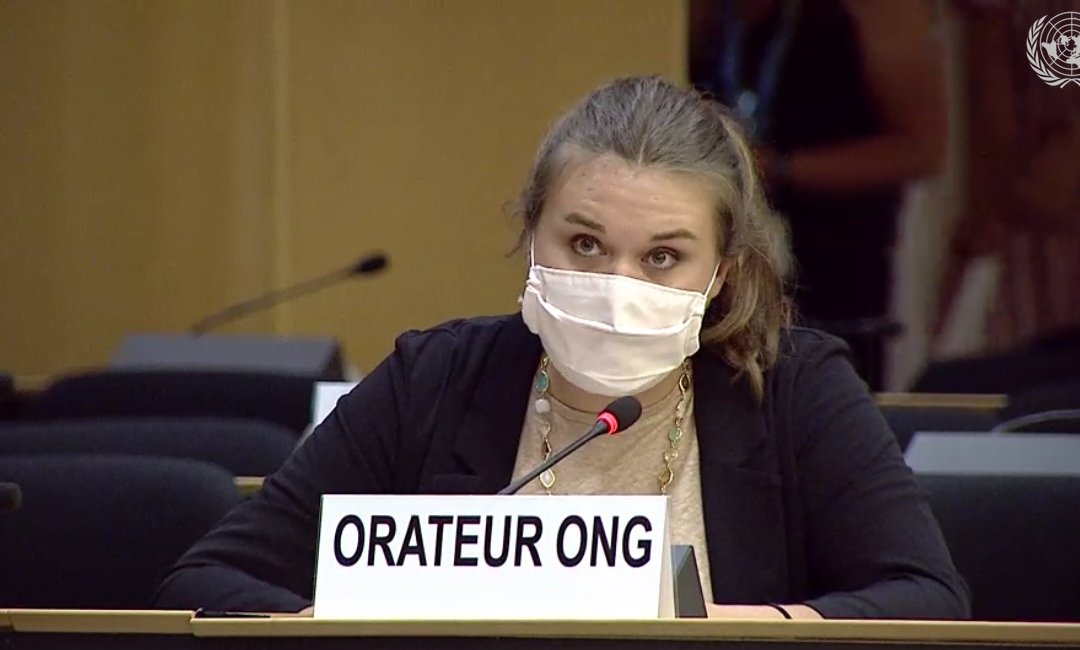
Speaking at the UN Human Rights Council today, the ICJ urged action on longstanding and pervasive impunity for human rights violations in the Philippines and highlighted new threats posed by a pending new counter-terrorism law.
The oral statement, delivered in an interactive debate on the human rights situation in the Philippines based on a report prepared by the High Commissioner for Human Rights, read as follows:
“Madame President,
The International Commission of Jurists (ICJ) concurs with the High Commissioner’s finding that overemphasis by the Government of the Philippines on national security and public order has led to serious human rights violations (A/HRC/44/22, para 12). Such violations will only increase if the draft Anti-Terrorism Act is approved and implemented.
The draft law would, for example, allows detention without judicial warrant for up to twenty-four days. Such prolonged pretrial detention without judicial review This is inconsistent with the prohibition of arbitrary detention under the International Covenant on Civil and Political Rights (ICCPR), and the right under the ICCPR of anyone arrested or detained on criminal grounds to be brought promptly before a judge. The Human Rights Committee has stressed that such judicial control of initial detention periods is not only essential to guarantee the right to liberty but also to prevent torture, other ill-treatment, and enforced disappearance.
In line with both the High Commissioner’s report and the 25 June 2020 statement by a large number of Special Procedures, the ICJ urges the Government of the Philippines to accept the findings and recommendations and rapidly implement corrective measures, in cooperation with the OHCHR, civil society, and the Commission on Human Rights, and to abandon or fundamentally revise the draft Anti-Terror Law. In the absence of clear, effective and measurable progress on accountability at the national level, this Council must stand ready to establish an independent international investigation (para 88(iii)).
Thank you.”