Aug 7, 2020 | Advocacy, Agendas, News
On 6-7 August the ICJ co-hosted a symposium on threats to judicial independence in East and Southern Africa.
The event was held with the collaboration of the Africa Judges and Jurists Forum, the Kenyan Section of the International Commission of Jurists Kenya Section, Open Society Initiative for Southern Africa, Southern Africa Development Community Lawyers Association, Malawi Law Society, Pan African Lawyers Association, East Africa Lawyers Association and the American Bar Association.
Recent actions taken to undermine judicial independence in East and Southern Africa include proposed constitutional amendments, executive interference with the functioning of the Judicial Service Commissions and verbal as well as physical threats against judges.
Participants in the symposium included judges, lawyers, academics and civil society representative. ICJ Commissioner and former Chief Justice of Kenya Dr Willy Mutunga, and Professor Jill Ghai of Katiba Institute delivered the key note addresses.
Dr Willy Mutunga speaking to challenges of judicial independence in the political context of Kenya in his keynote address, said “I believe that the independence of the judiciary… is about the integrity of the judicial officers… Building peoples’ confidence in the judiciary and the judicial officers depends on the integrity of the institution and its judicial officers and staff.”
In her address, Professor Jill Ghai evaluated various ways in which independence of the judiciary is undermined, taking into account examples from various countries.
“We must not relent in letting the Executive know that we are watching whenever there are attempts to undermine the judiciary,” Ghai said in closing.
ICJ Secretary General Sam Zarifi that judicial independence was facing genuine threats, not just in Africa but throughout the world.
“The issue of judicial independence has been at the heart of the ICJ’s work for the last 70 years almost… We have been defending the rule of law and human rights. For both of those the independence of the judiciary is absolutely essential,” Zarifi said.
On the second day of the symposium, participants into four groups discussed the nature of challenges and weaknesses in the Executive-Judiciary relations, litigation as a strategy for protecting judicial independence, strategies for increasing social and political activism in defence of judicial independence, and the prospects and strategies for regional and international advocacy in the age of COVID-19 respectively.
In his closing remarks, outgoing ICJ Regional Director Arnold Tsunga flagged Malawi as a recent case study where the judiciary had demonstrated its independence when the Constitutional Court nullified the 2019 presidential election results, citing widespread irregularities.
Watch the proceedings of the symposium here:
Welcome and keynote address
Closing remarks
Contact:
Justice Mavedzenge (ICJ Legal Advisor) t: +27793889990 e: justice.mavedzenge(a)icj.org
Shaazia Ebrahim (ICJ Media Officer) t: +27716706719 e: shaazia.ebrahim(a)icj.org

Jul 31, 2020 | Agendas, Events, News
The ICJ, together with the Global Initiative on Economic, Social and Cultural Rights (GI-ESCR) and the Right to Education Initiative (RTE), held webinars on 24 and 31 July.
The discussions explored The Guiding Principles on the Human Rights Obligations of States to provide public education and to regulate private involvement in education (Abidjan Principles) and their application in the context of COVID-19.
The webinars focused respectively on public education and private education.
Participants included judges and representatives of civil society organizations from Kenya, Uganda, South Africa and Sierra Leone.
“The aim of the conversation in these webinars is to better understand the problems facing civil society and judiciaries in the four countries in ensuring the protection of the right to education in the context of Covid-19 and the increased privatization of education,” said ICJ Commissioner Justice Jamesina King of Sierra Leone.
The Abidjan Principles, based in large measures on existing international law and standards, were developed by leading international experts and adopted in 2019.
They clarify and set out elements of State obligations to uphold the right to education and related standards in both public and private educational settings.
Participants were able to deepen their understanding of the Abidjan Principles as well as the increased pressure placed on education systems across Africa as a result of COVID-19.
“COVID-19 has dramatically exacerbated already well-known issues in the realization of the right to education” and the “divide in quality of access to education between public and private sectors,” added Justice King.
“Private actors in particular… have been reported to have capitalized on the pandemic to extend their business in the education sectors.”
Participants raised concerns about the use of public funds to support private actors in education, an issue which is addressed by the Abidjan Principles.
Ashina Mtsumi from the GI-ESCR, summarized the Abidjan Principles and emphasized that “States’ first priority should be public education, as there is no obligation for states to fund private actors in education.”
A theme emerging from the discussions was the important role of the State in regulating private actors in education in the context of the global pandemic. Judges discussed the role of the judiciaries in their respective countries in ensuring the protection of the right to education.
“Can courts force private institutions to continue [operating] or even reduce school fees as an incidence of the right to education?,” Justice Joel Ngugi of Kenya asked.
Justice Ngugi also highlighted the need for governments to ensure that schools are safe for all learners in the context of COVID-19.
Judge Lydia Mugambe said that while in Uganda the pandemic had seen some private schools continuing with online learning, learners in public schools had had to depend on State provision of learning through newspapers and news stations which had not been sufficient. In the COVID-19 context, States must ensure that they continue to “require private instructional educational institutions to meet the minimum standards set by the State”, as indicated by the Abidjan Principles.
“The real problem is that our infrastructure is bad, the education system is bad and we have had a constitutional right to education since 1994 and I am embarrassed to say that the Covid-19 crisis has not exacerbated the problems, but has exposed the problems and have left no place to hide for years and years of government negligence,” said former Justice of the Constitutional Court in South Africa Zak Yacoob.
Representative from civil society organizations from all four countries emphasized the increasing risks introduced to the right to education as a result of privatization of education in Africa.
Watch the first webinar here.
Contact:
Khanyo Farisè (ICJ Legal Adviser) e: Nokukhanya.Farise(a)icj.org
Tim Fish Hodgson (ICJ Legal Adviser) t: +27828719905; e: timothy.hodgson(a)icj.org
Jul 9, 2020 | Agendas, Events, News
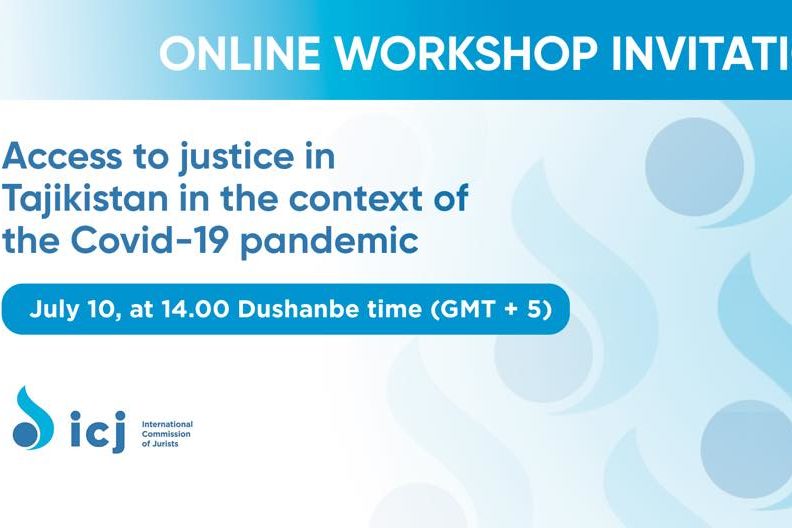
The ICJ is holding an online discussion for lawyers and other representatives of civil society in Tajikistan on access to justice in the context of the Covid-19 pandemic. The discussion is held on 10 July 2020 from 14.00 to 17.00 Dushanbe Time (GMT + 5) on the GoToMeeting platform
The discussion aims to raise some of the main issues that lawyers face in providing legal representation both in and outside of courts.
The event will present an opportunity for practicing lawyers, NGOs and IGOs to discuss the recent challenges that the legal profession faced in Tajikistan as well as seek some of the solutions based on international law and best practices of other countries.
During the discussion, relevant international law and standards as well as comparative examples from the Central Asian countries and Azerbaijan will be discussed.
To participate in the discussions registration is required on the following link : https://forms.gle/QRywqBFPSxfR5eyk7
Working languages of the event are Russian and Tajik.
Contact:
Dilshod Juraev, t: +992 77 700 18 34 ; e: Dilshod.jurayev(a)icj.org

May 15, 2020 | Agendas, Events, News
Kazakhstan National University (KazNU) Human Rights Institute in cooperation with the ICJ, the European Association of Lawyers and other partners will hold an online international conference “Law and human rights during the pandemic”.
The event will assemble leading legal experts and practitioners from Central Asia and other countries who will discuss the most pertinent issues for ensuring human rights and access to justice in times of pandemic.
The topics will include sections on human rights during quarantine and emergency situations, and administration of justice during the pandemic.
The event is open for participation upon online registration.
The working language of the event is Russian. The conference will start at 11.00 Nur-Sultan time (GMT +5).
Links
Website of the conference
Agenda in Russian
Agenda in English
Jan 9, 2020 | Agendas, Events, News
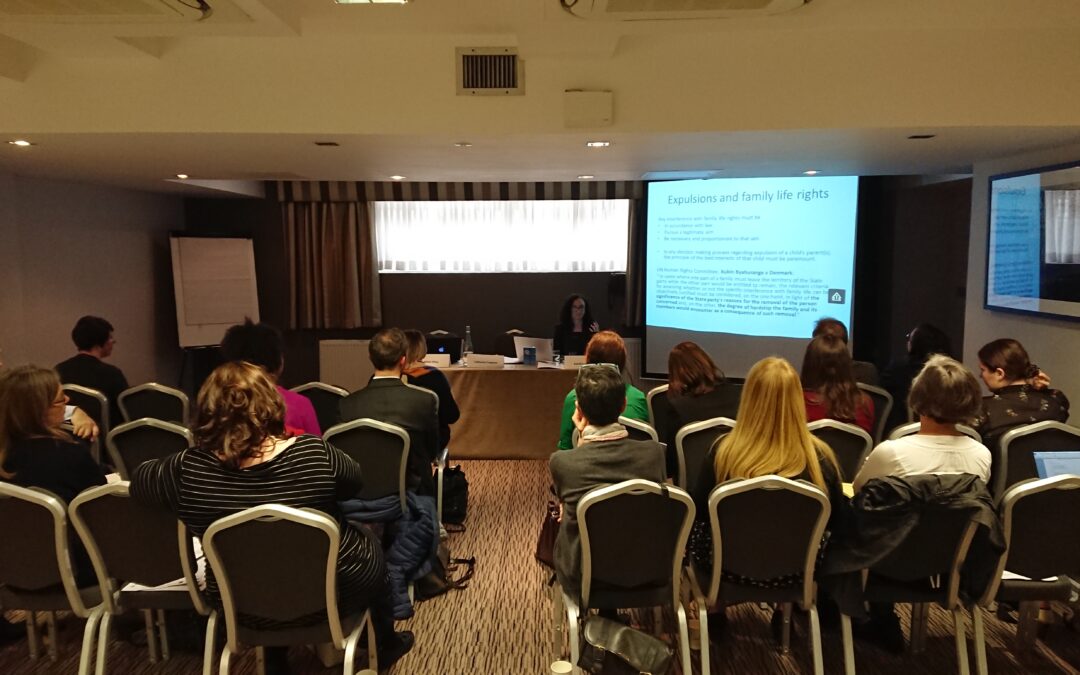
Today, the ICJ and Immigrant Council of Ireland (ICI) are holding a 2-day training seminar for judges and lawyers in Dublin, Ireland, on the rights of migrants, in particular the right to family life and due process in asylum proceedings.
The participants consist of about 30 judges and judicial assistants from the International Protection Appeals Tribunal (IPAT) administrative decision makers (IPO/INIS), and legal professionals.
During the two days of training, experts from the European Court of Human Rights, the UK Immigration Tribunal, Trinity College Dublin, the Immigrant Council of Ireland and the ICJ will deliver the training, bringing international human rights and EU law perspectives to the discussion on the Irish context.
Among the issues discussed will be – on day 1 – the right to private and family life in migration, including, and recent developments at the ECtHR, and right to private and family life in the national context as well as best interests of the child determination and family life rights in return decisions. On day 2 discussion will focus on procedural rights and remedies in the context of international protection,. Issues discussed will include due process rights in asylum procedures, safe third country concept, and credibitity assesments and vulnerability in international protection applications.
In parallel, a training for 20 social care professionals working with migrant children is being delivered.
This is the second national training under the FAIR PLUS project, following the first training held last December in Pisa.
See the full agenda here.
This training is a part of FAIR PLUS project. It was carried out with the financial support of the European Union. Its contents are the sole responsibility of ICJ and do not necessarily reflect the views of the European Union.

Dec 16, 2019 | Agendas, Events, News
Today begins in Ankara (Turkey) a one-day workshop for lawyers and CSO practitioners to discuss and brainstorm on an alternative Justice Reform Strategy.
This event is organized by ICJ, in cooperation with its partners Kapasite Geliştirme Derneği and Human Rights Joint Platform, as part of a EU co-financed project Rebuilding and Ensuring Access to justice with civil society in Turkey.
The workshop aims at discussing the key reforms proposed by the Government of Turkey in its Judicial Reform Strategy and provide with an assessment and an alternative plan for reform based on international standards and jurisprudence on access to justice and the independence of the judiciary.
The workshop will provide presentations on international standards on the judiciary as well as on access to justice for human rights violations. It will produce a ten point strategy document to propose reforms that will uphold the independence of the judiciary and access to justice in Turkey.
The project is funded by the European Instrument for Democracy and Human Rights (EIDHR) of the European Union.
Turkey-Workshop-Agenda-AltJRS-Ankara-2019-eng (download the agenda)