Feb 27, 2015 | Events, News
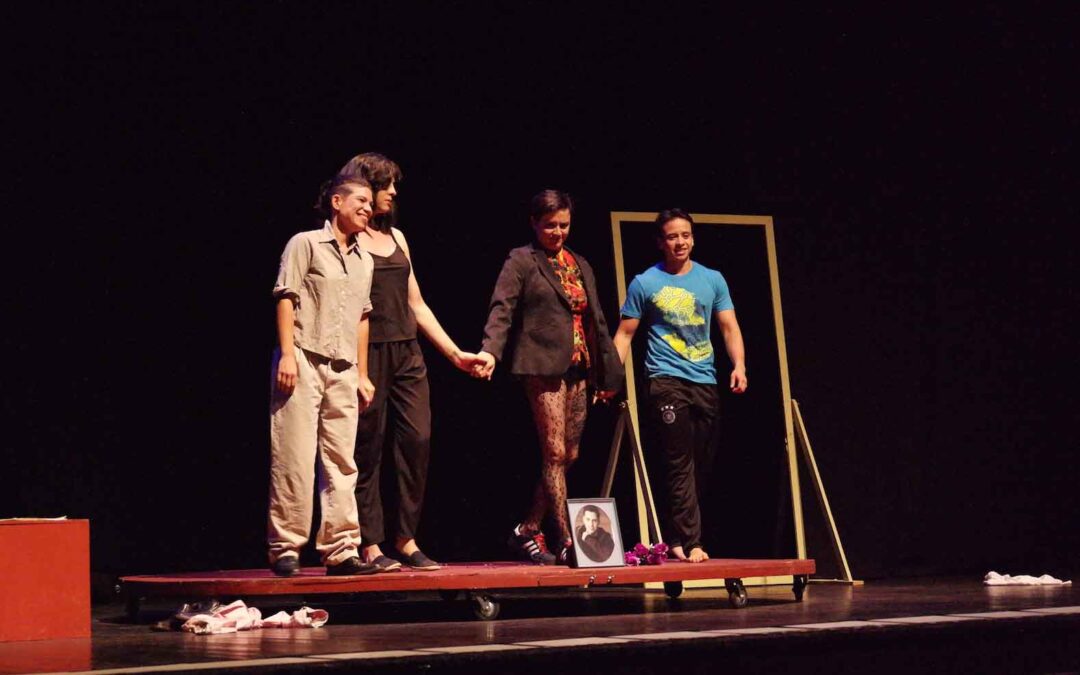
Presentación de la obra de teatro DESIDENCIAS y debate. Este es el primer evento de esta indóle que la CIJ lleva a cabo a favor de la promoción de los derechos humanos de las personas LGBTI en Guatemala.
La CIJ en asocio con la Oficina del Alto Comsionado de las Naciones Unidas para los Derechos Humanos en Guatemala (OACNUDH), el Programa Conjunto de las Naciones Unidas sobre el VIH/SIDA (ONSIDA), la Procuraduría para la Defensa de los Derechos Humanos (PDH) y con la colaboración de OASIS, llevó a cabo la presentación de la Obra DESIDENCIAS de la Colectiva Siluetas y la entrega de la Guía para profesionales del CIJ sobre orientación sexual, identidad de género y Derecho Internacional de los Derechos Humanos.
A la actividad asistieron más de 250 personas de diferentes organizaciones de la sociedad civil, operadores de justicia, estudiantes universitarios y público en general.
La Colectiva Siluetas inció a mediadios del año 2001 y actualmente la intergran tres guatemaltecas: Camilia Urrutia, Tatiana Palomo y Lu Robles y, la salvadoreña, Laia Cañénguez. La puesta en escena de la Obra DESIDENCIAS estuvo a cargo de Camila Urrutia, Laia Ribera, Lola Vásquez y Gabriel Álvarez, actrices lesbianas, transgénero y transexuales.
La obra expone muchos tabús dentro de la sociedad guatemalteca sobre la identidad sexual y la orientación de género.
La CIJ impulsará nuevas acciones para la promoción de la no discriminación y del derecho a la igualdad así como de otros estándares internacionales a favor de las personas LGBTI en Guatemala.
Dec 4, 2014 | Events, News
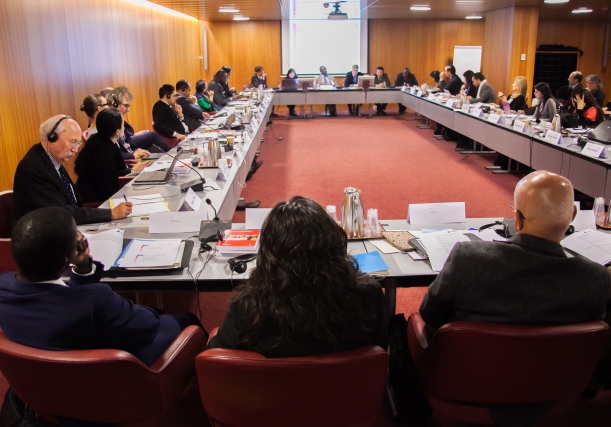
Today and tomorrow, the ICJ welcomes judges and lawyers from all regions of the world to discuss the “Judicial Enforcement of Economic, Social and Cultural Rights”.
The 2014 Geneva Forum of Judges and Lawyers is a joint initiative of the ICJ Center for the Independence of Judges and Lawyers (CIJL) and the ICJ Programme on Economic, Social and Cultural Rights.
Participants are exchanging views on the progress made over the past two decades, including the entry into force of the Optional Protocol to the International Covenant on Economic, Social and Cultural Rights in May 2013.
The Protocol allows individuals to bring complaints of violations of such rights to an independent international body of experts for adjudication.
Discussions are held also in relation to challenges to the justiciability of these rights, including as regards the principle of separation of powers between the judicial, executive and legislative branches of government.
Managing potential implications for public human and financial resources of judicial orders for enforcement of ESCR, and the conflicts that may arise between state development plans, public interest and the interests and rights of the individuals, will also be topics of discussion.
Participants are invited to ground the discussion of conceptual issues in examples from their own actual experience and practice in their national jurisdictions.
Alejandra Ancheita, recent winner of the Martin Ennals Award 2014 – The Nobel Prize of Human Rights – is among the guest speakers.
A report of the discussions will be published in 2015.
The draft agenda for the 2014 Geneva Forum is available here:
Universal-Programme GVA Forum 2014-Events-2014-ENG (English)
Universal-Programme GVA Forum 2014-Events-2014-ESP (Español)
The 2014 Geneva Forum has been made possible with the support of the République et Canton de Genève, the Permanent Mission of Germany to the United Nations in Geneva, and the Taipei Bar Association.
The Geneva Forum has been convened annually by the CIJL since 2010.
Information on, and reports of, the previous Geneva Forums can be found here:
Geneva Forum 2013 (photo)
Geneva Forum Series no. 1: Women and the Judiciary
Geneva Forum 2012
Third Geneva Forum for Judges and Lawyers: the report is published
Geneva Forum 2011
2nd ICJ Geneva Forum of Judges and Lawyers: final report
Geneva Forum 2010
1st ICJ Geneva Forum of Judges and Lawyers: accountable national security policies – the role of judges and legal practitioners
Nov 23, 2014 | Events
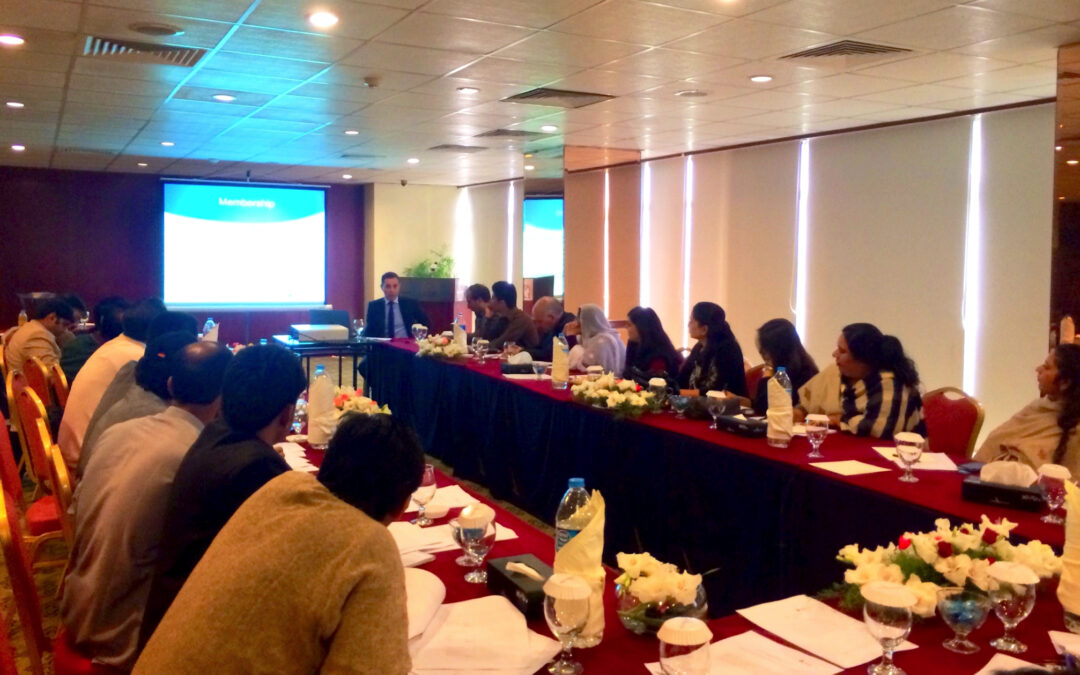
In partnership with the Human Rights Commission of Pakistan (HRCP), the ICJ convened and participated in a one-day workshop on the Universal Periodic Review (UPR) mechanism of the UN Human Rights Council, held in Lahore on 22 November 2014.
The workshop was convened by the ICJ and HRCP as a follow up to, and in response to requests by participants at, training workshops held in Pakistan in February 2014. Now half way between Pakistan’s second and third periodic reviews under the UPR mechanism, the workshop brought together representatives from civil society from throughout Pakistan working on a wide range of human rights issues. It drew from the experience of national and international advocates and human rights lawyers and defenders to discuss:
- The importance of international human rights law at the national level;
- The UPR as a mechanism for human rights protection and how it fits within the broader framework of UN human rights mechanisms;
- Opportunities for NGO engagement in the UPR, especially in the development of a mid-term civil society evaluation report and in preparation for Pakistan’s third cycle UPR in 2017; and
- Weaknesses in Pakistan’s engagement with the UPR.
Nov 19, 2014 | Events, News
On 18 November, the ICJ presented and discussed, in a meeting at the European Parliament in Brussels, its two reports on special economic regimes and their impact on social rights in Peru and Morocco.
MEP Richard Howitt, Member of the Subcommittee on Human Rights at the Parliament, and ICJ Commissioner Olivier De Schutter led the discussions.
The reports highlight the impact on rights, including labour and social security, land and water rights, of special economic regimes that aim at facilitating exports and investment in areas such as agriculture and textile.
The meeting enabled discussion of the role that the EU and its member states can and should play in its general dialogue and cooperation with the two countries, particularly in regard to trade relationships and agreements and also the regulation of the EU based business enterprises benefiting from these special regimes.
The presentation of the ICJ research and reports comes at an important moment in the relationships of the EU with both Peru and Morocco.
As to the latter, the ICJ report will feed into the Human Rights dialogue between the Subcommittee on Human Rights of the European Parliament and Morocco that is taking place today in Brussels.
Reports:
Peru-Social Rights for Export Promotion-Publications-thematic report-2014-ENG (Full report in English – PDF)
Peru-Regimenes especiales exportacion-Publications-thematic report-2014-SPA (Full report in Spanish – PDF)
Morocco-Droits sociaux et regimes speciaux-Publications-thematic report-2014-FRE (Full Report in French – PDF)
Contacts:
Carlos Lopez, Senior Legal Advisor, Business and Human Rights Programme, t +41 22 979 3816, carlos.lopez(a)icj.org
Sandra Ratjen, Senior Legal Advisor, Economic, Social and cultural Rights Programme, t +41 22 979 3835, sandra.ratjen(a)icj.org

Nov 6, 2014 | Events
The ICJ’s Director of International Law and Protection Programmes, Alex Conte, will speak next week on access to justice at a meeting of the OECD Public Governance Committee.
The meeting Fostering Inclusive Growth and Trust in Justice Institutions: Access, Performance and Alternatives, will be held in Paris on 12 November 2014.
The ICJ’s presentation will focus on the key components of access to justice as a means of ensuring access by all to legal institutions capable of rending independent, impartial, binding and enforceable decisions.
It will also address the question of how, when such components are adhered to, trust in justice institutions is attained, from the perspective of the rule of law and public governance, from individuals’ perspectives and from investment and international perspectives.
Nov 5, 2014 | Events, News
On 6 and 7 November 2014, judges and representatives of judicial training institutions from most ASEAN Member States will gather in Manila to discuss recent developments in international human rights law on questions relating to the right to life.
Among the areas of consideration will be custodial deaths and other extrajudicial killings and enforced disappearances.
The two-day event, entitled Judicial Dialogue on Deciding Cases Involving Human Rights Violations in the ASEAN, is organized by the ICJ in collaboration with the Working Group for an ASEAN Human Rights Mechanism.
This initiative is also part of ICJ’s continuous efforts to support Southeast Asian judiciaries through the facilitation of colloquia and dialogues.
Among the event’s participants are Honourable Dato Seri Paduka Hj Kifrawi bin Dato Paduka Hj Kifli, Chief Justice of Brunei Darussalam; ICJ Commissioners Justice Adolfo S. Azcuna and Professor Vitit Muntarbhorn; and Dato’ Param Cumaraswamy, Co-Chairperson of the Working Group for an ASEAN Human Rights Mechanism and Former UN Special Rapporteur on the independence of Judges and Lawyers.
This Judicial Dialogue is aimed to be a platform for peer-to-peer sharing of experiences among judges, representatives from judicial training institutions, and lawyers and other jurists in the ASEAN.
Some of the discussions expected to take place include the international legal framework on the right to life, including custodial deaths and other extrajudicial executions; landmark cases that have previously found state authorities accountable for serious violations of human rights; and challenges faced by judges in cases involving serious violations of human rights and practical solutions to overcome them.
ASEAN-Programme Judicial Dialoghe-News-Events-2014-ENG (full text PDF)