Mar 9, 2016 | News
The recent decision of the Thai Supreme Court in the case of the enforced disappearance of Somchai Neelapaijit demonstrates Thailand must urgently ratify the Convention against Enforced Disappearance and enact domestic laws consistent with the Treaty, said the ICJ today.
On 29 December 2015, the Supreme Court of Thailand upheld the acquittals of five police officers charged with gang-robbery and coercion. These charges related to Somchai’s abduction and the taking of his property.
The authorities have blamed the failure to charge anyone to date with Somchai’s actual enforced disappearance or presumed death, in part, on the absence of physical remains.
The Supreme Court further held that Somchai Neelapaijit’s wife, Angkhana Neelapaijit, and his children could not participate in the proceedings as plaintiffs as, under Thai law, it had to be shown that Somchai Neelapaijit was either injured or killed such that he could not represent himself.
The Court reasoned that this was not the case as “it is not currently known whether or not Mr. Somchai is alive” and the accused had only been charged with gang-robbery and coercion.
“The Supreme Court decision does not in any way end Somchai’s case,” said Sam Zarifi, ICJ’s Asia Director.
“The Thai government is obliged to seek and provide truth and justice for Somchai and his family,” he added.
The Department of Special Investigations (DSI), often described as the FBI of Thailand, has been conducting an ongoing investigation into Somchai Neelapaijit’s fate or whereabouts since 2005.
“The glacial pace of the DSI’s investigation and unfortunate decision of the Supreme Court after all these years is heart-breaking,” said Zarifi.
Before the United Nations Human Rights Council in May 2008, the Royal Thai Government pledged “to do its utmost and leave no stone unturned in order to bring to justice the case of Mr Somchai.”
“But to do its ‘utmost’ to resolve this case, Thailand must take urgent and concrete steps to ratify the Convention against Enforced Disappearance and pass domestic laws that retrospectively recognize enforced disappearance as a distinct offence and the full rights of victims, including family members,” Zarifi added.
Promisingly, the Ministry of Justice is in the process of drafting a Prevention and Suppression of Torture and Enforced Disappearance Bill, which, in a draft seen by the ICJ, defines and criminalizes enforced disappearance and torture in Thailand.
Contacts
Sam Zarifi, ICJ Regional Director, Asia-Pacific Programme, t: +66807819002 ; e: sam.zarifi(a)icj.org
Kingsley Abbott, International Legal Adviser for Southeast Asia, t +66 94 470 1345 ; e: kingsley.abbott(a)icj.org
Additional information
Angkhana Neelapaijit, now Commissioner of the Thai Human Rights Commission, told the ICJ: “The decision of the Supreme Court acquitting the five accused and denying my children and me the right to participate in the proceedings shows that victims of enforced disappearance have nowhere to turn to obtain justice in Thailand. It is clear that nothing will change until Thailand urgently ratifies the Convention against Enforced Disappearance and amends its laws to ensure the rights of victims are upheld.”
Thailand signed, but has not yet ratified, the Convention Against Enforced Disappearance in January 2012. Pending the ratification, Thailand must desist from any acts that would defeat the objective and purpose of the Convention, which among other things places an obligation on State Parties to make enforced disappearance a criminal offence, to thoroughly and impartially investigate cases, bring those responsible to justice and treat family members of a ‘disappeared’ person as victims in their own right.
Forthcoming event
On 11 March 2016, the ICJ, together with Amnesty International (Thailand), Human Rights Watch, and the Justice for Peace Foundation will hold “a discussion on enforced disappearance in Thailand focusing on the recent decision of the Supreme Court in Somchai Neelapaijit’s case and the draft Prevention and Suppression of Torture and Enforced Disappearance Bill” to mark the 12-year anniversary since Somchai Neelapaijit “disappeared” on 12 March 2004.
Date: 11 March 2016
Time: 10.00am -12.00pm
Location: The Sukosol Hotel, room Kamolthip 3, Sriayutthaya Road, Bangkok
The speakers will be:
- Angkhana Neelapaijit
- Kingsley Abbott, International Legal Advisor, the International Commission of Jurists
- Sunai Phasuk, Senior Researcher, Human Rights Watch
- Laurent Meillan, Acting Representative, Office of the High Commissioner for Human Rights Office for South-East Asia
- A representative from the Department of Rights and Liberty Protection, Ministry of Justice
Related readings
To mark the 10-year anniversary of Somchai Neelapaijit’s “disappearance”, the ICJ released a report Ten Years Without Truth: Somchai Neelapaijit and Enforced Disappearances in Thailand, in which it documented the tortuous legal history of the case.
On 11 December 2015, the ICJ published an English version of its Practitioners Guide “Enforced Disappearance and Extrajudicial Execution: Investigation and Sanction”, originally published in Spanish in March 2015.
Thailand-Somchai disap anniversary 2016-News-Press releases-2016-THA (full text in Thai, PDF)

Feb 19, 2016 | News
The ongoing incommunicado detention of human rights defenders Nguyễn Văn Đài and Lê Thu Hà must end, said today seven human rights groups, including the ICJ. It violates their right to freedom from torture and other cruel, inhuman or degrading treatment or punishment.
All charges against Nguyễn Văn Đài and Lê Thu Hà, should be withdrawn and they should be immediately and unconditionally released, the organizations added.
An incommunicado detention is one in which a detainee is held without access to the outside world, particularly to family, lawyers, courts and independent doctors. The practice of incommunicado detention violates key rights of persons deprived of liberty and facilitates torture and other ill-treatment. Prolonged periods of incommunicado detention can themselves constitute a violation of the prohibition on torture and other ill-treatment.
Nguyễn Văn Đài and Lê Thu Hà were arrested on 16 December 2015 and charged under Article 88 of the Penal Code, ‘Conducting propaganda against the state’. All efforts by family and legal counsel to visit the pair since their arrests have been denied.
Vietnam-Release prisoners-News-webstory-2016-ENG (full story, in PDF)
Feb 9, 2016 | News
The ICJ today condemned the arrest of Judge Ahmed Nihan and called it a further attack on the independence and integrity of the country’s judiciary.
“President Abdulla Yameen’s Government has dealt another blow to the independence of the judiciary and the rule of law,” said Sam Zarifi, ICJ’s Asia Director.
“The arrest of Judge Ahmed Nihan is another step down in the country’s downward spiral away from democracy and stability, and is squarely at odds with the Maldives’ international obligations,” he added.
Maldivian officials confirmed in a statement that Ahmed Nihan, a magistrate’s court judge, and Muhthaz Muhsin, former Prosecutor General, were arrested on Sunday night on charges of forging a warrant for the arrest of President Abdulla Yameen.
Muhthaz Muhsin was released soon after, but Judge Ahmed Nihan was placed in judicial custody for one week.
“Judge Ahmed Nihan’s arbitrary and seemingly politically motivated arrest is yet another example of executive highhandedness and the corrosion of separation of powers in the Maldives,” said Zarifi.
“Undue interference with the Human Rights Commission, the arbitrary dismissal of the Auditor General, and the unlawful removal of two Supreme Court justices are just a few examples,” he added.
According to the Maldivian media, the arrest warrant, allegedly issued by Judge Ahmed Nihan, related to an on-going investigation against President Abdulla Yameen for embezzlement of state funds.
President Yameen’s spokesperson said in an interview the warrant was “fraudulent” because it “did not originate from any official authority.”
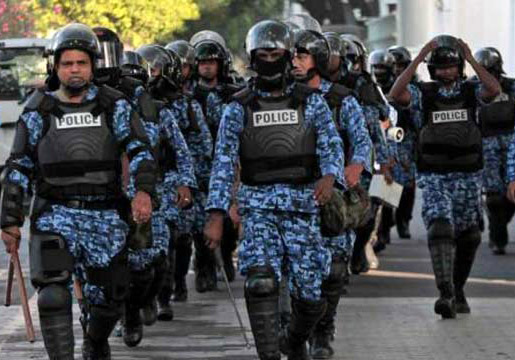
The Maldivian police (photo) claim the arrest warrant was issued using “falsified information”.
The ICJ calls on the authorities to immediately release Judge Ahmed Nihan and allow him to continue his judicial duties.
The ICJ also reiterates its previous calls on the Maldivian Government to implement recommendations on human rights and the rule of law, including the independence of the judiciary, received as part of the UN Universal Periodic Review process.
Contact:
Sam Zarifi, ICJ Asia Pacific Regional Director (Bangkok), t: +66 807819002; e: sam.zarifi(a)icj.org
Additional information:
In a fact-finding report released in August last year, the ICJ noted with concern the serious erosion of the independence, impartiality and integrity of the judiciary, which resulted in the deterioration in the rule of law in the Maldives and the stalling of the country’s transition toward a more representative government.
Article 14 of the International Covenant on Civil and Political Rights (ICCPR), which Maldives acceded to in 2006, safeguards the independence and impartiality of the judiciary.
International standards on judicial independence, including the UN Basic Principles on the Independence of the Judiciary, provide that judges shall be free from any “inappropriate or unwarranted interference with the judicial process”.
The fact that executive or legislative actors may disagree with a judge’s decision or interpretation of the law cannot be a valid ground for removal or punishment of the judge.
The UN Basic Principles on the Independence of the Judiciary further stipulate that judges shall be subject to suspension or removal only through proceedings that guarantee the right to a fair hearing (Principle 17); and then only for reasons of incapacity or behaviour that renders them unfit to discharge their duties (Principle 18); that all disciplinary, suspension or removal proceedings shall be determined in accordance with established standards of judicial conduct (Principle 19), and decisions in disciplinary, suspension or removal proceedings should be subject to an independent review (Principle 20). The Basic Principles elaborate on legal obligations under article 14 of the International Covenant and Civil Rights (ICCPR).
The Commonwealth Latimer House Principles on the Three Branches of Government 2003 contain similar provisions.
Article 154 of the Maldivian Constitution states that a judge may be removed from office only if the Judicial Service Commission finds that the person is grossly incompetent or guilty of gross misconduct.

Feb 5, 2016 | News
The ICJ today called on the Royal Thai Government to immediately drop criminal proceedings against human rights lawyer Sirikan Charoensiri.
On 2 February 2016, Sirikan Charoensiri received two summons to appear at the Chanasongkram Police Station on 9 February 2016 to be charged with two offences under the Criminal Code of Thailand: “giving false information regarding a criminal offence” and “refusing to comply with the order of an official”.
Such charges could result in punishment of up to two years’ imprisonment.
“The charges against Sirikan Charoensiri apparently relate to her efforts to protect the legal and human rights of her clients, students who never should have faced arrest or criminal proceedings for peacefully exercising their freedoms of expression and assembly in the first place,” said Matt Pollard of the ICJ’s Centre for the Independence of Judges and Lawyers.
“Prosecuting Sirikan Charoensiri for her efforts to defend human rights is totally unacceptable and will only put Thailand further in violation of its international obligations,” he added.
The charges appear to relate to the circumstances surrounding Sirikan Charoensiri’s provision of legal aid to 14 students who were arrested on 26 June 2015 after carrying out peaceful protests calling for democracy and an end to military rule.
Although the precise basis for the changes is not set out in the summonses, the complainant is named as Pol. Col. Suriya Chamnongchok, a police officer involved in the investigation of the 14 students.
Sirikan Charoensiri, a lawyer with Thai Lawyers for Human Rights (TLHR), has provided legal aid to many individuals, including activists and human rights defenders, since military rule was imposed in May 2014.
The ICJ first expressed concern about the Government’s targeting of Sirikan Charoensiri on 2 July 2015, after the Royal Thai Police threatened Sirikan Charoensiri with legal action, publically announced they were considering charging her with a crime, and visited her home and questioned her family.
These threats and harassment, like the currently pending charges, appeared to be in retaliation for her having refused consent for police to search her car after the students’ court hearing, and for having filed a complaint with the police when they proceeded to impound it.
The ICJ has brought the case to the attention of the United Nations Special Rapporteurs on the Independence of Judges and Lawyers, and on the Situation of Human Rights Defenders.
The situation of human rights in Thailand will be examined by the UN Human Rights Council in May 2016, as part of the Council’s Universal Periodic Review of all States.
“Ahead of Thailand’s human rights review by the United Nations in May, and against the background of the tabled ‘roadmap’ towards democratic rule, the need for the Royal Thai Government to restore respect for human rights only grows more urgent by the day,” said Pollard.
Contact
In Bangkok: Kingsley Abbott, International Legal Adviser for Southeast Asia, t +66 94 470 1345 ; e: kingsley.abbott(a)icj.org
In Geneva: Matt Pollard, ICJ Senior Legal Adviser, t: +41 22 979 38 12 ; e: matt.pollard(a)icj.org
Background
The International Covenant on Civil and Political Rights (ICCPR), to which Thailand is a Party, guarantees the right to peaceful assembly; the right to freedom of expression; the prohibition of arbitrary arrest or detention; the right to a fair and public hearing by a competent, independent and impartial tribunal established by law (including the right of prompt access to a lawyer and precluding jurisdiction of military courts over civilians in circumstances such as these); and the prohibition of arbitrary or unlawful interference with privacy, family, home and correspondence (which includes arbitrary searches or seizures).
The UN Declaration on Human Rights Defenders affirms the right of everyone peacefully to oppose human rights violations. It prohibits retaliation, threats and other harassment against anyone who takes peaceful action against human rights violations, both within and beyond the exercise of their professional duties. It protects the right of persons to file formal complaints about alleged violations of rights. The UN Basic Principles on the Role of Lawyers provide that governments are to ensure that lawyers are able to perform their professional functions without intimidation, hindrance, harassment or improper interference.
Thailand-Sirikan Charoensiri-News-Press releases-2016-THA (full text in PDF, Thai)

Feb 3, 2016 | News
Yesterday’s decision of the Indian Supreme Court to refer to a larger bench of the same Court the petition challenging Section 377 of the Indian Penal Code (IPC), offers the opportunity to undo the appalling 2013 judgment of a two-judge bench of the SC in the Suresh Koushal case, says the ICJ.
“This order of the Supreme Court is a crucial opportunity to undo the injustice of the Suresh Koushal decision,” said Sam Zarifi, ICJ’s Asia Director. “It is an important test of the Supreme Court’s commitment to equality and ending discrimination against people on the basis of sexual orientation or gender identity.”
After the December 2013 Suresh Koushal decision – when the Supreme Court upheld the constitutionality of section 377 and reversed the Delhi High Court’s courageous and much celebrated decision – the petitioners filed a review petition, which was dismissed.
The petitioners then filed “curative petitions” in 2014, stating that the Supreme Court’s judgment of December 2013 violated principles of natural justice for several reasons. A “curative petition” allows the Supreme Court to re-assess its previous decisions on limited grounds, even after appeals and reviews have concluded.
Yesterday the Supreme Court referred the curative petition, and the major constitutional questions it raised, to a five-judge bench of the same Court, thus acknowledging doubts about the correctness of its 2013 ruling. A five-judge bench will now be set up to hear this challenge.
“The referral highlights the Supreme Court’s recognition of the need for a judicial response to the ongoing discrimination against people on the basis of sexual orientation and gender identity,” Zarifi said.
“After 16 years within the court process, this issue clearly could not be resolved with the highly problematic Suresh Koushal decision, which ignored the reality of consensual same sex behavior in India and the fact that Section 377 criminalizes people for who they are and leads directly to serious human rights violations.”
By criminalizing consensual same-sex adult sexual conduct, Section 377 is inconsistent with India’s obligations under international human rights law, including in respect of the rights to sexual autonomy, equality, non-discrimination, privacy, dignity, free expression, and life.
Many of these rights are guaranteed in India’s Constitution.
India is also a party to several international instruments, which require that these rights be respected, protected and fulfilled.
The Yogyakarta Principles – which apply international human rights law to issues of sexual orientation and gender identity – clarify that the rights to equality, non-discrimination and privacy require states to “repeal all laws that criminalize consensual sexual activity among persons of the same sex who are over the age of consent.”
The Supreme Court referred to these principles in the 2014 National Legal Services Authority v Union of India (NALSA) case where it also acknowledged that Section 377 was “used as an instrument of harassment and physical abuse against Hijras and transgender persons”.
“Yesterday’s decision offers hope that the Supreme Court intends to reaffirm the principle that people in India cannot be subjected to discrimination, harassment and violence, simply on the basis of their sexual orientation or gender identity,” Zarifi said.
Background
Section 377 makes it an offence to “voluntarily ha[ve] carnal intercourse against the order of nature with any man, woman or animal” and has been used to persecute people for their real or purported engagement in consensual same-sex sexual conduct. The penalty can extend to life imprisonment.
Several reports document how Section 377 has been a tool for discrimination, blackmail, extortion, and violence by state and non-state actors against the LGBTI community.
It has adversely affected HIV/AIDS prevention efforts, and has also reinforced harmful social stereotypes and taboos against sexual minorities.
The petitioners in the original challenge against section 377 have waged this legal battle for over a decade. The constitutional challenge against Section 377 was filed in 2001.
In 2009, in Naz Foundation v. Government of NCT of Delhi and Others, the Delhi High Court held that Section 377 denied “a person’s dignity and criminalises his or her core identity solely on account of his or her sexuality”.
It went on to find that this criminalization of identity denied “a gay person a right to full personhood which is implicit” in the notion of life under Article 21 of the Indian Constitution, and also violated the constitutional right to equality and non-discrimination. The High Court held that Section 377 was unconstitutional insofar as it criminalized consensual same-sex sexual conduct.
However, its judgment was appealed to the Supreme Court.
On appeal, in 2013 the Supreme Court reversed the decision of the Delhi High Court, holding the section to be constitutional.
The Supreme Court also affirmed that legislature would “be free to consider the desirability and propriety of deleting Section 377 IPC from the statute book or amend the same as per the suggestion made by the Attorney General”.
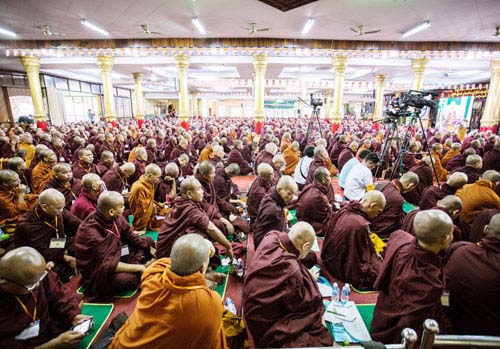
Jan 29, 2016 | News
The Myanmar authorities must immediately release and drop all charges or quash convictions against all people detained for allegedly having the “deliberate and malicious intention to insult religion,” said the ICJ today.
While President Thein Sein had declared an amnesty on 22 January for 102 prisoners, including 52 political prisoners, it is unclear exactly how many prisoners continue to be detained in prison under section 295A of the Penal Code and awaiting trials for blasphemy.
“Charging and imprisoning people on charges under Myanmar’s blasphemy laws is inconsistent with human rights including freedom of opinion and expression, freedom of thought, conscience, and religion, the right to liberty, and the right to equality before the law without discrimination,” said Sam Zarifi, ICJ’s Asia Director.
“The problem is compounded in Myanmar when courts have been convicting individuals in unfair trials and in the absence of evidence of any deliberate and malicious intent to insult religion,” he added.
Last week, President Thein Sein pardoned Philip Blackwood, a New Zealand citizen sentenced to two and a half years with hard labour for posting on Facebook a psychedelic image of the Buddha wearing headphones to promote a bar.
His colleagues Tun Thurein and Htut Ko Ko Lwin, Myanmar citizens, do not seem to have been released (although it is possible that they may have been granted amnesty as well).
Another detainee, Htin Linn Oo, a writer and National League for Democracy information officer who was sentenced to two years imprisonment with hard labour, has not been released.
U Nyar Na (aka) Moe Pyar Sayar Taw, a monk arrested in Kachin state in 2010 and charged under various provisions of the Penal Code, including section 295A, was sentenced to imprisonment for 20 years. His reported release during the amnesty last week remains unconfirmed.
These charges and convictions are in violation of international law, including a range of human rights guaranteed by the Universal Declaration of Human Rights and by international treaties, the ICJ says.
“The laws must be repealed or fundamentally changed, ongoing prosecutions ended, and those imprisoned for their beliefs or protected speech and other expression immediately and unconditionally released,” Zarifi said.
“These prosecutions seem to be a result of intense political pressure from extremist Buddhist political groups. As the Myanmar judiciary and legal system try to emerge from decades of political interference on with independence, it’s crucial that they act in the interests of justice and human rights,” he added.
The ICJ urges the Myanmar authorities to drop all charges against the accused persons who have not yet been tried; take immediate measures to secure the quashing of convictions under the law; and take effective measures to ensure the immediate and unconditional release of all detainees held pursuant Section 295A.
The ICJ also calls on the government to act to repeal or amend section 295A to bring it in line with international law and standards.
Contact:
In Bangkok: Sam Zarifi, ICJ Regional Director, Asia-Pacific Programme, t: +66807819002 ; e: sam.zarifi(a)icj.org
In Myanmar: Vani Sathisan, ICJ International Legal Adviser, t: +95 9250800301 ; e: vani.sathisan(a)icj.org
Additional information:
Myanmar’s Constitution guarantees the right to freedom of expression, conscience, and to freely profess and practice religion.
The UN Human Rights Committee established by the International Covenant on Civil and Political Rights (ICCPR) emphasizes that “Prohibitions of displays of lack of respect for a religion or other belief system, including blasphemy laws, are incompatible with the Covenant”. The only limited exception under the Covenant would be for proportionate and non-discriminatory measures to prohibit “advocacy of…religious hatred that constitutes incitement to discrimination, hostility or violence”. Section 295A falls far short of this threshold.