Mar 12, 2014 | News
The ICJ condemned the High Court decision sentencing prominent Malaysian lawyer and chairman of the opposition Democratic Action Party Karpal Singh with a criminal sanction. He was found guilty of sedition on 21 February 2014.
The sanction amounts to RM 4,000 fine (approximately US$1,220).
The High Court’s decision was based on a statement made by Karpal Singh at a press conference on 6 February 2009 that Sultan Azlan Shah’s decision to remove the Perak’s state Chief Minister from office in 2009 could be challenged in a court of law.
“The Malaysian government is brazenly utilizing a draconian and outdated sedition law to restrict freedom of expression in the country by lawyers and public figures,” said Emerlynne Gil, ICJ’s International Legal Adviser on Southeast Asia.
The Malaysian government on 21 July 2012 announced that it planned to repeal the colonial-era 1948 Sedition Act, but has been slow to act on its announcement.
“Public discussion, including debates on the interpretation of laws, are an integral part of the nature of the legal process and a crucial step in the strengthening of a country’s democracy and rule of law,” said Gil. “A lawyer’s right to freely and independently engage and express their views on the law fulfills an important aspect of their professional role.”
In June 2010, the High Court initially ruled that the prosecution had failed to prove a prima facie case and acquitted Karpal Singh. The prosecution, however, later appealed, and the Court of Appeal reversed the High Court’s decision and ordered a retrial.
Pursuant to article 48(e) of the Federal Constitution, Karpal Singh now risks losing his Parliamentary seat unless the High Court’s decision is overturned during appeal.
Karpal Singh was the lead counsel for opposition leader Anwar Ibrahim during his Sodomy II appeal from 6 – 7 March 2014, which saw the Court of Appeal overturn his acquittal and sentenced him to five years in prison.
Karpal Singh is expected to appeal both the conviction and the sentence to the Court of Appeal.
Contact:
Emerlynne Gil, ICJ International Legal Adviser for Southeast Asia, t +66 2 619 8477; email: emerlynne.gil(a)icj.org
Craig Knowles, ICJ Media Consultant, t +66 81 9077653; email:craig.knowles(a)icj.org
Mar 10, 2014 | Agendas, Events
This side event to the 25th Human Rights Council session will take place on Wednesday, 12 March 2014, 16.00 – 18.00 pm, in Geneva, Palais des Nations, Room XXII.
The members of this panel are in a unique position to highlight on-going challenges to the rule of law in Myanmar and their impact on the enjoyment of human rights.
They will provide personal insight into the important international presence for human rights monitoring, practical challenges facing lawyers concerning the rule of law, and link these issues to sustainable economic development on the ground in Myanmar today.
This panel argues that it is crucial to maintain a robust engagement with the UN human rights mechanisms in order to support and facilitate the reform process in Myanmar and improve the country’s human rights situation.
Speakers:
Tomás Ojea Quintana, UN Special Rapporteur on the situation of human rights in Myanmar
Kyaw Min San, Myanmar lawyer, Pyoe Pin and Justice For All
Daniel Aguirre, International Commission of Jurists, Myanmar
Chair/moderator:
Carlos Lopez, International Commission of Jurists
The presentations by panellists will be followed by an open interaction with the audience. Copies of the recent ICJ report Right to Counsel: The Independence of Lawyers in Myanmar will be available.
Myanmar – HRC25 Side event – March 2014

Mar 8, 2014 | News
The ICJ today condemned as a miscarriage of justice, Malaysian opposition leader Anwar Ibrahim’s conviction on sodomy charges.
The ICJ said the overturning of his 2012 High Court acquittal — following an appeal by the Malaysian government — by a Court of Appeal panel contravenes international human rights standards and the rule law.
“The ICJ condemns the use of the colonial-era Article 377B of the Malaysian Penal Code, which prohibits consensual same-sex sexual conduct, in conflict with international standards regarding respect for the right to privacy,” said Sam Zarifi, ICJ’s Regional Director for Asia and the Pacific.
“This article is seldom used in Malaysia, but this is the second time it has been used to convict Anwar, and both times its use seemed clearly motivated to hobble his ability to challenge the government as a politician.”
The sodomy charges against Anwar, which date back to 2008, were dismissed by the High Court on 9 January 2012, but the Court of Appeal today overturned that acquittal and instead sentenced Anwar to five years’ imprisonment. The Court of Appeal ruling took less than two hours.
The ICJ has been observing the proceedings in what has been called Anwar’s ‘Sodomy 2’ trial. ICJ Commissioner Justice Elizabeth Evatt AC, from the Australian High Court and a former member of the United Nations Human Rights Committee, was at the Court of Appeal today on behalf of the ICJ.
“This decision certainly casts doubts on the independence and impartiality of the Malaysian judiciary and tarnishes the reputation of the country’s legal system,” said Zarifi.
The judgement means Anwar will not be able to run for election in a local state seat later this month.
After sentencing, Anwar’s lawyers were successful in arguing for a stay in execution and bail, pending appeal.
CONTACT
Sam Zarifi, ICJ Asia-Pacific Regional Director, (Bangkok), t:+66 807819002, e-mail: sam.zarifi(a)icj.org
Craig Knowles, ICJ Media & Communications, (Bangkok), t:+66 819077653, e-mail: craig.knowles(a)icj.org
Mar 7, 2014 | News, Publications, Reports
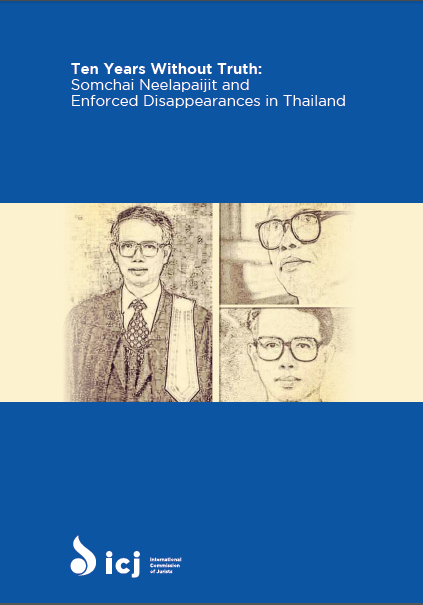
A new ICJ report criticizes the Thai Government’s failure to take the steps necessary to establish the fate and whereabouts of missing lawyer Somchai Neelapaijit, saying it illustrates the challenges of achieving justice in cases of serious human violations in Thailand.
In the report, Ten Years Without Truth: Somchai Neelapaijit and Enforced Disappearances in Thailand, the ICJ documents the tortuous legal history of the case.
It highlights several key problems, such as poor use of forensic evidence, failure to follow and develop leads, unduly restrictive interpretation of national and international law, and above all, a lack of political will to resolve a case that remains emblematic of the culture of impunity in Thailand.
“Over the past 10 years, this case has taken many unexpected turns, including the disappearance of a prime suspect, admissions of Somchai’s death from officials while the courts have rejected such a finding, and most recently, a statement from the Department of Special Investigations that it had lost, and then found, the case files,” said Sam Zarifi, ICJ’s Regional Director for Asia and the Pacific.
“The Royal Thai Government has not exhausted all potential areas of inquiry and it must continue this investigation. There is no statute of limitations on an enforced disappearance and Somchai’s case is not forgotten in Thailand or around the world.”
Somchai, a lawyer and human rights defender, was stopped at a Bangkok roadside on March 12, 2004 and pulled from his car by a group of men. He has not been seen since.
At the time, Somchai was defending clients from Thailand’s restive southern provinces who were accused of attacking a military base as part of the ongoing insurgency in the region. Somchai had alleged police tortured the Muslim suspects.
Ten years later, Somchai’s wife, Angkhana Neelapaijit, and her family are no closer to knowing the truth about what happened to him.
“Somchai’s enforced disappearance, and the failure of the Royal Thai government to provide accountability or even basic information about his fate are emblematic of the challenges of achieving justice in cases of serious human rights violations in Thailand,” said Zarifi. “Enforced disappearance is not only a serious human rights violation but also a crime under international law.”
Thailand signed, but has not yet ratified, the Convention Against Enforced Disappearance in January 2012. Pending the ratification, Thailand must desist from any acts that would defeat the objective and purpose of the convention, which places an obligation on State Parties to make enforced disappearance a criminal offence and treat family members of a ‘disappeared’ person as victims in their own right.
The ICJ has followed Somchai’s case closely and worked with Angkhana Neelapaijit since 2004.
“The Royal Thai government’s failure to shed any more light on the enforced disappearance of Somchai Neelapaijit, despite providing compensation for his family and finding him to be ‘disappeared’, contradicts multiple past declarations of its commitment to seeking justice, or at least truth, including by several former Prime Ministers, Attorneys General, and officials,” the report says.
“It also contradicts official commitments before the United Nations Human Rights Council in March 2008.”
The ICJ’s report calls on the Royal Thai government to prioritize and advance the investigation into Somchai’s disappearance in a manner that conforms to its international obligations. It also recommends that Thailand:
–Ratify the Convention Against Enforced Disappearance;
–Enact legislation that makes enforced disappearance a specific crime in Thai domestic law, together with penalties that recognize its extreme seriousness;
–Amend existing Thai law to conform to the Convention Against Enforced Disappearance, as well as the State’s obligations, including with respect to effective remedy and reparation, under the ICCPR and CAT;
–Provide Angkhana Neelapaijit and her family with effective remedy and full reparation, in particular knowledge and clarification of the facts leading to the enforced disappearance and the progress and results of the Department of Special Investigations, and;
–Address the recommendations the ICJ made to the DSI in its letter of February 4, 2014 with respect to its investigation.
CONTACT
Sam Zarifi, ICJ Asia-Pacific Regional Director, (Bangkok), t:+66 807819002, e-mail: sam.zarifi(a)icj.org
Craig Knowles, ICJ Media & Communications, (Bangkok), t:+66 819077653, e-mail: craig.knowles(a)icj.org
Download the full report in PDF:
Ten Years Without Truth- Somchai Neelapaijit and Enforced Disappearances in Thailand – report – 2014
Thailand-Ten Years Without Truth-Publications-Reports-2014-THAI

Mar 4, 2014 | Agendas, Events
This side event to the 25th Human Rights Council session will take place on Friday, 7 March 2014, 12.00 – 14.00 pm, in Geneva, Palais des Nations, Room XXI.
The panel, which includes family members of victims of enforced disappearance, will discuss unresolved cases of enforced disappearances in Southeast Asia, including human rights defenders Somchai Neelapaijit (Thailand) and Sombath Somphone (Laos).
The panel will also discuss the response of the ASEAN Intergovernmental Commission on Human Rights (AICHR), the regional human rights body composed of representatives from all ASEAN Member States, to these two cases and more generally to enforced disappearances of human rights defenders in the region.
Speakers:
Aileen Diez-Bacalso
Secretary General, Asian Federation Against Involuntary Disappearances (AFAD)
Angkhana Neelapaijit
Chairperson, Justice for Peace Foundation
Emerlynne Gil
International Commission of Jurists (ICJ), Southeast Asia
Chair/moderator:
Wilder Tayler
Secretary General, the International Commission of Jurists
The presentations by panelists will be followed by an open interaction with the audience. Copies of ICJ’s legal memorandum on the case of Sombath Somphone and the report Ten Years without Truth: Somchai Neelapaijit and enforced disappearances in Thailand will be available. Light refreshments will also be available immediately before the event.
Mar 3, 2014 | News
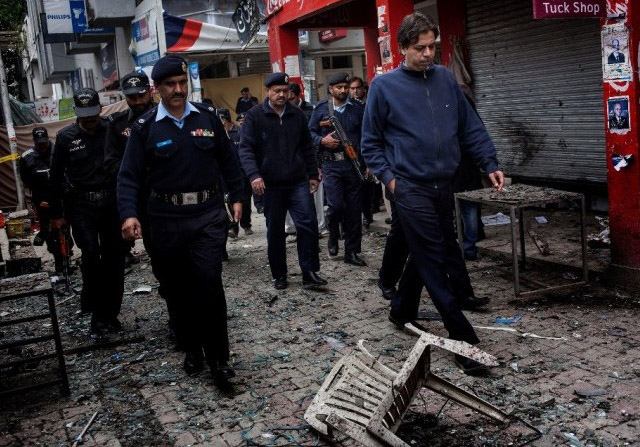
The shooting and bombing at an Islamabad Court today should be condemned as a presumed attack against the judicial officials and the independence of the judiciary in Pakistan, says the ICJ.
The attack resulted in the killing of Additional Sessions Judge Rafaqat Ahmad Khan Awan and at least ten other persons, including several lawyers.
According to reports, armed gunmen forced their way into a court complex in Islamabad, openly firing on judges and lawyers before at least two of the men blew themselves up inside the court complex.
One of the attackers detonated himself outside the door of a judge’s office, while the other targeted the office of the Lawyers’ Union President.
Another gunmen entered Judge Rafaqat Awan’s courtroom, where he shot and killed him.
“An intentional killing of a member of the judiciary can be seen as nothing other than an attack against the independence and impartiality of the judiciary as a whole,” said Sam Zarifi, ICJ Asia Pacific Regional Director.
“In addition to personal tragedy that has befallen the slain victims and their families, this attack and those like it are devastating for the people of Pakistan,” he added. “Courthouses, which should be places where justice is administered, are instead becoming slaughterhouses.”
This is the third armed attack against members of the judiciary in Pakistan in under a year. In March 2013, a judicial compound was attacked in Peshawar, killing four people.
In June 2013, a Sindh High Court judge’s convoy was attacked in Karachi, killing nine people.
As set out in the UN Principles on the Independence of the Judiciary, Pakistan must take steps to protect and ensure the safety of members of the judiciary from threats and violence from any quarter for any reason.
The Beijing Statement of Principles on the Independence of the Judiciary in the LAWASIA region further elaborates that the executive branch must at all times ensure the security and physical protection of judges and their families.
As a State party to the International Covenant on Civil and Political Rights, Pakistan is under a general obligation to ensure the safety of all persons within its territory at all times.
“If judges are under constant fear of violence from insurgent groups, they cannot function as an independent and impartial judiciary – an indispensible requirement for preserving rule of law and democracy,” Zarifi said.
The ICJ calls on the Government of Pakistan to take steps to immediately investigate and bring to justice those persons responsible for the armed attack on the Courthouse.
Contact:
Sam Zarifi, ICJ Asia-Pacific Regional Director, (Bangkok), t:+66(0) 807819002; email: sam.zarifi(a)icj.org
Reema Omer, ICJ Legal Advisor, Pakistan (London), t: +447889565691; email: reema.omer(a)icj.org
Photo credit: MYRA IQBAL