Sep 30, 2020 | News
Today, the ICJ joined fourteen other human rights organizations in condemning the Indian government’s actions against Amnesty India and pledged to continue support for local human rights defenders and organizations against the recent crackdown.
Amnesty International India announced that it is halting its work in the country after the Indian government froze its bank accounts in an act of reprisal for the organization’s human rights work.
The Indian government’s actions against Amnesty India are part of increasingly repressive tactics to shut down critical voices and groups working to promote, protect, and uphold fundamental rights, said the Association for Progressive Communications, Global Indian Progressive Alliance, International Commission of Jurists, International Federation for Human Rights (FIDH), CIVICUS: World Alliance for Citizen Participation, Front Line Defenders, FORUM-ASIA, Foundation the London Story, Hindus for Human Rights, Human Rights Watch, International Service for Human Rights, Minority Rights Group, Odhikar, South Asians for Human Rights (SAHR), and World Organisation Against Torture (OMCT) in the framework of the Observatory for the Protection of Human Rights Defenders.
The Hindu nationalist Bharatiya Janata Party (BJP)-led government has accused Amnesty India of violating laws on foreign funding, a charge the group says is politically motivated and constitutes evidence “that the overbroad legal framework is maliciously activated when human rights defenders and groups challenge the government’s grave inactions and excesses.”
The BJP government has increasingly cracked down on civil society, harassing and bringing politically motivated cases against human rights defenders, academics, student activists, journalists, and others critical of the government under sedition, terrorism, and other repressive laws.
These actions increasingly mimic that of authoritarian regimes, which do not tolerate any criticism and shamelessly target those who dare to speak out. With growing criticism of the government’s discriminatory policies and attacks on the rule of law, the authorities seem more interested in shooting the messenger than addressing the grievances. Women’s rights activists and indigenous and minority human rights defenders have been especially vulnerable. The recent action against Amnesty India highlights the stepped-up pressure and violence felt by local defenders on the ground, regardless of their profile.
The authorities have repeatedly used foreign funding regulations under the Foreign Contribution Regulation Act (FCRA), a law broadly condemned for violating international human rights law and standards, to target outspoken groups. United Nations experts on human rights defenders, on freedom of expression, and on freedom of association have urged the government to repeal the law, saying it is “being used more and more to silence organisations involved in advocating civil, political, economic, social, environmental or cultural priorities, which may differ from those backed by the Government.”
Yet, the Indian parliament amended the FCRA this month, adding further onerous governmental oversight, additional regulations and certification processes, and operational requirements that would adversely affect civil society groups and effectively restrict access to foreign funding for small nongovernmental organizations.
A robust, independent, and vocal civil society is indispensable in any democracy to ensure a check on government and to hold it accountable, pushing it to do better. Instead of treating human rights groups as its enemies, the government should work with them to protect the rights of all people and ensure accountability at all levels of government.
Contact
Ian Seiderman, ICJ Law and Policy Director: ian.seiderman@icj.org
Sep 24, 2020 | News
Today the ICJ condemned the adoption by both Houses of Parliament of the Indian Foreign Contribution (Regulation) Amendment Bill 2020 (FCRA 2020).
Sep 14, 2020 | News
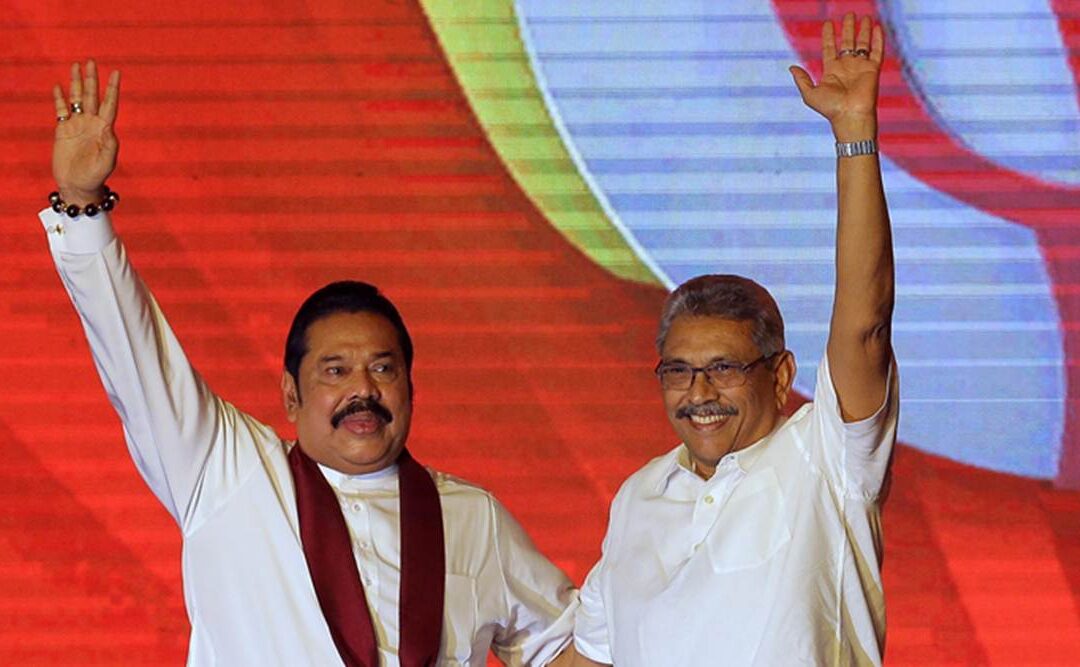
The Sri Lankan parliament should reject the Sri Lankan Government’s efforts to amend the country’s constitution to provide unfettered powers to the President while encroaching on the powers of the legislature and infringing upon the independence of the judiciary, said the ICJ today.
“The proposed 20th Amendment, which bestows an already powerful executive president with additional powers with no effective checks on him, essentially placing him above the law,” said Sam Zarifi, ICJ’s Secretary General. “These amendments would tilt the balance of State power heavily on the side of the executive and in particular on a single person.”
The proposed 20th Amendment to the Constitution bill rolls back most of the reforms brought about by the 19th Amendment to the Constitution, the passage of which the UN Human Rights Council welcomed as “promoting democratic governance and oversight of key institutions”.
The 19th amendment, adopted in 2015, had imposed certain limits to the Executive President’s authority and powers, including in respect of terms of the office of President, the capacity to dissolve Parliament and to fast-track legislation. It also removed the blanket immunity the President enjoyed from legal proceedings. Critically, it had established a Constitutional Council which restrained the President’s discretion in appointing key governmental actors including in the judiciary, the Attorney General and the Inspector General of Police.
The ICJ notes that the 20th amendment appears to reproduce much of the regressive features of the old 18th amendment, which the 19th amendment had been brought about to correct.
“Sri Lanka’s Executive branch has a poor record of respecting human rights and the rule of law, and the 19th Amendment was an effort to impose the checks and balances necessary for the rule of law,” said Sam Zarifi. “The constitutional changes being proposed would take the country back to the dark days of Executive impunity.”
“We are particularly concerned that these changes would undermine the independence of the judiciary, as the President would have unfettered discretion to appoint the superior judiciary, including the Chief Justice, the President and Judges of the Court of the Appeal, and to control the Judicial Service Commission,” said Sam Zarifi.
The JSC is the body entrusted with the power to appoint, promote, transfer exercise disciplinary control and dismiss judicial officers of the subordinate courts. The changes would also grant the President the power to nominate members of the Judicial Service Commission (JSC) other than its Chairman which is ex officio, the Chief Justice.
The UN Basic Principles on the Independence of the Judiciary states that “Any method of judicial selection shall safeguard against judicial appointments for improper motives.”
Under international standards and recommendations of the UN Special Rapporteur on the Independence of the Judiciary, appointments to the judiciary should not be vested solely with the executive.
A judicial appointment process which gives the President full discretion would inevitably result in the significant erosion of the independence and impartiality of the Sri Lankan judiciary.
Moreover, several checks placed on the President’s powers by the 19th Amendment have also been removed while giving him greater legal immunity. The President would also be granted sole power to appoint the cabinet, assign to himself any cabinet portfolio and been given unfettered discretion in relation to the appointment and dismissal of the Prime Minister. The President would also retain the power to dissolve the Parliament within one year.
Contact
For questions and clarifications: Osama Motiwala, Communications Officer – osama.motiwala(a)icj.org
Sep 1, 2020 | News
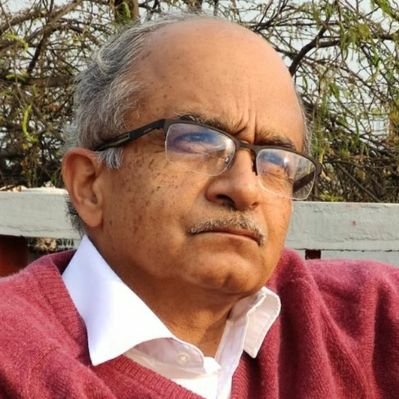
The ICJ today expressed its concern regarding the 31 August 2020 and 14 August 2020 decisions of the Indian Supreme Court to convict prominent human rights lawyer Prashant Bhushan for criminal contempt of court, on the basis of two twitter posts in which the lawyer criticized the performance of the Indian judiciary.
While the Court only imposed a symbolic fine of one rupee, rather than imprisonment, the ICJ considers that the conviction appears to be inconsistent with international standards on freedom of expression and the role of lawyers.
The ICJ stressed that the ruling risks having a chilling effect on the exercise of protected freedom of expression in India and urged a review of the laws and standards on criminal contempt as applied by the Indian courts.
The two tweets published by Prashant Bhushan referred to the Chief Justice of India riding an expensive motorbike belonging to a BJP leader “when he keeps the SC in Lockdown mode denying citizens their fundamental right to access justice” and asserted that the Supreme Court and the last four Chief Justices of India had contributed to how, in his view, “democracy has been destroyed in India even without a formal Emergency”
The Court in its 31 August judgment held that the tweets were a serious attempt to “denigrate the reputation of the institution of administration of justice” which, it said, is “capable of shaking the very edifice of the judicial administration and also shaking the faith of common man in the administration of justice.”
The Court considered that its ruling was consistent with freedom of speech and expression under Article 19 of the Indian Constitution, saying that it will have to balance its exercise of power to punish for contempt for itself (Article 129) with freedom of speech and expression.
The ICJ is concerned, however, that the conviction appears inconsistent with international law on freedom of expression as guaranteed by the International Covenant on Civil and Political Rights (Article 19, ICCPR) to which India is a party.
While some restrictions of freedom of expression are permitted by international standards, a particularly wide scope must be preserved for debate and discussion about such matters as the role of the judiciary, access to justice, and democracy, by members of the public, including through public commentary on the courts.
Any restrictions must be strictly necessary and proportionate to meet a legitimate purpose, such as protecting public order or the rights and reputations of others.
“There is a general concern that the protection of freedom of expression is rapidly eroding in India,” said Ian Seiderman, ICJ Legal and Policy Director.
“We have seen this recently around the COVID 19 crisis in relation to the imprisonment of human rights defenders, on draconian charges of sedition, rioting and unlawful assembly for protesting against the Citizenship (Amendment) Act.”
“While the Indian Supreme Court has over the years generally been an institution that has served to advance human rights in India and globally, we fear it now may be perceived as silencing criticism and freedom of expression by invoking outdated criminal contempt laws,” Seiderman added.
The ICJ joins the 1800 Indian lawyers in calling for the Supreme Court “to review the standards of criminal contempt”, emphasizing that the law is overbroad and should be aligned with international law and standards on the limited scope for restrictions on freedom of expression and criminal contempt.
“Prashant Bhushan is a lawyer and lawyers being part of the legal system have a ring-side view and understanding of the state of the court. Convicting a leading lawyer for contempt for expressing his views in this manner may have a chilling effect on lawyers, in particular considering his involvement in many public interest litigation cases,” said Mandira Sharma, ICJ South Asia Senior Legal Adviser.
Contact
Ian Seiderman – ICJ Legal and Policy Director; e: ian.seiderman(a)icj.org , t: +41 22 979 38 00
Matt Pollard – ICJ Senior Legal Adviser, Director, ICJ Centre for the Independence of Judges and Lawyers; e: matt.pollard(a)icj.org, t: +41 79 246 54 75
Download
India-Criminal-Contempt-of-Court-Press-Release-2020-ENG (PDF, with additional background information)
Aug 30, 2020 | Advocacy, News
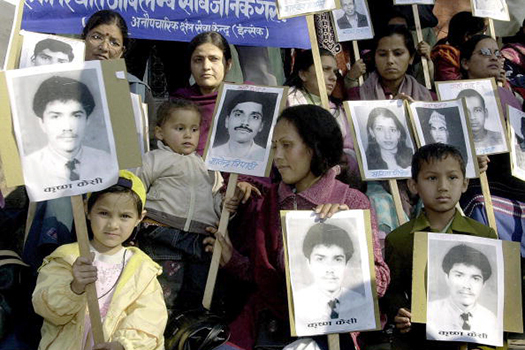
While commemorating the International Day of the Disappeared 2020, the ICJ and 47 other national and international organizations and groups of victims, in Nepal, call on the responsible authorities to undertake immediate steps towards reinvigoration of the transitional justice (TJ) process, adopting a transparent and consultative process.
On this occasion, the victims’ groups and human rights organizations in Nepal commend the patience and resilience shown by the family members of those subjected to enforced disappearance during the 10-year-long internal armed conflict from 1996-2006. They have worked tirelessly advanced the TJ process (Truth, Justice, Reparation and Institutional Reform) in Nepal for more than a decade through their peaceful struggle, despite many difficult hurdles.
In 2015 the Supreme Court found several sections of the Truth and Reconciliation Commission (TRC) Act, including the one empowering the commissions to offer amnesty and facilitate mediation/reconciliation between victims and perpetrators, including those involved in gross human rights violations, to be unconstitutional and non compliant with Nepal’s international obligations. More recently, on 26 April 2020 the Court rejected the petitions of the Government to review and revise the 2015 decision.
To date, the Government has not initiated any effort to amend the law as per these decisions. Rather, it has been misusing these Commissions in a manner that has prevented victims from accessing remedies through the regular criminal justice system and has made no efforts to strengthen these Commissions to delivery their mandates effectively. Two years back, Nepal recognized enforced disappearance as a distinct crime for the first time when enacting a new Penal Code. While this step is commendable, these legal provisions have not ensured justice for victims, the police typically refuse to investigate cases from the conflict period,arguing that they come under the jurisdiction of the TJ mechanisms.
Despite civil society’s repeated calls to appoint the Commissioners after amending the TRC Act following wider consultations with victims and civil society, the Government recently appointed Commissioners under the same Act that the SC had deemed flawed five years ago. Moreover, the Government has not addressed the repeated calls and concerns regarding the political interference and lack of transparency in the appointment of the Commissioners and the overall TJ process.
Human rights organizations and many victims groups have lost confidence in and stopped supporting to these Commissions.
The undersigned organizations call upon the Government of Nepal:
- To ensure the Commissions provide for, rather than delay and deny, truth and justice to
victims;
- Start fresh consultations to amend its law in compliance international human rights law
and Supreme Court directives, including by removing of amnesty for the perpetrators
provisions;
- Appoint a new set of commissioners under the revised Act that respects victims basic right
to truth and justice;
- Immediately ensure the social, cultural, economic, psychological and legal support
suffered by the victims and families of enforced disappearance as part of victims’ rights
to reparation;
- Revise the Penal Code to bring it in line with international standards. As a minimum, this
should include:
- amending the definition of enforced disappearances to bring it in line with Nepal’s international obligations and the Convention on the Protection of All Persons from Enforced Disappearance
- revising the penalty for enforced disappearance in the Penal Code to make it proportionate to the gravity of the crime
- removal of the statute of limitations for enforced disappearance cases
- Ratify International Convention for the Protection of All Persons from Enforced Disappearances Punishment.
Download
Full joint-statement with detailed information in English and Nepali. (PDF)
Contact
Ian Seiderman: ICJ Legal and Policy Director, e: ian.seiderman(a)icj.org
Mandira Sharma: ICJ Senior Legal Adviser, e: mandira.sharma(a)icj.org
Aug 22, 2020 | News
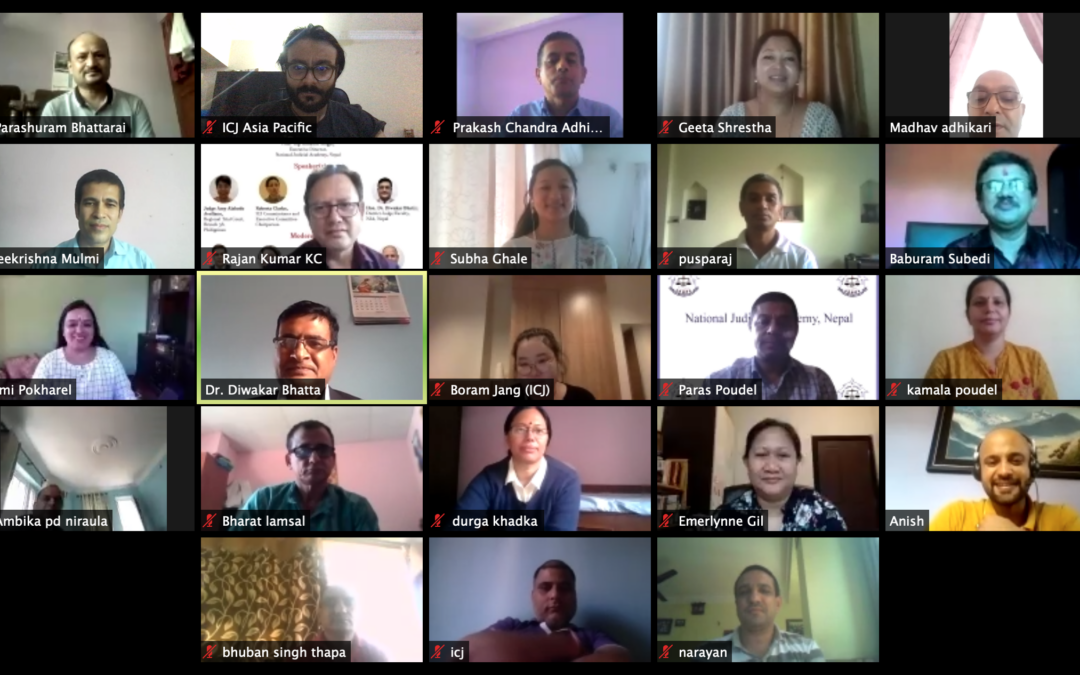
On 15 and 22 August 2020, the ICJ, in collaboration with the National Judicial Academy (NJA) of Nepal, organized the National Judicial Dialogue on the Elimination of Discrimination against Women and Enhancing Women’s Access to Justice.
Due to the exigencies caused by the COVID-19 pandemic, the judicial dialogue was conducted through virtual means.
Fifteen trial court judges from Kathmandu Valley participated in this judicial dialogue with judicial experts from other countries.
Judge Amy Alabado Avellano, a Regional Trial Court judge from the Philippines, engaged with the judges on the application of the Convention on the Elimination of All Forms of Discrimination Against Women (CEDAW) in their judicial decisions. Roberta Clarke, ICJ’s Executive Committee Chairperson and UN Women’s OIC for UN Women’s East and Southern Africa Regional Office, spoke on the right to access to justice under international human rights law.
The second day featured a discussion on specific barriers that women in Nepal face when they access justice. The judges discussed their own role and measures available to the judiciary as an institution to enhance access to justice for women in Nepal. Hon. Justice Sapana Pradhan Malla from the Supreme Court of Nepal and Dr. Diwakar Bhatta from the National Judicial Academy of Nepal led these discussions.
At the Dialogue Emerlynne Gil, ICJ Senior International Legal Adviser, remarked that “judges have a responsibility to uphold the fairness and integrity of the justice system by ensuring that proceedings are conducted in a fashion that does not subordinate the fact-finding process to myth and stereotype.” Honorable Top Bahadur Magar, the Executive Director of the National Judicial Academy, stressed that, “Trial court judges play a pivotal role in debunking myths and gender stereotypes.”
Highlighting the importance of continuing the work towards eliminating gender discriminatory practices among frontline justice actors, even during the COVID-19 pandemic, Emerlynne Gil said. “The COVID-19 pandemic is aggravating existing gender inequalities and women are experiencing more violations of their human rights.”
Contact
Laxmi Pokharel, National Legal Advisor, International Commission of Jurists, t: 977 9851047588, e: laxmi.pokharel(a)icj.org