Jul 18, 2019 | News
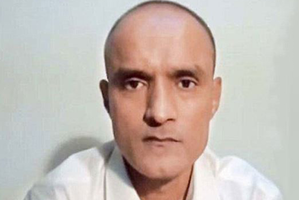
The International Commission of Jurists (ICJ) today welcomed the decision of the International Court of Justice (ICJ-CIJ for its acronym) upholding the right of consular access and notification for Indian national Kulbhushan Jadhav.
The Court determined that Pakistan had unlawfully denied Jadhav consular access before and after his summary trial by a military court.
It emphasized that any “potential prejudice and the implications for the evidence and the right of defence of the accused should receive close scrutiny during the review and reconsideration.”
The Court categorically held that Article 36 of the Vienna Convention on Consular Relations (VCCR) “does not exclude from its scope certain categories of persons, such as those suspected of espionage,” as argued by Pakistan.
“The decision by the International Court today is a resounding affirmation that there can be no curtailment of the right to consular access by foreign nationals by States that are Party to the VCCR,” said Ian Seiderman, Legal and Policy Director of the ICJ.
“Consular access is essential to ensure a fair trial for foreign nationals and this human right must not in any way be made contingent upon the offence foreign nationals are charged with.”
The International Court called on Pakistan to give effect to the Court’s ruling by providing effective review and reconsideration of both his conviction and sentence, including by taking account of the principles of the right to a fair trial.
The ICJ has pointed out that Pakistan’s military justice system and procedures are incompatible with the right to a fair trial. Under international standards, military tribunals are never permissible in prosecutions against civilians for offences carrying the death penalty.
Since 3 March 2016, Kulbhushan Jadhav has been in custody of the Pakistani authorities. The circumstances of his arrest remain in dispute between the Parties.
India was informed of the arrest on 25 March 2016. On 10 April 2017, Pakistan’s military announced Kulbhushan Jadhav had been convicted and sentenced to death by a military court for “espionage and sabotage activities against Pakistan.”
India had brought the case against Pakistan before the International Court of Justice, alleging “egregious violations” of the VCCR by Pakistan because of the denial of consular access to Jadhav.
In response, Pakistan had primarily argued that Jadhav is a an Indian spy involved in acts of terrorism in Pakistan, and the VCCR is not applicable to spies or “terrorists” due to the inherent nature of the offences of espionage and terrorism.
“States around the world continue to use counter terrorism and national security as a justification to curtail human rights – the International Court of Justice’s affirmation that the protections under the VCCR are not conditional is hugely significant in this context,” said Ian Seiderman.
The International Court also held that it considered a continued stay of Jadhav’s execution as constituting “an indispensable condition for the effective review and reconsideration of the conviction and sentence.”
In May 2017, the Court had asked Pakistan to take all measures at its disposal to ensure that Jadhav is not executed pending the final decision in the proceedings.
The ICJ considers the death penalty a violation of the right to life and cruel, inhuman or degrading punishment and notes that a large majority of States, in repeated UN resolutions, have called on retentionist states to declare a moratorium on the practice with a view to abolition.
Background
In addition to the arguments regarding espionage and terrorism, Pakistan also relied on a bilateral agreement on consular access, signed by India and Pakistan in 2008, arguing that the agreement overrides the obligations under the VCCR. The International Court of Justice, however, rejected this argument, on the ground that, among other things, obligations under the VCCR may be enhanced or clarified by bilateral treaties, but cannot be diluted or undermined.
India had requested a number of other measures of relief from the Court, including the annulment of Kulbhushan Jadhav’s death sentence; a declaration that Kulbhushan Jadhav’s military trial was in violation of the VCCR and international human rights law, including the International Covenant on Civil and Political Rights (ICCPR); a directive restraining Pakistan from giving effect to the death sentence; and a directive to release Kulbhushan Jadhav and ensure his safe passage to India.
However, in accordance with its jurisdictional competencies and prior precedents, the Court denied these remedies to India. As “appropriate reparation” in this case, the Court directed Pakistan to effectively review and reconsider Jadhav’s conviction and sentence “to ensure that full weight is given to the effect of the violation of the rights set forth in Article 36 of the Vienna Convention.”
Contact
Ian Seiderman: ICJ Legal and Policy Director, e: ian.seiderman(a)icj.org
Frederick Rawski: ICJ’s Asia Pacific Region, e: frederick.rawski(a)icj.org
Jul 11, 2019 | News
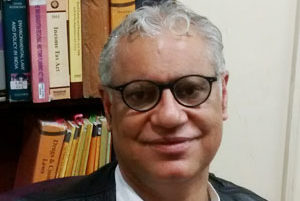
The ICJ today condemned the raids on 11 July by India’s Central Bureau of Investigation (CBI) on the homes and offices of Anand Grover and Indira Jaising, two lawyers prominent for frequently challenging the Indian government’s failures to respect and promote the rights of all people in India.
Grover and Jaising are both Supreme Court lawyers and co-founders of the Lawyers Collective, a non-governmental organization.
These raids were reportedly conducted pursuant to CBI’s registration of criminal charges into alleged violations of Foreign Contribution (Regulation) Act (FCRA), a much criticized law frequently used to target human rights defenders and critics of the Indian government.
“This raid seems designed to harass and intimidate two tireless advocates of Constitutional and international rights in India,” said Sam Zarifi, Secretary-General of the ICJ.
“The Indian government must immediately cease harassment of the Lawyers Collective and its founders Anand Grover and Indira Jaising,” he added.
The CBI raids appears to be based on a 2016 Ministry of Home Affairs report, now under appeal in the Bombay High Court, and without any material change in circumstances since its release.
The raid has also been conducted notwithstanding a National Human Rights Commission statement seeking a status report from the CBI by 21 July 2019 to ensure that the investigation is “non-discriminatory and to avoid arbitrariness”.
The attack is emblematic of a broader pattern of official threats to and harassment of Indian civil society in general, and the Lawyers Collective in particular.
Lawyers Collective’s FCRA license was cancelled in November 2016, a decision that is under appeal in the Bombay High Court. The action relied upon overly broad and vague legal provisions of the FCRA that violate India’s legal obligation to respect and protect the rights to freedom of expression, association and peaceful assembly.
“The repeated use of the FCRA to target civil society including Lawyers Collective has had a devastating chilling effect on public comment about the government,” said Zarifi.
“The law should be repealed, or substantially amended to include safeguards against arbitrary use of its provisions, and to protect freedom of expression and association,” he added.
The ICJ supports the 2016 call by three United Nations Special Rapporteurs to the Indian Government to repeal FCRA, which decried the FCRA’s use to “silence organisations involved in advocating civil, political, economic, social, environmental or cultural priorities, which may differ from those backed by the Government”.

Jul 8, 2019 | News
The ICJ welcomes the report issued today by the United Nations Office of the High Commissioner for Human Rights (OHCHR) documenting human rights violations and abuses in Indian administered Kashmir and Pakistan administered Kashmir.
The ICJ called upon both India and Pakistan to take immediate measures to implement the Report’s main recommendations, and to hold security forces as well as non-state actors accountable for human rights violations and abuses.
The Report follows a June 2018 report that documented similar violations, as well as the widespread impunity for human rights violations by Indian security forces and armed groups allegedly supported by Pakistan. The Indian Government has rejected both reports as a violation of its “sovereignty and territorial integrity”. The Pakistan government has welcomed the report and called for the establishment of a United Nations Commission of Inquiry.
“It is unfortunate that India has again refused to acknowledge the facts set out in the OHCHR report, or to pledge action on its recommendations,” said Frederick Rawski, Asia Pacific Director for the ICJ.
“This is an opportunity for India, a member of the Human Rights Council, to lead by example. It can start by repealing the Armed Forces Special Powers Act and launching an investigation into rights abuses in line with international standards and the guidelines set out by the Indian Supreme Court,” he added.
The Report documents human rights violations by Indian security forces including extrajudicial killings, arbitrary detentions, unlawful custodial deaths, enforced disappearances, and ill-treatment and torture, including rape and sexual violence, in Indian-administered Kashmir.
According to the Report, based on data from civil society organization Jammu and Kashmir Coalition of Civil Society (JKCCS), 71 extrajudicial killings were allegedly committed by security forces in 2018 (for a total of 1081 between 2008 and 2018). Between 2016 and 2018, 1253 people have been blinded by pellet guns.
The Report highlights how the extraordinary powers granted to security forces by the Armed Forces (Jammu and Kashmir) Special Powers Act, 1990 has been wielded arbitrarily and led to near total impunity from prosecution. In addition, it documents human rights abuses committed by non-state armed groups in Indian-administered Kashmir including kidnappings, killings and rape.
The Report also documents rights violations in Pakistan-administered Kashmir, including restrictions on freedom of expression and opinion, assembly and association, and the abuse of vague and overbroad anti-terrorism laws in contravention of international human rights law.
The Report documents cases of arbitrary arrest by local authorities and intelligence agencies, including charging 19 activists with treason for organizing a rally in November 2018, and the arbitrary detention of 30 members of the Jammu Kashmir National Students Federation in March 2019 by Pakistani law enforcement. The Report notes the particular vulnerability of journalists to threats, harassment and arbitrary arrest.
“While we commend Pakistan for welcoming the Report, the fact remains that the Government has done little to prevent the continuation of human rights violations by its security forces, or to implement the recommendations of the previous report,” Rawski said.
“Pakistan must take action to hold perpetrators of rights violations accountable, and take action to end threats and violence targeted at human rights defenders and journalists,” he added.
The ICJ called on both Pakistan and India to grant unconditional access to the OHCHR and Special Procedures of the UN Human Rights Council, and to ensure that human rights defenders and journalists can carry out their work without threats or reprisals from security forces and non-State armed groups.
The ICJ also underscores the importance of the OHCHR recommendation that the United Nations set up an independent commission of inquiry into allegations of rights violations by all parties to the conflict.
The ICJ urged both the Indian and Pakistan governments to respect, protect and fulfill their international human rights obligations in Kashmir, to accept the Report’s findings and take immediate and effective action to implement its recommendations.
Jun 28, 2019 | News
The ICJ categorically condemns Sri Lankan President Maithripala Sirisena’s endorsement of death warrants of four people convicted of drug-related offences.
Today, the ICJ urged the President to stop the imminent execution of these four convicts and to respect the de facto moratorium Sri Lanka has observed on capital punishment that over the past 43 years.
The ICJ has called on Sri Lanka to move toward full abolition of the abhorrent practice.
“President Sirisena’s resolve to resume executions would be a violation of Sri Lanka’s obligations under international human rights law and a disastrous for human rights in the country. It is also inconsistent with the global trend towards the abolition of the death penalty,” said Frederick Rawski, ICJ’s Asia-Pacific Director.
Speaking to the media on Wednesday June 26, President Sirisena announced that four execution warrants of those convicted of drug offences had been signed and that the dates for the execution had also been determined.
Those dates were left unspecified. With 1299 people on death row, the lives of at least 46 more prisoners, whose execution warrants have been prepared, are now under imminent threat.
Sri Lanka is a party to the International Covenant on Civil and Political Rights, under which it is not permitted to impose the death penalty for drug offences, the resumption of the death penalty after an extended is also incompatible with the ICCPR.
The ICJ opposes the death penalty in all circumstances without exception. The death penalty constitutes a violation of the right to life and the right not to be subjected to cruel, inhuman or degrading punishment.
The UN General Assembly has adopted repeated resolutions, most recently in December 2018, by overwhelming majority in calling for all retentionist States to observe an immediate moratorium with a view to abolition.
Sri Lanka voted in favour of a moratorium on the use of the death penalty in the 2018 UN GA Resolution.
The ICJ urgently calls on the Government of Sri Lanka to immediately halt all plans for execution and to do away with the capital punishment once and for all in keeping with its own commitment before the UN General Assembly for a global moratorium on the use of death penalty.
Instead of resuming executions, the Sri Lankan authorities should focus on effective, evidence-based approaches to crime prevention in manners that conform to international human rights law and standards.
Background
The UN Human Rights Committee, the supervisory body for the ICCPR, has made it clear that the imposition of the death penalty for crimes that are not of extreme gravity involving intentional killing, such as “drug offences” is incompatible with the Covenant as such offences do not meet the threshold of “most serious crimes”.
It has affirmed that that States parties that are not yet totally abolitionist should be on an irrevocable path towards complete eradication of the death penalty, de facto and de jure, in the foreseeable future.
The death penalty cannot be reconciled with full respect for the right to life, and abolition of the death penalty is both desirable and necessary for the enhancement of human dignity and progressive development of human rights.
It is contrary to the object and purpose of article 6 for States parties to take steps to increase de facto the rate and extent in which they resort to the death penalty, or to reduce the number of pardons and commutations they grant.
Contact
Frederick Rawski, ICJ Asia Pacific Region Director, e: frederick.rawski(a)icj.org, t: +66 644781121
Jun 23, 2019 | Events, News
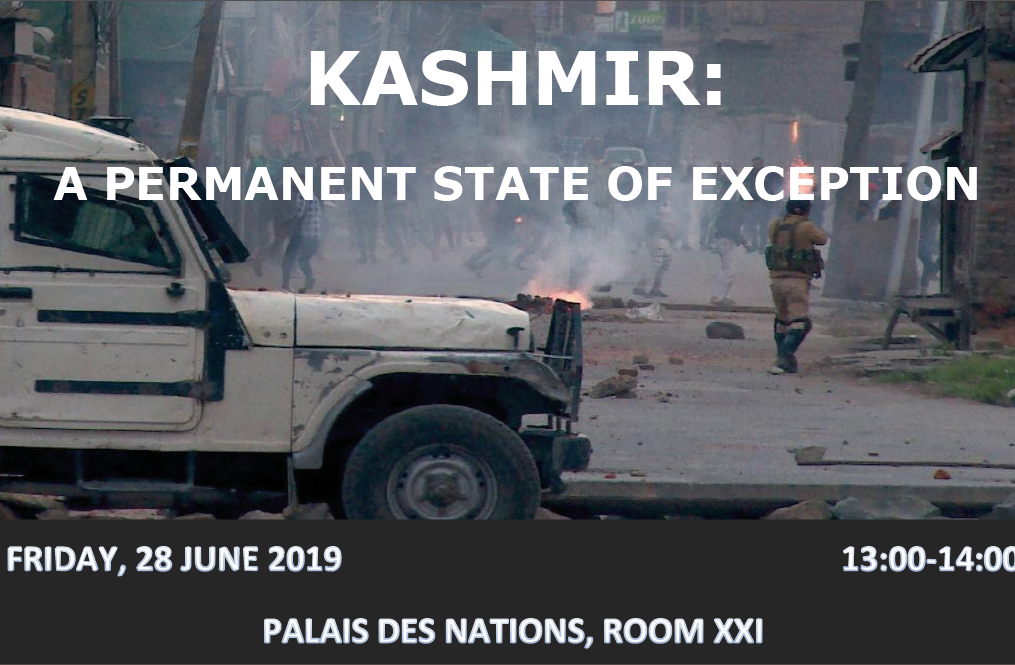
This side event will take place on Friday 28 June 2019, from 13:00-14:00, in Room XXI, at the Palais des Nations.
There has been an increase in serious human rights violations in Kashmir, particularly since 2016. This has coincided with shrinking space for human rights reporting and advocacy at the national level, with human rights defenders facing unprecedented threats and reprisals.
The escalating violence, coupled with systemic impunity for perpetrators, has made it imperative for the human rights situation in Kashmir to be highlighted at the international level, including at the UN.
This event aims to bring to the forefront the human rights aspect of the conflict and discuss possible strategies through which the international community can play a more effective role in ensuring the promotion and protection of human rights in the region.
Keynote Address
Hon. Judge Navanethem Pillay: Former UN High Commissioner for Human Rights (2008-2014)
Moderator
Sam Zarifi: ICJ Secretary General
Speakers
Juliette Rousselot: Program Officer for South Asia, International Federation for Human Rights (FIDH)
Gerard Staberock: Secretary General, World Organization Against Torture (OMCT)
Dr. Angana Chatterji: Co-chair, Initiative on Political Conflict, Gender and People’s Rights, Center for Race and Gender, University of California, Berkeley
Kashmir-HRC-Event-2019-ENG (Flyer in PDF)

Jun 8, 2019 | Multimedia items, News, Publications, Reports, Thematic reports, Video clips
The Indian Government must give effect to recent rulings of the Supreme Court and end discrimination and other human rights violations and abuses based on real or perceived sexual orientation, gender identity and expression, the ICJ said today at the Delhi launch of its new report on the conditions of LGBTQ people in India.
The ICJ’s 152-page report Living with Dignity: Sexual Orientation and Gender Identity-Based Human Rights Violations in Housing, Work, and Public Spaces in India details human rights violations suffered by LGBTQ persons in their family homes, workplaces, and public spaces including streets, public toilets, public transport and shopping centres.
Following on the Supreme Court’s decisions in NALSA and Navtej, which strongly affirmed the human rights of LGBTQ persons, the report identifies legal and policy challenges, as well as structural barriers that prevent them from enjoying the full range of human rights.
”Despite the promise of recent jurisprudence, the Indian government has not consistently met its constitutional and international obligations to guarantee the rights of LGBTQ persons,” said Frederick Rawski, ICJ Asia Director.
“The ICJ encourages the Indian State to build on existing efforts to protect these rights to ensure full compliance with the right to live with dignity in terms of the Indian Constitution and international human rights law,” he added.
The Living with Dignity report identifies a wide range of violations and abuses of rights in the context of housing, work and public spaces.
Human rights violations associated with housing included discrimination in accessing rental accommodation, harassment and violence by landlords and by families, and arbitrary evictions.
The report sets out instances of discrimination in the workplace, at all stages of employment, and throughout the formal and informal sectors.
It also documents obstacles faced by LGBTQ persons seeking access to public spaces, including discriminatory policing, gendered toilets and transport, harassment and abuse by State officials, and discriminatory targeting through the application of public nuisance, sex work and anti-beggary laws.
The report offers a set of recommendations meant to make existing law and policy more protective of LGBTQ persons’ rights and calls for the amendment or repeal of certain existing laws.
“There is no single law or policy solution to ending long-standing and systemic discrimination. But legal and policy reforms are essential to addressing the abuses suffered by LGBTQ persons and these must include the effective, inclusive and meaningful participation of a diverse range of LGBTQ individuals and advocacy groups,” Rawski said.
The report also recommends the convening of a nationwide consultation geared towards the enactment of a comprehensive anti-discrimination law prohibiting discrimination on the grounds of sexual orientation and gender identity as is required by international human rights law.
In a preface to the report, ICJ Commissioner and former Chief Justice of the Delhi High Court, Justice Ajit Prakash Shah, indicates his hope that the report will “be used as a tool by lawyers, human rights defenders and policymakers” and “contribute to enhancing public discourse on LGBTQ rights, as well as broader issues of discrimination and the rule of law in India”.
Download
Report: Living with Dignity: Sexual Orientation and Gender Identity-Based Human Rights Violations in Housing, Work, and Public Spaces in India (English)
Executive Summary (English)
Infographics
SOGIE-based Human Rights violations in Housing
SOGIE-based Human Rights violations at Work
Barriers experiences by LGBTQ people in accessing Public Spaces
Contact
Maitreyi Gupta (Delhi), ICJ International Legal Adviser for India, e: maitreyi.gupta(a)icj.org, t: +91 7756028369
Frederick Rawski, ICJ Asia Pacific Region Director, e: frederick.rawski(a)icj.org, t: +66 644781121
Read also
Briefing Paper on Navtej Singh Johar et al. v. Union of India and Others, July 2018.
Unnatural Offences”: Obstacles to Justice in India Based on Sexual Orientation and Gender Identity, February 2017.
ICJ Briefing Paper on Implementation of NALSA Judgment, 2016.
Watch the video