May 20, 2019 | Advocacy, News
The ICJ has made a submission to Ms. Karima Bennoune, the United Nations Special Rapporteur in the field of cultural rights (“Special Rapporteur”) in response to a call for submission, in advance of her forthcoming report to the General Assembly on how actors from across the cultural ecosystem access and use public spaces and the impact this has on their cultural rights.
ICJ’s submission draws on its ongoing work on the human rights of LGBTQ persons in India and includes findings from the ICJ’s forthcoming report on the rights of LGBTQ persons in the home, at work and in public spaces. The ICJ, concludes that LGBTQ persons’ rights to adequate housing, decent work, and equal access to public spaces are frequently violated throughout India.
The interviews conducted by the ICJ reveals that LGBTQ persons have challenges in accessing a variety of public spaces including streets, public transport, sanitation facilities, cultural and religious events, parks and shopping malls, challenges which are not faced by, or not faced in the same way by, non-LGBTQ persons. The ICJ submits that these findings are in contravention of Indian constitutional law and international human rights law.
Read the full submission here.
May 15, 2019 | News
The ICJ today condemned a series of the acts of violence directed against the Muslim community in the aftermath of the Easter attacks on 21 April in Sri Lanka directed at churches and other places.
In the most recent attacks on 13 May, at least one person was killed in anti-Muslim mob violence in Nattandiya. In addition, various attacks have resulted in the looting and destruction of mosques, Muslim-owned businesses and houses in several parts of the island including Negombo, Chilaw, Kurunegala and Gampaha.
The ICJ called upon the State authorities to conduct independent, impartial and effective investigations into the attacks and bring all perpetrators to justice in line with international standards. Furthermore, the ICJ urges the Government of Sri Lanka to send a clear public message that acts of violence against any religious minorities are not tolerated.
“Attacks perpetrated against religious minorities are more likely to occur in a climate of impunity” said Fredrick Rawski, ICJ’s Regional Director for Asia and the Pacific. “The fact that Sri Lanka has a history of serious violations of human rights of religious minorities makes it even more urgent that the Government act to safeguard the human rights of all persons and take immediate measures to protect members of religious minorities from further violence.”
Delayed action or inaction on the part of law enforcement authorities during and in the immediate aftermath of the attacks has further exacerbated the situation. Given the recurring patterns of mob violence against religious minorities in Sri Lanka, a handful of arrests will not suffice. It must be followed up by independent and impartial investigations and, where warranted, prosecutions as part of an effective preventive strategy to counter such collectively organized violence.
Under international human rights law, including the International Covenant on Civil and Political Rights, to which Sri Lanka is a party, States have a duty to protect freedom of religion, which includes persons from religious minorities against abuses committed against them by any person or group.
The Government of Sri Lanka must take appropriate security measures in response to the worst terror attack in recent years. However, it must ensure that the volatile situation is not made worse by inaction to prevent anti-Muslim violence and vigilantism. Moreover, the State must ensure that any counter-terrorism measure is adopted and implemented in line with its international human rights law obligations and does not explicitly or implicitly target a particular community.
Apr 1, 2019 | News
As military courts in Pakistan once again cease to have jurisdiction over civilians for terrorism-related offences, the Government must bring reforms to strengthen the country’s criminal justice system, the ICJ said today.
Perpetrators of terrorist attacks and other serious crime must be brought to justice fair trials before competent, independent and impartial courts as required under international law, the ICJ added.
“The lapse of the jurisdiction of military courts over civilians is a step in the right direction, but unsurprisingly – even four years after military courts were empowered to try civilians – there is no sign of the promised reforms to strengthen the ordinary criminal justice system to effectively and fairly handle terrorism-related cases,” said Frederick Rawski, ICJ’s Asia Director.
The 23rd Amendment and corresponding amendments to the Army Act, 1952, lapsed on 30 March 2019, as their respective two-year sunset clauses expired. So far, the Government has failed to get support from opposition parties for a constitutional amendment to once again extend the jurisdiction of military courts to conduct trials of civilians.
“The Government must not re-enact legislation to continue secret military trials of civilians, nor resort to more short-term, short-sighted security measures that are contrary to Pakistan’s obligations to protect human rights,” Rawski said.
“Instead, the Government should urgently invest in enhancing the capacity and security of judges, investigators and prosecutors to make the regular criminal justice system more effective in conducting fair, credible terrorism trials, and bringing perpetrators to account without imposing the death penalty.”
According to military sources and ICJ’s monitoring of military trials in Pakistan since January 2015, military courts have convicted 617 people for terrorism-related offences, out of which 346 people have been sentenced to death and 271 people have been given prison sentences. At least 56 people have been hanged. Only four people have been acquitted.
The ICJ has documented serious fair trials violations in the operation of military courts, including: denial of the right to counsel of choice; failure to disclose the charges against the accused; denial of a public hearing; failure to give convicts copies of a judgment with evidence and reasons for the verdict; and a very high number of convictions based on “confessions” without adequate safeguards against torture and ill treatment.
Contact
Frederick Rawski, ICJ Asia Pacific Regional Director (Bangkok), e: frederick.rawski(a)icj.org
Reema Omer, ICJ International Legal Adviser for Pakistan (London), t: +447889565691; e: reema.omer(a)icj.org
Additional information
Military courts were first empowered to try civilians for certain terrorism-related offences in January 2015 through the 21st Amendment to the Constitution and amendments to the Pakistan Army Act, 1952, which were in operation for a period of two years.
The expansion of the jurisdiction of military tribunals was a key part of the Government’s 20-point National Action Plan, adopted following the attack on the Army Public School in Peshawar in December 2014. NAP envisioned military courts to be a short-term “solution” to try “terrorists”, to be operational only for a two-year period during which the government would bring about necessary “reforms in criminal courts system to strengthen the anti-terrorism institutions”.
Despite promises that military courts were only temporary, after the expiration of the 21st Amendment, on 31 March 2017, Parliament enacted the 23rd Amendment and amendments to the Army Act to renew military courts’ jurisdiction over civilians. The amendments were given retrospective effect from 7 January 2017, and were due to lapse two years after their date of “commencement”. The expanded jurisdiction of military courts lapsed on 30 March 2019 (even though earlier reports suggested the amendments would expire on 6 January 2019) — two years after the date of “operation” of the 23rd Amendment).
The ICJ opposes the death penalty in all circumstances as a form cruel, inhuman and degrading punishment and an arbitrary denial of the right to life. The ICJ recalls that the UN General Assembly has by overwhelming majorities repeatedly called on all states the retain the death penalty to place a moratorium on the practice with a view to abolition. Pakistan previously had such a moratorium from 2008 to 2014.
Mar 12, 2019 | Events, News
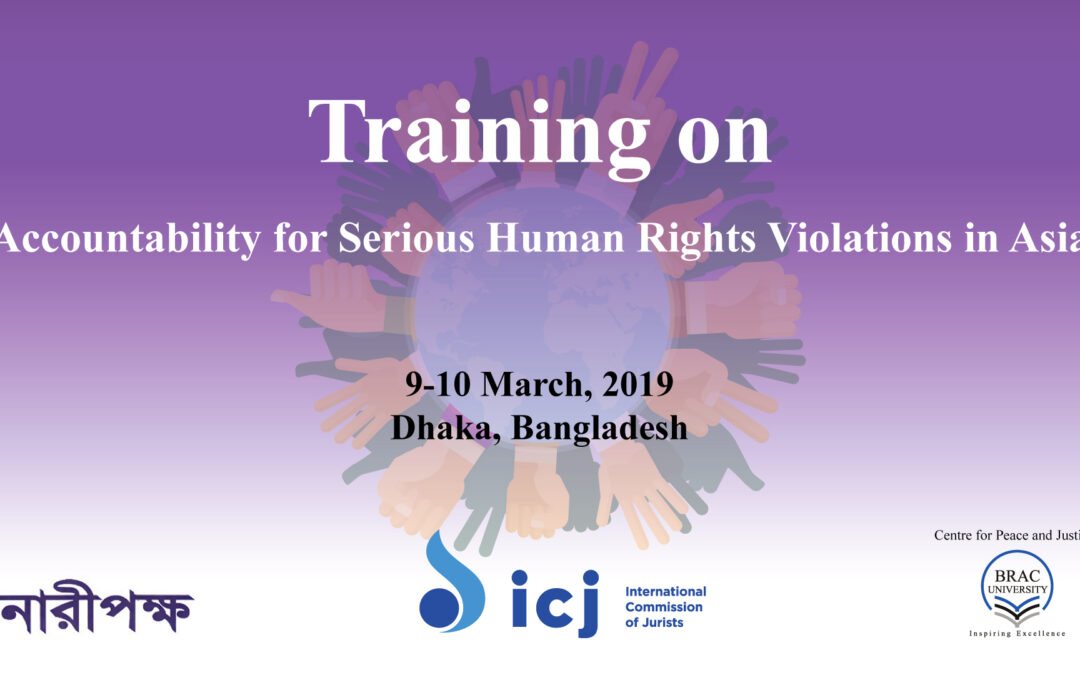
The ICJ convened a two-day workshop from 9th to 10th March 2019 in Dhaka, Bangladesh to discuss applicable international legal mechanisms designed to achieve accountability for serious human rights violations in Asia.
Bangladesh-based non-government organizations the Centre for Peace and Justice and Naripokkho co-hosted the event with the ICJ, with a representative of AJAR (Asia Justice and Rights) also joining. Twenty Bangladeshi lawyers, activists and academics attended the event.
Legal advisers from the ICJ provided an overview of the Independent Investigative Mechanism for Myanmar (IIMM), currently being established following a UN Human Rights Council resolution in September 2018.
They also discussed the structure and procedures of the International Criminal Court (ICC), whose prosecutors are currently conducting a preliminary examination into the deportation of Rohingyas from Myanmar into Bangladesh. Unlike Myanmar, Bangladesh is a State Party to the Rome Statute of the ICC, and its pre-trial chamber has indicated the Court has jurisdiction over crimes listed in the Rome Stature were one element, or part of a crime, was committed inside the territory of Bangladesh.
AJAR’s co-founder provided an overview of transitional justice processes, drawing upon international and regional experiences of truth-seeking, prosecutions, reparations and reforms to guarantee non-repetition of human rights violations.
Two of the ICJ’s legal advisers also travelled to Cox’s Bazar, Bangladesh, where they met relevant stakeholders to discuss the situation of Rohingya refugees from Myanmar, and to share information about accountability mechanisms, including about expected timelines, outcomes and limitations.
The activity is part of the ICJ’s global work on promoting accountability and redress for gross human rights violations to facilitate justice and deter repetition.
Contact: Kingsley Abbott, ICJ Senior Legal Advisor for Global Redress and Accountability e: kingsley.abbott@icj.org
Feb 28, 2019 | Events, News
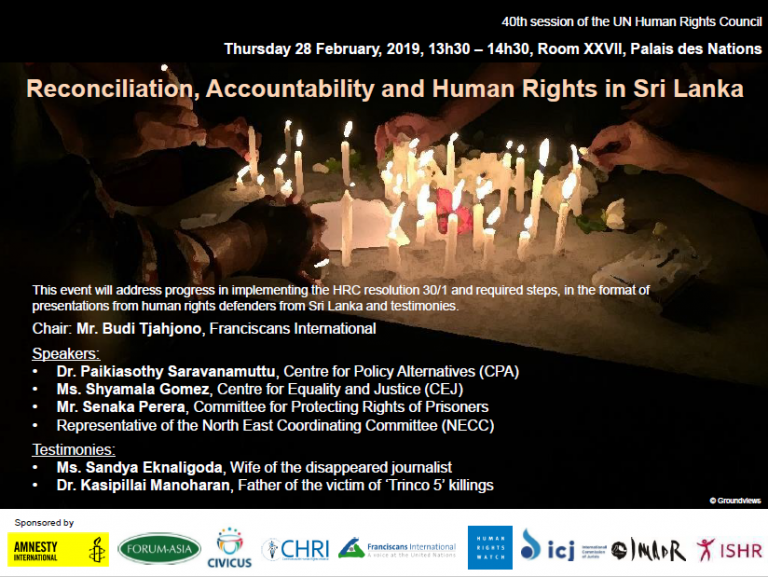
This event will address progress in implementing Human Rights Council resolution 30/1 and required steps, in the format of presentations from human rights defenders from Sri Lanka and testimonies.
Date: Thursday, 28 February 2019
Time: 13.30 – 14.30
Venue: Room XXVII, Palais des Nations
Chair: Mr. Budi Tjahjono, Franciscans International
Speakers:
- Dr. Paikiasothy Saravanamuttu, Centre for Policy Alternatives (CPA)
- Ms. Shyamala Gomez, Centre for Equality and Justice (CEJ)
- Mr. Senaka Perera, Committee for Protecting Rights of Prisoners
- Representative of the North East Coordinating Committee (NECC)
Testimonies:
- Ms. Sandya Eknaligoda, Wife of the disappeared journalist
- Dr. Kasipillai Manoharan, Father of the victim of ‘Trinco 5’ killings
Sponsors:
- Asian Forum for Human Rights and Development (FORUM-ASIA)
- Amnesty International
- CIVICUS
- Commonwealth Human Rights Initiative (CHRI)
- Franciscans International
- Human Rights Watch (HRW)
- International Commission of Jurists (ICJ)
- International Movement Against all forms of Discrimination and Racism (IMADR)
- International Service for Human Rights (ISHR)
Feb 28, 2019 | Advocacy, News
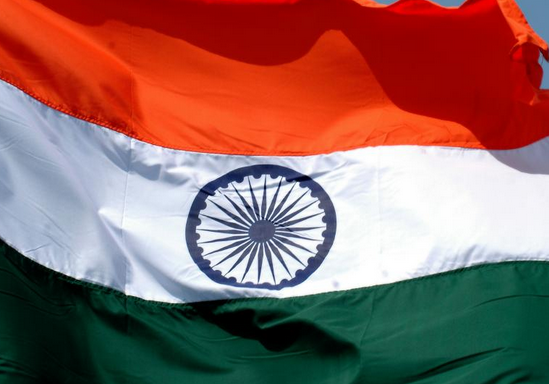
The ICJ made a submission to Mr. Léo Heller, the United Nations Special Rapporteur (Special Rapporteur) on the human rights to water and sanitation, in response to a call for submission in advance of the Special Rapporteur’s 2019 Human Rights Council Report on the human rights to water and sanitation in spheres of life beyond the households, in particular in public spaces.
The ICJ’s submission focuses on the status and the impact of inadequate access to water and sanitation on lesbian, gay, bisexual, transgender and queer individuals (LGBTQ), and more specifically on transgender persons and non-binary persons, in India.
ICJ’s submission draws on its ongoing work on the human rights of LGBTQ persons in India, where from 2017 to date, the ICJ has studied LGBTQ persons’ access to and enjoyment of economic, social, and cultural rights, focusing on access to adequate housing, decent work, and public spaces and services including water and sanitation. The goal is to reveal, address, and reduce discriminatory treatment against LBGTQ persons in accessing economic, social and cultural rights as a result of discriminatory laws and practice through advocacy with the Indian State and with the United Nations.
Read the full submission here.