Feb 15, 2019 | News
The International Court of Justice will hold public oral hearings in India v. Pakistan (Jadhav case) from 18 to 21 February 2019. Before they commence, the International Commission of Jurists (ICJ) has published a briefing paper to clarify the key issues and relevant laws raised in the case in a Question and Answer format.
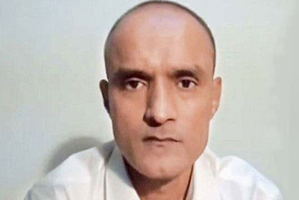
The case concerns Pakistan’s failure to allow for consular access to an Indian national, Kulbhushan Sudhir Jadhav, detained and convicted by a Pakistani military court on charges of “espionage and sabotage activities against Pakistan.”
India has alleged that denial of consular access breaches Pakistan’s obligations under Article 36(1) of the Vienna Convention on Consular Relations (VCCR), to which both States are parties.
Pakistan has argued, among other things, that the VCCR is not applicable to spies or “terrorists” due to the inherent nature of the offences of espionage and terrorism, and that a bilateral agreement on consular access, signed by India and Pakistan in 2008, overrides the obligations under the VCCR.
ICJ’s Q&A discusses the relevant facts and international standards related to the case, including: India’s allegations against Pakistan; Pakistan’s response to the allegations; the applicable laws; and the relief the International Court of Justice can order in such cases.
Contact:
Frederick Rawski (Bangkok), ICJ Asia Pacific Regional Director, e: frederick.rawski(a)icj.org
Reema Omer (London), ICJ International Legal Adviser, South Asia t: +447889565691; e: reema.omer(a)icj.org
Additional information
While the case at issue is limited to denial of consular access under the VCCR, it engages other critical fair trial concerns that arise in military trials in Pakistan.
The International Commission of Jurists has documented how Pakistani military courts are not independent and the proceedings before them fall far short of national and international fair trial standards. Judges of military courts are part of the executive branch of the State and continue to be subjected to military command; the right to appeal to civilian courts is not available; the right to a public hearing is not guaranteed; and a duly reasoned, written judgment, including the essential findings, evidence and legal reasoning, is denied.
The case also underscores one of inherent problems of the death penalty: that fair trial violations that lead to the execution of a person are inherently irreparable.
Download the Q&A:
Pakistan-Jadhav case Q&A-Advocacy-Analysis brief-2019-ENG
Feb 12, 2019 | News
The ICJ has called on Sri Lanka’s President, Maithripala Sirisena, to retract his recent pronouncement that executions would resume in the country notwithstanding a moratorium on capital punishment that has lasted 43 years. The last execution was carried out in Sri Lanka in 1976.
“Resuming executions would be an egregious violation of Sri Lanka’s obligations under international human rights law, a serious threat to human rights in the country, and it would be inconsistent with the global trend towards the abolition of the death penalty,” said Frederick Rawski, ICJ’s Asia-Pacific Director.
Speaking in Parliament last week, President Sirisena vowed to resume executions of those convicted of “drug offences” as early as within the next two months.
The ICJ considers any resumption of executions in Sri Lanka as constituting a violation of international law and an appalling disregard for the international human rights system as a whole.
“At least 150 countries have now either abolished the death penalty or instituted an official or unofficial moratorium. There is a growing understanding around the world that the death penalty is an unacceptable assault on rights and dignity,” Fredrick Rawski added.
The ICJ opposes the death penalty in all circumstances – as it constitutes a violation of the right to life and its imposition constitutes per se cruel, inhuman, or degrading punishment.
The Human Rights Committee, the Treaty Body supervising the implementation of the International Covenant on Civil and Political Rights (ICCPR), by which Sri Lanka is bound, has recently made clear in its General Comment 36 on Right to life that, “it is contrary to the object and purpose of Article 6 [of the ICCPR, which enshrines the right to life] for States parties to take steps to increase de facto the rate and extent in which they resort to the death penalty”, and that, “States parties that are not yet totally abolitionist should be on an irrevocable path towards complete eradication of the death penalty, de facto and de jure, in the foreseeable future. The death penalty cannot be reconciled with full respect for the right to life, and abolition of the death penalty is both desirable and necessary for the enhancement of human dignity and progressive development of human rights.”
Moreover, the UN Human Rights Committee has made it clear that the imposition of the death penalty for “drug offenses” is incompatible with the Covenant.
The UN General Assembly has adopted repeated resolutions, most recently in December 2018, by overwhelming majority in calling for all retentionist States to observe a an immediate moratorium with a view to abolition.
It must be noted that Sri Lanka voted in favor of a moratorium on the use of the death penalty in the 2018 UN GA Resolution. This commitment should not be reversed, but upheld in practice instead, the ICJ says.
The ICJ calls on the Government of Sri Lanka to reject the resumption of executions and to do away with the death penalty once and for all. Instead of planning on resuming executions, the Sri Lankan authorities should focus on effective, evidence-based approaches to crime prevention in manners that conform to international human rights law and standards, such as formulating policies and legislation that address the underlying social and economic causes of criminality, which are also vital to ensuring stability and the rule of law.
The ICJ also urges Sri Lanka to immediately ratify the 2nd Optional Protocol to the International Covenant on Civil and Political Rights, which obligates State Parties to take all necessary measures to abolish the death penalty.
Feb 11, 2019 | News
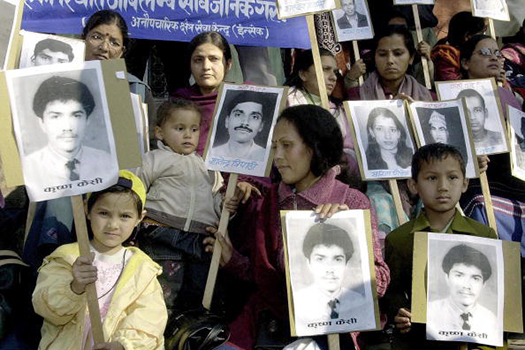
The ICJ, Amnesty International and TRIAL International today called for the Government of Nepal to commit to a transparent and consultative transitional justice process that complies with international law and the judgments of the Supreme Court of Nepal.
On 6 February, the Government of Nepal extended the mandates of the Truth and Reconciliation Commission (TRC) and the Commission on the Investigation of Enforced Disappearance of Persons (CIEDP) for an additional year and committed to the selection of new commissioners by April 2019.
Following the announcement, the ICJ, Amnesty International and TRIAL International voiced concerns about past approach to transitional justice and urged the Government to ensure that the next two months are used to get the flawed process on track.
The organizations warned that this should not become another missed opportunity to ensure that victims are provided the justice, truth and reparation that they so desperately seek.
“A further one-year extension will be meaningless if measures are not taken to secure the independence and impartiality of the commissions,” said Frederick Rawski, ICJ Asia Pacific Director.
“This can only be achieved through a transparent selection process driven by a genuine will to combat impunity – not just for conflict victims, but for future generations,” he added.
The three organizations reiterated their view that the process to date has failed to deliver justice, truth or reparation for victims of crimes under international law and gross human rights violations or establish laws and institutional safeguards to ensure that such crimes are never repeated.
The organizations underscored the need for independent, competent and impartial commissions, compliance with international law, and the meaningful participation of conflict victims, civil society and National Human Rights Commission in the design and implementation of the process.
“This is a great opportunity for Nepal to learn from its past, as well as experiences from other post-conflict societies, that the credibility of transitional justice process ultimately lies on the integrity, competence, independence and expertise of the commissioners. The independence of the Commission, together with a legal framework in accordance with international law, will make or break the success of the commitment to guarantee justice, truth and reparation,” said Biraj Patnaik, South Asia Director of Amnesty International. “The process for appointing new commissioners must be transparent and open to public scrutiny. Victims and civil society must have a robust opportunity to propose and vet candidates.”
The organizations also noted with disappointment that substantive legal concerns raised repeatedly by victims, civil society and the international human rights community have gone unanswered.
The government has not given a clear indication as to whether or how these concerns will be addressed.
“In addition to its obligation to ensure that conflict victims have access to an effective remedy and reparation, the authorities have a separate and independent obligation to investigate and if there is sufficient admissible evidence, prosecute those suspected of criminal responsibility in fair trials before ordinary civilian courts – and, if found guilty, punish them with appropriate penalties which take into account the grave nature of the crimes,” said Helena Rodríguez-Bronchú, Head of TRIAL International’s program in Nepal.
“These obligations are clearly established in international law, as well affirmed in ruling after ruling by the Supreme Court. It is about time that the Government stopped proposing measures that are clearly inconsistent with the letter and spirit of those judgements,” she added.
Concerns raised about existing, and proposed, legislation include: disparities between the definitions of specific crimes under international law and human rights obligations and violations under national, and international law; inadequate provisions to ensure that serious crimes under international law are subject to criminal accountability (including punishment proportionate to the seriousness of the crimes); and a reliance on compensation at the expense of other forms of reparation and remedy for conflict survivors and their families
The ICJ, Amnesty International and TRIAL International had previously submitted a legal analysis of draft transitional justice legislation circulated in 2018, including recommendations on how to ensure compliance with international law and good practices.
Dec 19, 2018 | News
The Transgender Persons (Protection of Rights) Bill, 2018 fails to protect the human rights of transgender people as guaranteed under the Indian constitution and international law and standards and must not be passed in its present form by the Rajya Sabha.
The Bill was passed by the Lok Sabha (Lower House of Indian Parliament) on 17 December, 2018. The next step in order for the Bill to progress is for the Rajya Sabha (Upper House of Indian Parliament) to pass it.
The ICJ considers this Bill to be a missed opportunity to address the serious problem of discrimination against transgender people in India. The ICJ calls for the rejection of its problematic parts by the Rajya Sabha and for the elaboration of a revised Bill in line with rights upheld by the Indian Supreme Court and India’s obligations under international law.
The 2018 Bill, if adopted, would effectively deny to most transgender people their right to self-identification, by providing an overly complex bureaucratic procedure requiring an individual’s application for a transgender certificate to be approved by two different sets of authorities, despite earlier widespread condemnation of this process by the transgender community.
“As the ICJ reported in 2017, the transgender community is continually harassed, stigmatized, and abused by the police, judges, their family and society. This Bill, if it becomes law would further serve to facilitate and compound human rights violations against people from a marginalized community”, said Ian Seiderman, Legal and Policy Director at the ICJ.
The Bill has also introduced mandatory sex reassignment surgery for those transgender people who seek to identify their gender within the binary (male/female) framework. This requirement would be in contravention of the Supreme Court’s judgment in NALSA v. UOI, which guarantees the right to self-identification without the need for medical intervention.
Further, the Bill would collapse all offences against transgender people into one provision which includes offences ranging from “sexual abuse” and “physical abuse”, to “compel[ing] or entice[ing] a transgender person to indulge in the act of begging” among others. These crimes have not been defined in the Bill.
It also would provide for the same six-month to two-year sentence for all offences against transgender people. In some cases, this could be a significantly lighter sentence than when the same crime is committed against others, including discriminated groups such as cis-gendered women, under the general criminal law. In addition, the identification of “beggary” as an offence under the Bill is problematic since for many transgender people in the country, it remains one of the limited livelihood opportunities.
Further, the Bill does not address the question of reservations in employment and education despite specific directions by the Supreme Court in NALSA v. UOI.
Lastly, while the proposed law guarantees the right to non-discrimination to transgender people against persons, state and private sector bodies, it does not provide a definition of discrimination, nor does it provide an enforcement mechanism for ensuring transgender people’s right to non-discrimination.
The ICJ calls on the Rajya Sabha to substantially revise the problematic provisions of the Bill before resubmitting it for parliamentary consideration.
Background
The provisions identified above do not accord with protection of the rights of transgender people to equality, non-discrimination, equal protection of the law, enshrined in the Constitution and international law, including the International Covenant on Civil and Political Rights, which India ratified in 1979. Further, they are incompatible with international standards such as the Yogyakarta Principles on the application of international human rights law in relation to sexual orientation and gender identity.
The ICJ, as part of SAATHII Vistaara Coalition, earlier this year drafted a Briefing Paper on India: Legal and Jurisprudential Developments on Transgender Rights, SAATHII Vistaara Coalition. The paper analyses in detail the domestic judicial developments on transgender rights as well as the legislative process undertaken until the Transgender Persons (Protection of Rights) Bill, 2018 was passed on 17 December 2018.
Additional Reading Material
- ICJ Briefing Paper on The Transgender Persons (Protection of Rights) Bill, 2016, analyzes the 2016 Bill, its shortcomings, and India’s international obligations, as it is the basis of the 2018 Bill.
- ICJ Briefing Paper on Implementation of NALSA Judgment discusses the 2014 April NALSA decision that affirmed that transgender people have the right to decide their self-identified gender. The paper analyses the responsibilities placed on Indian authorities, gaps in implementation, and India’s relevant international law obligations.
Contact
Maitreyi Gupta (Delhi), ICJ International Legal Advisor for India
e: maitreyi.gupta(a)icj.org, t: +91 7756028369

Dec 18, 2018 | Multimedia items, News, Video clips
Lawyers from a diverse range of countries, including Egypt, Lebanon, Nepal, the Philippines, Tunisia and Uzbekistan have identified the many barriers that women typically face in accessing justice in their countries.
Common trends and practices identified included socio-economic marginalization, gender stereotypes and patriarchal attitudes.
The observations came during two training workshops held in Geneva in June and September to coincide with sessions of the UN Human Right Council and UN Committee on the Elimination of Discrimination against Women. The workshops were part of a project on enhancing women’s access to justice through UN human rights mechanisms, supported by the Permanent Mission of the Federal Republic of Germany to the UN in Geneva.
A lawyer from Uzbekistan noted that domestic violence flourishes in states where common attitudes hold that this is an internal matter to be resolved within families.
A particular concern raised in respect of Lebanon was discrimination linked to transference of nationality, where Lebanese women married to a foreigner cannot pass their nationality to their children but Lebanese men married to a foreigner can.
Meera Maharjan, lawyer from Nepal, noted the cultural, educational and economic barriers that impede women from being able to take on decision-making roles and the impact this has on the exercise of their rights.
Malaysian lawyer Yvonne Lim explained that the women who are often in need of access to justice tend to be from the lower rungs of the socio-economic strata and lack the resources, support and basic awareness about their human rights and the remedies that may be available to them.
During the September training session the ICJ organized a side event to the 39th session of the Human Rights Council on ‘applying a women-centred approach to access to justice’ to further explore these issues.
Secretary-General Saman Zia-Zarifi moderated the event and panelists included:
• ICJ Commissioner Justice Sanji Monageng, former Vice-President of the International Criminal Court
• Lisa Gormley, Research Officer for the Centre for Women, Peace and Security at the London School of Economics
• Meera Maharjan, Nepalese lawyer and legal officer for Resilience for Sustainable Women Empowerment (RISE)
You can watch a recording of the event, and interviews with two of the workshop participants below.
https://www.facebook.com/ridhglobal/videos/565112000574216/UzpfSTQ3MTQ2NzA4NjIyMTM3MzoyMjEyNTUzNjc1NDQ2MDMw/
Dec 2, 2018 | Events, News
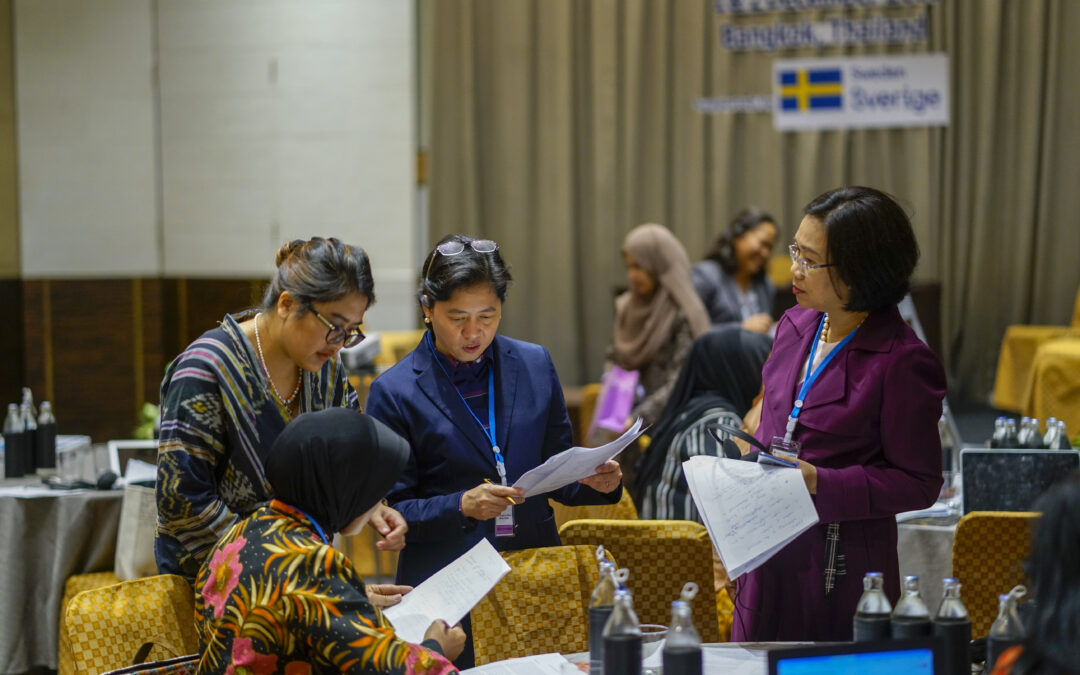
On 1-2 December 2018, the International Commission of Jurists (ICJ) held its 2018 Southeast Asia Regional Judicial Dialogue on enhancing access to justice for women in the region.
Participants included judges from Cambodia, Indonesia, Nepal, Pakistan, Philippines, Sri Lanka and Thailand.
The discussions, held in Bangkok, were focused around resources important for judges to aid in enhancing the capacity of their peers in eliminating gender discriminatory attitudes and behaviours towards women in their work. These resources include a training manual on the use of the Bangkok General Guidance for Judges in Applying a Gender Perspective, and a draft reference manual on women’s human rights and the right to a clean, healthy, safe and sustainable environment.
Frederick Rawski, ICJ’s Director of the Asia and the Pacific Programme, opened the dialogue by emphasizing how important it is for judges to be gender sensitive in their delivery of justice. This could only be done by applying a framework that gives primary attention on ensuring recognition of the applicable human rights, institutional support for the promotion of these rights, and accountability mechanisms for their implementation.
Roberta Clarke, Commissioner of the ICJ and Chair of the organization’s Executive Committee, noted that this judicial dialogue demonstrates the ICJ’s commitment to have a sustainable contribution to the implementation of international human rights standards at the domestic level. She hoped that the judges could contextualize the resources presented and bring these back to their countries for trainings of their peers.
This judicial dialogue is part of a joint project on access to justice for women that ICJ is implementing with UN Women.
Anna Karin Jatfors, UN Women-Asia Pacific’s Interim Regional Director shared that gender stereotypes and social norms which discriminate women are not unique in each country. She pointed out the importance of the ICJ and UN Women collaborating in this project to deconstruct this image to bring better access to justice to women in the region.
Overall, the dialogue was rich and substantive, with the full and active participation from all participating judges who shared their views and experiences on countering gender discrimination in cases before them. At the end of the judicial dialogue, the participating judges expressed strong interest to use the resources for capacity building initiatives of their peers in their own countries.
Contact
Emerlynne Gil, Senior International Legal Adviser, t: +662 619 8477 (ext. 206), email: Emelynne.gil(a)icj.org