ICJ adressed meeting focusing on criminal responsibility of corporations and business persons

ICJ adressed meeting focusing on criminal responsibility of corporations and business persons

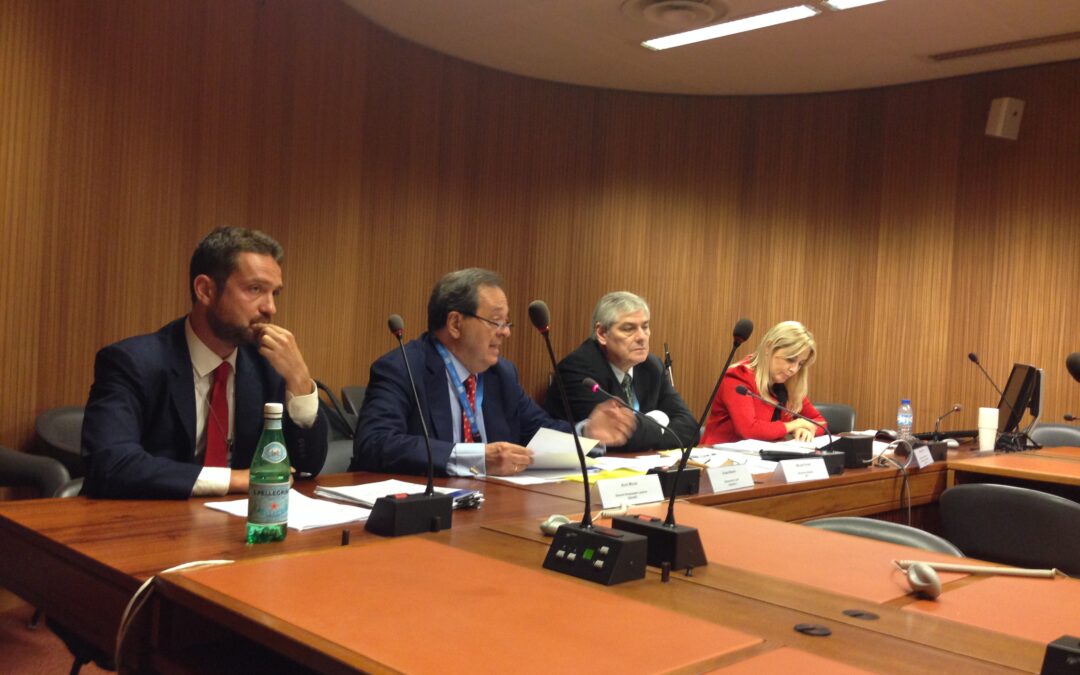
The ICJ addressed the 15th Meeting of the European Network of Contact Points for investigation and prosecution of genocide, crimes against humanity and war crimes.

The meeting, which took place in the Hague, had a focus on criminal responsibility of corporations and business persons for serious international crimes and congregated a number of European public prosecutors and investigators.

In its presentation, Carlos Lopez, Senior Legal Adviser at ICJ, addressed ways to overcome difficulties in prosecuting business corporations.

He focused on three cases that are among the ones most advanced in the investigation and prosecution stage of business corporations for crimes under international law: the Riwal/Lima Holding, the Amesys and the Lundin Petroleum cases.

They illustrate the acute dilemmas that public prosecutors are likely to face in these kind of cases and how difficult to solve them it may be.

The full ICJ presentation and the agenda of the meeting can be downloaded in pdf format below.

The Hague Meeting-Prosecuting corporations-Presentation-analysis brief-2013

The Hague Meeting-Prosecuting corporations-Agenda-2013


Bangladesh: immediately release human rights defender Nasiruddin Elan

Bangladesh: immediately release human rights defender Nasiruddin Elan

The ICJ is calling on the Bangladeshi authorities to immediately and unconditionally release Nasiruddin Elan, Director of the human rights group Odhikar.

Odhikar is an affiliate organization of the ICJ.

On 6 November 2013, a Dhaka cyber crimes tribunal rejected Nasiruddin Elan’s bail application and ordered his detention in Dhaka Central Jail.

Nasiruddin Elan (in the middle on the picture) has been accused of distorting information, presenting false evidence and manipulating photographs of a Government crackdown on a rally by Hefazat-e-Islam, an Islamist political organization, in May this year.

The action reportedly resulted in multiple deaths and injuries. Odhikar had reported that 61 protestors were killed by the Rapid Action Battalion (RAB) and the police. The Government contests the number of casualties.

“What we are seeing is a continuing unlawful attack on Odhikar and voices critical of the Government,” said Ben Schonveld, ICJ’s South Asia Director. “Nasiruddin Elan is being arbitrarily detained for the lawful exercise of the right to freedom of expression and his legitimate work as a human rights defender.”

“The Government should immediately drop its opposition to Nasiruddin Elan’s bail application,” he added. “We are concerned that he will be one of the many detainees who faces torture and ill-treatment during detention, as documented by Odhikar and other human rights organizations.”

Bangladesh-Elan arrest statement-news-web story-2013 (full text in pdf)


ICJ condemns Bangladesh’s alarming use of capital punishment

ICJ condemns Bangladesh’s alarming use of capital punishment

The ICJ condemns Bangladesh’s imposition of the death penalty in contravention of the global trend towards abolition of capital punishment.

It signifies a weakening of the rule of law and respect for human rights standards in the country.

On 5 November 2013, a special court sentenced 152 persons to death, most of them former officers of the Bangladesh Rifles (BDR), for participating in the 2009 mutiny in which 74 people were killed.

Two days earlier, the International Crimes Tribunal (ICT) had convicted Chowdhury Mueen Uddin and Ashrafuzzaman Khan in absentia for abduction and murder during Bangladesh’s liberation war in 1971 and sentenced them to death.

The ICT, set up by the Government of Bangladesh in 2010 to prosecute persons accused of committing genocide, crimes against humanity, war crimes and other serious crimes during the 1971 war, has so far convicted nine accused. Seven have been given death sentences.

“The numbers of death sentences issued by special courts in Bangladesh is alarming,” said Ben Schonveld, ICJ’s South Asia Director. “There seems little interest in seeking justice; this looks more like revenge.”

“Those responsible for committing atrocities during the Bangladeshi war of liberation and the 2009 mutiny must be prosecuted and brought to justice,” he added. “But the death penalty is a perversion of justice, even more so when imposed after trials that violate due process.”

The ICJ considers the death penalty to constitute a violation of the right to life and the right not to be subjected to cruel, inhuman or degrading punishment. The United Nations General Assembly has repeatedly called on all States to establish a moratorium on the death penalty with a view to abolition.

Under international law and standards, including the International Covenant on Civil and Political Rights, Bangladesh is required to scrupulously and strictly to observe all relevant fair trial guarantees.

This includes the right to effective legal assistance at all stages of the proceedings including the appeal.

The International Crimes Tribunal as well the Special Court set up by Bangladesh to try those accused of committing atrocities in the 2009 mutiny do not meet international standards and Bangladesh’s legal obligations concerning the right to a fair trial.

The 846 suspects tried by the special court in Dhaka for the 2009 mutiny had limited access to lawyers; did not have sufficient knowledge of the charges and evidence against them; and at least 47 suspects died while in custody, allegedly after being subjected to torture.

There are also serious procedural flaws at all stages in the ICT.

Pre-trial release has been routinely and arbitrarily denied; witnesses have been abducted and intimidated; and there have been credible allegations of collusion between the Government, prosecutors and judges.

The ICJ calls on Bangladesh to join the great majority of States around the world in rejecting the death penalty.

To that end, Bangladesh should impose a moratorium on the practice and take steps towards its abolition, as prescribed by repeated United Nations General Assembly Resolutions.

In addition, Bangladeshi authorities must order a retrial of all persons accused of participating in the 2009 mutiny and ensure that their fresh trials meet international law standards on fair trial.

Bangladesh-Death penalty statement-news-web story-2013  (full text in pdf)

Kazakhstan: ICJ welcomes release of a lawyer from psychiatric detention

Kazakhstan: ICJ welcomes release of a lawyer from psychiatric detention

The ICJ welcomes the release on 1 November of lawyer Zinaida Mukhotorova, from a psychiatric facility in Astana, Kazakhstan.

The lawyer was forcibly detained in the psychiatric facility, the “Medical Centre of the Problems of Psychiatric Health”, for almost three months.

Despite her release, the results of the psychiatric examination were said to be pending.

“While this release is welcome, the ICJ remains concerned that Zinaida Mukhotorova’s detention represented a reprisal for her legitimate exercise of her professional duties as a lawyer, in violation of her right to liberty as well as the UN Basic Principles on the Role of Lawyers,”  said Róisín Pillay, Director of the ICJ Europe Regional Programme.  “It must now be ensured that Zinaida Mukhotorova can challenge the legality of her detention through fair procedures, and receive appropriate measures of reparation for any violation of her human rights” she added.

Zinaida Mukhtorova was placed in the psychiatric facility on 9 August after she was forcibly taken from her house by several police officers and medical personnel.

Among the reasons given for her detention were her “possibly querulous” and “litigious” activity.

The ICJ previously raised concern that her psychiatric detention was being justified on grounds consisting in the exercise of her legitimate professional functions as a lawyer.

The ICJ continues to monitor the case, including ongoing legal challenges in the Kazakhstan courts to the lawfulness of Zinaida Mukhtorova’s detention in psychiatric facilities on this and another previous occasion.

In this regard, the ICJ calls on the government to ensure fairness of the proceedings challenging her detention.

Contact:

Róisín Pillay, Director, ICJ Europe Programme, roisin.pillay(a)icj.org

Temur Shakirov, Legal Adviser, ICJ Europe Programme, temur.shakirov(a)icj.org

Kazakhstan-Mukhtorova statement-news-webstory-2013-Rus (full text in pdf)

Falta de independencia judicial en Central America preocupa a juristas

Falta de independencia judicial en Central America preocupa a juristas

Jueces europeos y centroamericanos expresaron en Tegucigalpa su preocupación por la falta de independencia del sistema judicial en países como Honduras, Guatemala y El Salvador.

Instaron a los Estados a tomar medidas para garantizar la autonomía de esa rama del poder público.

El 31 de octubre y 1 de noviembre se llevó a cabo en la ciudad de Tegucigalpa (Honduras) el foro denominado “Encuentro de Juristas Europeos y Centroamericanos: experiencias sobre la defensa de la independencia judicial”.

Durante el mismo, se tuvo la oportunidad de intercambiar experiencias en torno a las amenazas que hoy día persisten en contra de la independencia judicial y las medidas que los estados de Centroamérica  deben tomar para fortalecer los diferentes sistemas de justicia en la región.

El foro reconoce el papel fundamental que tienen todos los jueces y juezas en la construcción y consolidación de la Democracia y el Estado de Derecho en Centroamérica; las y los participantes expresan su preocupación porque aún existen serias amenazas a la independencia judicial, entendiéndose dicha independencia como una garantía para los ciudadanos y ciudadanas.

En tal sentido, los estados centroamericanos deben respetar plenamente la independencia del Poder Judicial.

Honduras-Foro Jueces Independencia en CA-news-web story-2013-spa (full text in pdf)

Translate »