
Kyrgyzstan: ICJ condemns assaults on lawyers in Supreme Court
The ICJ today expressed serious concern at the physical assault of lawyers Tatiana Tomina and Ulugbek Usmanov at a Supreme Court hearing in Bishkek this morning.
The ICJ called on the Kyrgyzstan authorities to take effective measures to protect the physical security of lawyers as well as all other parties in court proceedings, and to hold accountable those responsible for today’s attacks.
The assaults took place during the Supreme Court hearing in the case against Shamshidin Niyazaliyev, who was recently acquitted of charges relating to the outbreak of widespread ethnic violence in the South of Kyrgyzstan in June 2010. During the hearing, several persons present in the courtroom subjected the two lawyers and the mother of Shamshidin Niyazaliyev to beatings. No immediate steps were taken by the Court to prevent the beatings, which continued for several minutes before security officers intervened.
“There has been a pattern of serious attacks on lawyers in Kyrgyzstan, but this is the first time that the authorities have failed to guarantee the security for lawyers at the Supreme Court”, Róisín Pillay, Director of the ICJ Europe Programme said today. “These attacks violate the international obligations of the Kyrgyz authorities to ensure the security of lawyers and to protect the right to a fair trial. No justice is possible unless all the parties to the judicial process are fully protected and lawyers are able to discharge their functions without harassment, or attack”.
International standards, including the UN Basic Principles on the Role of Lawyers, require that “where the security of lawyers is threatened as a result of discharging their functions, they shall be adequately safeguarded by the authorities”.
It is now essential for the credibility of the judicial system that today’s assaults are thoroughly and independently investigated and that those responsible are brought to justice, the ICJ emphasised.
According to lawyer Tatiana Tomina, the attacks began when about 15 men and women started insulting, pushing and punching the lawyers as they walked into the courtroom. The defendant’s mother, the only apparent supporter of the defendant allowed into the Court, was kicked and punched in the head. When the defence lawyers began to read a statement, several women attacked Tatiana Tomina and attempted to take documents from her by force. The panel of presiding judges did not attempt to prevent the beatings and security officers only appeared after several minutes had passed. Tatiana Tomina and the mother of the defendant were able to escape through the back door of the court. However Ulugbek Usmanov was unable to escape and suffered more serious injuries.
The Court adjourned the hearing for two hours. After the hearing resumed, only a few security persons were present in the courtroom and the defendant’s mother did not attend this part of the hearing. Following five minutes of deliberations the Supreme Court overturned the earlier acquittal.
Reportedly, at the hearing, defence statements were constantly interrupted, lawyers were insulted and prevented from speaking in defence of their clients and the Court refused to call any of the five witnesses of the defence. In her comments to the ICJ, lawyer Tatiana Tomina stated: “[i]n three years nothing has changed either in terms of the attitude towards lawyers or in terms of the investigation of criminal cases, which has not improved at all.” The ICJ has previously raised concerns at violence against lawyers in cases related to ethnic disturbances in the south of Kyrgyzstan in 2010.
CONTACTS
Róisín Pillay, Director, ICJ Europe Programme, roisin.pillay@icj.org
Temur Shakirov, Legal Adviser, ICJ Europe Programme, temur.shakirov@icj.org
ICJ condemns assaults on lawyers in Supreme Court (Full Text in Russian, PDF)

ICJ comments on draft EU accession agreement to European human rights convention
The ICJ, Amnesty International and the AIRE Centre submitted written comments on the draft EU accession agreement to the European Convention on Human Rights.
The ICJ, Amnesty International and the AIRE Centre have submitted written observations, on the occasion of the last meeting of the 47+1 Group in charge of the negotiations on the accession of the European Union to the European Convention on Human Rights. The observations focussed on issues of jurisdiction, responsibility, and on the mechanism of co-respondence in cases involving the EU.
EUAccessionECHR-Paper-Joint-2013 (download the paper)
Photo credit: © Yanni Koutsomitis (the author of the picture has no involvement in nor does support this submission)
ICJ seminar addresses the independence of the legal profession in Central Asia
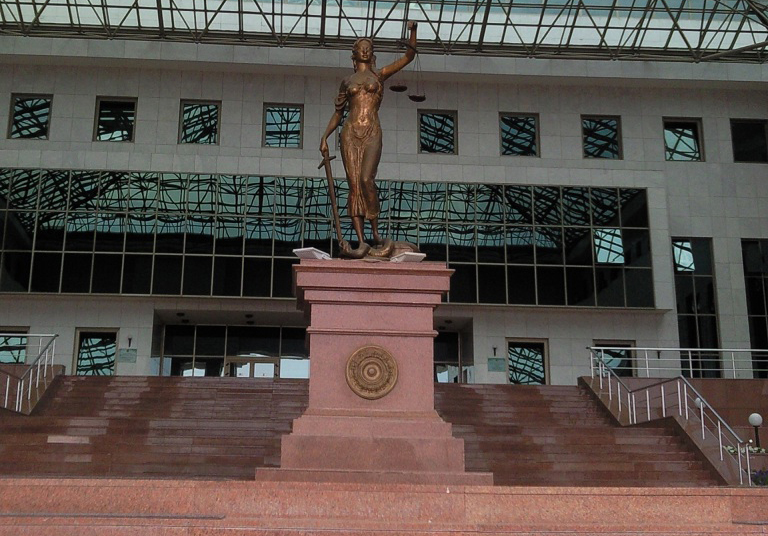 Lawyers from all five Central Asian countries participate in the seminar (28-29 March 2013) to discuss the independence of bar associations and problems faced by lawyers in working independently and effectively.
This ICJ roundtable seminar, organized in cooperation with the Central Asian League of Lawyers and to be held in Almaty, Kazakhstan, will address issues including the self-governance and organization of bar associations, their relationships with state bodies, lawyers and the public, entrance to the legal profession, lawyers’ codes of ethics, and disciplinary proceedings against lawyers.
It will also discuss problems faced by lawyers in criminal cases, in both the pre-trial and trial stages, and incidents of harassment or intimidation of lawyers.
Europe-CIS-ICJ Seminar Central Asia-event-agenda-2013 (full text in pdf)

Zimbabwe: Beatrice Mtetwa released on bail
Beatrice Mtetwa was eventually released today after mounting pressure from human rights groups and legal bodies, including the ICJ.
High Court Judge Joseph Musakwa finally decided to grant bail to Beatrice Mtetwa, under three conditions: that she deposits $500, that she resides at the given address and that she does not interfere with the ongoing investigations.
The ICJ believes that the politically-motivated harassment against Mtetwa is a threat to the legal profession in Zimbabwe – intended to alarm lawyers and intimidate them from providing independent representation.
Beatrice Mtetwa was arrested after attempting to come to the aid of her clients, Thabani Mpofu, Felix Matsinde, Anna Muzvidziwa and Worship Dumba, all MDC-T members, the opposition party.
The government has cracked down hard on dissidents as Zimbabwe approaches presidential elections.

Zimbabwe: African legal bodies express outrage at continued detention of Beatrice Mtetwa
The ICJ and other legal groups have expressed their outrage at the continued detention of Zimbabwean lawyer and human rights activist, Beatrice Mtetwa, after she was denied bail.
This was despite the fact that Mtetwa was improperly held before the court after the police had refused to comply with a High Court order to release her, the Pan African Lawyers Union (PALU), SADC Lawyers Association (SADC LA) and Southern Africa Litigation Centre (SALC) and the ICJ said.
It is perturbing that the Police would use a lower Court, to undermine a standing decision of a higher Court, and that the lower Court would allow itself to be so used, they also said.
Moreover, it is absurd that Mtetwa, a lawyer of 30 years’ standing in Zimbabwe, could be denied bail on the basis that she would interfere with police investigations, they added.
While the ICJ, PALU, SADC LA and SALC have learnt with disappointment of the postponement of Mtetwa’s bail appeal hearing from the 22nd of March 2013 to the 25th of March 2013, they have faith that Mtetwa will be vindicated and released by the High Court.
The concerted efforts to keep Mtetwa behind bars represent a calculated attempt by sections of the Zimbabwean Government to break her spirit and deter her from representing the many Zimbabweans who daily face harassment and intimidation from the state’s security services.
Over the years, Mtetwa has stood by these victims of government and police repression and is regarded as a hindrance by the police and security sector to their illegal activities.
The action against Mtetwa is a threat to the legal profession in Zimbabwe – intended to alarm lawyers and intimidate them from providing independent representation.
As the country edges towards elections, the persecution of lawyers and other actors can only be expected to escalate, judging from the number of civil society representatives and human rights defenders who have fallen victim to police harassment in the past few weeks.
The police’s actions stand in marked contrast to calls by the most senior political authorities in Zimbabwe for peace and tolerance as the country moves towards elections.
That no heed is paid to these calls by the police force is indicative of the widespread and endemic impunity enjoyed by the security sector. It is the clearest indication that, as matters stand, there exists little prospect for free and fair elections.
The ICJ, PALU, SADC LA and SALC urge the Southern African Development Community (SADC) as the Guarantor of Zimbabwe’s Global Political Agreement and President Jacob Zuma as the mediator in Zimbabwe’s political crisis to take action and urge the Government of Zimbabwe to release Mtetwa from prison and end the politically-motivated persecution of her.
The legal groups also urge the African Union and the international community to prevail upon the Zimbabwean Government to release Mtetwa.
They also call on the police and the judiciary in Zimbabwe to discharge their duties in an independent and impartial manner if the people of Zimbabwe are to have confidence in the judicial system as the country moves towards elections.
Contact:
Arnold Tsunga, ICJ Africa Director, +27 73 131 8411; e-mail: arnold.tsunga(at)icj.org
Recent News
 Thailand: Three draft anti-SLAPP laws must deliver comprehensive protection23 Oct 2026
 Egypt’s Matsda2sh case: end the crackdown on media workers with fake “terrorism” charges19 Oct 2026
 Joint Letter: Addressing Human Rights Abuses During Vietnam’s To Lam’s Visit16 Oct 2026
 Joint Letter: Urgent diplomatic action to halt further executions in eastern Libya13 Oct 2026