Feb 28, 2014 | News
A statement by Sultan Hassanal Bolkiah suggesting that critics of Brunei Darussalam’s new Penal Code may be criminally prosecuted for slander is clearly meant to curb freedom of expression and opinion in the country, the ICJ said.
The ICJ urged the Government of Brunei to ensure full respect for the right of freedom of opinion and expression.
In a speech marking Brunei’s 30th National Day on 23 February 2014, Sultan Hassanal Bolkiah said that social media had been used to express opposition to the implementation of the new Penal Code.
He said that those who use social media to express their opinions against the new Penal Code may be committing offences under the General Offences Chapter of the new law. He reportedly characterized some of this expression as amounting to slander, including of the King and of Ulamas, or Muslim scholars. The Sultan also warned that these critics “cannot continue to be allowed to inflict insults” and that they “can be brought to court.”
“Sultan Hassanal Bolkiah’s statement illustrates that human rights, particularly respect for freedom of opinion and expression, is widely disregarded by the authorities in Brunei,” said Sam Zarifi, ICJ’s Regional Director for Asia and the Pacific.
The ICJ has criticized the new Penal Code for being an affront to human rights and at odds with international standards.
The ICJ reiterates its concern that provisions in the new Penal Code are not in accord with the commitment made by Brunei Darussalam as a member of the Association of Southeast Asian Nations (ASEAN) to promote and protect human rights in the region.
“Free, unhindered debates on issues like the enactment or implementation of a law are important cornerstones of a democratic society,” said Zarifi.
Freedom of opinion and expression is a right that is affirmed in the Universal Declaration of Human Rights and guaranteed under the Convention on the Elimination of All Forms of Discrimination against Women (CEDAW) and the Convention on the Rights of the Child (CRC), to both of which Brunei Darussalam is a party. Under international law, any restrictions or limitations must be exceptional, in accordance with the principles of the proportionality and necessity.
The ICJ urged the Government of Brunei to allow free discussion, particular on matters of public importance such as State law and policies and to fully respect the right to freedom of opinion and expression.
Contact:
Emerlynne Gil, ICJ International Legal Adviser for Southeast Asia, t +66 2 619 8477; email: emerlynne.gil(a)icj.org
Craig Knowles, ICJ Media Consultant, t +66 81 9077653; email:craig.knowles(a)icj.org

Feb 21, 2014 | News
The Kuala Lumpur High Court’s decision today to convict prominent Malaysian lawyer Karpal Singh on charges of sedition is inconsistent with international law and standards regarding free expression of opinion by lawyers, the ICJ said.
“This conviction sends a message that lawyers in Malaysia are not free to express their opinions about legal issues,” said Emerlynne Gil, ICJ’s International Legal Adviser on Southeast Asia.
Karpal Singh’s conviction was based on the fact that during a press conference held at his law firm in early 2009 he had spoken allegedly “seditious words” when questioned about whether Sultan Azlan Shah had the legal authority to remove the province’s Chief Minister, Datuk Seri Mohammad Nizar Jamaluddin, from office.
“This case is another sign of the lack of respect of the Malaysian government for the principle of free expression,” said Gil. “Karpal Singh was expressing an opinion in his capacity as a lawyer over a matter of law. He has every right to do that, as a lawyer, and of course as someone exercising his right to free expression of his views. He also has acted in fulfilment of a core function of the legal profession, which is to contribute to the public discourse on matters of law.”
The UN Basic Principles on the Role of Lawyers specifically provide that lawyers, like ordinary citizens, are entitled to freedom of opinion and expression. They have the right “to take part in public discussion of matters concerning the law, the administration of justice and the promotion and protection of human rights” without fear of suffering professional restrictions or repercussions due to their lawful action.
The High Court has fixed 7 March 2014 to hear Karpal’s mitigating circumstances, and for sentencing.
Under section 4(1) of the 1948 Sedition Act, Karpal Singh now faces a fine of up to RM 5,000 (approximately US$1,5010) and/or imprisonment of up to three years.
The conviction may force Karpal Singh to give up his seat as a member of the Malaysian parliament. Under the Federal Constitution, an elected representative is disqualified from office if fined more than RM 2,000 or jailed for a term exceeding one year.
Karpal Singh has provided legal defense in several high profile cases, including that of opposition leader Anwar Ibrahim, whose trial on charges of ‘sodomy’ has drawn heavy criticism in Malaysia and internationally.
Contact:
Emerlynne Gil, ICJ International Legal Adviser for Southeast Asia, t +66 2 619 8477; email: emerlynne.gil(a)icj.org
Craig Knowles, ICJ Media Consultant, t +66 81 9077653; email:craig.knowles(a)icj.org

Feb 19, 2014 | News
The Philippines Supreme Court’s decision to uphold provisions in the Cybercrime Prevention Act that penalize online libel may stifle freedom of expression, the ICJ warned today.
Yesterday, the Philippine Supreme Court upheld as constitutional the provisions in the Cybercrime Prevention Act penalizing and increasing the penalty for libel committed online.
“By enacting this law, the Philippines government will inhibit people who try to express themselves through the Internet and electronic media,” said Emerlynne Gil, ICJ Legal Advisor on Southeast Asia. “The Supreme Court decision unfortunately means that the Philippines has now joined those countries in the ASEAN region that are vainly trying to turn back the tide of greater and freer expression online.”
The Cybercrime Prevention Act (Republic Act No. 10175) was adopted in September 2012, but its application was suspended in October 2012 by a temporary restraining order issued by the Supreme Court.
Several groups, such as the National Union of Journalists of the Philippines, the Internet and Society Program of the UP College of Law, and the National Press Club, filed petitions before the Supreme Court alleging that the law on its face violates the right to freedom of expression as guaranteed under the Philippine Constitution.
The ICJ considers the Cybercrime Prevention Act as incompatible not only with the Philippine Constitution, but also with Philippines’ international obligations under the International Covenant on Civil and Political Rights (ICCPR), which guarantees the rights to freedom of expression, including the right to receive and impart information.
“The criminalization of libel or defamation is an affront to freedom of expression,” Gil said. “It’s now up to the Philippine Congress to amend the Cybercrime Prevention Act and decriminalize libel and defamation so as to ensure respect for freedom of expression consistent with its international obligations.”
The Court upheld both Sections 4(4) and 6 of the law, which respectively provide that libel committed through a computer system or similar means is illegal and that responsible persons will incur the penalty one degree higher than what is provided under the Revised Penal Code.
Hence, a person found guilty of committing online libel may be subject to imprisonment from six to nine years.
The ICJ has previously expressed opposition to the law, pointing out that its provisions on online libel compound the existing problematic provisions on defamation in the Philippine’s Revised Penal Code and provide for even greater penalties for libel.
The decision of the Supreme Court made a distinction on who may be punished of committing online libel.
It specified that only the original author of the allegedly libelous statement and not the recipient or those who disseminated, such as an internet service provider, may be held criminally responsible for online libel under the law.
The UN Human Rights Committee, the international monitoring body of the ICCPR, has said that States should decriminalize libel or defamation.
It underlined that in order to comply with their obligations under ICCPR, States may only penalize the most serious defamation cases and even in these cases, “imprisonment is never an appropriate penalty.” The Philippines has been a party to the ICCPR since 1986.
The ICJ welcomed the Court’s striking down as unconstitutional section 19 of the Act, which gives the Department of Justice power to restrict or block access, without prior judicial determination, to computer data found to be in violation of the law.
This is in line with the international standard that no law shall confer unfettered discretion to those charged with its execution the restriction of freedom of expression.
Contact:
Emerlynne Gil, ICJ International Legal Adviser for Southeast Asia, t +66 2 619 8477; email: emerlynne.gil(a)icj.org (For English, Filipino, and Cebuano)
Craig Knowles, ICJ Media Consultant, t +66 81 9077653; email: craig.knowles(a)icj.org
Feb 18, 2014 | Advocacy, News, Non-legal submissions
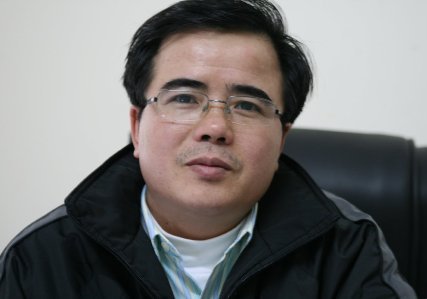
The ICJ condemned the decision by the Court of Appeal of the Supreme People’s Court in Hanoi to uphold the conviction and sentencing of lawyer and human rights defender Le Quoc Quan to 30 months imprisonment.
The ICJ called on Viet Nam authorities to release him immediately.
“The decision of the Court of Appeal is regrettable but not unexpected,” said Sam Zarifi, ICJ’s Regional Director for Asia and the Pacific. “The ICJ has repeatedly criticized the lack of independence of the courts in Viet Nam. This is a political case and the government of Viet Nam has again used the courts to punish a significant critical voice.”
Today’s appellate hearing lasted for four hours. Thirty minutes after the hearing ended, the court released its decision upholding Le Quoc Quan’s conviction.
Le Quoc Quan, a lawyer who was illegitimately barred from practice for challenging government human rights violations, was convicted on 2 October 2013 of tax evasion under section 161 of the Vietnamese Penal Code. The ICJ had criticized Le Quoc Quan’s conviction, pointing out that he did not receive a fair trial.
The Court of Appeal upheld Le Quoc Quon’s sentence with time served since his arrest on 27 December 2012 to be taken into account.
The Court of Appeal also upheld the earlier order made by the People’s Court of Hanoi for Le Quoc Quan’s company to pay 645 million VND (approximately USD30,000) and a fine of 1.3 billion VND (approximately USD60,000), for alleged unpaid taxes.
Le Quoc Quan has been on a hunger strike protesting his conviction since 1 February 2014. He was so weak that it was difficult for him to stand up during the hearing.
“Le Quoc Quan’s faulty trial violated right to an independent, impartial tribunal, and the appeal process also fell short of international fair trial standards, including under the International Covenant on Political and Civil Rights, to which Vietnam is a party,” Zarifi said.
The public was barred from entering the courtroom during today’s hearing and only Le Quoc Quan’s wife, mother, and lawyers were allowed inside.
Le Quoc Quan was also not allowed to meet with his lawyers in the last few days leading up to the appeal hearing.
His lawyers tried to visit him in prison at least twice last week, but they were barred from seeing him.
Le Quoc Quan’s lawyers also confirmed to ICJ that Le Quoc Quan was not allowed to meet and communicate with his lawyers immediately after his conviction by the People’s Court of Hanoi and had to file an appeal on his own.
In drafting his appeal, all legal documents and files pertaining to his case were withheld from him.
The UN Human Rights Committee has emphasized that all convicted persons like Le Quoc Quan must be given copies of a duly reasoned, written judgment of the trial court, as well as other documents such as transcripts, so that they may be able to effectively enjoy their right to appeal.
Under Viet Nam’s laws, lawyers of convicted persons cannot file an appeal on behalf of their clients.
It is only after the appeal has been filed and accepted by the appellate court that the convicted person may identify the lawyer of his choice.
The chosen lawyers are recognized and allowed to participate in the case only after the court approves their application for a “defence counsel’s certificate” or “advocacy certificate”.
The UN Basic Principles on the Role of Lawyers provide that no court shall refuse to recognize the right of a lawyer to appear before it on behalf of his client, unless the lawyer has been disqualified in accordance with domestic law.
“Viet Nam’s courts operate in violation of international standards that clarify that lawyers must be allowed to assist their clients in filing an appeal,” Zarifi said.
Le Quoc Quan cannot appeal the decision of the Court of Appeal under the article 248(3) of the Criminal Procedure Code of Vietnam, which states that decisions of the Court of Appeal are final and legally binding from the date of their pronouncement.
The lawyers of Le Quoc Quan, however, are said to be considering filing a petition on procedural issues on this case.
On 14 February, the ICJ submitted a written statement to the Human Rights Council (see below) under the title “Violations of the right to counsel of Viet Nam human rights defender Le Quoc Quan”.
In the statement, the ICJ called on the UN Special Rapporteur on the Independance of Judges and Lawyers to reiterate her request to the Government of Viet Nam to extend an invitation to her mandate to undertake a mission to the country.
The ICJ also called on Viet Nam to amend its laws expressly to ensure that anyone deprived of liberty, including human rights defenders, are given access to counsel from the moment of deprivation of liberty or at latest within 24 hours of detention.
Viet Nam should also consider including in its laws penalties for law enforcement authorities who do not honour such provisions.
Contact:
Emerlynne Gil, ICJ International Legal Adviser for Southeast Asia, t +66 2 619 8477; email: emerlynne.gil(a)icj.org
Craig Knowles, ICJ Media Consultant, t +66 81 9077653; email: craig.knowles(a)icj.org
Viet Nam-Human Rights Council-ICJWrittenStatement-advocacy-2014 (full text in pdf)
Feb 13, 2014 | News
The ICJ continued its observation of the trial of Malaysian opposition leader Anwar Ibrahim on sodomy charges under the colonial-era Section 377B of the Penal Code, which criminalizes consensual same-sex sexual relations.
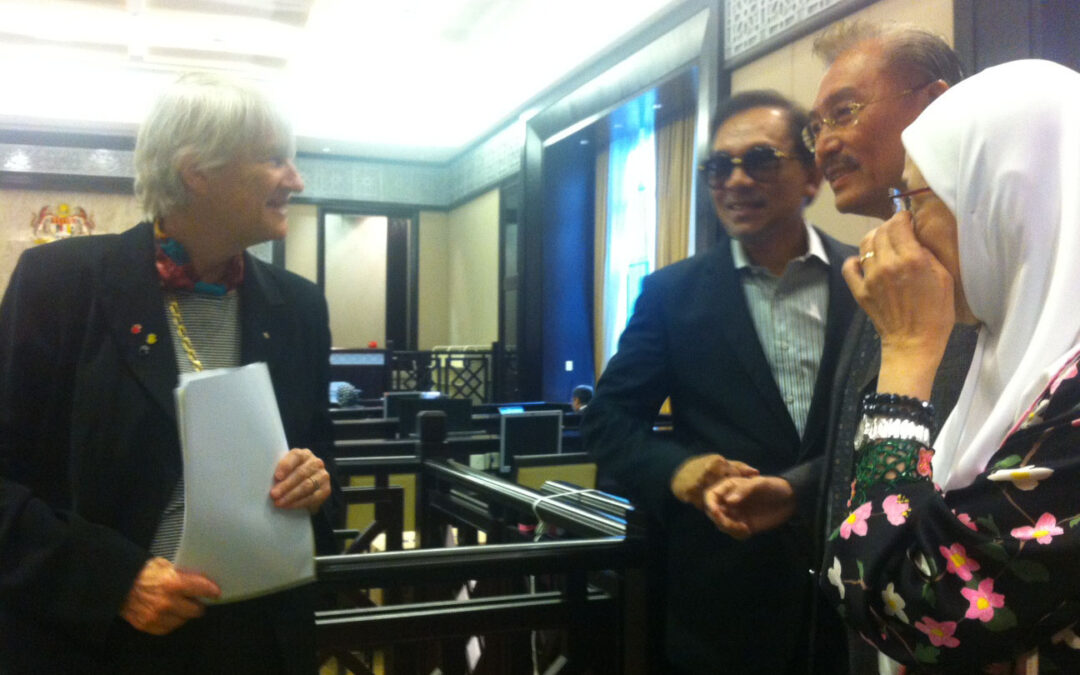
ICJ Commissioner Justice Elizabeth Evatt AC, the first woman judge to be appointed to an Australian Federal Court and a former member of the United Nations Human Rights Committee, observed a hearing on the appeal of Anwar Ibrahim at the Court of Appeal in Putrajaya yesterday.
“The ICJ will continue to monitor this case and evaluate the fairness of the proceedings in light of relevant international standards,” said Emerlynne Gil, ICJ international legal advisor for Southeast Asia. “The ICJ will also assess whether the prosecution under Section 377 is being used in this case to suppress political dissent, contrary to the right to freedom of expression.”
The hearing is an appeal against the High Court’s decision on 9 January 2012, which acquitted Anwar Ibrahim of sodomy.
“The ICJ has previously condemned Malaysia’s continuing use of colonial-era criminal charges of ‘sodomy’ to cover even consensual sexual relations between adults,” Gil said. “The ICJ believes that Article 377B of the Malaysian Penal Code is inconsistent with respect for the right to privacy under international standards.”
The Court of Appeal heard and eventually dismissed an interlocutory application filed by the lawyers of Anwar Ibrahim seeking to recall for testimony Jude Blacious s/o Pereira, the investigating officer and key witness in the sodomy case.
Pereira was recently found unfit to be a practicing lawyer in another case in a High Court decision of 10 January 2014.
In that decision, the High Court relied on a 2009 Human Rights Commission of Malaysia’s (SUHAKAM) report, which determined Pereira to be an unreliable witness in a public inquiry established to investigate the arrest and detention of 5 legal aid lawyers.
The Court of Appeal dismissed the application on the grounds that Anwar Ibrahim had failed to satisfy the court that additional evidence in the appellate stage was necessary in dispensing justice and that it fell in the category of “most exceptional” cases, particularly as the SUHAKAM report had already been available since 2009.
The Court of Appeal postponed the hearing on the appeal itself to allow Anwar Ibrahim’s lawyers to file a notice of appeal with the Federal Court on the dismissal of the interlocutory order.
Anwar Ibrahim’s counsel immediately filed a notice of appeal to the Federal Court on the dismissed interlocutory application.
The case management for the sodomy appeal has been fixed on 28 February 2014.
The appeal proper was initially scheduled on 17 and 18 September 2013 but has faced continuous delays due to a series of interlocutory matters.
Feb 11, 2014 | News
The seminar was on “The Role of Judicial Independence and Integrity in Improving the Effectiveness of the Rule of Law”, with the participation of the ICJ.
The event, hosted by the Office of the Supreme Court of the Union (OSCU) in collaboration with the United Nations Development Programme (UNDP) and the ICJ, took place in Nay Pyi Taw on February 10th and 11th 2014.
It was attended by more than 40 judges and senior court administrators from all states and regions in Myanmar.
Discussions at the seminar focused on the ways in which Myanmar’s judicial system can continue to develop its functional independence and deliver justice for all.
In opening the seminar, the Honourable Chief Justice of the Union, U Htun Htun Oo, remarked that judicial independence and integrity are essential to building a reliable judicial system in which the people of Myanmar can trust, and which can uphold the rule of law.
During the seminar, Justice Kalyan Shrestha of Nepal, and ICJ Vice President Justice Michèle Rivet of Canada shared their experiences of the challenges of preserving judicial independence as a key pillar of a democratic society.
In her opening remarks, Ms. Renata Lok-Dessallien, UN Resident Coordinator, also noted that in addition to the importance of a fair legal framework, a trained judiciary and well-functioning court system, “the other half of the equation is from the bottom up: it is people’s perceptions of the professionalism, integrity and fairness of the system.”
Sam Zarifi, ICJ’s regional director for Asia and the Pacific added that “access to an independent and impartial tribunal is a human right”.
Both UNDP and ICJ expressed their willingness to continue working with Myanmar’s judiciary on the issues of judicial independence, and justice for all for the long-term.
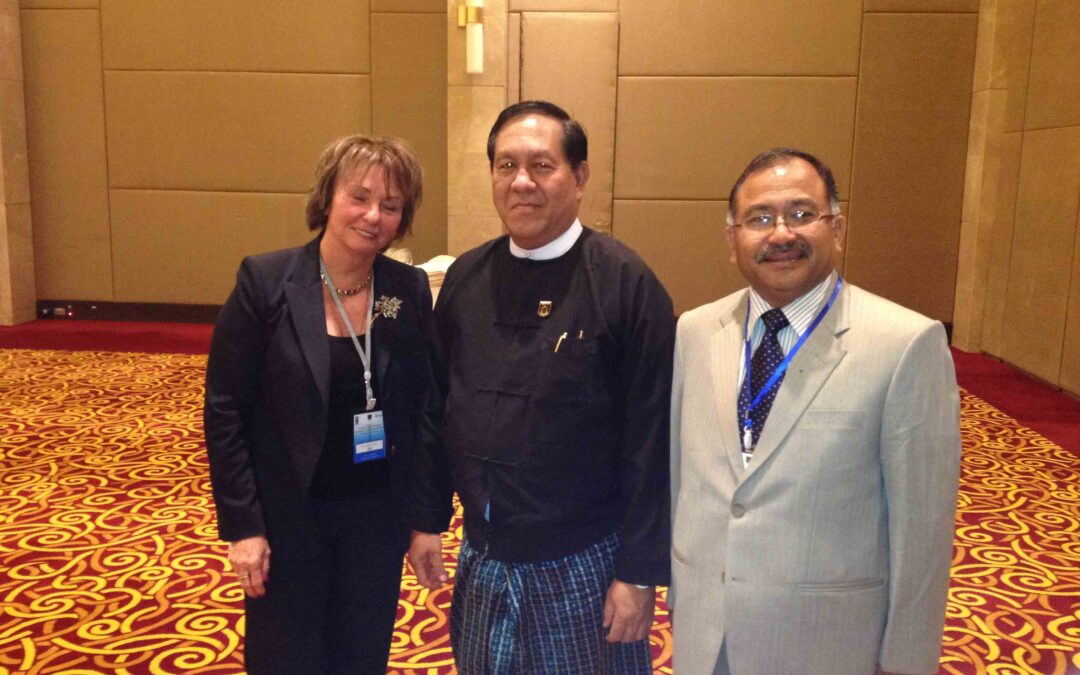
Photo: ICJ Vice President Justice Michèle Rivet, Justice Kalyan Shrestha and Chief Justice U Htun Htun Oo