Jul 1, 2016 | Feature articles, News
A feature article by U Hayman Oo, ICJ Legal Researcher in Yangon, Myanmar.
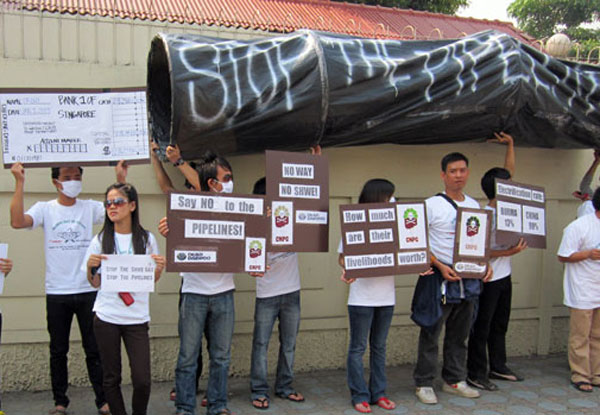
In a recent meeting with Chinese ambassador to Myanmar and villagers, organized in Kyauk Phyu, a villager from Gone Shein Village asked the ambassador to help address the damages caused to their farmland by the Shwe Gas Pipeline Project that began five years ago.
She also expressed doubts that the Kyauk Phyu Special Economic Zone (Kyauk Phyu SEZ) would benefit villagers amid all the unresolved disputes.
Given such disputes, local people are not optimistic about the upcoming development of the Kyauk Phyu SEZ.
They perceive that the project will be a ‘loss’ rather than a ‘gain’ for them.
Most of the local population of farmers fear that the project will be a disaster to their livelihood along with massive land losses.
On a recent trip to Kyauk Phyu by the International Commission of Jurists (ICJ), community members, including local MPs and lawyers, reported their concerns that a second round of such abuses will be experienced, this time even worse, during development of the Special Economic Zone planned for the area, despite promises from the Government that the development will be environmentally sustainable and bring socio-economic benefits to the region.
In fact, Special Economic Zone can contribute to the country’s economy and help benefit the welfare of its people – but only if sound policies of sustainable development in compliance with human rights are in place.
Otherwise, massive economic projects of this kind risk large-scale adverse environmental, social and human rights impacts.
Kyauk Phyu residents know very well how foreign investments can be harmful for the community when investors fail to comply with local laws as well as international standards, because of their experience with the Shwe Gas Project, a Myanmar-China pipeline.
The Gas Pipeline project was notorious for reported labour abuses, and claims of inadequate compensation for land confiscation, arrest and detention of community leaders and loss of community livelihoods and environmental degradation.
Villagers still frequently take to the street demanding for the damages caused to their farmland to be addressed, in the absence of a proper grievance mechanism.
With these prevailing experiences in mind, local residents were alarmed when authorities reportedly measured about 250 acres for the SEZ around Kathapray, Krat Tein, and Thaing Chaung village tracts in Kyauk Phyu, raising more concerns of land acquisition and compensation.
Locals complain that there was no transparent discussion over compensation for this potential land acquisition.
Villagers from Pyai Sate Kay village reportedly lost about 40 acres of farmland to the construction of a reservoir.
Although, the compensation were made for 5.1 acre of farmland, the rest of grazing land was not compensated according to a report from a villager.
There were also complaints that the compensation was neither a current market price nor a sufficient amount of money for them to be able to buy a similar size of land for cultivation.
He also complained that the Government promised to provide replacement land, but that this has not yet happened.
A total of over 70 acres of land was also apparently acquired for another reservoir under construction near Thai Chaung village.
Compensation was only paid for the farmland acreas occupied for the construction excluding land affected by the access to the reservoir.
“We were compensated but the land we lost were not measured properly. The amount paid was only on the basis of approximation. The land we lost should have been measured carefully to pay for the compensation,” said Ko Tun Nu from Thaing Chaung village.
It is reported that these reservoirs were constructed with the purpose of water supply for the SEZ project.
Furthermore, villagers from Ohn Taw and Pyai Sate Kay also reportedly lost a total of 220 acres of land when it was allocated for construction of a police station between the villages.
Although generally the purpose of the security force stationed there is for the security of the township, local people suspect that this increased security presence is instead in preparation to meet the security demands for the planned SEZ project.
There has apparently been no discussion over compensation. It is also questionable whether this volume of land is necessary for the construction of a police station.
According to the Special Economic Zone Law 2014, the Ministry of Home Affairs is responsible for land acquisition in the area of a SEZ in accordance with existing laws and regulations.
It also imposes duties on the investors and developers to bear the expenses of compensation and relocation and to ensure that the standard of living of affected persons does not fall below their original living standard.
The new NLD-led Government has inherited ample land-related problems and has prioritized dealing with these issues.
On May 5th, the Government formed the ‘Central Committee for the Review of the Acquisition of Farmland and Other Land’ in order to combat nation-wide land disputes.
The Committee’s responsibilities include investigation of compliance with existing laws by relevant authorities.
The President has also instructed that all land acquisition cease until all existing land disputes are resolved.
In addressing those issues, it is important that international standards such as Basic Principles and Guidelines on Development Based Eviction and Displacement are integrated into national policies and regulations.
Only then will such projects ensure the protection of the rights and livelihood of communities and the promotion of responsible business in the country.
Myanmar-Kyauk Phyu SEZ-News-Op-eds-2016-BUR (Full text in Burmese, PDF)

Jun 30, 2016 | News
The Pakistani Government should not extend the oppressive and ineffective Protection of Pakistan Act (POPA), which is set to expire on 15 July 2016, said the International Commission of Jurists (ICJ) today.
POPA was enacted in July 2014 for a period of two years to combat “waging of war or insurrection against Pakistan” and to provide “speedy trial” for offences “threatening the security of Pakistan”.
Earlier this week, the Ministry of Interior confirmed that it planned to renew POPA for another two years.
“In these two years, not one suspect has been convicted under POPA, so we can conclude that the law doesn’t really protect people in Pakistan from terrorism and other violent acts, but instead it undermines their basic human rights protections,” said Sam Zarifi, ICJ’s Asia director.
“The Government’s plan to renew this hastily drafted law is a classic case of supposedly ‘temporary’ departures from normal legal processes and human rights protections on the basis of ‘exceptional” circumstances’ becoming a permanent part of the legal system.”
In a statement issued shortly after the Protection of Pakistan Act was enacted, the ICJ warned that POPA gives military and law enforcement authorities sweeping powers to detain individuals in contravention of Pakistan’s international human rights law obligations.
The law allows prolonged preventive administrative detention without adequate safeguards; retrospectively authorizes otherwise arbitrary or unlawful arrests or detentions; authorizes secret and unacknowledged detention; and gives law enforcement agencies broad powers to “shoot at sight”.
In addition, the law creates “special courts” to try scheduled offences under the Act. Procedures for the operation of these “special courts” allow for secret hearings and do not meet international standards for fair and public criminal proceedings before a competent, independent and impartial tribunal.
According to Government officials, the Ministry of Interior has cleared “hundreds of cases of peace disrupting elements” for trial before the “special courts” constituted under POPA.
The five “special courts” remained non-functional for many months because of lack of staff and other facilities. The courts are now functional, but have so far not concluded a single trial.
“POPA is not only an oppressive law, it has also proven to be completely ineffective,” added Zarifi. “Instead of renewing the law, the Government should focus on strengthening the existing criminal justice system, which is suffering because of years of neglect.”
Political groups, including the Muttahida Qaumi Movement (MQM) and the Pakistan People’s Party (PPP), have alleged that the unfettered powers given to civilian and military law enforcement agencies under POPA are being used to target their workers for political activity and association. They say the law has been used to arbitrarily detain dozens of their activists.
“Pakistan faces a genuine threat from militant groups engaging in acts of terrorism, and the Pakistani Government has an obligation to protect all people from such attacks,” said Zarifi. “International law gives governments reasonable flexibility to combat terrorism, without contravening human rights obligations, and claims of ‘threats to national security’ can never be used as a justification for the practice of extrajudicial killings, secret detention, and enforced disappearance.”
The ICJ urges the Pakistani authorities not to extend POPA.
It further calls on the authorities to review all national security legislation to ensure it is fully compatible with international human rights law and standards.
Contact:
Sam Zarifi, ICJ Asia Pacific Regional Director (Bangkok), t: +66 807819002; e: sam.zarifi(a)icj.org
Reema Omer, ICJ International Legal Adviser for Pakistan (London), t: +44 7889565691; e: reema.omer(a)icj.org
Jun 21, 2016 | News
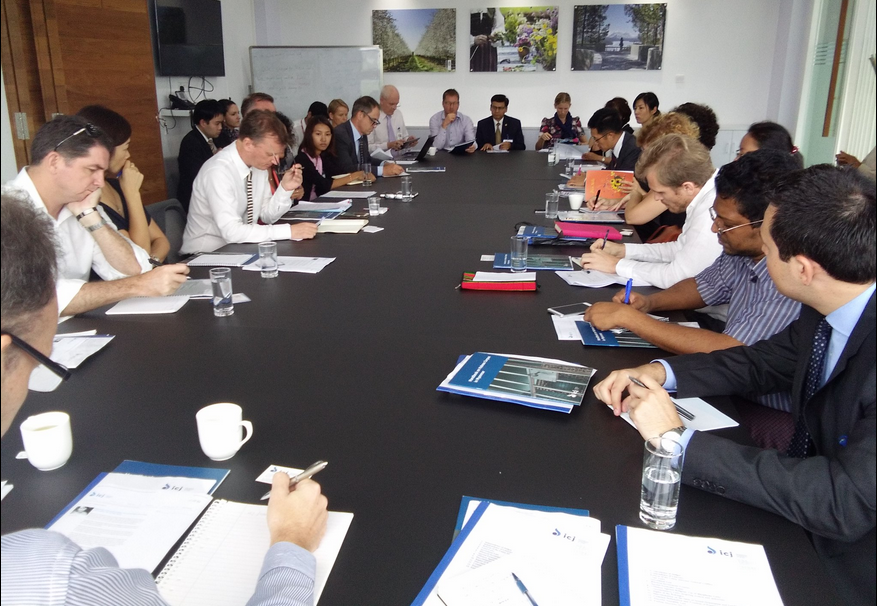
The ICJ urged the diplomatic community in Myanmar to assist, and assess, the new government’s efforts to improve the protection and promotion of human rights in the country at a diplomatic dialogue today.
The ICJ shared its 14 General Recommendations to the new Government and Parliament, with ambassadors and high-level diplomatic representatives, and discussed specific, actionable recommendations to the Government to effectively address human rights violations immediately and in the long term and to provide redress to those whose rights have been violated.
Access to justice for victims of human rights violations has been severely curbed in Myanmar during decades of military rule.
Most of the population has been consistently denied access to the courts and effective remedies as a result of unfair and discriminatory laws and poor court decisions.
With an improper regulatory regime for investment and environmental protection, and an ineffective judiciary to enforce laws and provide access to justice, economic development has risked undermining human rights protection and negatively impacting on economic, social and cultural rights.
Vani Sathisan, ICJ’s International Legal Adviser for Myanmar, stated that while the new government is more receptive than its predecessor to international human rights laws and standards, it should urgently establish a clear plan on strengthening rule of law reform and that all legislation must be guided by the principles of non-discrimination, greater accountability, transparency and justice.
Among the key recommendations the ICJ shared are:
- Supporting the committing of resources to the judiciary as well as the Attorney General’s Office to improve the state of legal education, court facilities, and safeguards to prosecutors to undertake investigations independently;
- Pushing for the passage of new land laws in consultation with civil society modeled on international standards and best practices;
- Ensuring that a new investment law conforms to the new land law that protects all forms of land tenure and provides access to justice when human rights occur;
- Seeking more clarity on the Government’s ability to monitor and regulate the conduct of businesses and their impacts on human rights;
- Supporting and strengthening the capacity of the Myanmar National Human Rights Commission to undertake investigations on human rights violations independently and impartially;
- Repealing or amending laws that are abused to violate the right to freedom of expression and opinion; and
- Encouraging the Government to consult and engage more closely with civil society and the international human rights community.
The diplomatic dialogue aimed to provide the international human rights organizations with an opportunity to clarify their various policy guidelines and provide updates to assist the diplomatic community with their multilateral lobbying efforts in Myanmar with the Executive, Legislative and Judiciary, and civil society.
The Embassy of Denmark hosted the event. Members of the diplomatic community included those from the EU, UK, Canada, Denmark, Sweden, Finland, Australia, The Philippines and Bangladesh.
The ICJ was joined in a panel by the Office of the High Commissioner for Human Rights and Human Rights Watch.
Jun 9, 2016 | News
The Thai military must immediately withdraw its abusive criminal complaints against three leading human rights defenders for raising allegations of torture in Thailand’s restive deep South, said the ICJ today.
“It is simply astonishing that the Thai government is lodging these complaints at a time when Thailand has just promised to adopt important anti-torture legislation and has publicly reaffirmed its commitment to protect human rights defenders,” said Sam Zarifi, ICJ Asia Regional Director.
“The military must immediately withdraw its complaints and instead ensure all allegations of torture and ill-treatment are promptly and effectively investigated in line with Thailand’s international legal obligations,” he added.
On 10 February 2016, three Thai organizations, the Cross Cultural Foundation (CrCF), Duay Jai Group (Hearty Support Group), and the Patani Human Rights Organization (HAP), issued a report that documented 54 cases of alleged torture and ill-treatment by the Thai authorities in the deep South since 2004.
On 17 May 2016, the Internal Security Operations Command (ISOC) Region 4, responsible for national security operations in the Southern Border Provinces, responded to the report by filing complaints of criminal defamation and violations of the Computer Crime Act B.E. 2550 (2007) against the report’s three co-editors, Somchai Homlaor and Pornpen Khongkachonkiet of CrCF, and Anchana Heemmina of Hearty Support Group.
Criminal defamation carries a maximum penalty of two years imprisonment and a fine of up to 200,000 Baht (USD $5,600). Violation of article 14(1) of the Computer Crime Act, carries a maximum penalty of five years imprisonment or a fine of up to 100,000 Baht (USD $2,800), or both.
It is the second time since 2014 that the Thai military has filed criminal defamation complaints against Pornpen Khongkachonkiet and Somchai Homlaor for raising allegations of torture in the deep South.
“The Thai military should also take heed of the recent decision of the Phuket Provincial Court in the Phuketwan case, which found that the Computer Crime Act was not intended to cover allegations of defamation,” said Zarifi.
On 1 September 2015, the Phuket Provincial Court acquitted two journalists of criminal defamation and violations of the Computer Crime Act after the Royal Thai Navy complained the journalists defamed it when, on 17 July 2013, the journalists reproduced a paragraph from a Pulitzer prize-winning Reuters article that alleged “Thai naval forces” were complicit in human trafficking.
The use of criminal defamation laws, carrying penalties of imprisonment, against human rights defenders reporting on alleged human violations, constitutes a violation of Thailand’s obligations under the International Covenant on Civil and Political Rights (ICCPR), to which it is a state party.
As affirmed in the UN Declaration on Human Rights Defenders, “Everyone has the right, individually and in association with others:… freely to publish, impart or disseminate to others views, information and knowledge on all human rights and fundamental freedoms.”
Background
On 17 December 2015, Thailand joined 127 other states at the UN General Assembly in adopting a UN Resolution on human rights defenders. The Resolution calls upon states to refrain from intimidation or reprisals against human rights defenders.
Last month, Thailand informed the Human Rights Council during its Universal Periodic Review that the Cabinet was considering a draft Act on Prevention and Suppression of Torture and Enforced Disappearance. It was reported that the Cabinet approved the draft law on 24 May 2016.
At the conclusion of the review, Thailand also adopted several recommendations to protect human rights defenders and investigate reported cases of intimidation, harassment and attacks against them.
The right to an effective remedy against torture and other ill-treatment and to have complaints promptly, fully and impartially investigated is guaranteed under international treaties to which Thailand is party, including the Convention against Torture and Other Cruel, Inhuman or Degrading Treatment or Punishment and the ICCPR.
Thailand has an obligation under both treaties to conduct such investigations where there are allegations of torture and ill-treatment and to bring to justice those responsible in fair criminal proceedings.
Thailand was criticized in May 2014 for its failure to address violations when the United Nations Committee Against Torture expressed its concern “at the numerous and consistent allegations of serious acts of reprisals and threats against human rights defenders, journalists, community leaders and their relatives, including verbal and physical attacks, enforced disappearances and extrajudicial killings, as well as by the lack of information provided on any investigations into such allegations.”
The Committee recommended that Thailand “should take all the necessary measures to: (a) put an immediate halt to harassment and attacks against human rights defenders, journalists and community leaders; and (b) systematically investigate all reported instances of intimidation, harassment and attacks with a view to prosecuting and punishing perpetrators, and guarantee effective remedies to victims and their families.”
Contact:
Sam Zarifi, Asia Regional Director, t: +66 80 781 9002; e: sam.zarifi(a)icj.org
Kingsley Abbott, Senior International Legal Adviser, t: +66 94 470 1345; e: kingsley.abbott(a)icj.org
Thailand-Retaliation HRDs-News-web stories-2016-ENG (full story in Thai, PDF)

Jun 2, 2016 | News
The ICJ is alarmed by the intimidation and harassment experienced by bloggers in Singapore recently, perpetrated by police authorities.
In the last few days, the homes of four bloggers were raided and their phones and laptops confiscated, without the legal process or justification required by international standards.
The ICJ strongly urges the Government of Singapore to stop this harassment and ensure that bloggers are protected against such unjustified interference with or reprisals for the exercise of their right to freedom of expression.
“By resorting to this kind of harassment and intimidation of bloggers, Singapore is showing complete disregard for human rights and the rule of law,” said Sam Zarifi, ICJ’s Regional Director for Asia and the Pacific.
“The Government of Singapore must stop intimidating citizens who express their political opinions openly. The actions taken by the Singaporean police against the four bloggers do not only constitute an attack on freedom of opinion and expression in the country, but also clearly violates their right to privacy,” he added.
On 27 May 2016, the Election Department of Singapore filed police reports alleging that bloggers Roy Ngerng and Teo Soh Lung, and The Independent Singapore, an independent news website, violated the rules against election advertising ahead of polling day.
Under Singapore’s election rules, campaigning is prohibited 24-hours prior to polling day, which is called the “Cooling-Off Day”.
Roy Ngerng and Teo Soh Lung were alleged to have written posts on their social media accounts expressing support for the opposition candidate, Mr. Chee Soon Juan.
The Independent Singapore, on the other hand, was alleged to have published articles that amount to election advertising.
The ICJ considers that provisions or interpretations of Singapore’s election laws that would impose a sweeping ban on all political expression in relation to particular candidates in a 24-hour period prior to polling day, including the expression of opinions by private individuals without remuneration, cannot constitute a demonstrably justified and proportionate restriction on freedom of opinion and expression under international standards.
Early this year, the delegation representing the Government of Singapore said as it went through the 2nd cycle of the Universal Periodic Review that “no one in Singapore is prosecuted for criticizing the government or its policies.”
The delegation emphasized that Singapore’s Constitution guarantees the right to freedom of expression.
The Government of Singapore also accepted recommendations made by other States at the Universal Periodic Review to “ensure the full enjoyment of the right to freedom of expression”.
It also accepted the recommendation to protect bloggers from persecution and harassment for the exercise of their human rights.
The ICJ urges the Government of Singapore to remain true to the commitments it made during the recent Universal Periodic Review and respect the right to freedom of expression of bloggers.
Contact:
Emerlynne Gil, ICJ’s Senior International Legal Adviser for Southeast Asia, t: +668 4092 3575 ; e: emerlynne.gil(a)icj.org
Additional information
On 6 May 2016, The Independent Singapore published two articles: 5 Highlights of DPM Speech and Workers’ Party and the Bukit Batok by-election – what WP members said.
The first article reported about the speech of the Deputy Prime Minister of Singapore at the rally of the ruling party, the People’s Action Party (PAP), wherein he expressed support for the PAP candidate.
The second article reported statements made by the Workers’ Party (WP) members on key issues relating to the elections.
On 7 May 2016, it published the article Tan Cheng Bock Denies involvement in posting by irrational group of PAP fans, where it reported on how the former Member of Parliament, Dr. Tan, disavowed statements he allegedly made and that were posted on the Facebook group which favor the ruling party.
On 31 May 2016, Roy Ngerng and Teo Soh Lung were interrogated for three hours by police. The two were interrogated separately. Teo Soh Lung was accompanied by her lawyer, while Roy Ngerng was not.
After the interrogation, the police accompanied the bloggers back to their respective homes. The police searched their homes without warrants or their consent, and confiscated their mobile phones, laptops, and hard disks. After the search, Roy Ngerng was taken back to the police station and interrogated for another few hours.
At the police station, law enforcement authorities intimidated Roy Ngerng into logging in and out of his social media accounts and his blog, The Heart Truths, in their full view and presence.
The publisher and editor of The Independent Singapore were likewise interrogated separately by the police, on 31 May 2016 and 1 June 2016. Their mobile phones and laptops were also confiscated by the police after their interrogation.
May 31, 2016 | News
Myanmar’s Supreme Court engages in 2nd High Level Dialogue with the ICJ on Drafting and Implementing a New Judicial Code of Ethics and Accountability.
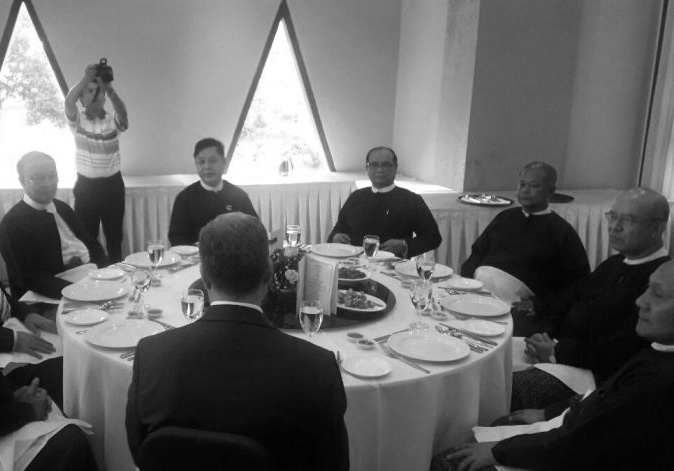
The ICJ, the United Nations Development Program and the Office of the Supreme Court of the Union (OSCU) held a High Level Dialogue on “Implementing a Code of Judicial Ethics” in Nay Pyi Taw on 30-31 May 2016.
This dialogue followed a commitment by the OSCU to draft a code and to ensure it is informed by and implemented in accordance with international best practice. The OSCU’s Judicial Ethics Review Committee, Supreme Court and High Court Judges and other senior court administrators participated in the dialogue.
Building on the previous dialogue’s focus on the contents of a code of ethics, the participants and their international counterparts from the ICJ and UNDP discussed international standards for accountability and implementation mechanisms to accompany a code of ethics.
In opening the dialogue, the Honourable Supreme Court Justice of the Union, U Mya Thien explained that the new code reflected international standards and would enhance public trust and promote accountability in the Judiciary.
In his opening remarks, ICJ Commissioner and Justice of the Supreme Court of South Africa, Azhar Cachalia, explained the importance of the code as a basis for legitimacy and independence.
He stressed that the judiciary must become accountable to the public.
“Myanmar has an historic opportunity to make decisions that will shape the judiciary for generations to come,” he said.
During the dialogue, the UNDP’s Elodie Beth outlined research on regional judicial accountability and its lessons for Myanmar.
Sam Zarifi, the ICJ’s Regional Director shared experience and international standards on implementing a code of ethics Zarifi explained that “in order for it to be effective, the Supreme Court must establish mechanisms and institutions to hold judges accountable to the code of ethics.”
All participants agreed that implementing a proper code of ethics would strengthen the accountability and independence of Myanmar’s judiciary.
Both the UNDP and the ICJ congratulated the OSCU for following its Strategic Plan for 2015-2018 and engaging in a dialogue designed to further this process.
Both expressed willingness to continue working with Myanmar’s judiciary on the issues of judicial independence, the rule of law and human rights.