May 30, 2016 | News
The ongoing criminal trial in the Loei Provincial Court, where a verdict is awaited tomorrow, is an important test of Thailand’s commitment to hold those responsible for criminal offences against human rights defenders to account, the ICJ and Protection International said today.
On 31 May, the Loei Provincial Court will render its verdict following the trial of retired Royal Thai Army officer, Lt Gen Poramet Pomnak, and his son, Royal Thai Army officer, Lt Col Poramin Pomnak, on criminal charges related to their alleged participation in a violent attack by a group of over 100 armed men against members of the Khon Rak Ban Kerd Group (KRBKG) in Nanonbong village in Loei and other villagers.
The victims were assaulted and held captive for over seven hours during the attack in the evening of 15 May 2014.
More than 20 people were injured, with seven requiring hospitalization for serious injuries.
KRBKG is a community-based group protesting what they allege is the damaging impact of mining operations on their health and their environment.
Most of KRBKG’s activities have focused on stopping the operations of the Phuthapfa gold mine operated by Thai company, Tungkum Ltd., situated in Loei Province.
“This case has become emblematic of the human rights abuses faced by human rights defenders trying to protect their communities in Thailand,” said Sam Zarifi, ICJ’s Asia Director. “Many people are looking at this case to see whether the Thai government will follow through on its commitment to protect human rights defenders.”
The attack on Nanonbong village occurred after KRBKG and local residents barricaded the road to the gold mine, which passes through the village.
During the attack, the barricade was destroyed and at least 13 trucks were reportedly seen transporting materials from the mine site.
Partly based on the villagers’ testimony that Lt Col Poramet Pomnak and Lt Col Poramin Pomnak were involved in the 15 May violence, the two were indicted on several charges, including offences of ‘injury to the person causing bodily harm’ and ‘false imprisonment’ (or illegal deprivation of liberty), under articles 295 and 309 of the Thai Criminal Code.
“Given credible reports that a group of over 100 armed men were involved, the ICJ is concerned that only two people have been indicted for the attack, and we are therefore calling on the Thai authorities to re-open investigations and ensure all those responsible are held to account and redress is provided for the victims concerned,” Zarifi added.
The case against Lt Col Poramet Pomnak and Lt Col Poramin Pomnak comes against a background of disputes between KRBKG and Tungkum Ltd.
The company filed at least 19 criminal and civil lawsuits against 33 members of KRBKG and other villagers in the past seven years.
One of those cases includes claims of criminal defamation against a 15-year old girl who allegedly made negative statements about the company’s activities on a television program.
Members of KRBKG have joined as plaintiffs in the criminal case and are demanding compensation from the two defendants.
Background
Lt Col Poramet Pomnak and Lt Col Poramin Pomnak were formally indicted on the following charges of the Thai Penal Code: articles 295 (‘injury to the person causing bodily harm’) and 296 (sentencing for bodily harm), 309 (‘false imprisonment’ or ‘illegal confinement’) and 310 (sentencing for false imprisonment), 358 (‘offence of mischief’ or ‘damage to property’) 371 (‘offence of bearing arms’), 376 (‘offence of discharging a firearm’), 391 (sentencing for acts of violence not amounting to bodily harm) taken together with articles 32, 33, (‘forfeiture of property used in the commission of an offence’) 83, 84, (principals and accomplices, accessories or conspirators) 91, (articles 90 and 91 set out provisions for sentencing when an act constitutes multiple offences. Sentences can be awarded for each offence consecutively, but with a maximum time as prescribed by article 91); and articles 4, 7, 8bis, 72, 72bis of the Firearms, Ammunition, Explosives, Fireworks, and the Equivalent of Firearms Act B.E.2490 (1947); article 3 of the Firearms, Ammunition, Explosives, Fireworks, and the Equivalent of Firearms Act (No.3) B.E.2501 (1958); No. 3, 6, 7 of the Order of the Announcement of the National Administrative Reform Council no.44 dated 21 October 1976.
Thailand has a legal obligation to protect all human rights defenders from retaliation for the legitimate and lawful exercise of their rights. On 17 December 2015, Thailand joined 126 other States at the UN General Assembly in adopting one of the latest UN resolutions on human rights defenders. General Assembly resolution 70/161 recognizes the importance of States’ protection of human rights defenders, in particular from being prosecuted for peaceful activities and against other threats, harassment and intimidation; and encourages States to investigate allegations of intimidation and reprisals, and to bring perpetrators to justice.
Thailand-Loei case-News-2016-THA (full text in Thai, PDF)
May 15, 2016 | News
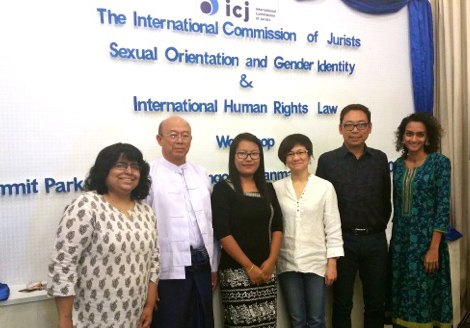
The ICJ hosted a workshop on “Sexual Orientation and Gender Identity and International Human Rights Law” in Yangon on 14 and 15 May 2016.
The workshop was the first of its kind in Myanmar to bring together such a varied group of people to discuss the topic of Sexual Orientation and Gender Identity (SOGI) and international human rights law.
The event drew together a diverse group, including more than 50 lawyers from different parts of Myanmar, along with lesbian, gay, transgender, bisexual, inter-sex and queer (LGBTI) activists, members of the Myanmar National Human Rights Commission, and regional academics and lawyers and international experts.
Myanmar-SOGI workshop-News-Web Story-2016-ENG (full story in PDF)
May 13, 2016 | News
Nepal’s leading political parties should not bargain away justice for victims of serious human rights abuses as part of an agreement to form a new coalition government, the ICJ, Human Rights Watch, and Amnesty International said today.
A new agreement between the ruling parties threatens to entrench impunity for those who planned and carried out killings, enforced disappearances, torture, and other crimes in Nepal’s civil war, just as the country’s long delayed transitional justice process is finally about to get under way.
On May 5, 2016, presumably in a bid to retain the support of the United Communist Party of Nepal (Maoist) (UCPN-M) for the Communist Party of Nepal-Unified Marxist Leninist (CPN-UML) coalition government of Prime Minister K.P. Sharma Oli, the two ruling coalition partners agreed to a nine-point deal containing provisions that aim to shield perpetrators of abuses in Nepal’s decade-long civil war.
Provision 7, which directs the authorities to withdraw all wartime cases before the courts and to provide amnesty to alleged perpetrators, is particularly problematic.
“This political deal between the ruling parties is extremely damaging to the credibility of an already deeply politicized and flawed transitional justice process in the eyes of Nepal’s victims,” said Sam Zarifi, ICJ Asia-Pacific Director.
“Moreover, it flies in the face of Nepal’s international human rights obligations and the rulings of its own Supreme Court by trying to wash away the crimes of the conflict by attempting to coopt pending criminal cases and provide blanket amnesty to alleged perpetrators,” he added.
The Supreme Court of Nepal has in several instances reaffirmed the principle under international law that amnesties are impermissible for serious international crimes.
However, Nepal authorities have consistently ignored the orders from the country’s highest court.
Nepal has an obligation under international law to investigate and, where sufficient evidence exists, prosecute crimes under international law, including torture and other ill-treatment, enforced disappearance, extrajudicial executions, war crimes, and crimes against humanity.
Article 2 of the International Covenant on Civil and Political Rights (ICCPR) and Article 14 of the Convention against Torture and Other Cruel, Inhuman and Degrading Treatment or Punishment (CAT) – both treaties to which Nepal is a party – require states to ensure the right to an effective remedy and reparation for victims of human rights violations.
“The political deal by the ruling parties to grant amnesty to those responsible for conflict-era human rights abuses is a callous attempt to disregard Nepal’s international treaty obligations by violating victims’ right to an effective remedy,” said Brad Adams, Asia Director at Human Rights Watch. “Nepal’s political deal jeopardizes the war victims’ last best hope for justice and accountability.”
The applicability of this international obligation under Nepali law was reaffirmed by the Nepal Supreme Court in its 2015 decision in the Suman Adhikari case, striking down provisions of the Investigation of Disappeared Persons, Truth and Reconciliation Commission Act, 2014 (TRC Act) that it ruled were inconsistent with international law and ordering the government to amend the TRC Act, the May 2014 legislation creating the two transitional justice mechanisms, the Commission on Investigation of Disappeared Persons (COID) and the Truth and Reconciliation Commission (TRC).
The Supreme Court ruled in the same decision that criminal cases already before the judiciary could not be transferred to the two commissions, confirming that the judiciary and not the commissions had the authority to determine the criminality of conflict-era human rights violations.
“Nepal’s ruling parties cannot bargain away victims’ rights to truth, justice, and reparation by using the commissions as a substitute for their legal obligations to investigate and prosecute human rights abuses through the criminal justice system,” said Champa Patel, South Asia Regional Office Director at Amnesty International.
The ICJ, Human Rights Watch, and Amnesty International, along with Nepali civil society, victims’ groups, the United Nations, and the international diplomatic community, have consistently called for the Nepal government to amend the TRC Act in line with Nepal’s international obligations as well as the Supreme Court’s jurisprudence, in order to ensure a credible transitional justice process that safeguards victims’ rights and conforms to rule of law principles.
In a flagrant display of deliberate disregard for the rule of law, however, the ruling parties’ deal to amend the TRC Act by attempting to reinforce the same amnesty provision that has been repeatedly struck down by the Supreme Court ignores both the country’s international legal obligations and the binding judgments of its own apex court, and further threatens the prospects for post-war justice and accountability in Nepal.
The ICJ, Human Rights Watch, and Amnesty International therefore call upon the Nepal government to take immediate and effective steps to safeguard victims’ rights to truth, justice, and reparation through a credible transitional justice process that is free of any political interference or any forms of pressure or intimidation.
Contact
Sam Zarifi, ICJ Asia-Pacific Director, t: +66-807-819-002; e: sam.zarifi(a)icj.org
Nikhil Narayan, ICJ Senior Legal Adviser, t: +977-981-318-7821 (mobile); e: nikhil.narayan(a)icj.org
May 13, 2016 | News
The ICJ and other human rights organizations condemn the imminent executions of Kho Jabing in Singapore and at least 15 individuals which apparently includes, 4 Chinese nationals, 2 Nigerians, 2 Zimbabweans, 1 Senegalese, 1 Pakistani and 5 Indonesian nationals in Indonesia.
The organizations call on the authorities of the two countries to halt the impending executions.
On 12 May 2016, the family of Kho Jabing, a Malaysian national on death row in Singapore, received a letter from the Singapore Prisons informing them that he would be executed on 20 May 2016. Kho Jabing was convicted of murder in 2011.
Of particular concern is the fact that there was a lack of unanimity in sentencing Kho Jabing to death, which demonstrates that reasonable doubt exists as to whether he deserved the death penalty.
As regards the imminent executions that will be taking place in Indonesia, Indonesia would contravene her own international obligations under the International Covenant on Civil and Political Right by executing these individuals.
The Association of South East Asian Nations Member States (“ASEAN”), including Singapore and Indonesia, have continuously emphasized the importance of the rule of law and the protection of rights.
The death penalty therefore stands out as an aberration.
In December 2014, the United Nations General Assembly adopted its latest resolutions calling on all States to adopt a moratorium on the use of the death penalty, with a view towards abolition.
A record number of 117 Member States supported the Resolution.
Regrettably, Indonesia abstained and Singapore voted against the Resolution.
The ASEAN Member States must use the opportunity presented by this Resolution to align themselves with the global movement towards abolition.
Singapore has recently undergone its second Universal Periodic Review in January 2016.
The continued use of the death penalty was one of the key highlights of the review, with Singapore receiving over 30 recommendations related to the death penalty, including recommendations to abolish the death penalty.
In 2015, Indonesia, a United Nations Human Rights Council Member until 2017, executed 14 individuals convicted of drug-related offences amid strong international opposition.
The imminent executions would further damage Indonesia’s human rights record and erode her standing in the international community.
The death penalty has no place in the 21st Century.
Not only is there a real possibility of wrongful executions, it deprives inmates of their life and dignity, and creates new classes of victims.
We strongly urge the governments of Singapore and Indonesia to halt the upcoming executions, immediately impose a moratorium on the use of the death penalty and take meaningful steps towards its eventual abolition.
List of signatories:
Anti-Death Penalty Network Asia (ADPAN)
Center for Prisoner’s Rights Japan (CPR)
Community Action Network (CAN, Singapore)
Free Community Church (Singapore)
Function 8 (Singapore)
MADPET (Malaysians Against Death Penalty and Torture)
Maruah (Singapore)
International Commission of Jurists (ICJ)
Journey of Hope
Legal Aid Community (LBH Masyarakat, Indonesia)
Murder Victims’ Families for Human Rights (MVFHR)
Ocean
Pusat Studi Hukum dan Kebijakan Indonesia (The Indonesian Center for Law and Policy Studies)
Reprieve Australia
Sayoni (Singapore)
Singapore Anti-Death Penalty Campaign (SADPC)
Suara Rakyat Malaysia (SUARAM)
Taiwan Alliance to End the Death Penalty (TAEDP)
The Commission for the Disappeared and Victims of Violence (KontraS, Indonesia)
The Indonesian Center for Law and Policy Studies (PSHK, Indonesia)
The Institute for Criminal Justice Reform (ICJR, Indonesia)
The Institute for Policy Research and Advocacy of Indonesia (ELSAM)
The National Human Rights Society, Malaysia (HAKAM)
Think Centre Singapore
We Believe in Second Chances (WBSC, Singapore)
Contact:
Sam Zarifi, ICJ Asia-Pacific Director, t: +66-807-819-002; e: sam.zarifi(a)icj.org

May 9, 2016 | News
Bangladesh President Abdul Hamid must stay the execution of opposition political leader Motiur Rahman Nizami, said the ICJ today.
On 5 May 2016, the Supreme Court of Bangladesh dismissed a petition by Motiur Rahman Nizami to review its previous decision confirming his death sentence.
He is now at imminent risk of execution.
“Bangladesh must stay this execution, and end its continued and unlawful use of the death penalty,” said Sam Zarifi, ICJ’s Asia-Pacific Director. “The death penalty is not justice and is the ultimate form of cruel and inhuman punishment.”
Motiur Rahman Nizami, a leader of the Jamaat-e-Islami party, was found guilty of crimes committed during the 1971 war for independence in Bangladesh, including genocide, torture, and the murder of intellectuals, and sentenced to death by the International Crimes Tribunal (ICT) in October 2014.
The Supreme Court confirmed this decision and sentence on appeal earlier this year, following which Motiur Rahman Nizami filed his review petition.
Thus far, four individuals have been executed based on convictions by the Bangladesh International Crimes Tribunal: Salahuddin Quader Chowdhury and Ali Ahsan Mohammad Mujahid were executed in November 2015; Muhammad Kamaruzzaman was executed in April 2015; and Abdul Qader Mollah was executed in 2013. Several others have been sentenced to death.
“The perpetrators of the atrocities committed during the 1971 war for independence must be brought to justice and held to account for their crimes,” said Zarifi.
“However, another execution on the basis of a flawed trial that is inconsistent with international human rights standards undermines justice, and must be stopped,” he added.
Bangladesh is party to most of the principal human rights treaties, including the International Covenant on Civil and Political Rights, which obliges it to respect the right to a fair trial.
The ICJ has previously raised concerns that trials before the ICT are not in compliance with Bangladesh’s international legal obligations, and international standards for fair trials.
According to the ICJ, there are serious procedural flaws at all stages: pre-trial release has been routinely and arbitrarily denied; witnesses have been abducted and intimidated; and there have been credible allegations of collusion between the Government, prosecutors and judges.
Background information
In a statement on 8 April 2016, the UN Office of the High Commission of Human Rights reaffirmed that trials before the ICT in Bangladesh did not met international standards of fair trial and due process, and that the imposition of a death sentence in such circumstances constitutes a violation of the right to life.
The ICJ opposes capital punishment in all cases without exception. The death penalty constitutes a violation of the right to life and the right not to be subjected to cruel, inhuman or degrading punishment.
In December 2014, the UN General Assembly adopted a resolution, for the fifth time since 2007, emphasizing that that the use of the death penalty undermines human dignity and calling on those countries that maintain the death penalty to establish a moratorium on its use with a view to its abolition.
A majority of 117 UN Member States voted in favor of a worldwide moratorium on executions as a step towards abolition of the death penalty.

May 9, 2016 | News
The ICJ is deeply concerned at the recent legal harassment of several Cambodian human rights defenders and perceived political opponents, which raises serious questions as to the impartiality of the investigators, prosecutors and judges involved.
The ICJ calls on the Government to immediately conduct an independent review of the decision to pursue these cases, to end the prosecution of those who have been charged if the allegations are found to be groundless or the proceedings to have been unlawful or abusive, to cease the use of judicial and prosecutorial processes to harass and intimidate human rights defenders and perceived political opponents, and to respect its international obligations under the Convention on the Privileges and Immunities of the United Nations.
“The decision to proceed with these cases should be subject to a careful and independent review and any charges that have resulted must be dropped if the allegations are found to be without merit or have been carried through unlawful or abusive procedures,” said Kingsley Abbott, International Legal Adviser for Southeast Asia with the ICJ.
“The strong appearance of bias present in these cases flies in the face of the absolute right of all accused to have their case considered by independent and impartial prosecutors and judges at every stage of the process,” he added.
The different proceedings all stem from allegations centered on an alleged affair between Khom Chandaraty (also known as Srey Mom) and Kem Sokha, acting leader of the opposition Cambodia National Rescue Party (CNRP).
After a voice recording appeared on social media, allegedly of a conversation between them, the Cambodian Counter-Terrorism Directorate of the Government’s Central Directorate for Security “invited” Srey Mom for questioning, which prompted her to seek human rights assistance from a leading Cambodian NGO, the Cambodian Human Rights and Development Association (ADHOC).
On 11 March 2016, the Counter-Terrorism Directorate questioned Srey Mom. She denied the suggestions she had a relationship with Kem Sokha and that she was the female voice on the recording.
On 19 April 2016, after having met with ADHOC on a number of further occasions, Srey Mom was asked in a closed session with a prosecutor at the Phnom Penh Municipal Court to answer allegations of having provided false testimony and of having engaged in prostitution.
On this occasion, Srey Mom admitted to a relationship with Kem Sokha.
On 22 April 2016, Srey Mom alleged in an open letter that ADHOC staff had attempted to persuade her to lie to the authorities.
On 2 May 2016, an Investigating Judge in Phnom Penh charged four staff members of ADHOC, Nay Vanda, Ny Sokha, Yi Soksan, and Lem Mony, with “bribery of a witness”.
A former staff member of ADHOC, Ny Chakrya, and a staff member of the Cambodia Office of the High Commissioner for Human Rights (OHCHR), Sally Soen, were also charged with being accomplices, notwithstanding Sally Soen’s immunity from prosecution under the Convention on the Privileges and Immunities of the United Nations.
The allegation of bribery appears to relate to the fact that ADHOC reportedly provided Srey Mom with a small sum of money to cover food and transport costs, including to attend questioning by judicial authorities.
“While Cambodia has a positive legal duty under international law to protect human rights defenders from attacks arising out of their work, these proceedings appear to be aimed at intimidating and silencing Cambodian civil society and are the latest in a series of laws and actions directed against them,” said Abbott.
Last year, the Government passed the Law on Associations and NGOs (LANGO), which Abbott stated would “severely restrict the ability of members of civil society to exercise their rights to freedom of association and expression which Cambodia has a duty to protect under its international obligations.” Abbott further stated that the Governments intention was to “…weaken the impact of NGOs, including human rights defenders.”
Under Article 12 of the United Nations Declaration on Human Rights Defenders, States have an obligation to take all necessary measures to ensure the protection of human rights defenders, including against any threats, pressure, retaliation or arbitrary action as a consequence of the legitimate exercise of their rights under the Declaration.
In other proceedings, the Phnom Penh Municipal Court summoned Kem Sokha to answer allegations of criminal defamation and two other members of the CNRP, Pin Ratana and Tok Vanchan, have been questioned about allegations of prostitution.
Political commentator, Ou Virak, has been summoned to appear in the Phnom Penh Municipal Court on 12 May 2016 to answer allegations of criminal defamation for expressing the view that the ruling Cambodian Peoples Party (CPP) was exploiting the alleged affair between Kem Sokha and Srey Mom.
On 24 April 2016, a CNRP commune chief, Seang Chet, was arrested and detained on charges of bribery after Srey Mom alleged Seang Chet had attempted to pay her mother US $500 to encourage her to deny the affair.
Read also:
Cambodia: the ICJ condemns Senate’s approval of draft Law on Associations and NGOs
Cambodia: approved NGO law poised to hobble the work of civil society
Cambodia: withdraw draft law on associations and non-governmental organizations – joint letter
Cambodia: ICJ and other rights groups urge end to NGO law
Contact
Kingsley Abbott, ICJ’s International Legal Adviser, t: +66 94 470 1345, e: kingsley.abbott(a)icj.org