Apr 6, 2017 | News
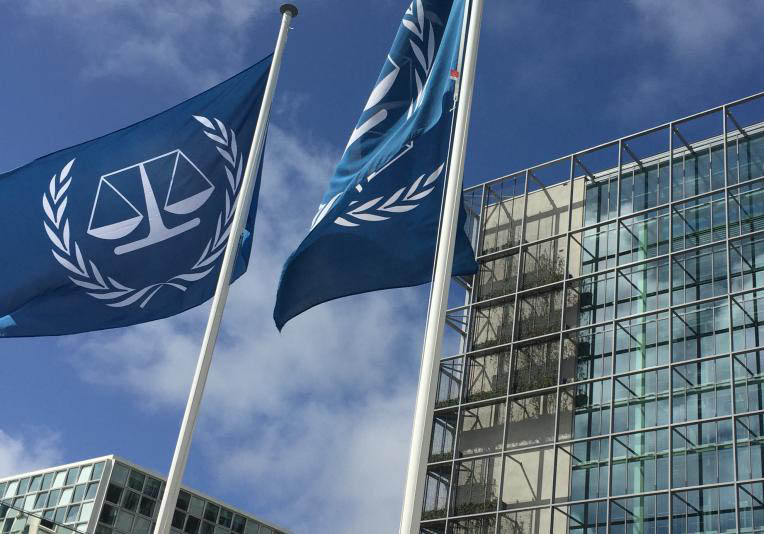
South Africa is to appear before a scheduled hearing at the International Criminal Court on 7 April 2017 (ICC) in The Hague for a hearing on its failure to arrest Sudanese President Omar Hassan Ahmad al Bashir when he visited South Africa in June 2015.
The hearing, before the pre-trial Chamber of the ICC will consider whether South Africa was in breach of its obligations under the ICC Rome statute when it failed to effect the ICC arrest warrant on President Bashir.
The ICJ, represented by South African Justice Johann Kriegler, will be attendance observing the proceedings.
President Bashir has been indicted by the ICC on charges of genocide, war crimes and crimes against humanity in relation to atrocities committed from 2003 to 2008 in Darfur.
“The case is critical for ensuring the effectiveness of the ICC as an institution. The only means the ICC has of enforcing its orders is through the cooperation of States,” said Sam Zarifi the Secretary General of the ICJ.
“The failure to arrest President Bashir and the subsequent efforts to withdraw from the ICC Rome statute raise important questions about South Africa’s commitment to the fight against impunity in Africa and globally,” Zarifi added.
South Africa gave notice last October that it intended to leave the ICC, but this notice has been withdrawn, at least pending debate in Parliament.
The ICJ had filed a brief with the South African Parliament calling on South Africa to remain with the ICC Rome statute.
The brief was signed by retired South African Constitutional Court Justices Laurie Ackermann, Richard Goldstone, Johann Kriegler, Yvonne Mokgoro, Kate O’Regan and Zak Yacoob.
It was co-signed by Navi Pillay, former United Nations High Commissioner for Human Rights, former judge of the ICC and former President of the International Criminal Tribunal for Rwanda (ICTR) and Wilder Tayler, then Secretary General of the ICJ.
Justice Zak Yacoob remarked that “pursuit of justice and pursuit of peace are complementary and mutually reinforcing objectives that South Africa will best achieve by remaining party to the Rome Statute of the ICC. Its not an either or situation. Protecting heads of States from justice whatever they do compromises peace too much.”
Contact
Arnold Tsunga, ICJ Director for Africa, t +27716405926 ; e: arnold.tsunga(a)icj.org
Background
South Africa was among the first States to ratify the Rome Statute of the ICC. It signed the Rome Statute on the day it was adopted, 17 July 1998, and ratified it on 27 November, 2000.
Both during the negotiations preceding the Rome Conference that established the Court in 1998, and at the Conference itself, South Africa played a leading role.
However, the events of June 2015 surrounding the arrival of President Omar al Bashir of Sudan in South Africa appears to have engendered a shift in South Africa’s posture, leading many observers to call into question the country’s commitment to international justice.
The failure by South African authorities to arrest and surrender President al Bashir to the ICC, although he had been indicted by the ICC for war crimes, crimes against humanity and genocide, led to the Southern Africa Litigation Centre (SALC) taking the government to court to compel it to fulfill its obligations both under the Rome Statute and the Implementation of the International Criminal Court Act 27 of 2002 (Implementation Act).
On 19 October 2016, the Minister of International Relations and Co-operation gave notice of South Africa’s intention to withdraw from the Rome Statute.
The Portfolio Committee on Justice and Correctional Services put out a call for submissions to be made to the Parliamentary Portfolio Committee on Justice and Correctional Services on the Implementation of the Rome Statute of the International Criminal Court Act Repeal Bill [B23-2016] to be made by 8th March 2017.
Mar 30, 2017 | News
The ICJ expressed its hope today that an arrangement reached between four judges of the High Court and Botswanan President Ian Khama along with Chief Justice Dibotelo would serve to restore the effective functioning of the High Court and its critical role in the administration of justice.
The settlement resulted in Justices Key Dingake, Modiri Letsididi, Ranier Busang and Mercy Garekwe withdrawing a petition and letter they had written complaining about what they considered to be a range of deficiencies in the justice system, as well as a failure of leadership in judicial administration.
The President and executive, for its part, discontinued pursing allegations of misconduct and bringing the name of the judiciary into disrepute against the judges and disestablished the impeachment tribunal that had been set up to try them.
The ICJ had previously expressed its concern about the process of the impeachment of the judges and the impact of the impeachment proceedings on judicial independence and impartiality in Botswana.
The ICJ was also concerned that impeachment proceedings would not accord with the principles of the right to fair trial.
“This settlement paves the way for the four judges to resume their normal duties,” said Arnold Tsunga Director of the ICJ.
“The Botswana executive and judicial officials charged with administration of the justice can now focus their attention on addressing the very real challenges facing the justice system in the country,” Tsunga added.
The ICJ reminds the Botswana authorities of their duty to guarantee the independence, impartiality and accountability of the judiciary under international law, including the International Covenant on Civil and Political Rights and the African Charter on Human and Peoples Rights, treaties to which Botswana is a party.
Contact
Arnold Tsunga, ICJ Regional Director for Africa, t: +27 716405926or +263 777 283 249; e: arnold.tsunga(a)icj.org
Background
The ICJ recalls that the four judges were suspended under section 97 of the Botswana Constitution on allegations of misconduct and bringing the name of the judiciary into disrepute.
The suspension was precipitated by a signed petition directed to the Chief Justice. In the petition the judges objected, among other things, to alleged poor conditions of service, as well as disparaging comments the Chief Justice was said have made about another judge’s ethnicity and defamatory statements related to corruption.
The petition also advocated for the Chief Justice’s impeachment and was copied to all judges of the High Court.
The Chief Justice and the President took issue with the contents and tone of the petition, alleging it to be disrespectful of the Chief Justice and causing disrepute of the judiciary in the eyes of members of the public.
Mar 21, 2017 | News
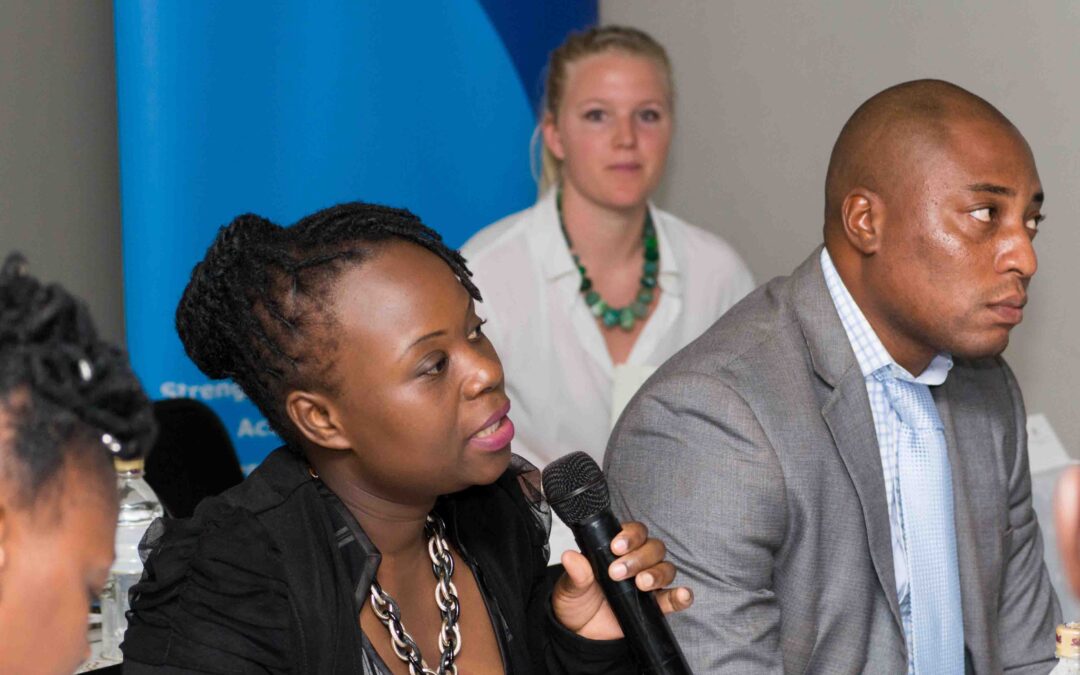
The National Prosecuting Authority (NPA) held a consultation conference on case and docket management system in Harare on 21 March 2017. The ICJ provided technical support.
The consultation conference was intended to validate findings of the field and desk research conducted in respect of case management in Zimbabwe.
The ICJ engaged consultants reviewed the case and docket management system as it relates to other justice actors such as the judiciary, police, prisons and legal aid providers.
The case and docket management assessment was measured against regional and international comparative standards.
The assessment focused on how case and docket management systems address the rights of vulnerable groups’ including women, unrepresented minors, juveniles and persons with disabilities.
From these consultations and field work, the NPA will be supported with a comprehensive, specific and detailed proposal with practical steps for adopting an improved case and docket management system.
Further, the findings will make recommendations on strengthening the case management system in Zimbabwe and how to address the needs and interests of the various justice sector stakeholders.
The consultation conference was attended by the Acting Prosecutor General, Deputy Prosecutor General, National Director of Public Prosecutions, senior law officers, senior magistrates, clerks (criminal courts), representatives from Zimbabwe Prisons and Correctional Services (ZPCS), Zimbabwe Republic Police (ZRP), and Zimbabwe Human Rights Commission (ZHRC).
Civil society representatives included directors and senior staffers from Zimbabwe Human Rights NGO Forum, Zimbabwe Lawyers for Human Rights (ZLHR) among others.
This consultation was held with financial support from the Foreign Commonwealth Office (FCO) Magna Carta Fund, through the British Embassy in Harare.
Contact
Arnold Tsunga, ICJ Regional Director for Africa, t: +27 716 405 926, e: arnold.tsunga(a)icj.org
Mar 8, 2017 | Advocacy, Analysis briefs, News
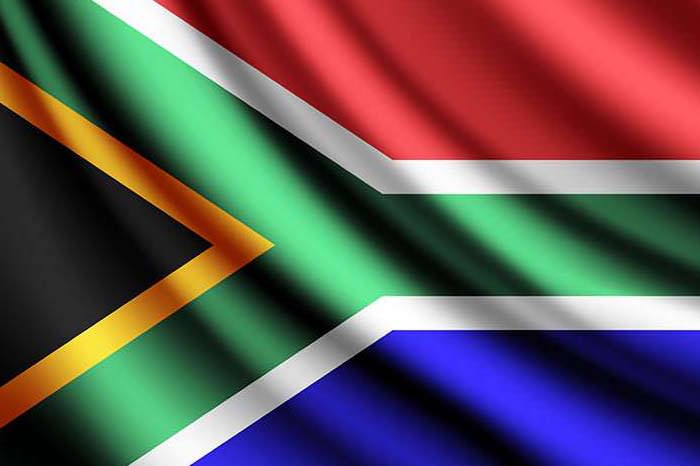
Today the ICJ submitted a brief opposing the current efforts by South Africa to withdraw from the Rome Statute of the International Court.
The brief was submitted in collaboration with a number of South Africa’s leading jurists to the South African Parliamentary Portfolio Committee on Justice and Correctional Services.
The brief was signed by Retired South African Constitutional Court Justices Laurie Ackermann; Richard Goldstone; Johann Kriegler; Yvonne Mokgoro, Kate O’Regan, Zak Yacoob. It was co-signed by Navi Pillay, former United Nations High Commissioner for Human Rights, former judge of the ICC and former President of the International Criminal Tribunal for Rwanda (ICTR). Wilder Tayler, Secretary General, signed on behalf of the ICJ
The ICJ and leading South Africa jurists call on South African Parliamentarians not to pass The Implementation of the Rome Statute of the International Criminal Court Act Repeal Bill [B23-2016].
They also urge South Africa to remain a party to the Rome Statute of the ICC and engage, where appropriate with other African States, in actively pursuing appropriate reforms within the Assembly of State Parties, with a view to making the ICC more effective in advancing the objectives of international justice.
“South Africa should actively encourage other African states to put in place legislation required to empower domestic courts with the ability to try genocide, war crimes and crimes against humanity. South Africa should continue to work constructively with civil society on the advancement of international criminal justice,” the report stated.
“Pursuit of justice and pursuit of peace are complementary and mutually reinforcing objectives that South Africa will best achieve by remaining party to the Rome Statute of the ICC. Its not an either or situation. Protecting heads of States from justice whatever they do compromises peace too much,” said Retired Justice Zak Yacoob.
The report also underscored the danger of an impunity gap if South Africa pulls out of the ICC, as there would be no other effective regional or international forum in which to prosecute the most serious crimes under international law.
“Given the devastating impact of impunity on the rule of law, on development efforts and on society at large, it is vital that South Africa projects itself as a leader in anti-impunity efforts in the region. Pulling out of the Rome Statute of the ICC would crush the best chances that Africa has today to tackle the pervasive impunity that affects the region and would be a most unfortunate move for South Africa and the wider international community,” said Wilder Tayler, Secretary General of the ICJ.
Background
South Africa is one of the earliest parties to the Rome Statute of the ICC. It signed the Rome Statute on the day it was adopted, 17 July 1998, and ratified it on 27 November, 2000. Both during the negotiations preceding the Rome Conference that established the Court in 1998, and at the Conference itself, South Africa played a leading role.
However, the events of June 2015 surrounding the arrival of President Omar al Bashir of Sudan in South Africa appears to have engendered a shift in South Africa’s posture, leading many observers to call into question the country’s commitment to international justice.
The failure by South African authorities to arrest and surrender President al Bashir to the ICC, although he had been indicted by the ICC for war crimes, crimes against humanity and genocide, led to the Southern Africa Litigation Centre (SALC) taking the government to court to compel it to fulfil its obligations both under the Rome Statute and the Implementation of the International Criminal Court Act 27 of 2002 (Implementation Act).
On 19 October 2016, the Minister of International Relations and Co-operation gave notice of South Africa’s intention to withdraw from the Rome Statute.
The Portfolio Committee on Justice and Correctional Services put out a call for submissions to be made to the Parliamentary Portfolio Committee on Justice and Correctional Services on the Implementation of the Rome Statute of the International Criminal Court Act Repeal Bill [B23-2016] to be made by 8th March 2017. The ICJ Brief was filed pursuant to that call.
Contact
Arnold Tsunga, Director of the ICJ Africa Programme, arnold.tsunga@icj.org and +277 164 059 26
RSA-ICC Withdrawal-Advocacy-Analysis Brief-2017 (Analysis brief in PDF)
Mar 3, 2017 | News
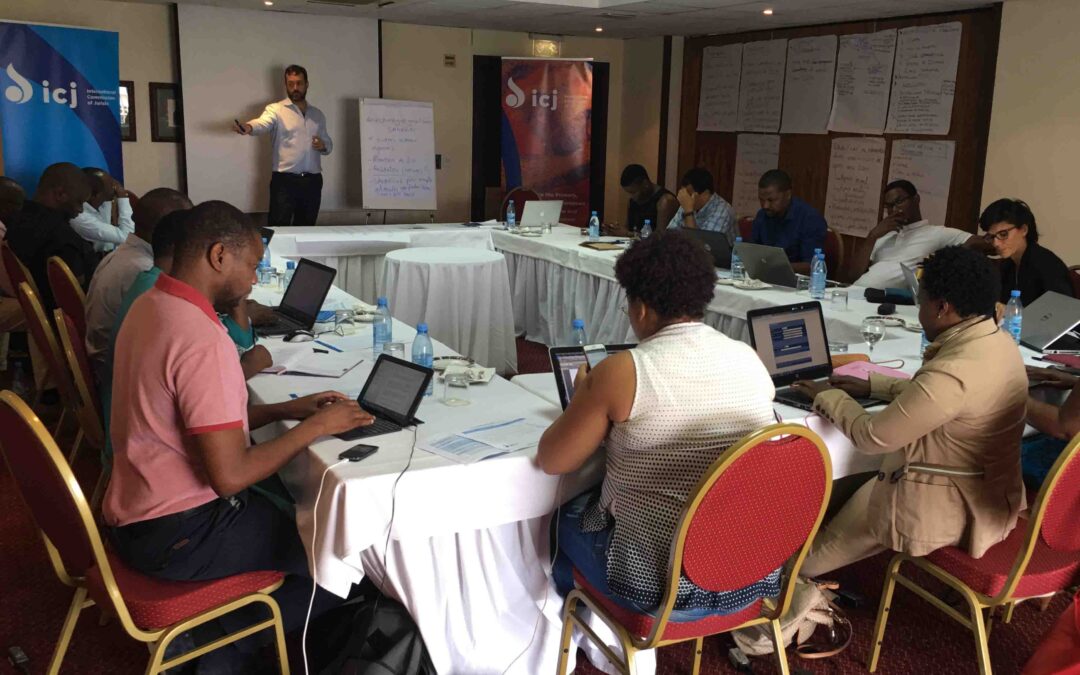
15 HRDs from Mozambique, including lawyers and journalist working in different provinces and towns of Mozambique including Nampula, Manica, Tete, Sofala and Beira held a strategy meeting for the protection of human rights defenders (HRDs) in Maputo from 2-3 March 2017.
The meeting was facilitated by the ICJ in collaboration with the Southern Africa Human Rights Defenders Network (SAHRDN) supported by the Open Society Foundations (OSF) and Open Society Institute of Southern Africa (OSISA).
Participants reflected on the state of human rights in Mozambique with a focus on prevailing political and economic conditions requiring urgent multi-pronged interventions to support HRDs.
The participants developed practical steps for legal protection of HRDs, enhancing a HRDs network, the nature of services and safety mechanisms required to protect HRDs including in violent conflict. In addition, ideas on how to address business and human rights violations were explored.
The use of strategic litigation at the domestic and international level to protect human rights was looked at and specific situations mapped as requiring some attention.
Linkages to regional and international human rights mechanisms for protection purposes and challenging impunity were discussed and some initial measures to take at the African Commission on Human and Peoples Rights were identified.
Contact
Arnold Tsunga, ICJ Regional Director for Africa, t: +27 716405926, e: arnold.tsunga(a)icj.org