Nov 18, 2019 | News
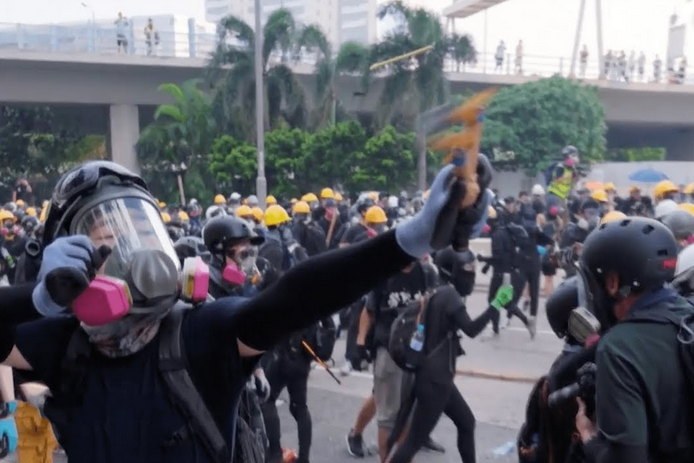
Authorities in Hong Kong must avoid using excessive force to respond to protesters as the political crisis in the city deteriorates, the ICJ said today.
Media reports today show scenes of spiraling violence as police try to force their way into the campus of Hong Kong Polytechnic University (PolyU) past barricades erected by students and demonstrators.
“Any police who use excessive force, particularly as they surround and attack student protesters inside PolyU, must be sanctioned,” said Frederick Rawski, ICJ’s Asia Director.
“The events of the past week mark a further deterioration in the situation in Hong Kong – one that can only be effectively addressed through genuine political dialogue, and a commitment to holding police who use unlawful force accountable,” he added.
This morning, more than 100 people were also arrested in Tsim Sha Tsui, hands zip-tied by police and detained in public.
The ICJ urges the Hong Kong SAR government to:
• Ensure that people are able to exercise their freedom of expression, assembly, association and right to political participation;
• Review the means and methods used for the policing of assemblies, including the use of water cannons, tear gas, batons and shields, to ensure that they are not applied indiscriminately and excessively or against peaceful protesters and that they do not result in an escalation of tension;
• Ensure that all victims of excessive use of force by law enforcement officials are provided with access to medical services;
• Ensure that the detained people’s rights to timely and confidential access to counsel;
• Undertake prompt, independent, impartial and thorough investigation of all allegations of unlawful use of force, with a view to holding accountable any responsible authorities including possibilities of criminal prosecution of police officers, and providing an effective remedy and reparation, including compensation and rehabilitation to victims.
Additional information
- Under the Bill of Rights Ordinance and Basic Law Article 39, the International Covenant on Civil and Political Rights is applicable in Hong Kong. Pursuant to the ICCPR, the Hong Kong SAR government has a duty to guarantee and protect the rights to freedom expression and freedom of assembly and freedom from torture and other cruel, inhuman or degrading treatment or punishment, including through the unlawful use of force.
- Under the Basic Principles on the Use of Force and Firearms by Law Enforcement Officials, “Law enforcement officials shall not use firearms against persons except in self-defence or defence of others against the imminent threat of death or serious injury, to prevent the perpetration of a particularly serious crime involving grave threat to life, to arrest a person presenting such a danger and resisting their authority, or to prevent his or her escape, and only when less extreme means are insufficient to achieve these objectives. In any event, intentional lethal use of firearms may only be made when strictly unavoidable in order to protect life.”
- Since June, large numbers of people have taken to the streets of Hong Kong to protest against the now-withdrawn extradition bill, which would have allowed case-by-case fugitive transfers to mainland China.
- Police have used excessive and indiscriminate force against protesters, in contravention of international standards, as well as arrested, harassed and attacked journalists. Police have regularly deployed tear gas against crowds and using water cannons, rubber bullets, pepper spray, and batons on protesters. On 15 November, hundreds of riot police fired more than 1,500 canisters of tear gas on the grounds of the Chinese University of Hong Kong (CUHK). On November 11, a police officer shot a protester with live ammunition.
Contact
Frederick Rawski, ICJ’s Asia Director, t +66 644781121 ; e: frederick.rawski(a)icj.org
Boram Jang, ICJ Legal Adviser, Asia & the Pacific Programme, e: boram.jang(a)icj.org

Nov 14, 2019 | News
On 14 November 2019, the ICJ called on the Government of Cambodia to drop apparently politically-motivated charges of treason against Kem Sokha, leader of the now-defunct Cambodia National Rescue Party (CNRP).
The ICJ also called on the government to remove restrictions on the exercise of fundamental freedoms of all individuals in Cambodia.
On 10 November, Kem Sokha was released from court-imposed conditions amounting to house arrest, following his arrest in 2017 on spurious charges of treason under article 443 of the Criminal Code. This came after Phnom Penh Municipal Court partially lifted the judicial supervision conditions to which Sokha had been subject. He remains banned from participating in political activities and from leaving Cambodia, and must respond to summons from any authority. Charges of alleged “conspiracy with a foreign power” remain active against Sokha, pursuant to which he risks being imprisoned for between 15 and 30 years.
“Although the release of Kem Sokha from house arrest is a welcome development, it is not nearly enough to show that the government is committed to ending its persecution of civil society and political rivals,” said Frederick Rawski, ICJ’s Asia Pacific Director.
The release comes just after the European Commission released a preliminary report outlining the findings of an investigation triggered in February 2019 on possible removal of tariff preferences granted to Cambodia under the ‘Everything But Arms’ (EBA) trade agreement, on the basis that the Cambodian government had failed to comply with its international obligations to respect, protect and fulfil human rights and the rule of law. A fact-finding mission completed by the Commission last year found ongoing serious, systematic violations of human rights in Cambodia, particularly of the rights of free expression, association, assembly and political participation. In February 2020, the European Commission will finalize its decision.
“The fact that the charges remain in place, and Kem Sokha’s rights to freedoms of association, expression and the right to political participation continue to be suppressed is further evidence of an overall dire human rights and rule of law environment in Cambodia,” said Rawski.
Cambodia has seen a sharp deterioration in human rights and the rule of law since before the 2018 general elections, which has seen abuse of legal and judicial processes to harass and silence members of the political opposition, civil society, and independent media.
Members of the political opposition have been targeted in recent months. In 2019 alone, Cambodian authorities have charged more than 100 members of the political opposition with offences for political reasons, and detained more than half of them. The Cambodian government has also attempted to ban the return of opposition members in exile by urging neighbouring governments to stop their movement into Cambodia, and through increased monitoring of border crossings. In October 2019, the ICJ and other organizations also called for the dropping of spurious charges against former Radio Free Asia (RFA) journalists Yeang Sothearin and Uon Chhin, who are being tried for multiple offences in connection with carrying out their journalist functions.
Background
The charges against Kem Sokha appear politically-motivated. His arrest in 2017 came just months before the CNRP – the main opposition party which he led – was dissolved, and more than 100 of its members banned from political activity following a Supreme Court judgment in November 2017. Soon after, the ruling Cambodian People’s Party won the July 2018 general elections by a landslide. The ICJ has highlighted that the “single largest problem facing the Cambodian justice system is the lack of independent and impartial judges and prosecutors”, including “an endemic system of political interference in high-profile cases and an equally entrenched system of corruption in all others”.
Contact
Frederick Rawski, ICJ Asia and Pacific Regional Director, e: frederick.rawski(a)icj.org
See also
ICJ, ‘Cambodia: charges against journalists Yeang Sothearin and Uon Chhin must be dropped’, 4 October 2019
ICJ, ‘Misuse of law will do long-term damage to Cambodia’, 26 July 2018
ICJ, ‘Cambodia: weaponization of the law (UN Statement)’, 22 March 2018
ICJ, ‘Cambodia: the ICJ condemns dissolution of main opposition party’, 16 November 2017
Nov 13, 2019 | Advocacy, Multimedia items, Video clips
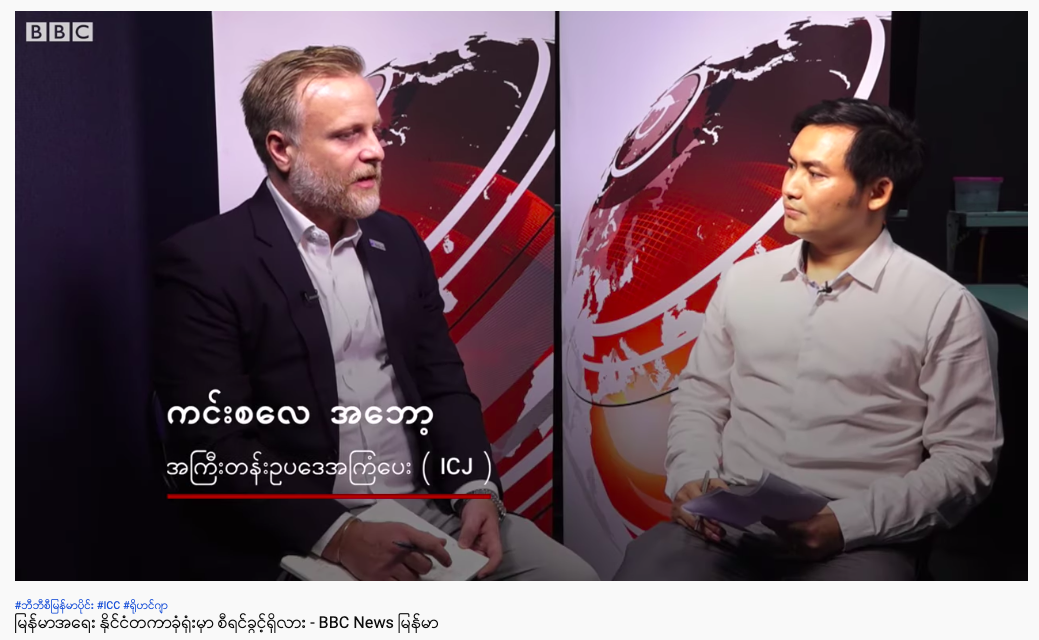
In a video interview with the BBC’s Burmese broadcasting service, ICJ senior legal adviser Kingsley Abbott explains to the Myanmar public how the International Criminal Court prosecutor plans to investigate the crime against humanity of deportation from Myanmar to Bangladesh, which has affected around one million Rohingya.
Recorded on 24 August and published on 12 November 2019. The interview transcript is available in Burmese and English.
Contact
Kingsley Abbott, ICJ Senior Legal Adviser, e: kingsley.abbott(a)icj.org
Nov 12, 2019 | News
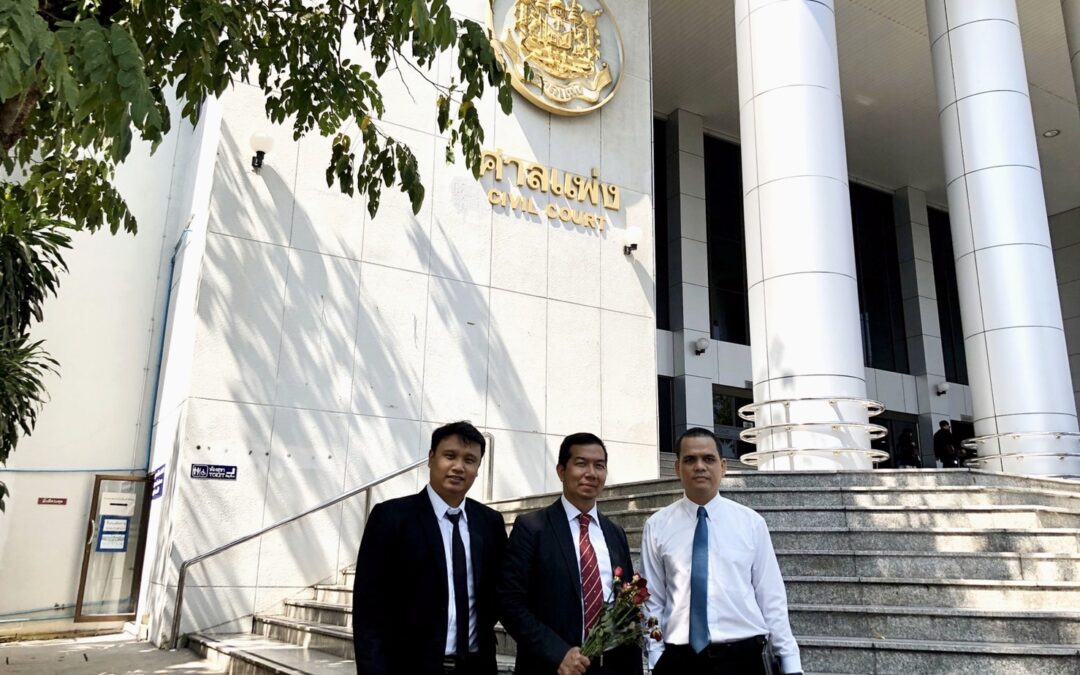
Today, the ICJ condemned the use of civil proceedings to harass Nakorn Chompuchart and Sira Osottham, lawyers representing labour rights researcher Andy Hall.
The ICJ called on Thailand to take measures to protect lawyers so that they can perform their duties without intimidation, harassment or improper interference.
On 12 November 2019, the Bangkok Civil Court conducted its first hearing in a tort case under the Civil and Commercial Code by a Thai fruit processing company, Natural Fruit Company Ltd. (‘the Company’), against the lawyers. The two lawyers represent Andy Hall in several criminal and civil proceedings brought against him seeking damages claimed to have resulted from his research into labour rights abuses allegedly committed by the Company. In the lawsuit against the lawyers, the Company is seeking 50 million Thai baht (approximately 1.65 million USD) as compensation for lost business.
“This legal action is part of a pattern of harassment by Natural Fruit against Andy Hall,” said Frederick Rawski, ICJ Asia Pacific Regional Director. “It is a bedrock principle of the rule of law that lawyers should not be identified with their clients or their clients causes as a result of discharging their function.”
In the complaint, Natural Fruit claims that Andy Hall and his lawyers “excessively exercise their rights”, “intentionally damage the Company’s reputation”, and “caused financial loss in their business” when they brought a case in 2017 against the Company, the Company’s lawyers, and public prosecutor for allegedly “giving false testimony” and “filing false complaint” in other criminal proceedings. The case was dismissed by the Supreme Court who was of the view that the Company exercised its right in good faith.
“This is not the first time in Thailand that lawyers have faced the unwarranted threat of criminal or civil prosecution when representing their clients,” said Rawski. “As with the criminal proceedings brought against Sirikan “June” Charoensiri for her professional activities as a lawyer, such vexatious actions set a precedent that endangers the ability of lawyers to effectively represent their clients. The government must take prompt and effective measures to ensure that the safety and independence of lawyers is guaranteed in law and in practice.”
Background
This case was also initially brought against Andy Hall, but was later withdrawn because the Court could not send court writs to Andy as he does not reside in Thailand.
Criminal and civil proceedings have brought against Andy Hall were in relation to the report of a Finnish NGO, Finnwatch, published in January 2013, called Cheap Has a High Price, which alleged that labour rights violations were taking place at Natural Fruit Company.
Thailand is a party to the International Covenant on Civil and Political Rights (ICCPR). Article 14 of the ICCPR guarantees the right of the clients of the concerned lawyers to an effective defense.
UN Basic Principles on the Role of Lawyers also provides that “governments shall ensure that lawyers are able to perform all of their professional functions without intimidation, hindrance, harassment or improper interference” and “shall not suffer, or be threatened with, prosecution or administrative, economic or other sanctions for any action taken in accordance with recognized professional duties, standards and ethics.” Moreover, lawyers should not be identified with their clients or their clients causes as a result of discharging their function.
To download the statement in Thai, click here. (PDF)
Contact
Frederick Rawski, ICJ Asia-Pacific Director, t: +66 64 478 1121; e: frederick.rawski(a)icj.org
Further reading
Thailand: verdict in Andy Hall case underscores need for defamation to be decriminalized
Thailand: amicus in criminal defamation proceedings against human rights defender Andy Hall
Nov 12, 2019 | Advocacy, News
The Government of Myanmar should adopt constitutional and legislative guarantees to enable the Myanmar National Human Rights Commission (MNHRC) to better protect and promote human rights for all persons in the country, according to a new ICJ briefing note.
Entitled Four Immediately Implementable Reforms to Enhance Myanmar’s National Human Rights Commission, the note analyzes the ability of the MNHRC to address various human rights violations, some of which have been found by experts to constitute the most serious crimes under international law. The briefing is available in Burmese and English.
“The NLD-led government should promptly reform the MNHRC Law, allowing for the selection of better qualified and representative Commissioners, and granting them the independence and resources necessary for their work. This reform is a low-hanging fruit for the NLD, and overdue” said Sean Bain, ICJ Legal Adviser.
“At the same time, Commissioners should robustly pursue their mandate, including by advocating for the rights of society’s most vulnerable people,” he added.
The MNHRC itself has recognized the need for law reform, in its self-assessment of 2018, and in its reform proposals to the Government. Any law reform process should be opened up to genuine public consultation, enabling inputs from experts and the general public.
“The MNHRC generally fails to act on reported human rights violations, from crimes by soldiers in border areas through to regular attacks on the press, rendering it ineffective in providing redress to victims,” said Sean Bain, ICJ Legal Adviser. “The MNHRC’s routine inaction in critical cases demonstrates its lack of the necessary independence to stand against state actors, particularly the military,” he added.
One illustrative case is the Commission’s reluctance to further pursue justice for the death in military custody of journalist Ko Par Gyi, whose killers were secretly tried and acquitted in a military court, despite the MNHRC’s finding that a public criminal prosecution was warranted. Commissioners have also been notably silent on gross human rights violations against Rohingyas, perpetrated by Tatmadaw soldiers in the context of “clearance operations”.
The note highlights that the Commission refrains from investigating alleged human rights violations by referencing Section 37 of the 2014 MNHRC Law. This provision is narrowly construed to effectively preclude the MNHRC from conducting inquiries on matters that are already the subject of a legal proceeding.
The composition of the Commission also does not reflect Myanmar’s ethnic, religious, regional and gender diversity, which further erodes its ability to address the conflict-related violations and abuses particularly prevalent in border areas such as Rakhine, Kachin and Shan states.
While amending problematic provisions in the 2014 MNHRC Law is warranted, a constitutional guarantee would also significantly improve the Commission’s institutional independence.
“A constitutional provision, in contrast to ordinary legislation, is subject to a stricter amendment process that would less likely render the MNHRC politically vulnerable,” said Jenny Domino, ICJ Associate Legal Adviser.
“Myanmar can look to the experience of the national human rights institutions of East Timor and the Philippines, which were established by constitutional provision at a time that both countries were transitioning to a democratic and rule of law based order”,” she added.
Four immediately implementable reforms for the Government of Myanmar are recommended:
- To the Union President and the Selection Board: appoint Commissioners through a transparent and fully consultative process that enables its composition to effectively protect human rights and appropriately reflect the full diversity of the population of Myanmar, including ethnic, religious, regional, gender and sexual identities;
- To the Commissioners: adopt a broad and active interpretation of their mandate, including by taking steps to address the most serious violations, including crimes under international law, and certain human rights cases that have gone before courts;
- To the Myanmar parliament: amend the 2014 MNHRC Law to include provisions that strengthen the MNHRC’s capacity and independence, and improve the appointment process for commissioners
- To the Constitutional Amendment Committee: propose provisions guaranteeing the structural and financial independence of the MNHRC in amending the 2008 Constitution.
To download the press release in Burmese, click here.
Download
Myanmar-MNHRC-Advocacy-Briefing-Note-2019-ENG (in English, PDF)
Myanmar-MNHRC-Advocacy-Briefing-Note-2019-BUR (in Burmese, PDF)
Contact
Jen Domino, ICJ Associate Legal Adviser, e: jenny.domino(a)icj.org, t: 09968134317
Daw Hnin Win Aung, ICJ Legal Adviser, e: hninwin.aung(a)icj.org, t: 09428122794
Related material:
Achieving Justice for Gross Human Rights Violations in Myanmar: Baseline Study
Myanmar: Five years without justice for journalist Ko Par Gyi