Dec 7, 2018 | Events, News
On 7 December 2018, the ICJ, together with the Embassy of the Federal Republic of Germany to Thailand, held an event at the German Ambassador’s Residence in Bangkok to mark Human Rights Day.
This was the fourth event co-hosted annually by the ICJ and the German Embassy as an early commemoration of International Human Rights Day, which falls on 10 December every year on the anniversary of the adoption of the Universal Declaration of Human Rights in 1948.
Ambassador-Designate H.E. Georg Schmidt delivered the opening address for the event, highlighting the importance of the principle of universality of human rights and noting the 70th anniversary of the Universal Declaration of Human Rights where that principle was enshrined.
ICJ’s Asia and the Pacific Director Frederick Rawski then delivered opening remarks, welcoming Germany’s long-standing support of the work of ICJ and its partners in Thailand in advancing the rule of law and human rights. He highlighted some positive developments in the human rights situation and stressed upon continuing challenges, in the context of potential upcoming elections in February 2019. He also recognized the crucial work of human rights defenders in Thailand.
Yaowalak Anuphan, Head of Thai Lawyers for Human Rights (TLHR), opened the discussion on the current human rights situation in Thailand, particularly focusing on challenges in the legal landscape and fundamental freedoms in the context of potential upcoming elections.
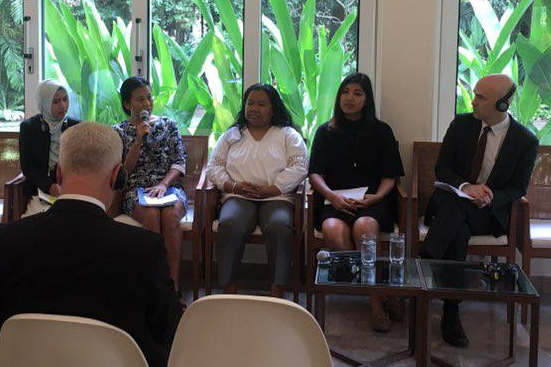
A panel discussion on prevailing human rights concerns then followed, moderated by ICJ’s Frederick Rawski. The discussion touched on a range of themes including land rights and the rights of indigenous peoples; human rights violations in the Deep South; Business and Human Rights and Thailand’s National Action Plan on Business and Human Rights; and refugee and migrants’ rights.
The panelists were:
- Pornpen Khongkachonkiet, Director, Cross Cultural Foundation;
- Waesonk Baneng, Lawyer, Muslim Attorney Centre Foundation;
- Sor Rattanamanee Polkla, Coordinator and Lawyer, Community Resource Centre Foundation;
- Yuhanee Jehka, Legal Officer, Asylum Access Thailand.
Approximately 80 individuals from Thai civil society, the diplomatic community, affected communities, academia, and Thailand’s Ministry of Justice and Ministry of Foreign Affairs attended the event.
Dec 5, 2018 | News
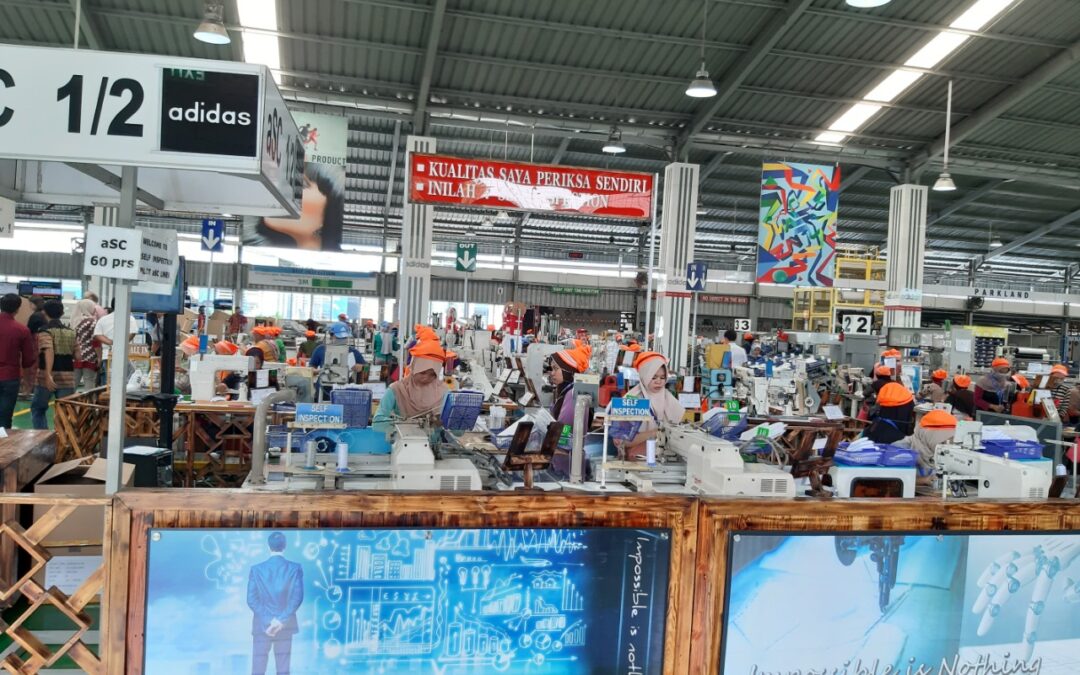
From 28 November to 3 December 2018, a delegation of the ICJ carried out a learning and assessment visit to two factories in Indonesia that are part of the supplier network of the global brand adidas.
The ICJ delegation noted at the conclusion of the visit to two of the global brand’s supply chain factories a number of elements of good practice, highlighted in the full statement available below.
The mission did not aim to identify human rights impacts or to assess individual cases, their procedures and outcomes. While the ICJ assessment of the information gathered during the visit continues, the ICJ has already recommended improvements in transparency and public communication about the performance of adidas’ factory suppliers.
The ICJ also invited the companies to a broad reflection on the need to have a factory level grievance mechanism, instead of the existing compartmentalized system. Finally, adidas and partners need to also step up action in relation to the establishment of an effective community grievance mechanism.
The full statement can be downloaded in PDF format here: Statement-adidas-Indonesia-BusinessHumanRights-2018
Dec 3, 2018 | Advocacy, News, Non-legal submissions
Today, the ICJ joined fifteen other organizations to call on the Thai authorities and Thammakaset Company Limited to ensure that criminal and civil defamation complaints brought by the company against human rights defenders Nan Win and Sutharee Wannasiri do not proceed.
The charges have been leveled in connection with work by the two defenders to bring attention to labour rights violations at a Thammakaset-owned chicken farm in Thailand.
The organizations further called on the Thai authorities to act to ensure that no person is held criminally liable for defamation, including by decriminalizing defamation in Thai law and protecting individuals from abusive litigation aimed at curtailing the rights to freedom of expression and access to information and other activities of human rights defenders.
Today, the Bangkok Criminal Court will hold preliminary hearings on the criminal defamation complaints filed by Thammakaset Co. Ltd. against the two human rights defenders.
“This is the most recent in a series of spurious legal cases brought by companies in Thailand aimed at intimidating human rights defenders and curtailing their important work in defence of human rights,” said Ian Seiderman, ICJ’s Legal and Policy Director.
“Thai authorities must take all necessary measures in law and in practice to ensure that private business entities do not misuse the law to interfere with human rights such as freedom of expression and access to information.”
On 12 and 26 October 2018, Thammakaset Co. Ltd. filed criminal and civil defamation complaints against Nan Win, a migrant worker from Myanmar, and Sutharee Wannasiri, a woman human rights defender and a former Human Rights Specialist with Fortify Rights.
The complaints related to a 107-second film published by non-governmental organization Fortify Rights on 4 October 2017 that called on Thai authorities to drop criminal defamation charges against 14 migrant workers at a Thammakaset-operated chicken farm and to decriminalize defamation in Thailand.
Nan Win was one of the above-mentioned 14 migrant workers and faces a criminal defamation suit for reportedly testifying about alleged labour rights violations he faced in the Thammakaset-operated farm. Sutharee Wannasiri faces criminal and civil defamation suits for reportedly sharing information about the Fortify Rights film on Twitter.
If convicted of criminal defamation, Nan Win faces up to four years’ imprisonment and/or a fine of up to 400,000 Thai Baht (more than US$12,150) and Sutharee Wannasiri faces up to six years’ imprisonment and/or a fine of up to 600,000 Thai Baht (more than US$18,200). Thammakaset Co. Ltd. is also seeking five million Thai Baht (US$151,400) in compensation for alleged damage to the company’s reputation in its civil defamation suit against Sutharee Wannasiri.
“We urge the Thai government not only to uphold their own legal obligations, but also to remind business enterprises in Thailand that they are also responsible for upholding human rights under international standards and domestic law,” said Seiderman.
Thailand-Drop defamation Nan Win Sutharee Wannasiri-Advocacy-Joint Statement-2018-ENG (Joint Statement, English, PDF)
Thailand-Drop defamation Nan Win Sutharee Wannasiri-Advocacy-Joint Statement-2018-THA (Joint Statement, Thai, PDF)
Background
On 12 October 2018, Thammakaset Co. Ltd. filed a criminal defamation suit under sections 326 and 328 of Thailand’s Criminal Code against Sutharee Wannasiri, a former Thailand Human Rights Specialist with Fortify Rights, for three comments she was alleged to have made on Twitter related to the Fortify Rights film.
On 26 October 2018, Thammakaset Co. Ltd. filed a criminal defamation suit under sections 326 and 328 of Thailand’s Criminal Code against Nan Win, one of the 14 migrant workers from Myanmar, for two interviews he gave in a Fortify Rights film and during a Fortify Rights press conference on 6 October 2017.
On the same day, Thammakaset Co. Ltd. also filed a civil defamation suit against Sutharee Wannasiri citing the above mentioned alleged Twitter comments and demanding five million Thai Baht (more than USD 142,000) in compensation for alleged damage to the company’s reputation.
The UN Human Rights Committee has clarified that defamation laws must ensure they do not serve, in practice, to contravene the rights to freedom of expression and information protected under article 19 of the International Covenant on Civil and Political Rights (ICCPR) and enshrined under articles 34, 35 and 36 of the 2017 Constitution of Thailand. While civil penalties are appropriate to achieve a lawful aim of protection of reputation, the imposition of such penalties must be proportionate and strictly necessary to achieve a legitimate purpose.
Thailand has an obligation under international human rights law, including the ICCPR, to protect persons against the action of businesses that impair the exercise of human rights. The U.N. Guiding Principles on Business and Human Rights also clarify that business entities have a responsibility to uphold human rights. In August 2018, Thailand launched a revised draft National Action Plan on Business and Human Rights in order to implement the U.N. Guiding Principles.
Contact
Ian Seiderman, ICJ Legal and Policy Director, email: ian.seiderman(a)icj.org
Other reading
For recent ICJ advocacy on similar criminal defamation proceedings launched against labour rights defender Andy Hall, see:
ICJ, Lawyers Rights Watch Canada, ‘Thailand: amicus in criminal defamation proceedings against human rights defender Andy Hall’, 26 July 2016
ICJ, ‘Thailand: verdict in Andy Hall case underscores need for defamation to be decriminalized’, 20 September 2016
For recent ICJ advocacy on the misuse of defamation laws in Thailand against human rights defenders, see:
ICJ, ‘Thailand: immediately stop criminal defamation complaint against torture victim’, 15 February 2018
ICJ, ‘Thailand: ICJ welcomes decision to end proceedings against human rights defenders who raised allegations of torture’, 1 November 2017
ICJ, ‘Thailand: stop use of defamation charges against human rights defenders seeking accountability for torture’, 27 July 2016
Dec 2, 2018 | Events, News
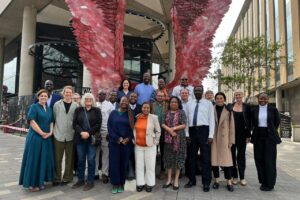
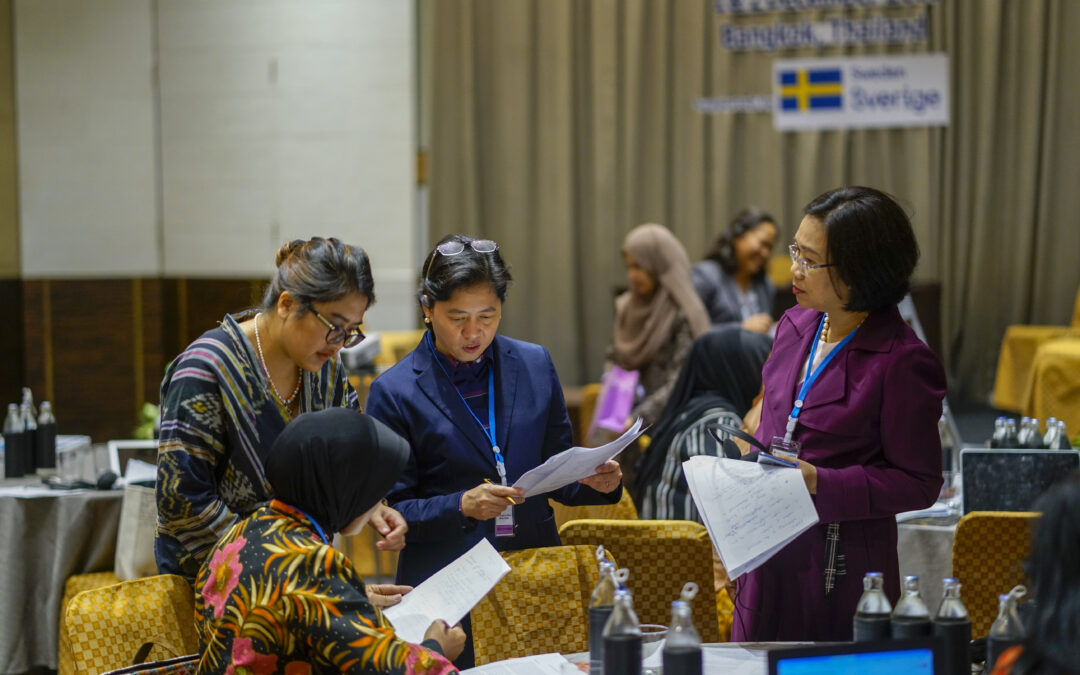
On 1-2 December 2018, the International Commission of Jurists (ICJ) held its 2018 Southeast Asia Regional Judicial Dialogue on enhancing access to justice for women in the region.
Participants included judges from Cambodia, Indonesia, Nepal, Pakistan, Philippines, Sri Lanka and Thailand.
The discussions, held in Bangkok, were focused around resources important for judges to aid in enhancing the capacity of their peers in eliminating gender discriminatory attitudes and behaviours towards women in their work. These resources include a training manual on the use of the Bangkok General Guidance for Judges in Applying a Gender Perspective, and a draft reference manual on women’s human rights and the right to a clean, healthy, safe and sustainable environment.
Frederick Rawski, ICJ’s Director of the Asia and the Pacific Programme, opened the dialogue by emphasizing how important it is for judges to be gender sensitive in their delivery of justice. This could only be done by applying a framework that gives primary attention on ensuring recognition of the applicable human rights, institutional support for the promotion of these rights, and accountability mechanisms for their implementation.
Roberta Clarke, Commissioner of the ICJ and Chair of the organization’s Executive Committee, noted that this judicial dialogue demonstrates the ICJ’s commitment to have a sustainable contribution to the implementation of international human rights standards at the domestic level. She hoped that the judges could contextualize the resources presented and bring these back to their countries for trainings of their peers.
This judicial dialogue is part of a joint project on access to justice for women that ICJ is implementing with UN Women.
Anna Karin Jatfors, UN Women-Asia Pacific’s Interim Regional Director shared that gender stereotypes and social norms which discriminate women are not unique in each country. She pointed out the importance of the ICJ and UN Women collaborating in this project to deconstruct this image to bring better access to justice to women in the region.
Overall, the dialogue was rich and substantive, with the full and active participation from all participating judges who shared their views and experiences on countering gender discrimination in cases before them. At the end of the judicial dialogue, the participating judges expressed strong interest to use the resources for capacity building initiatives of their peers in their own countries.
Contact
Emerlynne Gil, Senior International Legal Adviser, t: +662 619 8477 (ext. 206), email: Emelynne.gil(a)icj.org
Nov 26, 2018 | News
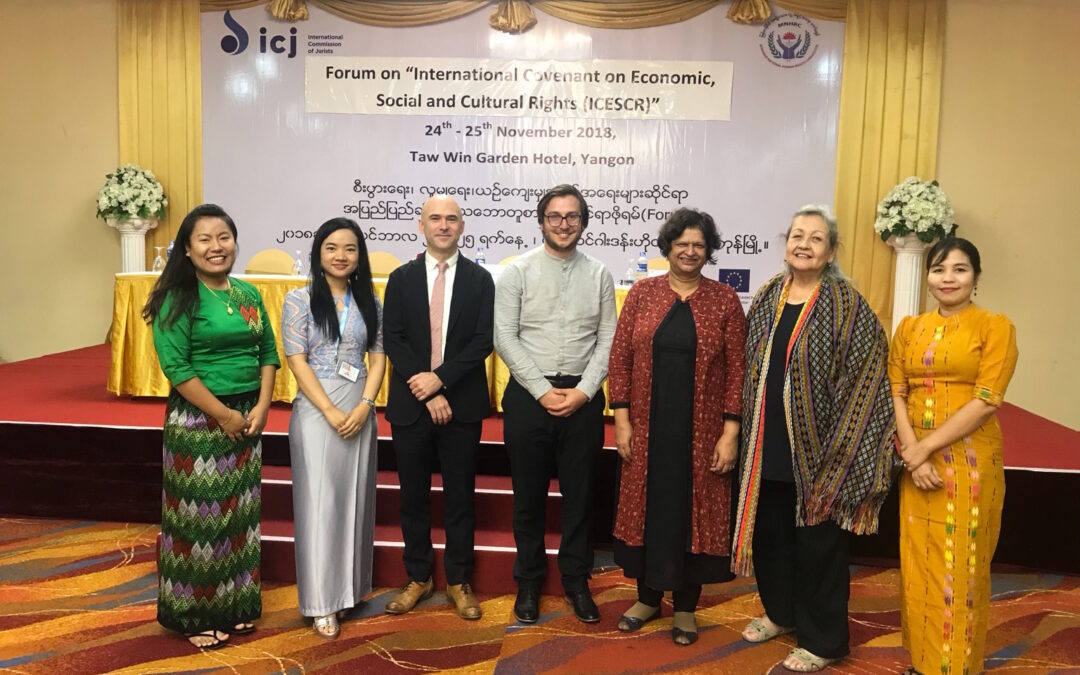
The ICJ convened a Forum of international legal experts and Myanmar civil society actors in Yangon from the 24 to 25 November 2018 on Myanmar’s obligations under the International Covenant on Economic, Social and Cultural Rights (ICESCR).
Representing each of Myanmar’s 14 States and Regions, more than 130 civil society members attended the event, which was co-hosted with the Myanmar National Human Rights Commission in collaboration with Dan Church Aid, Norwegian Church Aid, Equality Myanmar and the Local Resource Center.
The ICJ’s Asia Pacific Regional Director, Frederick Rawski, introduced the Forum objectives which were to raise awareness of the rights, obligations and reporting processes associated with Myanmar’s ratification of the ICESCR on 6 October 2017.
As a State Party to the ICESCR, Myanmar is obliged to respect, protect and fulfill a variety of human rights including the rights to: decent work, an adequate standard of living, adequate housing, food, water and sanitation, social security, health, and education.
The Chairperson of the UN Committee on Economic, Social and Cultural Rights, Virginia Brás Gomes, discussed the vital role civil society plays in documenting and providing information about human rights challenges, and advocating for law to be enforced and interpreted in compliance with the State’s international law obligations.
Virginia B. Dandan of the Philippines, a former Chairperson of the Committee, described the rights protected under ICESCR and highlighted the universality of human rights and the indivisibility of economic, social and cultural rights from other human rights including protection from discrimination.
Visiting Myanmar from the ICJ’s Southern Africa Office, legal adviser Timothy Fish Hodgson, ICJ Legal Adviser in the ICJ Africa Programme, discussed from a comparative perspective the justiciability of ESC rights in South Africa, and the roles lawyers and other civil society actors have played in progressing rights protections.
Legal advisers from the ICJ’s Myanmar Team moderated a series of panel discussions where civil society representatives discussed challenges and opportunities related to the realization of ESC rights in Myanmar.
Separate to this initiative, the visiting international experts also travelled to Nay Pyi Taw to engage with government. Myanmar’s first State report to the ESCR Committee is due in late 2019, also opening opportunities for civil society engagement.
This event was part of the ICJ’s ongoing effort to convene civil society actors to discuss the promotion and protection of human rights through legal mechanisms.