Kyrgyzstan: Searches of lawyers’ premises are contrary to international law and standards
The ICJ today expressed concern at searches of lawyers’ homes and workplace by Kyrgyz investigators in the city of Osh.
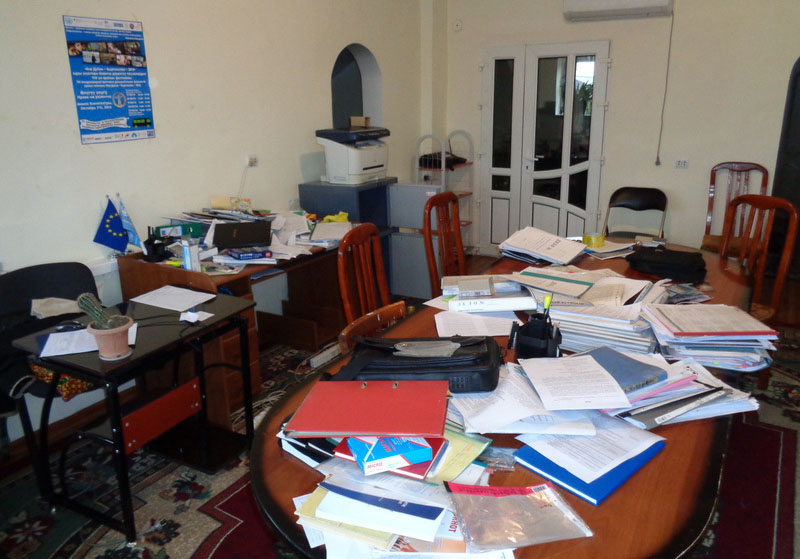
The home of lawyer Valerian Vakhitov and the office of the human rights organization “Bir-Duyno-Kyrgyzstan” (photo) where lawyers Valerian Vakhitov and Khusanbay Saliyev worked, were searched and materials of the lawyers’ cases were seized. The ICJ considers that the searches are violations of the right to confidential communication between a lawyer and his or her client.
The confidentiality of lawyer-client communications and lawyers’ files is protected in international human rights law as part of the right to a fair trial, as well as the prohibition of arbitrary interference with correspondence, privacy and (in this case) home.
The searches followed the arrest of Umar Farooq, a US citizen and journalist who reportedly conducted research on inter-ethnic tensions in the Kyrgyz Republic, in particular near the border with Uzbekistan.
On 25 March 2015, he was arrested by officers of the State Committee of National Security (SCNS) and a number of items in his possession were seized including recordings containing “statements on religious topics and clips of military activities”, copies of charges filed against clients of the two lawyers, A.M. Yusupov and I.I. Salibayev, and the business cards of the two lawyers.
On 28 March, Umar Farooq was expelled from the Kyrgyz Republic on grounds of collection of information without accreditation.
The investigator sought a search warrant for the lawyers’ premises on the grounds that they could contain documents “necessary for the investigation” in criminal case No. 082-15-0236.
Warrants to search the NGO premises where the lawyers worked and to search the residence of Valerian Vakhitov, were issued in separate proceedings on 26 and 27 March by judges K.M. Matisakov and B.T. Satybaldiyev.
According to the search warrant issued by the Court, the search of Lawyer Vakhidov’s home was authorized taking into account the “the need for a full, objective, comprehensive resolution of the crime, obtaining evidence necessary for the investigation of the case, inevitability of the punishment for a crime committed and for the purposes of national security”.
The same reasons were given to authorize searches of the office of “Bir-Duyno-Kyrgyzstan” Investigators seized computers, memory sticks, dictaphones and disks with information on cases in which the lawyers represented clients.
Lawyer Vakhitov reported that among other documents, files relating to nine cases in which he represented individuals before the UN Treaty Bodies, including communication with the UN bodies, had been seized.
The ICJ notes that the State Committee of National Security of the Kyrgyz Republic officially stated, on 30 March, that the searches of work and residence places of lawyers were “legal and within the framework of the CPC of the KR [Criminal Procedure Code of the Kyrgyz Republic]”.
On the same day, the Council of Advokatura, its main executive body, issued a statement calling on the Prosecutor General Indira Zholdubayeva “to take the strictest measures provided by law in regard to the officers of the State Committee of National Security which violated the guarantees of the independence of lawyers’ activity and integrity of lawyers”.
The ICJ considers that the searches are a clear violation of the law of the Kyrgyz Republic. According to Article 29 of the Law On Advokatura and Lawyers’ Activity the Kyrgyz Republic “requisitioning, seizure, examination, inspection, copying documents, collection and use of information related to legal assistance in a particular criminal case are allowed only in the case involving a lawyer as a defendant …”.
A criminal case against a lawyer may be initiated only by the Prosecutor General or her deputy (Article 29.3).
According to article 30 of the Law, information related to providing legal aid to clients is protected as lawyer-client privilege (…).
Read the full statement here:
Kyrgyzstan-Searches of lawyers-Advocacy-2015-ENG (full text in PDF)
Kyrgyzstan-Searches of lawyers-Advocacy-2015-RUS (Russian version in PDF)