

Spain: NGOs call on lawmakers not to close the doors to universal justice
The ICJ and other human rights organizations issued a public statement calling on Spanish lawmakers not to pass draft legislation that, if approved, would seriously limit Spanish courts’ ability to investigate and prosecute serious crimes under international law.
The draft legislation, tabled in Parliament by the Popular Party (PP), provides that, for cases involving allegations of genocide, crimes against humanity and war crimes not occurring on Spanish territory to be investigated and prosecuted in Spain, the suspect must either be a Spanish national or a foreigner habitually resident in Spain or a foreigner who is in Spain, whose extradition has been denied by Spanish authorities.
For case of torture and enforced disappearance, the proposed legislation requires that the suspect be a Spanish national or, alternatively, that the victim be a Spanish national at the time when the crime was committed and that the suspect be present in Spain when jurisdiction is assumed.
Where these conditions are not met, the proposal would allow Spanish courts to hear cases for those crimes for which prosecution is required by international treaties where the suspect is a foreigner on Spanish soil, so long as Spain has received and denied an extradition request.
The ICJ and other organizations stressed in their statement that if enacted, this legislation would close the doors of Spanish courts to certain victims of gross human rights violations who are unlikely otherwise to be able to obtain justice, particularly within their own jurisdictions.
Spain-Universaljurisdiction-NGOsJointStatement-2014-eng (download the joint statement in English)
Spain-Universaljurisdiction-NGOsJointStatement-2014-SPA (download the joint statement in Spanish)

Italy : Constitutional Court’s rendition ruling undermines the fight against impunity
The ICJ today expressed concern at a ruling of the Italian Constitutional Court which denies full accountability of Italian officials in the case of the 2003 unlawful rendition, enforced disappearance and torture of Osama Mustafa Hassan Nasr, also known as Abu Omar.
In a ruling making no mention of the international human rights law obligations of Italy, the Court agreed with the contention of the Italian Government that it may protect from disclosure and use in court what it considers to be “secrets of state” even if to do so would prevent the revelation of the truth about serious crimes and human rights violations and the holding of those responsible to account.
The Court ruled that, under the Italian Constitution and the law on secrets of state, it is the sole prerogative of the President of the Council of Ministers, exercising “a wide discretionary power”, to establish the width of application of the secret of state doctrine.
The Court affirmed that such decisions cannot be questioned by ordinary courts.
A number of Italian and United States intelligence agents, including the former Director of the Italian Military Secret Service, Nicolò Pollari, had been found guilty of criminal offences in connection with the rendition.
The Constitutional Court’s ruling is likely to effectively annul the convictions of the top Italian secret agents involved in the rendition.
“This ruling constitutes a serious blow to the fight against impunity for some of the most serious crimes under international law”, said Massimo Frigo, Legal Adviser for the Europe Programme. “It disregards fundamental pillars of international human rights law, including the right to truth and the duty to investigate, prosecute and ensure accountability for gross violations of human rights”.
“The doctrine of “secret of state” must never be used as a means to cover up responsibility for crimes under international law or gross violations of human rights,” Frigo added. “The United States, which is primarily responsible, deplorably has abdicated its responsibility to meaningfully investigate and hold officials to account for gross human rights violations in its rendition and secret detention programme. Italy, by contrast, had been the only country in which the courts had imposed convictions for the US-led renditions. After this judgment, there is a real risk that the Italian complicity in this crime will never be fully ascertained and accounted for.”
The ICJ is concerned at reports that time limits for the conclusion of criminal proceedings in this case could expire in two months, despite the fact that, under international standards, limitation periods should not be imposed in respect of serious of crimes such as torture and enforced disappearance.
The expiry may foreclose any further investigation or criminal trial on Italian involvement in this rendition, which should occur irrespective the obstacles caused by the secret of state doctrine.
The ICJ is particularly concerned that successive Italian governments since 2007 have either proposed or refused to withdraw government applications before the Constitutional Court affirming that the executive prerogative on secret of state takes precedence over the fight against impunity.
The ICJ considers that the law and practice regarding the “secret of state” must be reformed to be into compliance with Italy’s duty to investigate crimes under international law and gross human rights violations.
While States may protected a limited amount of information when strictly necessary for legitimate national security purposes, they may not do so with respect to information concerning gross violations of human rights.
Background
Hassan Mustafa Osama Nasr, also known as Abu Omar, was been kidnapped in 2003 in the streets of Milan by CIA operatives and subject to rendition to Egypt where he had been subject to enforced disappearance, arbitrary detention and torture.
The case of Abu Omar was one of at least 136 known cases in the rendition and secret detention carried out since 2001 by the United States, with the participation of some 54 other States, which typically involved multiple human rights violations, including torture and ill-treatment, enforced disappearance, and arbitrary detention.
The Constitutional Court judgment effectively reversed the ruling of the Court of Cassation that ordered the reopening of the trial against the former Director of the Italian Military Secret Service, Nicolò Pollari, his deputy, Marci Mancini, and other Italian military secret services operatives for their alleged complicity in the operation.
The Court of Cassation had held that the doctrine of “secret of state”, which barred their conviction, would not apply to them, because the Italian secret services have no authority to conduct such illegal operations and they had therefore effectively acted in private capacity.
Following that judgment, the Court of Appeal convicted, among others, for complicity in the kidnapping Nicolò Pollari to ten years of imprisonment and Marco Mancini to nine years.
The Court of Cassation upheld in absentia the convictions and sentences of 23 US agents involved for the offence of kidnapping.
On 5 April 2013, the President of the Italian Republic, Giorgio Napolitano, granted a pardon for US Colonel Joseph L. Romano III, who had been convicted by Italian courts of the offence of complicity with the US in kidnapping for his role in the rendition of the Milan cleric Abu Omar in 2003.
Contact:
Massimo Frigo, Legal Adviser, ICJ Europe Programme, massimo.frigo(a)icj.org

ICJ calls for more human rights protection in EU home affairs
The ICJ submitted today its contribution to the public consultation of the European Commission on the future of home affairs policies in the European Union.
In its contribution, the ICJ highlighted the need to increase human rights protection in EU home affairs legislation and in its implementation.
The ICJ submission recommends an increased monitoring of the human rights compliance of draft legislation; calls for increased transparency in the legislative process; and for a better use of infringement proceedings by the European Commission to ensure the effective implementation of EU home affairs legislation with particular attention to the protection of human rights.
The ICJ addressed, in its contribution, the importance of a correct and human rights compliant implementation of the new Common European Asylum System, and the need of further reforms in the EU legislation on asylum, migration and border control.
Finally, the ICJ stressed the poor record of the EU institutions, besides the European Parliament, in ensuring accountability for human rights violations committed in countering terrorism, for example in the cases of the National Security Agency (NSA) surveillance programme scandal and in the cases of alleged complicity of European States in the US-led system of renditions and secret detentions.
EU-PublicConsultation-ICJ-FutureHomeAffairs-2014-Final (download the contribution)
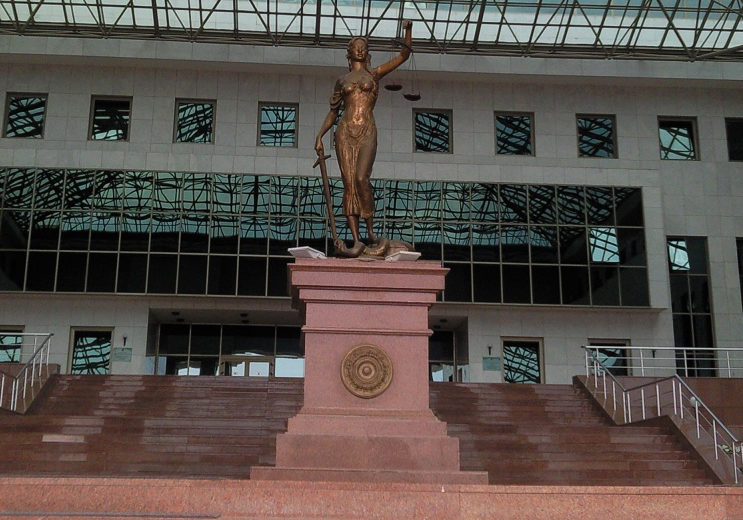
Kazakhstan: ICJ welcomes the Supreme Court decision to grant an appeal of a disbarred lawyer
On 6 December, the ICJ concluded a trial observation mission to Kazakhstan on the case of the disbarment of lawyer Polina Zhukova.
Lawyers Lyubov Agushevich and Polina Zhukova were disbarred following disciplinary proceedings initiated by the Ministry of Justice regarding their defence of a client in court proceedings.
The alleged misconduct, which lead to the disbarment of the lawyers, included inter alia a statement of innocence of their client, submitting motions to the court, submitting requests for recusals, one lawyer “putting a question which she knew the answer to”, reading a page out of the case file, and filing a motion for an examination of the witnesses who attended the hearing.
These actions were interpreted by the presiding judge in the criminal case in which the lawyers represented the defendant as violations of professional ethics, and were later used as grounds for the termination of their licenses to practice law.
ICJ observers, Justice Ketil Lund, an ICJ Commissioner and a former Justice of the Supreme Court of Norway, and Zulfikor Zamonov, a lawyer from Tajikistan, observed the Supreme Court appeal hearing in the case on 5 December.
The Supreme Court upheld the motion of lawyer Zhukova to resume proceedings in her case and reconsider the issue of the lawfulness of her disbarment.
“The ICJ welcomes the decision to review the case against the lawyer and will continue following the case,” said Temur Shakirov, Legal Adviser of the ICJ Europe Programme.
Read also:
Disbarment proceedings against lawyers in Kazakhstan
Disciplinary action against lawyers in CIS countries: analysis of international law and standards
Contact:
Róisín Pillay, Director, ICJ Europe Programme, roisin.pillay(a)icj.org
Temur Shakirov, LegalAdviser, ICJ Europe Programme, temur.shakirov(a)icj.org
Recent News
 HRC63: ICJ Calls for Protection of Lawyers and Accountability in Myanmar07 Sep 2026
 More than fifty years on: enforced disappearance, the families who named it, and the reframing of international protection26 Aug 2026
 Türkiye: Osman Kavala must be immediately released following European Court order to quash his conviction25 Aug 2026
 Sudan: ICJ joins call to extend UN Fact-Finding Mission and strengthen accountability21 Aug 2026