
Kyrgyzstan: the ICJ welcomes new investigation into the case against human rights defender Azimzhan Askarov
The ICJ today welcomed the decision of Oktyabrskiy Court of Bishkek to reopen the investigation in the case against Azimzhan Askarov.

The ICJ today welcomed the decision of Oktyabrskiy Court of Bishkek to reopen the investigation in the case against Azimzhan Askarov.
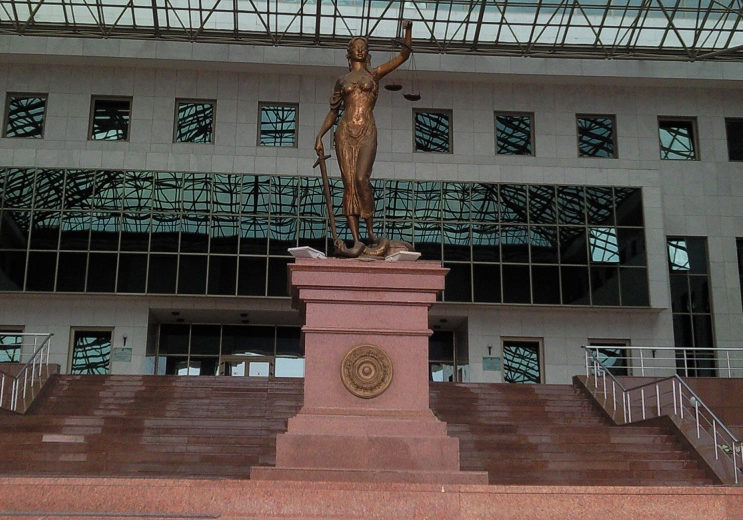
The ICJ today expressed concern at the decision of the Kazakhstan Supreme Court, on 26 March, to affirm the disbarment of lawyer Polina Zhukova on spurious grounds that run contrary to international standards on the role and independence of lawyers.

The ICJ today called on the Ukrainian authorities to discontinue criminal prosecutions and dismissals of Constitutional Court judges.
These measures, which came at a time of crisis in the country, were taken due to disagreement with a ruling made by the judges in 2010.
The measures interfere with the independence of the judiciary, and are inconsistent with the principle of separation of powers and respect for the rule of law.
Wilder Tayler, ICJ Secretary General underscored that “In times of crisis the stability and continuity of the judiciary is essential. Judges should not be subject to arbitrary removal, individually or collectively, by the executive, legislative or judicial branches”.
On 24 February 2014, the Verkhovna Rada, the Parliament of Ukraine, adopted a resolution according to which twelve of the eighteen judges of the Constitutional Court were to be dismissed by the institutions which appointed them.
Five of the judges were dismissed by the Rada itself. The Rada recommended that the Acting President and the Congress of Judges consider dismissing the other seven judges.
On 13 March, the Parliament appointed four new judges of the Constitutional Court.
The grounds for dismissals were breaching the oath of a judge.
Moreover, in accordance with the resolution, the Prosecutor General was assigned by the Parliament to initiate criminal proceedings against those judges who were “guilty of adopting the decision of the Constitutional Court of Ukraine of 30 September 2010 No 20-rp/2010”, which overturned the adoption of the Constitution of 2004.
The Parliament’s resolution against the justices of the Constitutional Court followed the Ukrainian political crisis, which reached its peak on 22 February 2014 after three months of protests and violent clashes, and resulted in a change of government.
“The ICJ is deeply concerned at the dismissal and criminal prosecution of Ukrainian Constitutional Court judges on grounds of their interpretation of the law in judicial decisions” said Wilder Tayler.
“These measures are inconsistent with respect for the independence of the judiciary and the rule of law. It is precisely at moments of transition or crisis, such as Ukraine is now experiencing, that upholding the rule of law and the separation of powers is most critical. Any disciplinary action against judges must respect the independence of the judiciary, be based on established standards of judicial conduct and be taken only following a fair procedure in which the rights of the judge concerned, including to a defence, are respected.”
The ICJ stressed that action taken against the judges of the Constitutional Court is inconsistent with the duties of all branches of the government of Ukraine to respect and protect the independence of the judiciary.
This duty, a fundamental pillar of the rule of law and a fundamental aspect of the principle of separation of powers of the three branches of government, is enshrined in both the European Convention on Human Rights and the International Covenant on Civil and Political Rights, international human rights treaties to which the State is a party.
Furthermore, Article 1 of the UN Basic Principles on the Independence of the Judiciary clarifies that all governmental and other institutions must respect and observe the independence of the judiciary.
This requires that judges have jurisdiction over issues of a judicial nature and that judicial decisions by courts must not be subject to revision (Principle 4).
Judges must have guaranteed tenure until a mandatory retirement age or the expiry of their term of office (Principle 12) and can be subject to suspension or removal only following fair procedures (Principle 17) and only for reasons of incapacity or behaviour that renders them unfit to discharge their duties (Principle 18).
The European Court of Human Rights found, in the recent case of Volkov v Ukraine, that dismissal of a judge of the Ukraine Supreme Court through a parliamentary procedure violated the right to a fair hearing under Article 6.1 of the European Convention on Human Rights, since there had been insufficient examination of the merits of the case, and it had not been heard by a tribunal established by law.
Contacts:
Róisin Pillay, Director, Europe Programme, t + 32 273 48 46, roisin.pillay(a)icj.org
Temur Shakirov, Legal Adviser, Europe Programme, t + 41 22 979 38 32, temur.shakirov(a)icj.org
Ukraine-dismissal and criminal prosecution of judges-news-2014 (Statement, PDF)

The ICJ expressed concern at the arrest and detention, on 28 February, of lawyer Taisiya Baskayeva, who represents a significant number of victims of human rights violations before the European Court of Human Rights.
Taisiya Baskayeava was arrested on charges of large-scale fraud under article 159.3 of the Russian Criminal Code, based on allegations by investigators that she misappropriated reparations awarded to victims she represented in the case of Salkazanov and others v. Russia before the European Court.
The arrest followed repeated attempts by the investigator to place her in detention in connection with the case.
A previous request to the Court by the investigator for her arrest, on 14 February, had been based partly on the allegation that she was in hiding in the United Arab Emirates and the fact that she had been “put on an international missing list.”
However the Court on that occasion denied the request, saying that it “received no reliable information that Baskayeva T.S. had left the territory of Russia” and that she had sent an urgent telegram from the Moscow region to prove her presence in the territory of Russia.
Taisiya Baskayeva was detained in Moscow region while undergoing a medical check and driven some 1200 km in a car to North Osetia.
At a hearing on 4 March 2014 the Soviet District Court of Vladikavkaz decided to grant the motion to detain the lawyer for two months pending trial. The Court ruled out other less restrictive measures.
The ICJ has received information indicating that the investigation presented no evidence that Taisiya Baskayeva had left Russia, except for an allegation made by the investigator in the motion for her arrest.
The ICJ is unaware of the reasons for declaring the lawyer missing, since her whereabouts were clearly known.
Moreover, the fact that she was detained while undergoing a medical check, of which the investigative authorities were duly informed by the Central City Hospital, contradicts her inclusion on a “international missing list”.
According to the official letter of the Deputy Head Physician at the disposal of the ICJ, the schedule of her visits was also made known to the investigative authorities.
The ICJ is concerned at that the detention may be arbitrary, and may have been ordered for the improper motive of subjecting Taisiya Baskayeva to persecution, harassment or intimidation in regard to her representation of her clients before the European Court of Human Rights.
If so, the Russian Federation would be in breach of obligations in respect of the right to liberty under article 9 of the International Covenant on Civil and Political Rights and article 5 of the European Convention on Human Rights.
The ICJ recalls that for lawyers to be able to fulfill their role and duties effectively, and independently, the State authorities must ensure that they are able to discharge their functions without any intimidation, harassment or improper interference.
According to the UN Basic Principles on the Role of Lawyers, lawyers must not be threatened with prosecution or any other form of sanctions for any action taken in accordance with professional duties or standards and ethics (Principle 16).
Under these principles when lawyers are threatened as a result of discharging their functions, the state authorities must take adequate steps to protect them (Principle 17).
The ICJ is concerned that the detention may constitute a form of a reprisal for an effective representation of the interests of a significant group of victims before the European Court of Human Rights.
Any such reprisal would be incompatible with Russia’s obligations under article 34 of the European Convention for Human Rights guaranteeing an effective exercise of the right to bring lodge applications claiming violations under the ECHR.
Approximately 200 other cases submitted by Ms. Baskayeva are currently pending before the European Court of Human Rights.
The ICJ will continue to monitor the criminal prosecution of lawyer Taisiya Baskayeva.
Contacts:
Róisin Pillay, Director, Europe Programme, t + 32 273 48 46, roisin.pillay(a)icj.org
Temur Shakirov, Legal Adviser, Europe Programme, t + 41 22 979 38 32, temur.shakirov(a)icj.org
Russia-Concerns over Baskayeva-news-web story-2014-rus (full text in pdf)

The ICJ expressed concern at today’s arrest of Fakhriddin Zokirov, a prominent defence lawyer who had represented the former Minister of Industry, Zaid Sayidov.
The former Minister was recently convicted for a number of crimes including polygamy, receiving a bribe, rape, fraud, illegal confinement and sentenced to 26 years of imprisonment.
The ICJ is concerned at reports that the arrest of the lawyer may be related to his active and robust defence of the former Minister in court.
Lawyer Zokirov was arrested by the State Finance Control and Anti-Corruption Agency on charges of fraud in banking transactions, which allegedly took place several years ago.
Two other lawyers who defended the former Minister, Shukhrat Kudratov and Iskhok Tabarov, announced at a press conference that they had recently faced various threats and intimidation in connection with the case.
The lawyers reported that the pressure on them had significantly increased in relation to a lawsuit which they brought against the head of the State Finance Control and Anti-Corruption Agency, Fattokh Sayidov.
They alleged that the head of the Agency threatened that if they did not drop the case, they would “share the dock” with their client, the former Minister.
“Abusive prosecutions of lawyers and threats against them in connection with their work are contrary to international standards on the independence of lawyers and undermine the integrity of the justice system”, Róisín Pillay, Director of the Europe Programme, said today. “In the exercise of their profession, lawyers must remain free from intimidation, harassment, fear and arbitrary prosecution and arrest. The ICJ calls on the authorities of Tajikistan to ensure that lawyers’ integrity is protected, and that the criminal justice system is not misused to intimidate them.”
Under the UN Basic Principles on the Role of Lawyers, lawyers must not be identified with their clients’ causes, and must be protected against attacks and intimidation, including prosecutions or administrative or other sanctions for action taken in accordance with their recognized professional duties.
Contacts:
Róisin Pillay, Director, Europe Programme, t + 32 273 48 46, roisin.pillay(a)icj.org
Temur Shakirov, Legal Adviser, Europe Programme, t + 41 22 979 38 32, temur.shakirov(a)icj.org
Tajikistan-arrest of lawyer-news-web story-2014-rus (full text in pdf)
 HRC63: ICJ Calls for Protection of Lawyers and Accountability in Myanmar
 More than fifty years on: enforced disappearance, the families who named it, and the reframing of international protection
 Türkiye: Osman Kavala must be immediately released following European Court order to quash his conviction
 Sudan: ICJ joins call to extend UN Fact-Finding Mission and strengthen accountability