Dec 3, 2015 | News
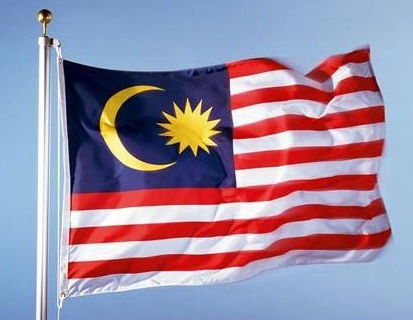
The ICJ condemned the passage of the National Security Council bill by Malaysia’s House of Representatives today. The passage of the bill underlines the need to establish reforms in the lawmaking processes in the country, the Geneva-based organization says.
The ICJ calls on the Government of Malaysia to undertake these reforms immediately.
The bill, hastily tabled at the House of Representatives on 1 December 2015 by the Government, was passed by a vote of 107 in favour and 77 against the proposal.
Members of the ruling party, Barisan Nasional, voted overwhelmingly in its favor.
The vote took place despite repeated calls from Malaysian civil society, opposition lawmakers, and human rights advocates to delay consideration to allow for extensive debate and adequate consultations on the draft legislation.
The ICJ deplored the manner in which the government steamrolled the bill to passage.
“The same rushed maneuvers occurred when the Prevention of Terrorism Act (POTA) and amendments of the Sedition Act were hastily passed in parliament earlier this year,” observed Emerlynne Gil, ICJ’s Senior International Legal Adviser for Southeast Asia.
“There seems to be a disturbing pattern of avoiding deliberative care on legislation that is both addressed to serious security concerns that have the greatest implications for human rights,” she added.
The ICJ considers that the poorly conceived legislation gives overbroad powers to the Prime Minister and the security forces which is inconsistent with the rule of law and could lead to serious human rights violations
The bill establishes a National Security Council (NSC) that will be the central authority in the government on matters pertaining to national security.
The NSC will be headed by the Prime Minister and composed of the Deputy Prime Minister, Minister of Defence, Minister of Home Affairs, Minister of Communication and Multimedia, Chief Secretary, the Commander of the Armed Forces, and Inspector-General of Police.
Under the bill, the Prime Minister is granted the power to declare any part of Malaysia as a “security area” if it is found by the NSC that such area is under serious threat from any person or entity that could harm the general public, the economy, infrastructure or other national interests.
Any part of the country may be declared a “security area” by the Prime Minister for up to six months and the declaration may be renewed an infinite number of times.
A Director of Operations is also to be appointed to oversee the operations over the “security areas”.
The specific powers of the Director of Operations are left vague, but they are overbroad and therefore prone to abuse.
They apparently include authority to prevent any person from entering these “security areas”, to transfer persons out of these areas, to impose curfews, and at least temporarily, to take possession of any property necessary in the interest of national security or for the accommodation of the security team.
The security team under the Director of Operations will have the power to conduct warrantless arrests and warrantless searches and seizures.
There are no processes specified by which affected persons may challenge such actions, either before a court or administrative body, nor are there other procedural safeguards.
Any members of the security team would be authorized to “use any amount of force against a person or entity to the extent that is reasonable and necessary within the circumstances to protect national security”.
The ICJ notes that under international law, lethal force may only be used to the extent strictly necessary to protect life.
Finally, the draft law provides immunity from any legal proceeding for members of the NSC, the Director of Operations, the security team, and other government staff involved in the administration of the “security area” for carrying out their duties and functions under the law.
There is no exception even in cases involving serious violations of human rights and crimes under international law, for which immunity is not permitted.
“The wide ranging powers conferred to members of the NSC and the security team clearly lack any form of safeguards and will inevitably lead to arbitrary exercise of authority, in contravention of the rule of law. This bill could very likely be used to further restrict freedom of expression and opinion and other rights in the country,” said Emerlynne Gil.
Vague and overbroad language in laws are inconsistent with the rule of law, contravening the principle of legality, the ICJ says.
This poses particular hazards in respect of national security legislation.
The bill will now need to be passed by the Senate and thereafter, the Malaysian King will have to assent to it so that it becomes law.
The ICJ expects the bill to be passed by the Senate and assented to by the King without thorough deliberations.
Nevertheless, it still calls on both the Senate and the King to reject the present draft, with a view to returning it the House to make necessary reforms in line with the rule of law.
Contact:
Emerlynne Gil, ICJ Senior Legal Adviser (Bangkok), t: +66840923575, e: emerlynne.gil(a)icj.org
Nov 25, 2015 | News
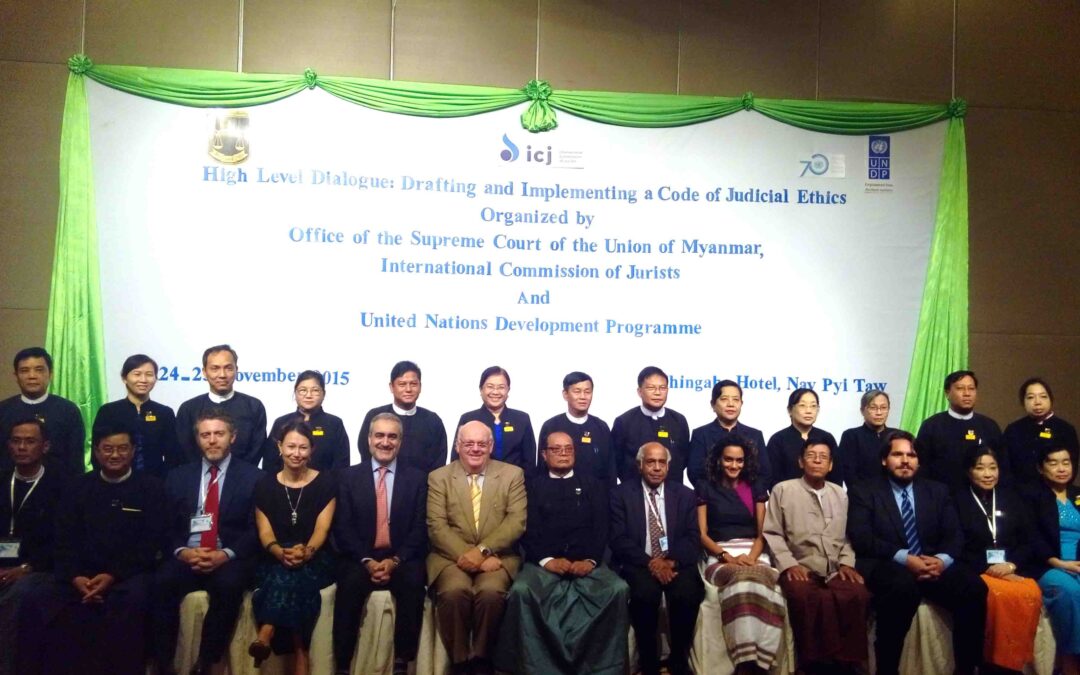
The ICJ, the UNDP and the Office of the Supreme Court of the Union (OSCU) held a High Level Dialogue on “Drafting and Implementing a Code of Judicial Ethics” in Nay Pyi Taw on 24-25 November 2015.
This followed on a commitment by the OSCU to create a new code and to work together with the ICJ and UNDP to ensure it is informed by and implemented in accordance with international best practice.
The Judicial Ethics Review Committee, Regional High Court Judges and other senior court administrators participated in the Dialogue.
The participants and their international counterparts from the ICJ and UNDP discussed the content of the Draft Code of Ethics, international standards on Judicial Codes of Ethics and accountability mechanisms.
In opening the Dialogue, the Honourable Supreme Court Justice of the Union, U Mya Thien explained that the new code reflecting international standards would enhance public trust and promote accountability in the Judiciary.
In his opening remarks, Sam Zarifi, the ICJ’s Regional Director for Asia and the pacific noted the historic occasion in which the world was watching transition in Myanmar.
During the Dialogue, former ICJ Commissioner and UN Special Rapporteur on the Independence of Judges and Lawyers, Dato Param Cumaraswamy, and Justice Murray Kellum of Australia shared their wealth of experience developing codes of ethics and accountability mechanims at the national and international levels.
Both explained that public perception of the Judiciary is key in a transition to the rule of law and human rights.
All participants agreed the Myanmar’s judiciary is not yet independent and that its current judicial code of ethics requires updating.
It was acknowledged that new code of ethics would develop the independence of the judiciary in Myanmar.
Sam Zarifi explained that, “in order for the Supreme Court to assert judicial independence it must demonstrate that it can hold itself accountable to a code of ethics.”
Both the UNDP and the ICJ congratulated the OSCU for following its Strategic Plan for 2015-2018 and engaging in a dialogue designed to further this process.
Both expressed willingness to continue working with Myanmar’s judiciary on the issues of judicial independence, the rule of law and human rights.

Nov 3, 2015 | News
The ICJ and 26 other civil society organizations called today upon the Vietnamese government to comprehensively revise the draft Law on Religion to conform with the country’s obligations under international human rights law.
The groups are concerned that Vietnam’s draft Law on Belief and Religion is inconsistent with the right to freedom of religion or belief.
In its current form, the draft Law places limitations on freedom of religion or belief that extend beyond those permitted under international human rights law that is binding on Vietnam, they say.
Article 18(3) of the International Covenant on Civil and Political Rights (ICCPR), to which Vietnam is a state party, requires the authorities to ensure that the freedom to manifest one’s religion or belief is subject only to such limitations as are prescribed by law and are necessary and proportionate to protect public safety, order, health, or morals or the fundamental rights and freedoms of others.
While the draft Law purports to acknowledge “the right to freedom of religion and belief” and proclaims that the “government respects and protects the freedom of religion and belief of everyone,” the provisions of the draft Law, if passed, would act as a powerful instrument of control placing sweeping, overly broad limitations on the practice of religion or belief within Vietnam, perpetuating the already repressive situation.
Contact:
Kingsley Abbott, ICJ International Legal Adviser, (Bangkok), t:+66 944701345, e-mail: kingsley.abbott(a)icj.org
Vietnam-Draft Law on Religion-Advocacy-2015-ENG (full statement, in PDF)

Oct 29, 2015 | News
The Singaporean government should halt the imminent execution of Kho Jabing and commute his death sentence, said the ICJ today.
In 2010, Kho Jabing was convicted and sentenced to death, after having been found guilty of murder.
Amendments made to its laws on the death penalty in 2012 allowed for persons who had been subjected to the death penalty the option to elect to be considered for re-sentencing under the new rules.
Kho Jabing, under this process, was re-sentenced to life imprisonment and 24 strokes of the cane.
The prosecution, however, appealed the re-sentencing, and the case was brought to the Court of Appeal.
On 14 January 2015, the Court of Appeal decided to reinstate the death penalty in the case.
Kho Jabing filed a clemency appeal and the Court of Appeal rejected this on 19 October 2015.
The authorities have not released the date of Kho Jabing’s execution, but it is believed that he is likely to be executed during the first week of November 2015.
“Singapore has obscured the extent and nature of its execution practices and its record on respect for the right to life”, said Sam Zarifi, ICJ’s Regional Director for Asia and the Pacific.
“Failure to be transparent about its use of the death penalty, flies in the face of international human rights standards,” he added.
The ICJ opposes the death penalty in all circumstances and considers the imposition of the death penalty to constitute a denial of the right to life and a form of cruel, inhuman and degrading punishment.
The view that the death penalty is never justifiable is shared by the overwhelming majority of States, United Nations institutions, and numerous civil society organizations.
In December 2014, the UN General Assembly, by a very wide majority, adopted a Resolution repeating its call for all States retaining the death penalty to institute a moratorium on the practice, with a view to abolition.
The ICJ has also received information that Singapore carried out two executions in October 2015. The authorities, however, have not issued an official statement regarding these executions.
To date, the Singapore government has not released the exact number of executions undertaken in the country.
In 2004, UN Special Rapporteur on extrajudicial, summary, or arbitrary executions emphasized the importance of transparency wherever the death penalty is applied.
According to the UN Special Rapporteur, “Secrecy as to those executed violates human rights standards.”
In addition, a “full and accurate reporting of all executions should be published, and a consolidated version prepared on at least an annual basis.”
The ICJ calls on the Singapore government:
- to stop the execution of Kho Jabing and commute his sentence, to one that does not include caning, which constitutes a form of cruel, inhuman or degrading punishment
- to institute an immediate moratorium on executions
- to take all necessary measures to abolish the death penalty in law
- to make public a full and accurate report of all executions in the country
Contact:
Emerlynne Gil, ICJ Senior International Legal Adviser for Southeast Asia, (Bangkok), t: +66840923575, e: emerlynne.gil(a)icj.org
Oct 26, 2015 | News
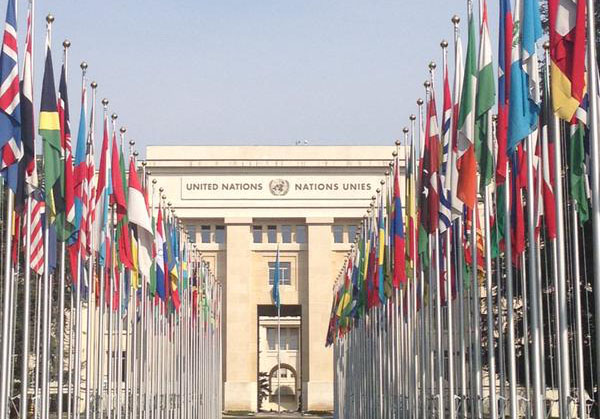
Myanmar’s human rights record for the past four and a half years will be under scrutiny at the United Nations (UN) Human Rights Council (HRC), as the country goes up for its Universal Periodic Review (UPR) review on 6 November 2015.
Myanmar will be assessed on developments based on information provided by the government, UN human rights experts, institutions and treaty bodies; and stakeholders including Non-Governmental Organizations (NGOs).
The eleventh round of Pre-Sessions to discuss the human rights situations in Myanmar was held on 8 October 2015 and was organized by UPR-Info.
The event brought together various permanent missions and various Myanmar civil society organizations (CSOs) that presented their respective UPR recommendations.
This event also provided NGOs, including the ICJ, with an opportunity to contribute to the UPR process by informing several delegations at once about specific, actionable recommendations to the government to effectively address human rights violations and provide redress.
In its UPR stakeholder submission, the ICJ drew the attention of the HRC Working Group on the UPR, and that of the HRC itself, to the ICJ’s concerns about the independence of the judiciary and legal profession, the lack of legislation adequately protecting human rights and the environment, discriminatory laws targeting women and minorities, and the writ of habeas corpus in Myanmar.
The Office of the Commissioner for Human Rights referred to these issues in its summary to the HRC Working group on the UPR.
UPR discussions in Geneva led by NGOs reiterated that despite reforms, significant human rights challenges remain in Myanmar. These include, but are not limited to, the following:
- During its first UPR in 2011, Myanmar had supported recommendations to consider signing and ratifying core human rights treaties, but has made no significant progress;
- A recent parliament veto reserves the 25% of the seats in the legislative bodies for the military, thus continuing military impunity and preserving their hold over any constitutional or legislative amendment;
- The Myanmar National Human Rights Commission suffers from low credibility due to its lack of autonomy from the government and failure to investigate egregious human rights violations;
- The package of “race and religion protection” laws comes at a time of increasing ethnic and religious tension, and discriminates on grounds of gender and religion. Discrimination against religious minorities has led to mass displacement, deaths and rights violations;
- Lesbian, Gay, Bisexual and Transgender rights are routinely violated;
- The Environmental Conservation Law allowed government departments and private business abroad exemptions from environmental protection obligations;
- Judicial independence is compromised as judges in some instances still render decisions based on orders coming from military and the government.
Contact:
Vani Sathisan, ICJ International Legal Adviser, Myanmar, t: +95-09250800301; e: vani.sathisan(a)icj.org
The ICJ’s UPR stakeholder submission for Myanmar can be found here
The OHCHR summary to the UN Working Group for the UPR can be found here