
Report of the Special Rapporteur on freedom of religion or belief, A/HRC/28/66, 29 December 2014
II. Preventing violence committed in the name of religion A. A complex phenomenon 11. Furthermore, homophobic and transphobic violence against lesbian, gay, bisexual and transgender (LGBT) persons may also be perpetrated in the name of religion. Those perceived as...General Comment No. 35 on liberty and security of person (art. 9), CCPR/C/GC/35, 16 December 2014
I. General remarks 3. Liberty of person concerns freedom from confinement of the body, not a general freedom of action.{{1}} Security of person concerns freedom from injury to the body and the mind, or bodily and mental integrity, as further discussed in paragraph 9...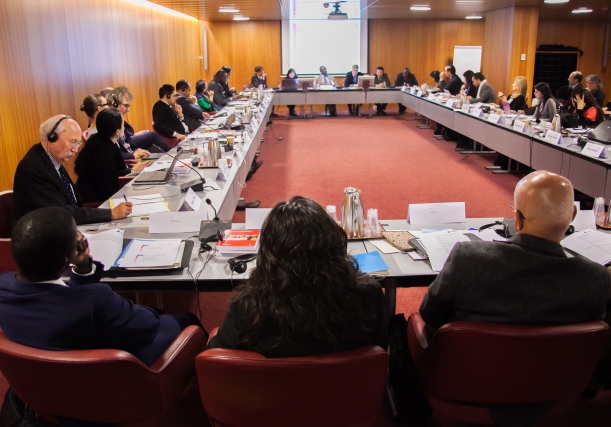
ICJ holds Geneva Forum 2014 on enforcement of economic, social and cultural rights
Today and tomorrow, the ICJ welcomes judges and lawyers from all regions of the world to discuss the “Judicial Enforcement of Economic, Social and Cultural Rights”.
The 2014 Geneva Forum of Judges and Lawyers is a joint initiative of the ICJ Center for the Independence of Judges and Lawyers (CIJL) and the ICJ Programme on Economic, Social and Cultural Rights.
Participants are exchanging views on the progress made over the past two decades, including the entry into force of the Optional Protocol to the International Covenant on Economic, Social and Cultural Rights in May 2013.
The Protocol allows individuals to bring complaints of violations of such rights to an independent international body of experts for adjudication.
Discussions are held also in relation to challenges to the justiciability of these rights, including as regards the principle of separation of powers between the judicial, executive and legislative branches of government.
Managing potential implications for public human and financial resources of judicial orders for enforcement of ESCR, and the conflicts that may arise between state development plans, public interest and the interests and rights of the individuals, will also be topics of discussion.
Participants are invited to ground the discussion of conceptual issues in examples from their own actual experience and practice in their national jurisdictions.
Alejandra Ancheita, recent winner of the Martin Ennals Award 2014 – The Nobel Prize of Human Rights – is among the guest speakers.
A report of the discussions will be published in 2015.
The draft agenda for the 2014 Geneva Forum is available here:
Universal-Programme GVA Forum 2014-Events-2014-ENG (English)
Universal-Programme GVA Forum 2014-Events-2014-ESP (Español)
The 2014 Geneva Forum has been made possible with the support of the République et Canton de Genève, the Permanent Mission of Germany to the United Nations in Geneva, and the Taipei Bar Association.
The Geneva Forum has been convened annually by the CIJL since 2010.
Information on, and reports of, the previous Geneva Forums can be found here:
Geneva Forum 2013 (photo)
Geneva Forum Series no. 1: Women and the Judiciary
Geneva Forum 2012
Third Geneva Forum for Judges and Lawyers: the report is published
Geneva Forum 2011
2nd ICJ Geneva Forum of Judges and Lawyers: final report
Geneva Forum 2010

Annual Business and Human Rights Forum: ICJ experts talk about issues linked to access to remedies, local communities and the rights of the child
Vani Sathisan, ICJ’s International Legal Adviser in Myanmar, and Carlos Lopez, ICJ Senior Legal Adviser on Business and Human Rights made presentations at the annual Business and Human Rights Forum.
Vani Sathisan’s statement highlighted the State duty to protect human rights and provide access to remedies; the need for greater cooperation between businesses and local communities; and possibilities for home governments to cooperate on business and human rights issues.
She underscored that the State duty to protect, respect and fulfil human rights is one that is already grounded in international human rights law and accordingly, Myanmar must adopt and enforce laws – including policies, legislation, and regulations – that are preventative and remedial, and to regulate business conduct and protect the economic, social and cultural rights of its people.
Without proper investment, land and environmental laws, as well as an effective judiciary to enforce these laws and provide appropriate judicial remedies, development projects risk being counterproductive for sustainable development and the protection of human rights in Myanmar.
This panel discussion can be viewed on the UN’s Web TV.
Carlos Lopez Carlos Lopez focused on the work of the Committee on the rights of the child on business and human rights through the adoption of General Comment 16 on States obligations regarding the impact of business on the rights of the child.
The Guiding Principles on Business and Human Rights do not establish legal obligations, but elaborate on the practical implications of those obligations. The legal obligations for States to protect, respect and fulfil human rights are contained in international human rights treaties. One of them is the Convention on the Rights of the Child.
Besides examining State reports and providing conclusions and recommendations, the Committee elaborates General Comments to assist States in their implementation of their legal obligations under the Convention. In February 2013 the Committee adopted General Comment 16 on States obligations regarding the business impacts on the rights of the child. This General Comment was necessary:
· First, because in the Committee’s examination of State reports the issue of impacts of economic actors had arisen repeatedly. The General Comment is a more organized response to these practical and recurrent issues.
· Second, the Committee considered that the existing instruments and guidance did not sufficiently address the particular situation and needs of children. GC16 aims at fulfilling that gap in relation with States while the UNICEF Child Rights and Business Principles does so in relation to business enterprises.
The Committee, with the support of a core group comprising UNICEF, ICJ, Save the Children and OHCHR started a process of reflection, research and global and regional consultations (these took place in Kenya, India and Argentina and an international seminar was held in Sion, Switzerland.
This panel discussion can be viewed on the UN’s Web TV.
Carlos Lopez also moderated a Panel on the rights of the child and business enterprises, under the title Measures for implementing the Convention on the Rights of the Child in the context of business operations.
Recent News
 HRC61: ICJ Statement on attacks against the rule of law and independent legal professionals — highlighting situations in Afghanistan and Guatemala02 Mar 2026
 Iran/United States/Israel: Unlawful attacks must cease01 Mar 2026
 The Use of Anti-Terrorism Courts to Suppress Dissent in Venezuela27 Feb 2026
 South Sudan: Extend UN Investigations Amid Deteriorating Human Rights Crisis19 Feb 2026