

Engaging with civil society after Facebook revelations
On 8 December 2021, ICJ alongside 20 other civil society organisations sent a letter to Frances Haugen, the former Facebook employee who spoke out about the tech giant’s business model and the problems it raises for human rights, inviting her to speak and exchange ideas with us. We believe that engaging with civil society is crucial in order to find solutions that work for businesses and individuals alike.

States must implement an immediate moratorium on the sale, transfer and use of surveillance technology
ICJ along with 155 civil society organizations and 26 independent experts worldwide call on states to implement an immediate moratorium on the sale, transfer and use of surveillance technology.
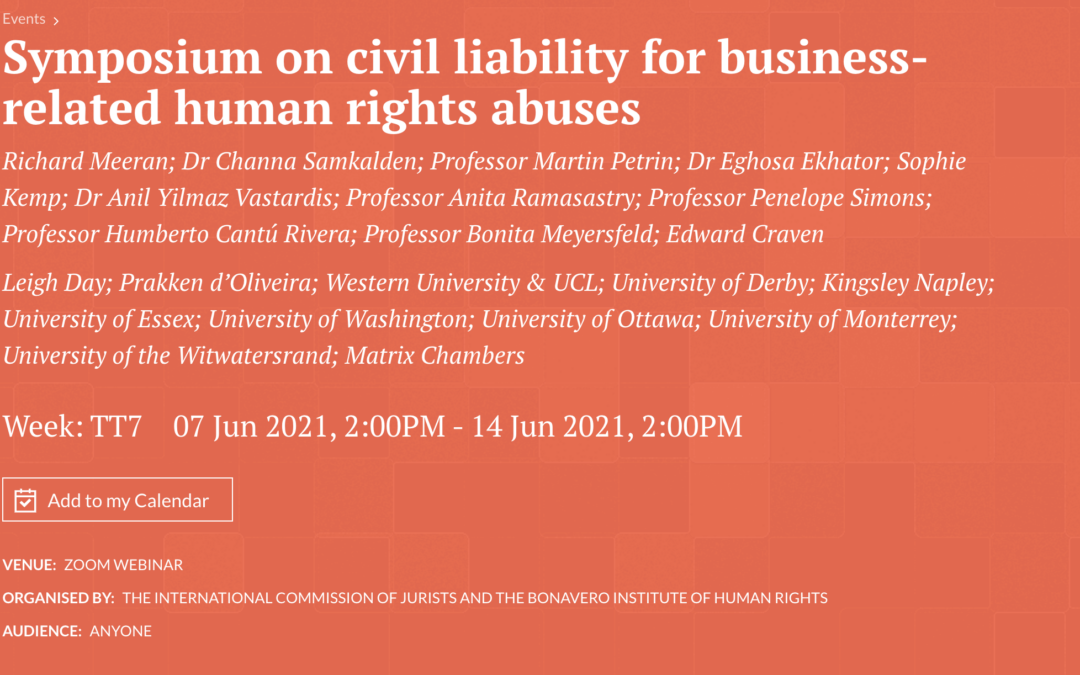
Symposium on civil liability for business-related human rights abuses
As part of its work to raise awareness and deepen the understanding about the importance of civil liability for the objective of improved accountability of business-related human rights abuses and access to justice and reparations, the ICJ is partnering with the Bonavero Institute of Human Rights to organize an online symposium.
The symposium is open to practitioners, policymakers, civil society, academics, and students working on these subjects. It will feature two panel discussions on Zoom on 7 June 2021 and 14 June 2021.
Past decades saw an emerging trend towards reliance on civil liability claims to address business-related human rights abuses (e.g., Lungowe v Vedanta and Okpabi v Shell in the UK; Choc v Hudbay Minerals and Araya v Nevsun in Canada; Akpan v Shell in the Netherlands; Jabir and others v KiK Textilien in Germany).
The ICJ and the Bonavero Institute of Human Rights’ symposium will discuss the wider implications of recent jurisprudence and identify the remaining gaps in the law.
The discussions will focus on a range of issues, including 1) the contours of rules on the duty of care; 2) prospects for supply chain liability under the law of civil remedies; 3) parent company liability and complicity under civil law; 4) prospects of access to justice.
Please follow the links below to register separately for each panel. The symposium will also involve a series of blogs by experts in the field to be published by Opinio Juris starting 21 June 2021.
Panel 1 ‘Duty of care and parent company liability’
Day and time: 7 June 2021 at 14.00 – 16.00 BST
- Richard Meeran (Leigh Day)
- Dr Channa Samkalden (Prakken d’Oliveira)
- Professor Martin Petrin (UCL)
- Dr Eghosa Ekhator (University of Derby)
- Julianne Hughes-Jennett (Quinn Emanuel)
- Dr Anil Yilmaz Vastardis (University of Essex)
To register for Panel 1, please click here
Panel 2 ‘Access to justice and civil claims for business-related human rights abuses: Challenges and opportunities’
Day and time: 14 June 2021 at 14.00 – 16.00 BST
- Professor Anita Ramasastry (University of Washington)
- Professor Penelope Simons (University of Ottawa)
- Professor Humberto Cantú Rivera (University of Monterrey)
- Professor Bonita Meyersfeld (University of the Witwatersrand)
- Edward Craven, (Matrix Chambers)
- Further speakers will be announced shortly
To register for Panel 2, please click here
This symposium is co-convened by Dr Carlos Lopez and Dr Ekaterina Aristova. Please get in touch with the organisers if you have any questions. The symposium is part of the project on civil liability for human rights violations led by the Bonavero Institute and funded by the Oak Foundation.
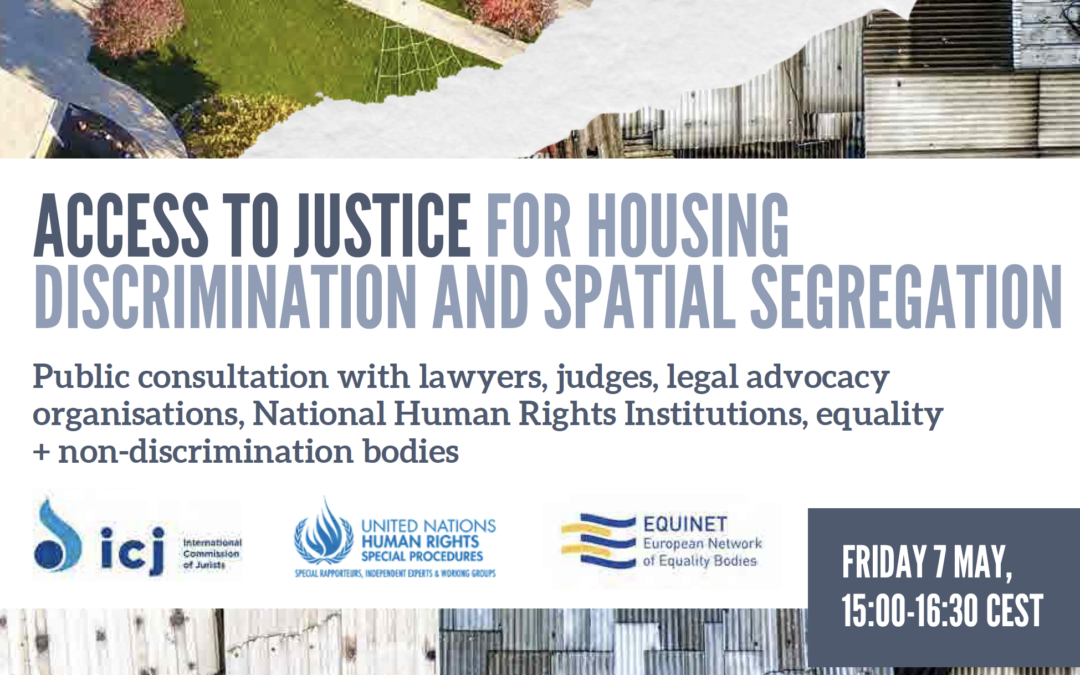
ICJ, OHCHR, Equinet to hold public consultation on access to justice for housing discrimination on 7 May
On 7 May, the ICJ will hold a public consultation, together with the UN Office of the High Commissioner of Human Rights and Equinet on Access to Justice for Housing Discrimination and Spacial Segregation.
Featured speakers include Special Rapporteur on the right to housing Balakrishnan Rajagopal; retired Justice Zak Yacoob of the South African Constitutional Court; Supreme Court of India Advocate Vrinda Grover; and Equinet human rights defender Valérie Fontaine
More info here.
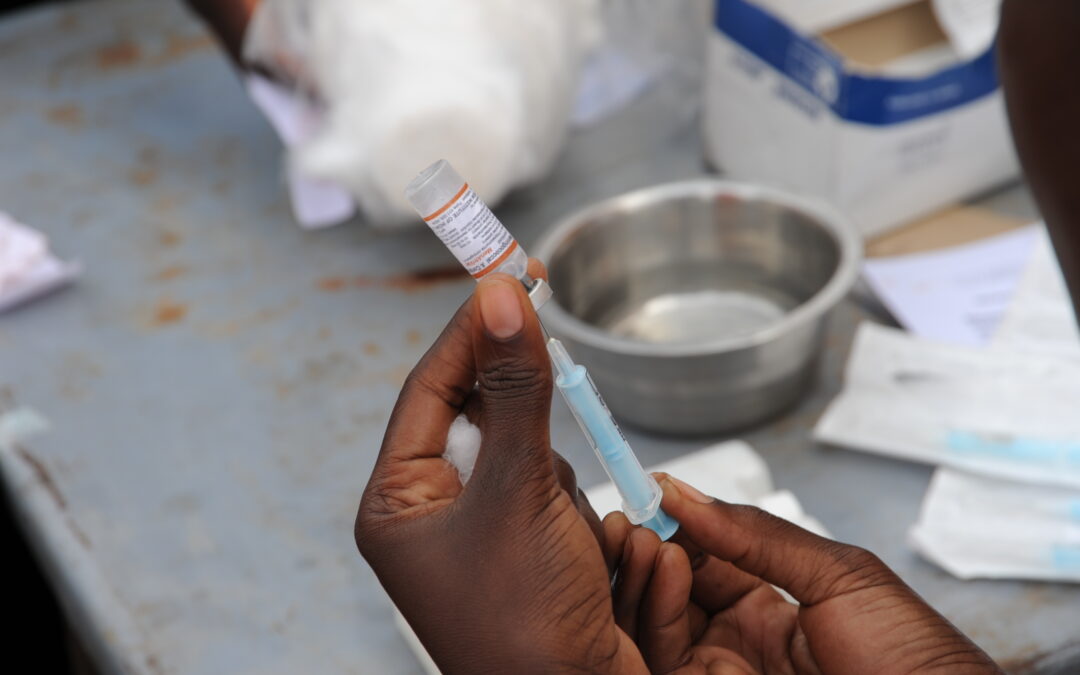
Human rights and universal access to COVID-19 vaccines: does the Human Rights Council resolution go far enough?
[TOC]By Tim Fish Hodgson, Legal Adviser on Economic, Social and Cultural Rights at the International Commission of Jurists and Rossella De Falco, Programme Officer on the Right to Health at Global Initiative on Economic, Social and Cultural Rights.
Historically pandemics have often catalyzed significant social change. As historian of epidemics Frank Snowden puts it: “epidemics are a category of disease that seem to hold up the mirror to human beings as to who we really are”. At the moment gazing in that mirror remains a regrettably unpleasant experience.
United Nations human rights Treaty Body Mechanisms and Special Procedures, the World Health Organization (WHO), UNAIDS and numerous local, regional and international human rights organizations have produced reams of statements, resolutions and reports bemoaning the human right impacts of COVID-19 and almost every single aspect of the lives of almost all people around the world. The latest being the UN Human Rights Council Resolution adopted today by consensus on “Ensuring equitable, affordable, timely and universal access for all countries to vaccines in response to the coronavirus disease (COVID-19) pandemic”.
Key amongst the human rights law and standards underpinning these analyses is the protection of the right to the highest attainable standard of health, which, certainly for the 171 States Parties to the International Covenant on Economic, Social and Cultural Rights places an obligation on States to take all necessary measures to ensure “the prevention, treatment and control of epidemic, endemic, occupational and other diseases”, and, in the context of access to medicines the right to “enjoy the benefits of scientific progress and its applications”.
Despite these legal obligations, in late February, the UN Secretary General António Guterres felt compelled to highlight the rise of a “pandemic of human rights abuses in the wake of COVID-19”, including, but extending beyond violations of the right to health. The impact of COVID-19 on human rights has, and continues to be, sufficiently ubiquitous that an Indonesian transwoman activist Mama Yuli perhaps captured it best when telling a journalist that she and others in her position were “living like people who die slowly”.
Vaccines for the few, but what about the many?
Disappointingly, however, instead of a symbol of hope of a light at the end of the Coronavirus tunnel, the COVID-19 vaccine has fast become yet another pronounced illustration of the parallel pandemic of human rights abuses described by Guterres. The disastrous state of COVID-19 vaccine production and distribution throughout the world – and even within particular countries where vaccines are available – is now often described by many activists, including significantly the People’s Vaccine campaign, as “vaccine nationalism” and profiteering which has produced a “vaccine apartheid”.
What this means, in human rights language, is that States have often arranged their own affairs in a way that is detrimental to access to vaccines in other countries in spite of their extraterritorial legal obligations to, at very least, avoid their actions that would foreseeably result in the impairment of the human rights of people outside their own territories.
It is worth emphasizing that it has still been only some four months since the first mass vaccination campaigns began in December 2020. At the time of writing, approximately 450 million people had been vaccinated worldwide, while many African nations, for example, had yet to administer a single dose. While in North America 23 COVID-19 vaccine doses have been administered per 100 hundred people, with the number standing at 13/100 in Europe, the ratio decreases dramatically in the Global South with 6.4/100 in South America, 3.8/100 in Asia, 0.7/100 in Oceania and a mere 0.6/100 in Africa.
Vaccines, State Obligations and Corporate Responsibilities
The inadequate and inequitable distribution of vaccines has a variety of causes.
First, is the generally dysfunctional nature of the global health system due to what the UN Committee on Economic, Social and Cultural Rights described in its first statement on COVID-19 as early as April 2020 as “decades of underinvestment in public health services and other social programmes”. The incredible inequities caused by privatization of healthcare services, facilities and goods in the absence of sufficient regulation is well-documented, both in the Global North and the Global South.
Second, are the obstacles to vaccine access created and maintained by States, singly but collectively in the form of intellectual property rights regimes. This is not for a lack of guidance or legal mechanisms to ensure the flexible application of intellectual property protections in favour of the protection of public health and the realization of the right to health. The TRIPS agreement is an international legal agreement concluded by members of the World Trade Organization which sets minimum standards for intellectual property rights protections.
States are specifically permitted to interpret intellectual property rights protections “in the light of the object and purpose of” TRIPS and States therefore retain “the right to grant compulsory licences and the freedom to determine the grounds upon which such licences are granted” in the specific context of public health emergencies. Nor is it the first time that epidemics have necessitated the engagement of flexible arrangements to ensure expeditious, universal, affordable and adequate access to life saving medications and vaccines.
This is why the majority of States and an overwhelming majority of civil society actors have supported South Africa and India’s request that the WTO issue a “waiver” of the application of intellectual property rights for COVID-19 “diagnostics, therapeutics and vaccines”. This request has also been formally supported by a number of independent experts of the UN Human Rights Council of UN Special Procedures, and recently received the emphatic endorsement of the UN Committee on Economic, Social and Cultural Rights. There is already precedent for such TRIPS waivers, with the WTO having already applied a waiver until 2033, for example, for least-developed countries (LDCs), which are exempted from applying intellectual property rules on pharmaceutical products and clinical data.
Disappointingly, however, the ink had barely dried on the issuing of the CESCR’s statement, when, plainly disregarding all of these recommendations, the waiver was blocked by a coalition of wealthier nations, many of whom already have substantial and advanced vaccine access. Importantly, the CESCR’s recommendations were not just made on vague policy grounds, but as the best way to fulfill States’ clear legal obligation in ICESCR that, “production and distribution of vaccines must be organized and supported by international cooperation and assistance”.
The recently adopted Resolution of the UN Human Rights Council, led by Ecuador and States of the Non-Aligned Movement and adopted on 23 March 2021 provides some hope of the alteration of this existing collision course with disaster. The resolution, which calls for “equitable, affordable, timely, and universal access by all countries”, reaffirms vaccine access as a protected human right and openly acknowledges “unequal allocation and distribution among countries”.
The resolution proceeds to call on all States, individually and collectively, to “remove unjustified obstacles restricting exports of COVID-19 vaccines” and to “facilitate the trade, acquisition, access and distribution of COVID-19 vaccines” for all.
However, despite the protestations of civil society organizations involved in deliberations about the resolution, the resolution only restates the right for States to utilize TRIPS flexibilities, as opposed to endorsing such measures as a best practice for realizing State human rights obligations. This tepid approach (which follows principles of international trade while, ironically given the resolution emanates from the Human Rights Council, ignoring human rights standards) to perhaps the pressing issue relating to vaccine access is inconsistent with the Resolution’s otherwise firm grounding of vaccine access in human rights. It therefore remarkably even falls short of insisting that States comply with their own long-established international human rights obligations.
The resolution also inexplicably fails to address corporate responsibilities, including those of pharmaceutical companies, to respect the right to health in terms of the UN Guiding Principles on Business and Human Rights, and States’ corresponding duty to protect the right to health through adopting adequate regulatory measures.
Third, and connected to the above, is the general failure of States to fully and adequately centre their human rights obligations in the broader context of COVID-19 responses worldwide. The subtle but important phrasing of the exercise of TRIPS flexibilities as a “right of States” rather than as one of the optimal ways of fulfilling an obligation, exposes the degree to which the attitudes by State policy makers and legal advisors towards and understanding of human rights are out of sync with the obligations that they have willingly assumed by becoming party to treaties like the ICESCR.
A Critical Moment: it does not have to be this way
As Snowden’s insightful work predicted, the COVID-19 pandemic represents a critical moment in human history. States, collectively and individually, are presented with a unique opportunity to set a precedent and begin to seriously address the root causes of inequality and poverty which are prevalent across the world.
Making the right decision and taking a moral stand on the importance of access to COVID-19 vaccines is both practically and symbolically important if these efforts are to succeed. Vaccines must be accepted and acknowledged as global public health goods and human rights. Private companies too should not stand in the way of equitable and non-discriminatory vaccine access for all people.
For this to happen, bold leadership is required from international human rights institutions such as the UN Human Rights Council, the UN General Assembly and the WTO. Unfortunately, at present, not enough has been done and politicking and private interest continue to trump principle and public good. Until this changes, many people around the world will continue to exist, “living like people who are dying slowly”. It does not have to be this way.
Recent News
 HRC63: ICJ Raises Concern over Torture, Executions and Impunity in Libya23 Sep 2026
 HRC63: ICJ Calls for Renewal and Strengthening of the Venezuela Fact-Finding Mission21 Sep 2026
 Joint Statement: Attacks on the Rule of Law, Judicial Independence and Access to Justice in Zambia17 Sep 2026
 HRC63: ICJ Raises Concern over Widespread and Systematic Arbitrary Detention in Egypt16 Sep 2026