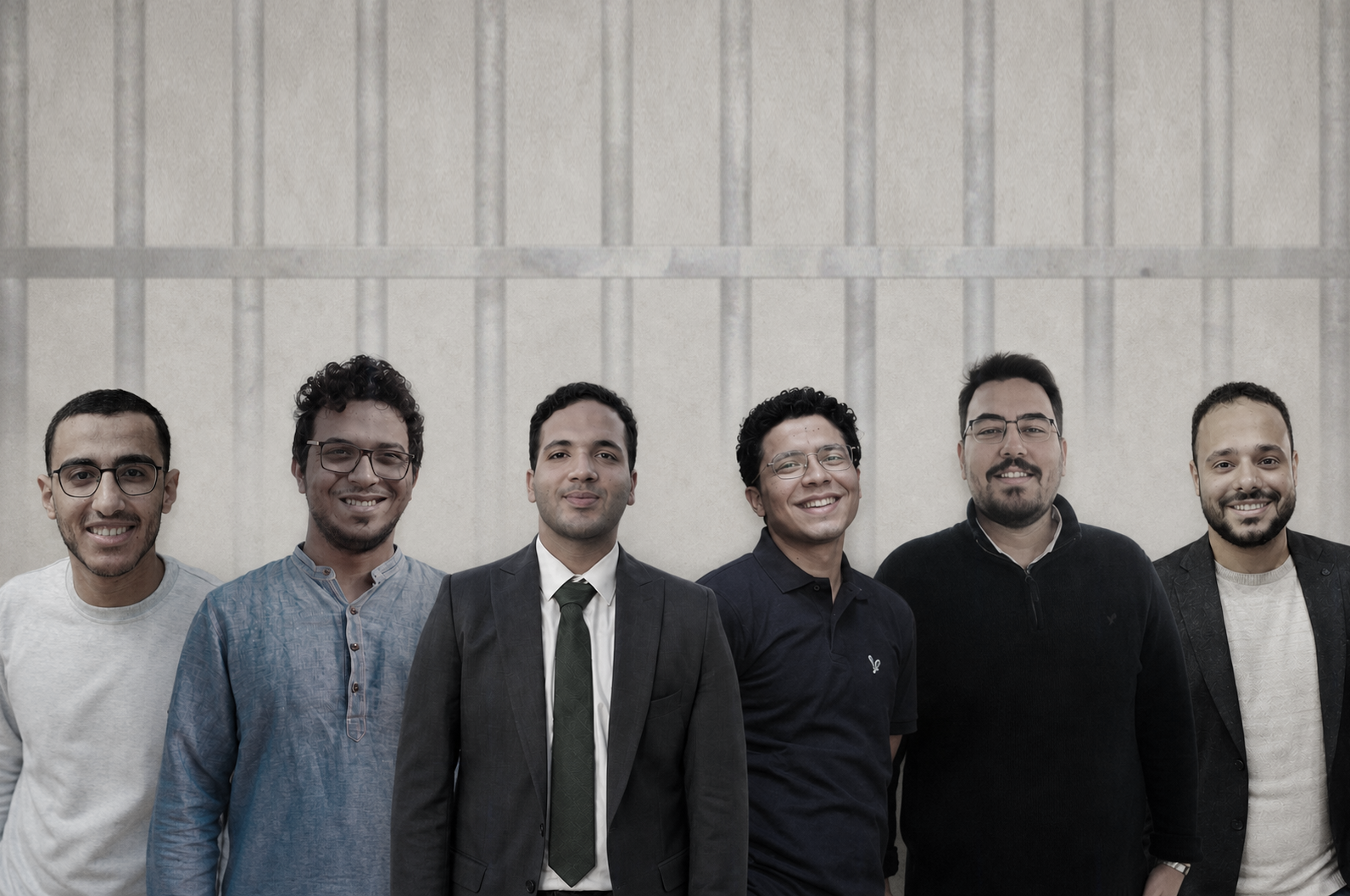
The International Commission of Jurists (ICJ) strongly condemns the Egyptian authorities’ arbitrary arrest, detention and prosecution of the entire editorial team of the independent fact-checking platform Matsda2sh, under the “Counter-Terrorism” Law, on terrorism-related charges in violation of the six journalists’ right to freedom of expression and right to liberty, and contrary to media freedom. The ICJ calls on the Egyptian authorities to immediately release all six journalists, drop all charges and cease the arbitrary criminal proceedings against them and promptly carry out independent and impartial investigations into their credible allegations of torture.
.هذا البيان الصحفي متوفر باللغة العربية أيضاً
“Once again, the Egyptian authorities have resorted to vague, overbroad and abusive laws –purportedly countering “terrorism” – to further their efforts to stamp out the last vestiges of media freedom in Egypt,” said Saïd Benarbia, ICJ Middle East and North Africa Programme Director. “The Egyptian authorities must guarantee the right to freedom of expression and media freedoms, including by immediately releasing the six Matsda2sh journalists and all other journalists currently detained solely for their legitimate work.”
Between 28 and 29 September 2026, National Security Agency (NSA) officers arrested Mohamed Ashraf Abu Omeira, Abdallah Kadry, Islam Barakat, Mohamed Adel, Mohamed Mahmoud and Omar Helal in various Egyptian governorates and held them incommunicado for a few days at NSA detention facilities, denying them access to counsel and contact with their families. Additionally, NSA officers allegedly subjected some of the six detainees to beatings, electric shocks, prolonged handcuffing and blindfolding, forced removal of their clothes, and threats of harm against them or their relatives, while also forcing them to “confess” and video-recording their fabricated “confessions”.
On 1 October, the Ministry of the Interior issued a public statement confirming that the six journalists had been arrested. However, their families and lawyers were not told where they were being held.
The journalists’ lawyers were only able to access their clients when the six detainees were brought individually before a Public Prosecutor at the Supreme State Security Prosecution (SSSP) between 3 and 4 October for interrogation. The lawyers then learnt that a Public Prosecutor at the SSSP in Cairo had authorized the extension of each of the detainees’ custody at NSA facilities pursuant to article 40 of Counter-Terrorism Law No. 94 of 2015 (the “Counter-Terrorism” Law). This provision empowers Public Prosecutors to extend, beyond 24 hours, the initial detention in the custody of law enforcement forces for up to 28 days, when such extension is purportedly required to confront “an imminent terrorist crime”. In addition, during this extended period of detention, article 41 of the same Law allows the denial of the rights of those detained to contact a family member and to seek the assistance of a lawyer if such denial is in “the interests of the investigation”. In the present case, these provisions appear to have been relied upon despite the seeming absence of the required need to confront the “imminent commission of a terrorist crime” and of a necessity arising out of any specific investigation.
Before the SSSP, some of the detainees conveyed to the Public Prosecutor details of the ill-treatment they had reportedly suffered while detained by the NSA. While the Ministry of Interior publicly denied these allegations, the Public Prosecutor failed to open an official investigation into the credible allegations, as required under international law, and merely referred three of the detainees for forensic medical examination, which the SSSP later claimed produced no evidence of injury or use of physical violence.
During interrogation, the Public Prosecutor questioned each of the detainees exclusively about their journalistic publications. The Public Prosecutor then charged each of the detainees in Case No. 8083 of 2026 with joining a “terrorist group”, “funding terrorism”, publishing “fake news”, and using social media to call for acts of “terrorism”, purportedly on the basis of their alleged connections to the proscribed Muslim Brotherhood organization. Each defendant was then remanded into pre-trial detention for an initial period of 15 days, which was renewed on 13 October.
In light of the above, the ICJ calls on the Egyptian authorities to immediately release the six Matsda2sh journalists and drop all charges against them since they arise solely from their legitimate exercise of their right to freedom of expression in the course of their journalistic work. The human rights organization also calls on the authorities to conduct prompt, independent, impartial and effective investigations into their credible allegations of torture or other ill-treatment. The ICJ also reiterates its calls on the Egyptian authorities to reform the “counter-terrorism” legislation and to stop using it to crack down on journalists, human rights defenders and others for the mere exercise of their human rights.
Background
The arbitrary arrest, incommunicado detention, prosecution and alleged torture of the Matsda2sh journalists form part of a broader pattern in which the Egyptian authorities initiate criminal proceedings on “terrorism-related charges” against journalists, human rights defenders and others for the mere exercise of their human rights, including the right to freedom of expression. UN Special Procedure mandate-holders have recently highlighted patterns in “counter-terrorism” cases in Egypt, often involving “overbroad terrorism accusations following peaceful civic, professional or expressive activity”, whereby detainees subjected to enforced disappearance are “held in unacknowledged and incommunicado detention in undisclosed locations, without prompt registration, acknowledgment of their detention, access to lawyers, notification of family members, or access to a judge”, before subsequently appearing before the SSSP. They have also expressed particular concern about recurring allegations of torture, as well as the subsequent use in criminal proceedings of statements obtained from torture. As a State Party to both the Convention against Torture (CAT) and the International Covenant on Civil and Political Rights (ICCPR), Egypt is required not only to prevent torture, but also to conduct prompt, thorough, independent, impartial and effective investigations into all allegations of torture or other ill-treatment, and ensure that statements obtained through torture or other forms of coercion are excluded from evidence in any proceedings, except when used against a person accused of torture to establish that such statements were made.
With respect to articles 40 and 41 of the “Counter-Terrorism” Law, under which Public Prosecutors have the power to extend detainees’ custody with law enforcement authorities for up to 28 days and, during that period, to deny detainees their rights to contact their family and seek the assistance of a lawyer, purportedly in “the interests of the investigation”, the ICJ has previously underscored that these prosecutorial powers enable arbitrary detention, including incommunicado detention. The ICJ notes that a prosecutor cannot be considered an independent judicial authority under article 9(3) of the ICCPR (guaranteeing the right of anyone arrested or detained on a criminal charge to be brought promptly before a judge or other officer authorized by law to exercise judicial power), as the prosecutorial function is incompatible with the independence required for judicial review of detention. In light of this, the abovementioned provisions enable the denial of detainees’ rights to be brought promptly before a judge – rather than a prosecutor – following arrest and detention and to have access to counsel from the outset of their detention, which, in turn, increases risks of enforced disappearance and torture. In this regard, UN Special Procedure mandate-holders have previously described Egypt’s “Counter-Terrorism” Law as having “effectively codified enforced disappearance”. In the present case, these concerns have proven to be particularly acute, with the six journalists having been held incommunicado for a number of days
Contact
Saïd Benarbia, Director, ICJ Middle East and North Africa Programme; t: +41 22 979 3800, e: said.benarbia@icj.org
Nour Al Hajj, Regional Communications & Advocacy Officer, ICJ Middle East and North Africa Programme; e: nour.alhajj@icj.org