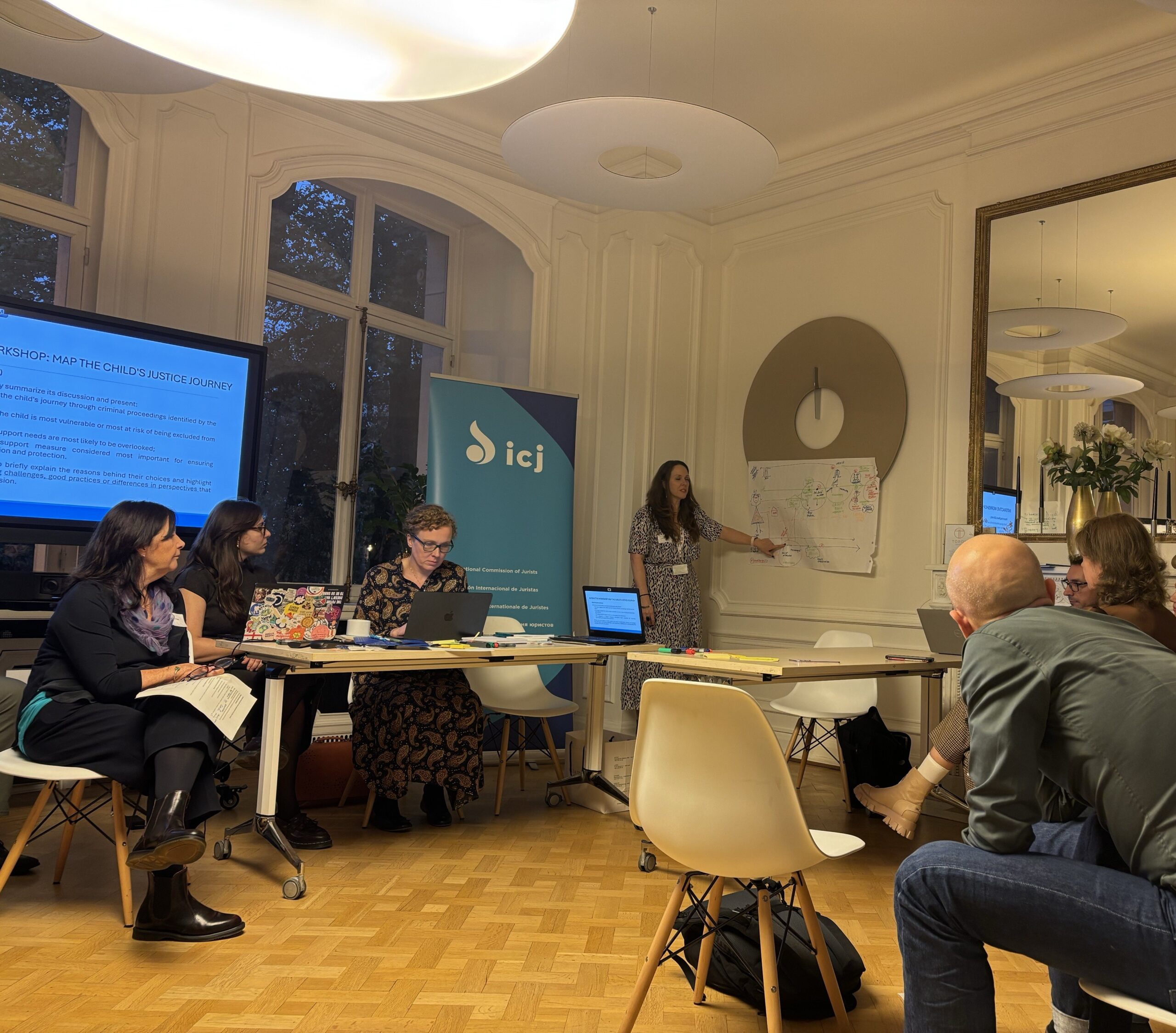
Access to justice for child victims with disabilities should not depend on the child’s ability to adapt to existing procedures, participants stressed at the international conference “From Rights to Reality: Ensuring Meaningful Participation of Child Victims with Disabilities in Criminal Proceedings”, held by the International Commission of Jurists (ICJ) and its partners in Brussels on 3 and 4 November 2026.
The conference brought together justice professionals, policymakers, child protection specialists, psychologists, psychiatrists, disability rights advocates and civil society representatives to discuss how justice systems can better respond to the rights and needs of children with disabilities.
The ICJ and its partners presented the findings of national research conducted in Austria, Romania and Serbia on the availability and implementation of procedural accommodations and professional support for child victims with disabilities in criminal proceedings, together with the comparative report Left to Discretion. The report found that, in all three countries, access to accommodations “depends largely on the discretion of individual justice actors, fragmented support structures and uneven awareness, rather than on systematic needs assessment or enforceable entitlements”.
Participants identified individual needs assessments as one of the conference’s key priorities. They stressed that assessments should begin as early as possible, ideally from the child’s first contact with the justice system, and continue throughout the proceedings as the child’s needs may change. An assessment should never become a test of whether a child is capable of participating in legal proceedings. Instead, it should identify the practical measures needed to enable that participation. Participants also emphasized that procedural accommodations are a right, not a discretionary measure.
Discussions also focused on the professionals who support children throughout criminal proceedings and the importance of clarifying their roles. Registered intermediaries from the UK organization Intermediaries for Justice shared examples from England and Wales, showing how adjustments to questions, additional time and changes to the hearing environment can improve children’s participation. They also explained how intermediaries help children give evidence, reduce the risk of retraumatization and prevent communication differences, silence or trauma-related responses from being mistaken for a lack of credibility or of willingness to participate.
A recurring message throughout the conference was that strong legislation alone is not enough. The effective implementation of children’s rights requires investment in professional capacity, accessible infrastructure, coordination and monitoring. Participants called in particular for continuous training of judges, lawyers, police officers, social workers, psychologists and other professionals working with children. They also called for clear protocols for referrals, and information-sharing, and for accessible legal assistance and information enabling children to understand their rights and take part in decisions affecting them.
Tanya Petkova, a member of the ENSURE project’s Disability Advisory Board, opened the discussions with her own experience of the justice system as a child, stressing the need to listen to children and to ensure that any support person helps them express their views without influencing them. Professor Dainius Pūras, former member of the UN Committee on the Rights of the Child and former UN Special Rapporteur on the right to health, made the case for a rights-based approach rather than primary reliance on medical diagnoses or assumptions about vulnerability. Marieta Tosheva, of the European Commission’s Criminal Procedural Law Unit, presented the revised Victims’ Rights Directive adopted in June 2026 and the challenge of putting its protections for child victims with disabilities into practice.
You can find the agenda here.
Background information
The conference was organized under the Ensuring Access to Intermediaries for Children with Disabilities in Legal Proceedings (ENSURE) project, which aims to strengthen access to justice for child victims with disabilities in Austria, Romania and Serbia, in line with international and European Union law and standards. The project runs from 2025 to 2027 and is implemented by the ICJ, together with the Validity Foundation, Terre des Hommes (Romania), the Child Rights Centre (Serbia), and the Ludwig Boltzmann Institute of Fundamental and Human Rights (Austria).