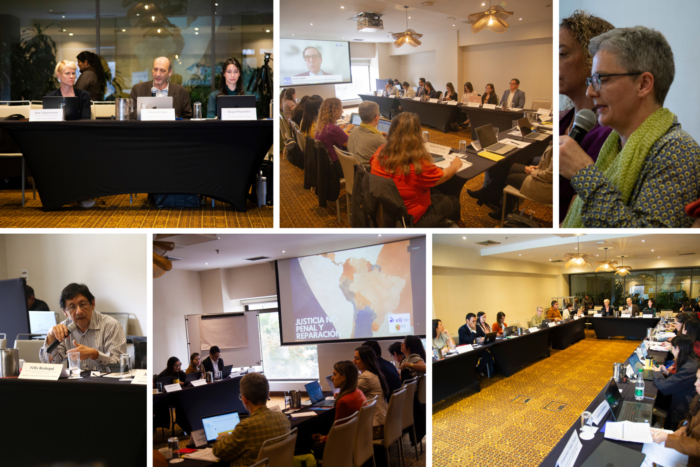
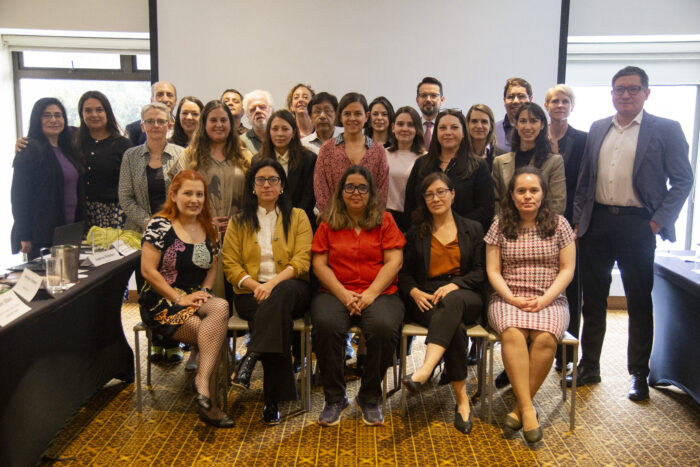
On 3–4 June 2026, the International Commission of Jurists (ICJ) convened legal practitioners, civil society representatives, victim advocates, and other institutional actors from across Latin America in Bogotá, Colombia, for a regional consultation on non-criminal justice and redress.
The Latin America Consultation forms a critical part of the ICJ’s multi-year initiative to strengthen knowledge and provide tools to make more effective the practice and implementation of non-criminal justice mechanisms for gross human rights violations, abuses, and serious violations of international humanitarian law.
The Consultation builds on the ICJ’s 2025 Geneva Forum on Non-Criminal Justice and Redress, consisting of representatives from around the world. It is the first regional consultation in a broader process that hopes to inform the development of global guidance for practitioners.
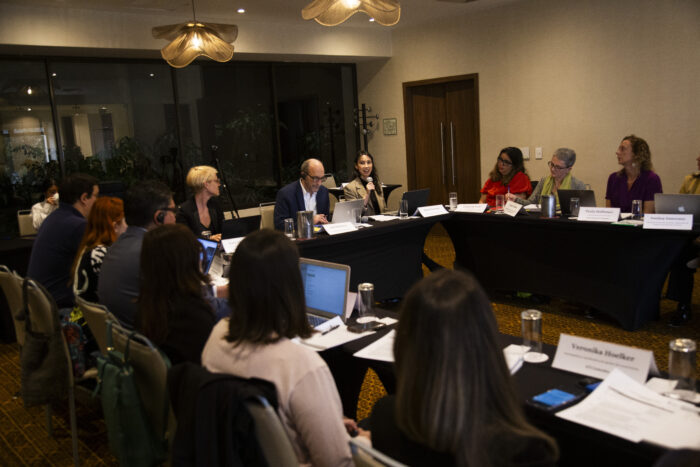
Across two days, participants examined how civil, administrative, constitutional, truth-seeking, victim registry, regional human rights, customary, hybrid and other reparations mechanisms operate alongside criminal accountability processes in Latin America. Participants drew on the region’s extensive experience with the Inter-American human rights system, domestic courts, truth commissions, administrative reparations programmes, special jurisdictions, and civil society-led strategies to pursue effective remedies and reparations.
Participants underscored that criminal trials remain indispensable to accountability for violations of heightened gravity but cannot alone respond to the full range of harms suffered by victims, survivors, families, and affected communities. They emphasized that non-criminal justice mechanisms can provide forms of redress that criminal proceedings may not deliver, including recognition of responsibility, access to information, rehabilitation, memorialization, restitution, compensation, satisfaction, guarantees of non-recurrence, institutional reform, and measures aimed at restoring victims’ dignity and agency.
Drawing on comparative experiences from such countries as Argentina, Chile, Colombia, Peru, Guatemala, Mexico, Venezuela, Nicaragua, the consultation highlighted the persistent gap between advanced legal standards and actual implementation. Participants discussed how political resistance, underfunding, institutional fragmentation, administrative delay, weak coordination, and lack of enforcement often prevent victims and survivors from receiving the reparations to which they are entitled. They also noted that reparations programmes may create further harm where they raise expectations but fail to deliver concrete outcomes.
The consultation examined the relationship between criminal and non-criminal accountability processes, including how sequencing, evidence use, victim participation, truth-seeking, reparations design, and institutional coordination can either reinforce access to justice or create duplication and impose further burdens on victims and survivors. Experiences from Colombia’s transitional justice system and Chile’s search for the missing and other reparations processes illustrated both the possibilities and the challenges of coordinating judicial, administrative, truth-seeking, and other reparative measures in practice.
Participants also addressed the pursuit of justice in closed or severely constrained civic space, considering situations marked by authoritarianism, institutional capture, retaliation against judges, lawyers, prosecutors, victims and civil society actors, censorship, and the absence of effective domestic remedies. Practitioners emphasized the continued importance of documentation, universal and regional mechanisms, precautionary and protective measures, strategic litigation, and civil society collaboration where domestic avenues are unavailable, unsafe, or ineffective.
Across the consultation, participants stressed that meaningful non-criminal justice must be victim-centred, trauma-informed, gender-sensitive and intersectional. They highlighted the importance of psychosocial accompaniment, safety, informed participation, culturally appropriate processes, disability inclusion, and approaches that avoid re-traumatization. Participants highlighted the need to address sexual, reproductive, and other forms of gender-based violence, collective harms, and the different ways in which victims and survivors define justice and reparation.
The Latin American Consultation also explored the strategic role of lawyers, judges, civil society organizations, victim representatives, bar associations, judicial institutions, regional human rights actors, and international partners in advancing non-criminal redress. Participants identified the need for practical guidance on how to design, use, coordinate, and enforce non-criminal mechanisms in ways that are consistent with international law and standards and responsive to victims’ and survivors’ lived experiences.
Background
The Bogotá Consultation took place in the context of a multi-year ICJ initiative to strengthen accountability for crimes under international law by advancing both criminal and non-criminal pathways to justice. The findings from the Geneva Forum and the Bogotá Consultation will inform further consultations and the development of ICJ global guidance on non-criminal justice and accountability.
The 2026 Bogotá Regional Consultation was made possible with the support of the Republic and Canton of Geneva.