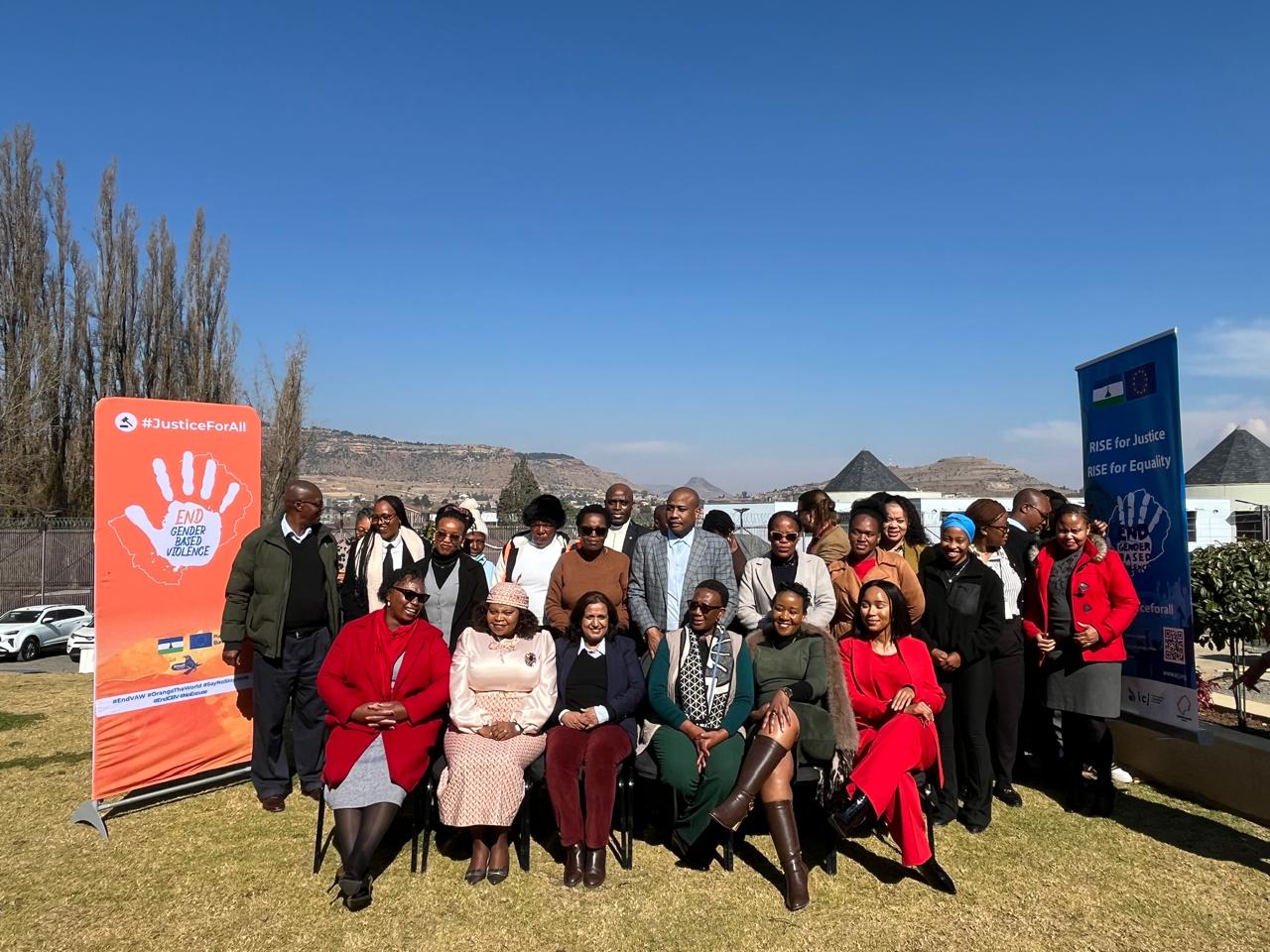
On 14 July 2026, the International Commission of Jurists (ICJ) and the Seinoli Legal Centre convened an expert discussion in Maseru, Lesotho’s capital city, on women’s human rights to land, property and inheritance, as guaranteed under international human rights law and standards, in the context of large-scale development projects. Held as a key initiative under the Reform for Inclusion, Support and Empowerment (RISE) Project, the dialogue brought together representatives from affected communities, civil society organizations, government institutions, oversight bodies, experts and development partners to examine challenges faced by women in communities impacted by development initiatives, including the Lesotho Highlands Water Project (LHWP) Phase II, in exercising their human rights to land, property and inheritance.
The discussion explored the legal, social and structural barriers that continue to affect women’s ability to access, own, inherit and exercise meaningful control over land and property. It also sought to identify practical legal, policy and advocacy interventions to strengthen women’s participation, agency and protection in development processes in light of international human rights law and standards guaranteeing women’s human rights, including, the Convention on the Elimination of All Forms of Discrimination against Women, in the first place.
The event opened with the screening of a documentary highlighting women’s experiences of land, property and inheritance rights in development contexts, followed by keynote reflections on sustainable development, access to water and energy, and the importance of ensuring that development benefits women and communities that are marginalized or otherwise discriminated against.
In a keynote address, Marcella Veneziani of the European Union Delegation emphasized that development must be inclusive and grounded in human rights principles.
“Development cannot be called successful if women lose land, livelihoods, participation, safety and voice in the process,” she said.
She noted that, while Lesotho has undertaken important legal reforms to advance gender equality, including through the Legal Capacity of Married Persons Act 2006, the Harmonization of Customary Law Widows with the Legal Capacity of Married Persons Act 2022, and the Administration of Estates and Inheritance Act 2024, continued efforts are required to ensure that rights recognized in law translate into meaningful protection and access to justice in practice.
Following the panel discussions, participants engaged in a stakeholder consultation session to identify priority concerns, recommendations and advocacy actions for inclusion in a forthcoming briefing document on women’s human rights to land, property and inheritance in communities affected by LHWP Phase II.
The consultation brought together perspectives from women within affected communities, experts, civil society organizations and institutions working on land governance, development planning, gender equality, human rights protection and access to justice. Participants highlighted the importance of strengthening women’s participation in development decision-making, improving access to justice and effective remedies for human rights violations and ensuring that development processes address existing inequalities.
The discussion also reinforced the need for continued collaboration among stakeholders to develop evidence-based recommendations and support advocacy efforts aimed at protecting women’s human rights in development contexts.
Background
The expert discussion forms part of the ICJ and SLC’s work under the RISE Project, which seeks to promote inclusion, support and empowerment through human rights-based advocacy and engagement.
Women’s human rights to land, property and inheritance remain a significant concern in communities affected by large-scale development projects. In Lesotho, women continue to face challenges linked to customary practices, unequal access to resources, limited participation in decision-making processes and barriers to effective remedies.
Through the RISE Project, the ICJ and SLC continue to support dialogue among communities, civil society organizations, experts and institutions to strengthen legal protections, promote accountability and advance gender equality in development processes.
Contact
Kaajal Ramjathan-Keogh, Director, ICJ Africa Regional Programme, e: kaajal.keogh@icj.org