On 22 June 2026, India’s Ministry of Home Affairs adopted the Foreign Contribution (Regulation) Amendment Rules granting the Indian government sweeping new powers to police the activities, operation, management and leadership of non-governmental organizations (NGOs) receiving foreign funding.
The amendments significantly expand an already restrictive legal framework established under the Foreign Contribution (Regulation) Act (FCRA), 2010, which regulates the receipt and use of foreign contributions by individuals and organizations in India. It prohibits contributions for activities deemed to be detrimental to the “national interest,” an overbroad term open to misuse. Since 2010, successive governments have amended the Act three times, most significantly in 2020, when the law was expanded to ban the transfer of foreign funds between organizations, to cap administrative expenditure and to require funds to be routed through a single designated bank account. In 2016, three United Nations Special Rapporteurs jointly urged the Indian government to repeal the FCRA, warning that it was being used to silence organizations whose priorities did not align with those of the government.
In 2011, the Indian government notified rules to the FCRA, and has amended them 10 times since then. The latest amendments further perpetuate the Indian authorities’ use of the FCRA over the last decade as a tool to silence peaceful dissent and the exercise of fundamental freedoms and obstruct independent human rights work in the country. Such misuse has been repeatedly noted by various UN mechanisms, most recently by the UN Human Rights Committee in 2024 in its concluding observations on the fourth periodic review of India’s implementation of the International Covenant on Civil and Political Rights (ICCPR).
The new rules apply to nearly 14,500 organizations that currently hold a FCRA license, and to all non-profits who may want to apply in the future. Existing non-profit organizations now face a one-year deadline to bring their registration in line with a far more limiting framework, or risk losing the ability to carry out their work altogether.
Under international human rights law, the right to freedom of association includes the right of associations to seek, receive and use resources, including funding from foreign sources. This is protected by Article 22 of the ICCPR, to which India is a state party, as well as by Article 13 of the UN Declaration on Human Rights Defenders adopted by consensus by the UN General Assembly. Any restriction is permissible only if it is prescribed by law with precision and is not overbroad, is strictly necessary to meet only a legitimate aim provided for under article 22 namely, national security or public safety, public order, the protection of public health or morals or the protection of the rights and freedoms of others, and adopts a proportionate means to meet that aim. This test also applies to restrictions on the right to freedom of expression protected by Article 19 of the ICCPR. The new amendments place multiple undue restrictions on NGOs and in doing so, fail this test in several respects.
Activities
The amendments require mandatory compliance by NGOs with a curated list of “reasonable activities” that organizations are allowed to carry out. The prescribed list added as a Schedule to Rule 9(1B)(b)(i) is grouped under five headings: religious, cultural, economic, educational and social. It explicitly rules out religious work involving “proselytization”, contemporary arts containing “political or ideological content”, and awareness activities on constitutional rights or civic participation unless they are “strictly non-political in nature”. Section 3(1)(g) of the FCRA already bars associations producing or broadcasting news or current affairs. Through this list, the rules effectively exclude any form of human rights advocacy, policy research, campaigning, strategic litigation and accountability. Organizations carrying out this type of work in India would effectively be barred from receiving foreign funds.
By confining permissible foreign-funded work to a restrictive list and excluding activity deemed political or ideological, the rules give officials overbroad discretion over which forms of expression and association are allowed without specifying how they meet the permissible grounds for restrictions of those rights. This is the very failing identified by the UN Special Rapporteur on the rights to freedom of peaceful assembly and of association in his 2016 legal analysis of the FCRA, which concluded that the law was not in conformity with international law and failed all three limbs of the permissible restrictions test. He warned that terms such as “political” in the FCRA were broad enough to capture activities that international law protects and even encourages, including promoting knowledge of rights and participation in public affairs. India’s own Supreme Court, in Indian Social Action Forum v Union of India in 2020, read the concept of “political nature” narrowly, confining it to active and party politics. The new closed list in the rules and its exclusions risk reopening, through the design of the registration system, the very executive control that the judgment sought to limit.
Operations
Rule 9(1B)(a) and b(ii) require that organizations tie their funding to specific purposes and to specific states or union territories, with an additional fee charged for each new purpose and new state to which the organization may want to expand. Along with a fee, Rule 9(1B)(c) requires new registration, which may be granted or refused after conducting an inquiry under Section 17B(3), before an organization may change what it does or where it works. The granular purpose-and-geography licensing, the per-purpose and per-state fees, the discretionary approval of any change of scope, and the expanded inquiry and disclosure requirements risk converting a one-time registration into a continuous instrument of control and multiplies the technical grounds on which registration can be refused or cancelled. The intrusive monitoring this entails is precisely what the then UN High Commissioner for Human Rights criticized in 2020, when she concluded that the FCRA had a detrimental impact on the rights to freedom of association and expression of human rights organizations.
Further, Rule 14A introduces a minimum spending threshold for an organization to be treated as undertaking reasonable activity. It requires the organizations to spend at least INR 1 million (USD 7,856) of foreign contribution over two financial years, failing which it may face cancellation and non-renewal of its FCRA license. The minimum spending threshold especially penalizes small and grassroots organizations and those that deliberately keep their foreign funding modest, with no apparent connection to any legitimate aim. This also compounds an already restrictive regime that was put in place by the 2020 FCRA amendment which lowered the ceiling on foreign contribution utilized for administrative expenses by NGOs in a given year, bringing it down from 50 percent to 20 percent. Administrative expenses include the essential costs of running an organization including the salaries, remuneration and travel of its governing members and management staff, along with rent, utilities, telephone and postage, accounting and legal or professional costs, amongst others. Organizations exceeding this limit were held to be liable to a fine of INR 1 million or 5 percent of the excess amount. Together, the two amendments pigeonhole NGOs leaving them with extremely limited agency to manage foreign funds according to their own operational judgement.
Management
Rule 2(1)(ca) expands the categories of people with compliance responsibilities going beyond an organization’s governing board to any person “by whatever name called, who has control over, or responsibility for the management or affairs.” The NGOs seeking foreign funds must disclose all publications by their key functionaries, including those made in their personal capacity, to the Ministry of Home Affairs, and their salaries would now count towards the 20 percent cap on administrative expenses. Subjecting a broadly defined class of individuals – and their publications, which is a form of expression – to the state’s review as a condition for obtaining foreign funding is inconsistent with the principles of legality, necessity and proportionality underpinning rights’ restrictions under international human rights law and will further create a chilling effect on civil society.
The rules also bar foreign nationals from holding key positions. Such a restriction on who may form and lead an organization sits uneasily with the principle of non-discrimination.
Rule 9(a) introduces the undertaking of mandatory field inquiries before the release of second and subsequent funding instalments, and require disclosure of social media accounts, detailed year-on-year activity reports, and the identity of ultimate donors behind intermediary funding organizations. This kind of surveillance of an organisation’s communications, discretionary control over the release of funds and mandatory disclosure of donors does the opposite of facilitating organizations’ access to resources and exceed the limits of international human rights law-compliant oversight.
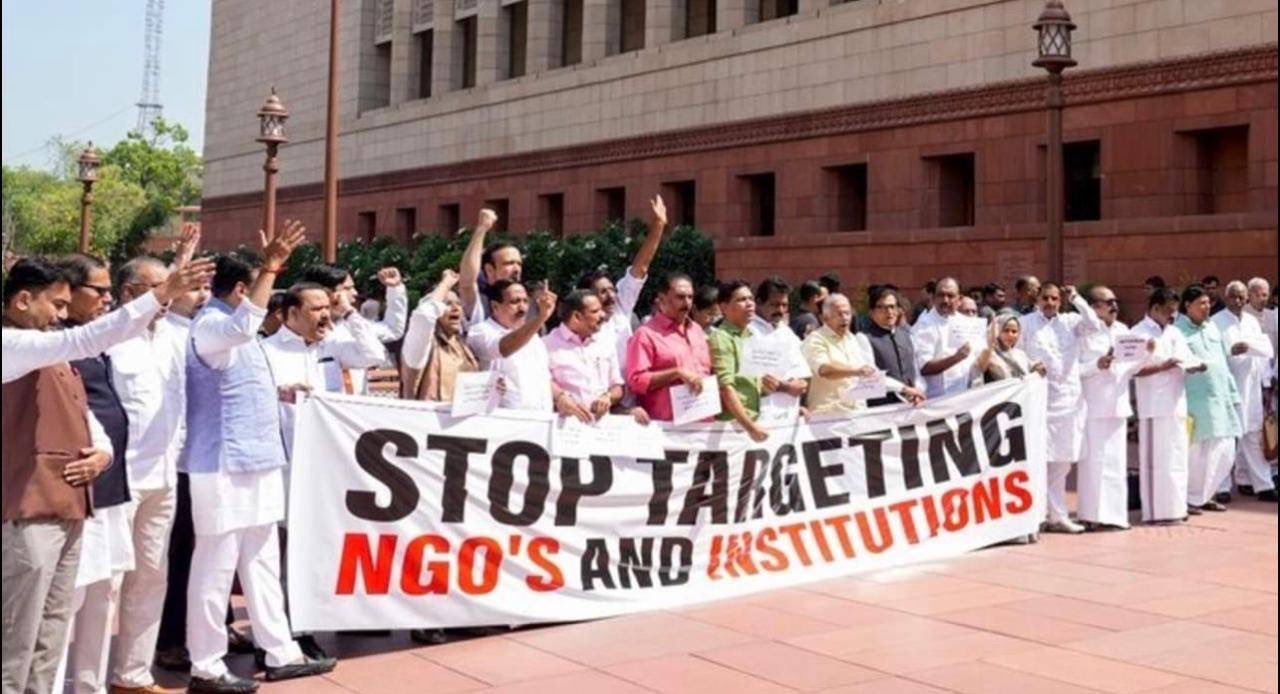
The latest amendments come amid the Ministry of Home Affairs’ cancellation of 22,498 FCRA registrations over the past decade, many of them targeted because of their human rights work. This is part of a broader pattern in which only 27.7 percent of the NGOs and associations registered under the FCRA remain active, with licenses of the rest either cancelled or deemed expired. Organizations providing free legal aid or human rights education, and those working on environmental rights or protecting the rights of religious minorities or vulnerable populations, have been particularly targeted, including OXFAM India, People’s Watch, World Vision India, Commonwealth Human Rights Initiative, Centre for Policy Research, Lawyers Collective, Apne Aap – Women Worldwide India, Evangelical Fellowship of India, and Students’ Educational and Cultural Movement of Ladakh.
The Indian government has often sought to justify its FCRA restrictions by claiming they are necessary to comply with the standards of the global terrorism financing and money laundering watchdog, Financial Action Task Force (FATF). However, FATF standards do not support such measures. FATF’s 2024 assessment of India’s anti-money laundering and countering of terrorism financing called for a targeted, risk-based approach focused on organizations demonstrably at risk of terrorism financing, together with consultation with the non-profit sector, rather than blanket and unlawful restrictions across civil society. Instead, in March 2026, the Indian government proposed amendments to the FCRA that would grant the authorities sweeping new powers over the assets of NGOs that have had their licenses withdrawn. Even as the bill remains pending in parliament with the Indian government facing severe criticism from minority groups over it, the Ministry of Home Affairs decided to bring in a new set of amendments through the Rules, circumventing legislative or public consultation.
The undersigned groups call on the Indian government to immediately withdraw the latest amendments to the Foreign Contribution (Regulation) Rules, as they fail to meet international human rights law and standards. India should also amend the Foreign Contribution (Regulation) Act to ensure that it is fully in line with the rights to freedom of association, freedom of expression and the right to non-discrimination. The groups also call on the Indian authorities to adopt a risk-based and proportionate approach to financial regulation of the non-profit sector, developed in consultation with civil society, consistent with the Financial Action Task Force’s own 2024 recommendations, and cease the use of the Foreign Contribution (Regulation) Act to harass, intimidate, restrict or retaliate against human rights defenders, activists, and independent civil society organizations.
Signed by:
Amnesty International
CIVICUS: World Alliance for Citizen Participation
Front Line Defenders
Human Rights Watch
International Commission of Jurists (ICJ)
International Federation for Human Rights (FIDH)
International Service for Human Rights (ISHR)
World Organisation Against Torture (OMCT)