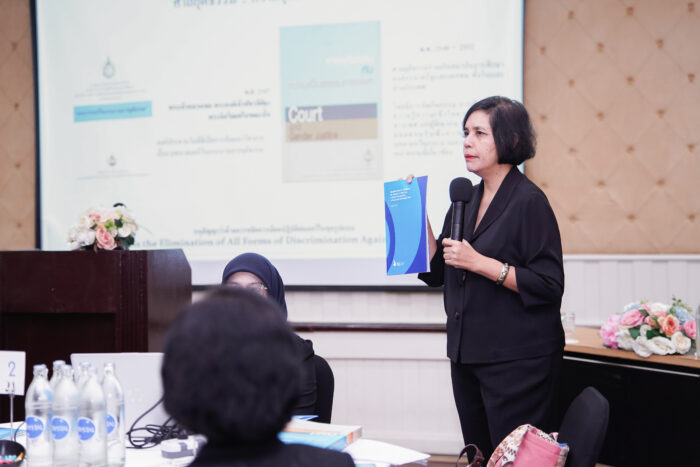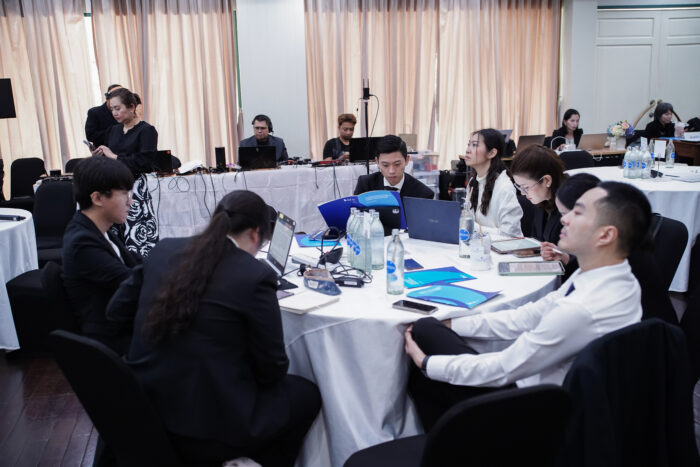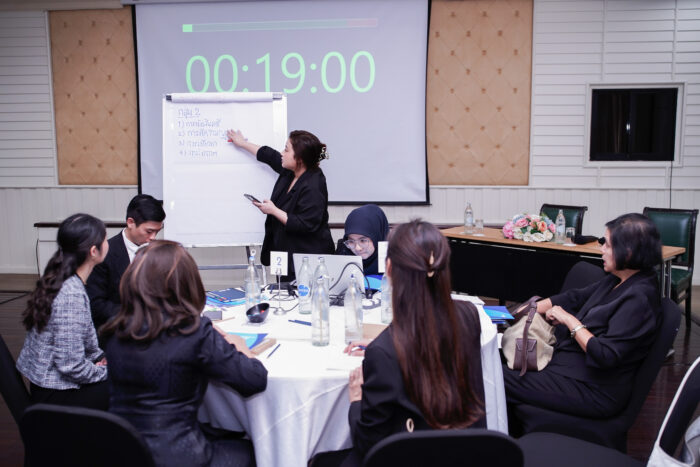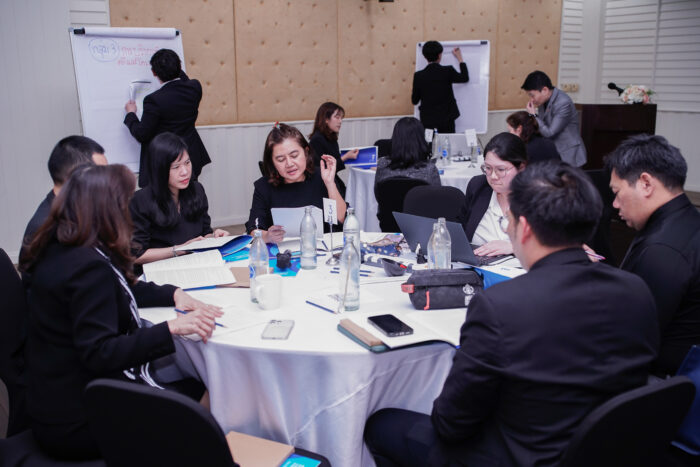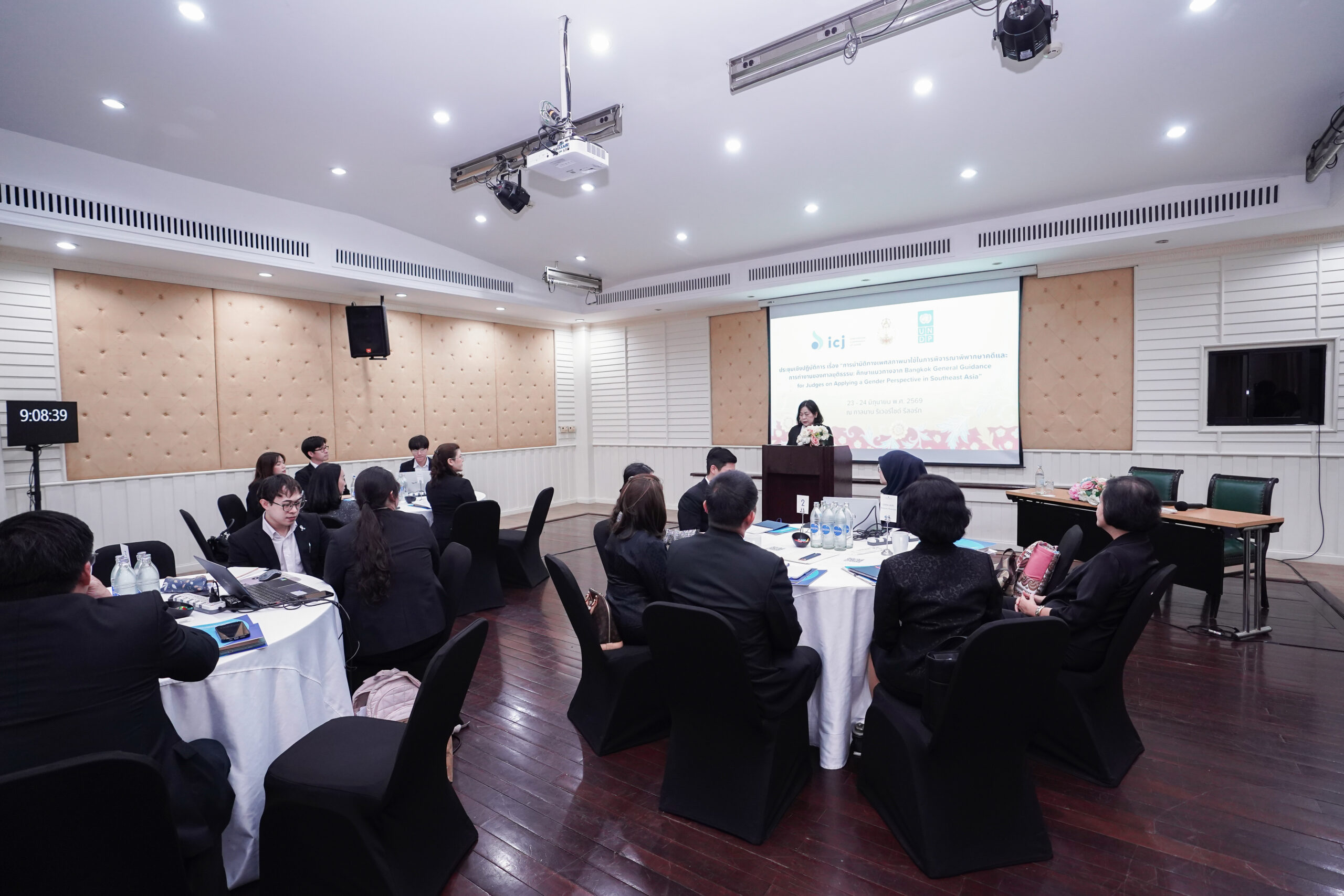
On 23-24 June 2026, the International Commission of Jurists (ICJ) and the UN Development Programme (UNDP) worked together with Thailand’s Office of the Court of Justice, to conduct a workshop on effectively applying a gender perspective in judicial work.
The workshop grounded the work in the Bangkok General Guidance for Judges on Applying a Gender Perspective in Southeast Asia (BGG), a set of guidelines developed by judges from South and Southeast Asia in a process facilitated and supported by the ICJ.
At the workshop, 27 members of the Thai judiciary from all levels examined how the BGG’s standards can be effectively incorporated into everyday judicial practice in Thailand. Participants discussed the potential production of a detailed set of practical judicial recommendations across four thematic areas: support for victims and survivors; gender-responsive adjudication; case management and court infrastructure, and the role of women and LGBTIQ+ judges within the judiciary.
In considering how courts can best engage with victims and survivors in a gender-responsive manner, participants emphasized the importance of avoiding secondary traumatization, recording victim and survivor testimony on video and audio from the investigation stage to avoid repeated questioning, and stronger judicial control of the courtroom to make it a safe space for testimony. In addition, they discussed the problem of victims and survivors typically having limited awareness of their rights and access to an effective remedy and the particular barriers facing persons with intersecting vulnerabilities, including migrant workers, Muslim women, sex workers and persons with disabilities.
Judges also examined gender-responsive adjudication, flagging stigmatizing or victim-blaming language still appearing in some judgments and the continued public disclosure of the names of survivors in cases of sexual or gender-based violence. Proposals included a bench checklist of language to avoid and anonymizing the identities of survivors in published decisions. On consent, participants discussed how judicial assumptions about a silence or delayed reporting by a survivor can be wrongly read as consent, and called for standardized guidance on assessing testimony together with training informed by research on trauma responses.
A further set of issues considered concerned the situation of the status of women and LGBTIQ+ judges in Thailand, including limited representation on judicial committees and family-unity rules that place a disproportionate burden on women judges. Proposals included establishing gender quotas on relevant committees, review of family-unity and parental leave rules, and a confidential complaint channel for judiciary staff facing discrimination or harassment.
Following these discussions, participants worked to synthesize the results of the dialogue into a practical tool suited to the Thai judicial context and built directly on the BGG framework. They also considered how the outcomes of the two days could be carried forward into concrete institutional change, such as developing specific judicial guidance to embed gender-responsive practice within the Thai judiciary and discussed the actual scope and language to be included in such guidance. Court of Justice representatives further committed to providing regular updates to participants and the ICJ on progress.
Background
The workshop forms part of ongoing efforts by the ICJ to operationalize the BGG across the judiciaries of South and Southeast Asia. The ICJ has supported the development of the BGG as a practical reference tool for judges seeking to apply a gender-responsive approach to case management, evidentiary assessment and judgment-writing, and continues to work with judiciaries throughout the region to adapt the Guidance to national legal systems and institutional structures.
The first edition of the BGG was discussed and adopted by judges from Indonesia, the Philippines, Thailand and Timor-Leste at a judicial dialogue organized by the ICJ and UN Women in Bangkok, Thailand, on 24 and 25 June 2016.
Five years after the elaboration of the initial edition, the ICJ acted to update the 2016 BGG with a view to contextualizing it in a manner also tailored to the South Asia subregion. The updated draft was discussed and launched by judges from Bangladesh, India, the Maldives, Nepal, Pakistan and Sri Lanka at a regional judicial dialogue held in the Maldives on 27 and 28 May 2022.
Further reading
Bangkok General Guidance for Judges on Applying a Gender Perspective in South and Southeast Asia