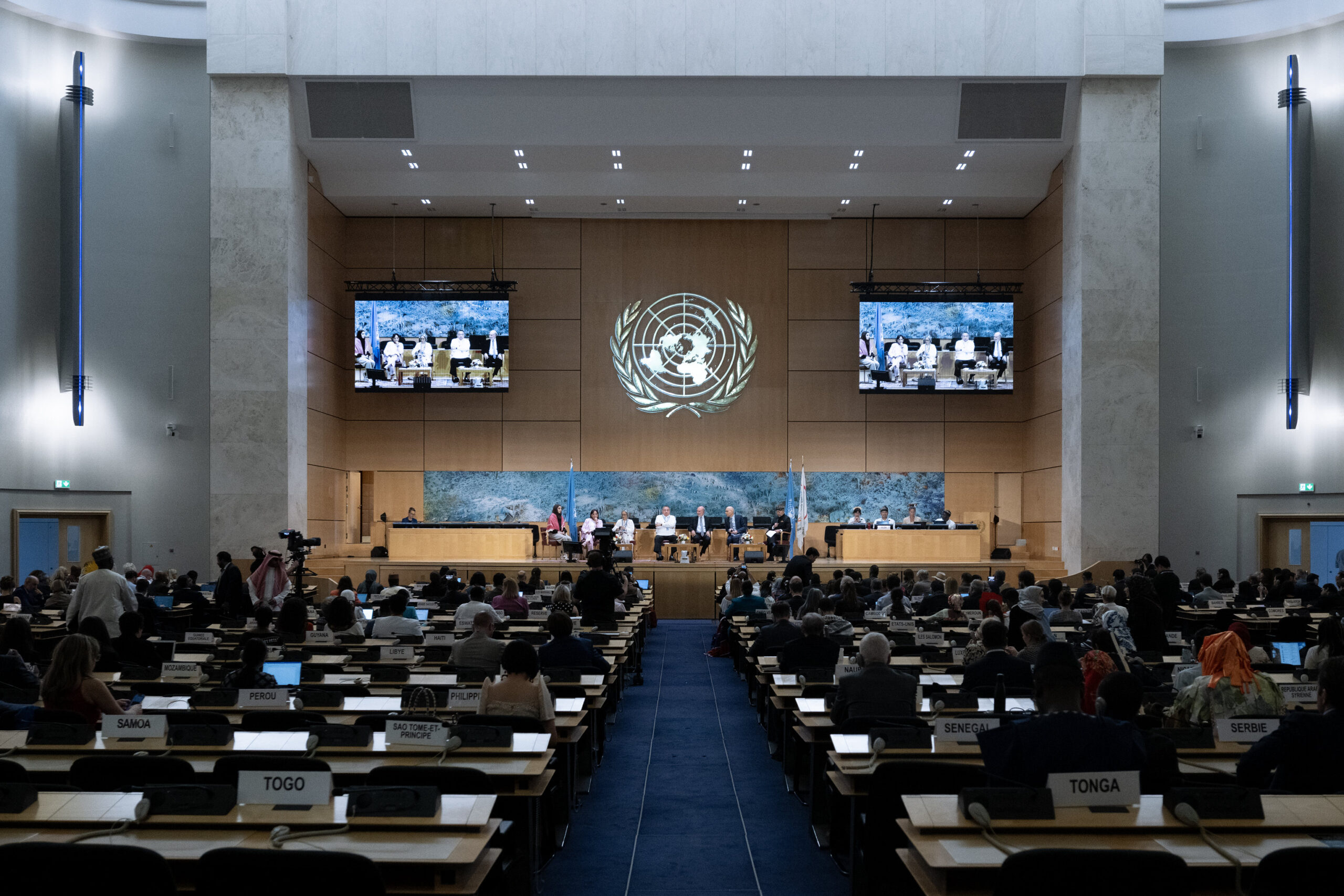
Council responds to escalating atrocities in Sudan, calls for accountability in Myanmar, and advances protections for judicial independence and the rights of women and girls
At its 62nd session, the Human Rights Council responded to escalating atrocities in Sudan, called for accountability for grave violations in Myanmar, strengthened protections for the independence of judges and lawyers, and addressed critical challenges concerning climate change and the rights of women and girls. The Council also recognized reproductive violence as a form of sexual and gender-based violence for the first time in a negotiated UN text.
Geneva, 8 July 2026. The United Nations Human Rights Council (HRC), the universal intergovernmental body dedicated to promoting better protection of human rights everywhere for everyone, has just ended its 62nd session. The HRC adopted 28 resolutions on country situations and thematic issues, 25 of which were adopted without a vote.
As the HRC celebrates its 20th anniversary, it has demonstrated its unique agility within the United Nations system in combining prevention, monitoring, investigation and accountability in response to grave human rights violations and abuses, including those amounting to crimes under international law. The Council took action on situations in specific countries, including Sudan, Myanmar and Eritrea. It also addressed several pressing thematic issues, such as the protection of healthcare in armed conflict; the denial of humanitarian access and threats to the safety of humanitarian personnel; the protection of women’s and girls’ human rights in humanitarian situations, or climate change-related disasters; the independence of judges and lawyers; and the human rights of women and girls.
Momentously, the Council for the first time recognized reproductive violence as a form of sexual and gender-based violence.
Urgent debate on the situation in El-Obeid, Sudan
The Council held an urgent debate on 3 July on an unfolding human rights emergency in Sudan. In the words of UN High Commissioner for Human Rights Volker Turk: “another human rights catastrophe is unfolding in Sudan, this time in the capital of the strategic state of North Kordofan. Civilians have been subjected to siege-like conditions for 18 months, battered by relentless drone strikes as the Sudanese Armed Forces and the Rapid Support Forces battle for control over areas surrounding the city.”
The debate occurred just over six months after the atrocities committed by the Rapid Support Forces and allies in and around El Fasher, including torture, summary executions, and widespread use of rape and other forms of sexual and gender-based violence.
Following the urgent debate, the Council adopted a resolution tasking the already established International Fact-Finding Mission (FFM) to urgently investigate violations and abuses of human rights and violations of international humanitarian law occurring in El Obeid. While denouncing in the abstract external support to the conflict, including the deployment of foreign forces and the supply of weapons such as drones, the Council worryingly failed to explicitly name those external actors, including the United Arab Emirates (UAE), whose support to the RSF has been well documented.
Myanmar – Rohingya Muslims and other minorities
The Council adopted a resolution on the human rights of Rohingya Muslims and other minorities in Myanmar, who have been first victims of forced displacement, unlawful killings, and other systematic and widespread human rights violations and abuses before and after the 2021 military coup. More than one million Rohingya presently live as refugees in Bangladesh, and UN agencies have warned that 2025 saw a record number of Rohingya dying at sea after fleeing bombings and persecution.
The resolution adopted condemns the atrocities committed by parties to the conflict.
The ICJ, in its advocacy around the resolution, called for an emphasis on accountability for the military junta, responsible for criminal abuses of human rights and violations of international humanitarian law. The ICJ has emphasized that the return of refugees to Myanmar is only possible when the conditions are met for return to be voluntary, dignified, safe and based on an informed and independent decision.
The ICJ welcomes the stress on the critical need for accountability in the resolution, including the progress made in the case The Gambia v. Myanmar pending before the International Court of Justice. The Gambia credibly alleges that Myanmar failed to fulfill its obligations to prevent and punish acts of genocide committed against the Rohingya in Rakhine State as required under the 1948 Genocide Convention.
Tunisia –Collapse of the rule of law and human rights protection
The ICJ together with several other human rights NGOs, in a statement to the Council and at a side event, emphasized Tunisia’s collapsing rule of law and human rights situation that has so far been largely neglected by the Council.
In the country, since 2021, the systematic dismantling of judicial independence and the rule of law, and the criminalization of the legal profession have severely undermined the protection of human rights, including fair trials. Judges have been unconstitutionally removed, and lawyers have been prosecuted, solely for discharging their duties and legitimately exercising freedom of expression.
The shrinking of civic space and crackdown on civil society organizations and journalists continue. The ICJ will continue to call on the Council to act at its next session.
Thematic discussions on the independence of judges and lawyers, gender issues, and climate change
A resolution on the independence of judges and lawyers led by Hungary, Australia, Botswana, Maldives, Mexico and Thailand was adopted by consensus. The ICJ successfully advocated for a strong resolution, which renewed the mandate of the UN Special Rapporteur on the independence of judges and lawyers. Most critically, the Council condemned the increasing attacks against independent lawyers and judges, including through repression across borders, abusive litigation, and the risks posed by some technologies on the privileged lawyer-client relationship based on the principle of confidentiality.
The HRC also reaffirmed the link between climate change and human rights, just weeks after the UN General Assembly adopted, on 29 May by an overwhelming majority of States, a resolution welcoming the Advisory Opinion of the International Court of Justice on the obligations of States in respect of climate change, which included an admonition to transition away from fossil fuels. The ICJ deplores the fact that the HRC resolution failed to incorporate proposals to make a reference to this necessary transition, particularly due to fierce opposition by some major oil and gas producing States such as Gulf States.
On gender issues and the rights of women and girls, the Council adopted without opposition important resolutions: “Elimination of all forms of discrimination against women and girls in care and support systems”; “Child, early and forced marriage”; and “Promoting, protecting and respecting women’s and girls’ full enjoyment of human rights in humanitarian situations”.
During the debates, some States continued to question long-agreed precepts, such as sexual and reproductive rights, comprehensive sexuality education, and all of which are fundamental to the equal and effective enjoyment of their human rights by women and girls and are based on the guidance and scientific evidence developed by relevant UN human rights bodies and UN agencies such as the World Health Organization.
Tribute to Ambassador Gustavo Gallón Giraldo
Finally, the 62nd session was marked by the sudden tragic death on 30 June of Ambassador Gustavo Gallón Giraldo, Permanent Representative of Colombia in Geneva and honorary member of the ICJ. His role as an outstanding jurist and tireless human rights defender, particularly as founder and head of the Colombian Commission of Jurists, was celebrated in a moving memorial by his family, friends and colleagues in civil society and the diplomatic community.
His legacy and commitment were expressly acknowledged in the tributes paid by the Member States of the HRC during the adoption of the resolution led by Colombia on “promoting, protecting and respecting women’s and girls’ full enjoyment of human rights in humanitarian situations”. The resolution addresses the specific issues and needs faced by women and girls in armed conflict, including occupation, as well as in the context of the adverse effects of climate change. Among other very significant elements in this resolution, reproductive violence, as a distinct form of sexual and gender-based violence, was recognized for the first time in a negotiated text within the UN.
The full list of events and statements of the ICJ at the 62st session of the HRC can be found here:
ORAL STATEMENTS
1- ID with Special Rapporteur on the Independence of Judges and Lawyers: International Commission of Jurists
2- ID on the HC annual report: International Commission of Jurists
ORAL STATEMENTS SPONSORED
1- Item 3: Interactive Dialogue with the UN Special Rapporteur on the Independence of Judges and Lawyers
International Bar Association and the International Commission of Jurists – International Bar Association
2- Item 4: ID on the comprehensive report of the HC on the situation of human rights in the Bolivian Republic of Venezuela –
Lawyers for Lawyers, the International Bar Association Human Rights Institute, Lawyers’ Rights Watch Canada, and the International Commission of Jurists. – International Bar Association
3- Item 4: ID on the report of the SR on the situation of human rights in Belarus – Interactive Dialogue
The International Bar Association’s Human Rights Institute and the International Commission of Jurists – International Bar Association
4-Item 6: Adoption of Universal Periodic Review outcomes of Nepal
Asian Forum for Human Rights and Development (FORUM-ASIA), International Commission of Jurists, Peace Brigades International and Good Shepherd International Justice and Peace – Asian Forum for Human Rights and Development
5- Urgent Debate to address the human rights situation in and around El Obeid, North Kordofan in the context of the ongoing conflict in the Sudan
Joint Oral Statement led by Amnesty International – International Commission of Jurists
SIDE EVENTS
1- Human Rights in Tunisia (ICJ side event)
On 24th of June, the International Commission of Jurists hosted a side event with the UN Special Rapporteur on the independence of judges and lawyers and several Tunisian lawyers, to discuss the deepening human rights crisis in Tunisia.
Note: We didn’t communicate on this one for security reasons.
3- Track record of 20 years of standard setting by the HRC
4- The HRC at 20: a lifeline for defenders – Sponsored by the International Commission of Jurists