Dec 5, 2017 | News
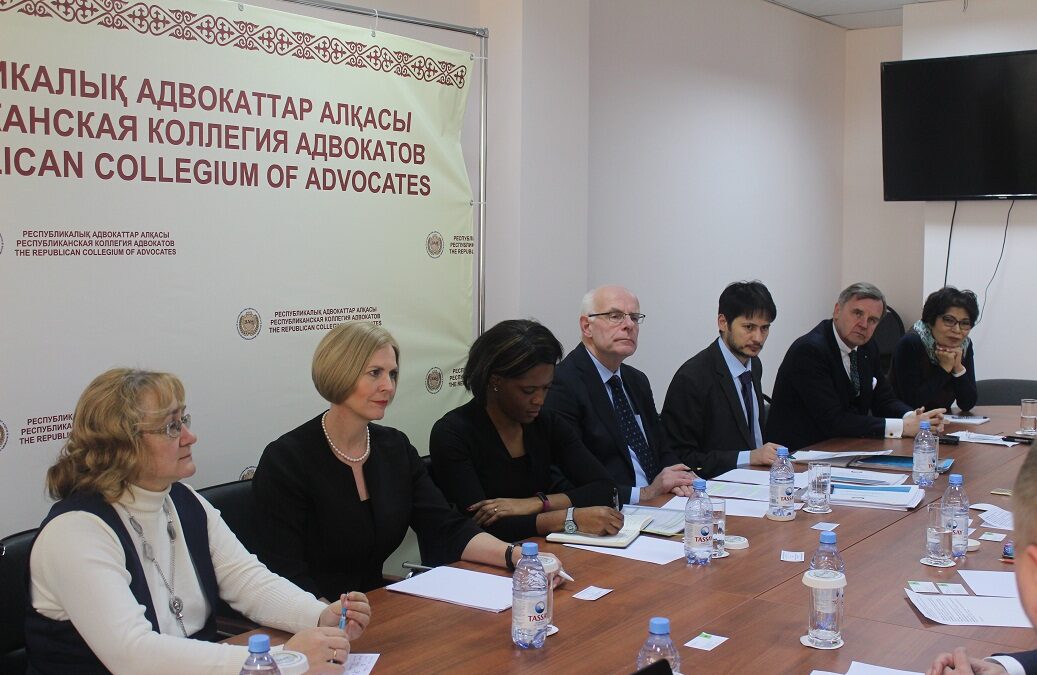
The ICJ, following a mission to Kazakhstan this week to assess the proposed draft law reforming the regulation of the legal profession, called for the postponement of the adoption of the law and more active participation of the legal profession in its development.
The ICJ stressed that any reform of the legal profession should strengthen the independence of lawyers to ensure that it is fully in line with international law and standards on the role of lawyers.
The independence of the legal profession is vital for lawyers to protect the human rights of their clients, including the right to a fair trial and access to justice.
The ICJ is concerned that the Draft Law changes the disciplinary system for lawyers from an independent procedure to one under significant influence of the executive.
In particular, the Draft Law provides for participation of representatives of the executive in disciplinary bodies.
The ICJ recalls that an independent disciplinary procedure is one of the pillars of an independent legal profession and should be guaranteed by law and in practice.
In line with the principle of an independent legal profession, the ICJ also believes that the provision in the Draft Law allowing for the creation of a “State Advokartura” should be removed.
One of the weaknesses of the current administration of the legal profession in Kazakhstan is that the qualification process for lawyers is not independent of the executive.
The ICJ stresses that the reform creates an opportunity to make the qualification procedure for lawyers fully independent, and administered by the Bar Association.
This would bring the current legislation in line with best international practices and with the principle of the independence of the legal profession.
The ICJ has noted that the Bar Association has not been sufficiently involved in the discussion of the reform of the profession. As a professional association of lawyers, the Bar Association should play a significant role the development of the legislation regulating its functioning and should ideally lead the discussion on the reform.
The ICJ believes that the adoption of the law should not be rushed and further discussion among all interested parties should take place before the Draft Law progresses further.
Reforms along the lines set out above would be consistent with Kazakhstan’s international obligations and commitments under, for instance, the International Covenant on Civil and Political Rights, and the UN Basic Principles on the Role of Lawyers.
Background
On 4 and 5 December, the ICJ carried out a visit to Astana where a number of high-level meetings were held. The visit was prompted by the reform of the legal profession and the related draft law which has been submitted to the Parliament.
The ICJ is grateful to its delegates from different jurisdictions who agreed to join the ICJ mission:
Mr. Otmar Kury, President of the Hamburg Bar Association, Chairman of the Commission on Federal Lawyers Act of the German Federal Bar
Jeroen Browder, President of the Ethics Commission of the Bar Association of the Netherlands and former President of the Bar Association of the Netherlands
Georg Stawa, President of the European Commission for the Effectiveness of Justice (CEPEJ)
Christina Blacklaws, Vice President of the Law Society of England and Wales
Chika Muorah, International Policy Adviser of the Law Society of England and Wales
The ICJ expresses its gratitude to all who kindly agreed to meet with it. In particular, the Mission thanks the Minister of Justice of Kazakhstan, the Supreme Court, members of the Parliament, the President of the Republican Bar Association, the “Kazbar” NGO and all others who it met with.
Kazakhstan-News-Web stories-Independence of the judiciary-2017-ENG (full report, in English)
Kazakhstan-MissionLawyers-News-pressreleases-2017-RUS (full story in Russian, PDF)
Dec 4, 2017 | News
Today, the International Commission of Jurists (ICJ) began a two-day mission on the reform of the legal profession in Kazakhstan.
The ICJ mission will discuss comparative experiences and international standards on the role and independence of lawyers.
The ICJ mission will include representatives of the Bar Associations of Germany, the Netherlands and the United Kingdom.
The experts will have an opportunity to share their views on the reform and discuss their own country practices on the role of lawyers and institutional guarantees of the independence of the legal profession.
In Astana, the ICJ mission will meet, among others, with the Minister of Justice, the Supreme Court of Kazakhstan, members of the Parliament, the Kazakhstan Collegium of Lawyers and National Public Association of Commercial Lawyers “Kazakhstan Bar Association” (“KazBar”).
Contact:
Temur Shakirov, Senior Legal Adviser, ICJ Europe Programme, temur.shakirov(a)icj.org
Nov 23, 2017 | Events, News
The 8th Geneva Forum brought together judges, lawyers, and other legal experts from around the world, and relevant UN representatives, to discuss the relationship between traditional and customary justice systems and international human rights, access to justice, and the rule of law.
The potential for improving access to justice
In many countries the majority of legal disputes, especially in rural areas, are resolved by traditional and customary justice systems that are not necessarily recognised by national law as a part of the official court system. The role of traditional and customary justice systems is therefore a key question for realization of “access to justice for all” and “effective, accountable and inclusive institutions” under Sustainable Development Goal 16.
Traditional and customary justice systems are often more practically and culturally accessible to local populations than is the official court system, and may be seen by local people as having greater legitimacy as well. Indeed, official recognition of the existence of traditional and customary courts in a country can be a positive reflection of the international human rights of ethnic, religious or linguistic minorities, or the particular rights of indigenous peoples, or cultural rights more generally.
For marginalized and disadvantaged rural populations in developing countries, traditional and customary courts may in practical terms be the only form of access they have to any kind of justice. Development agencies have increased their engagement with informal justice systems, and are considering much greater investment in capacity-building of such systems, noting their potential to reach large portions of the population who face significant obstacles to realizing access to justice in the official justice system.
The risks for human rights, particularly of women and children
At the same time, the composition, procedures, and outcomes of traditional and customary justice system mechanisms and processes can conflict with the human rights protections contained in international law and standards on human rights and the rule of law.
One key concern is in relation to the rights of women and children. Traditional and customary justice systems may be rooted in patriarchal systems and, as such, can reinforce harmful gender stereotypes and cultural assumptions that are inherently likely to discriminate against women and children and therefore negatively impact upon their rights.
Other concerns include consistency with the right to a competent, independent and impartial tribunal established by law; respect for fundamental guarantees of fairness comprising the right to fair trial; accountability of judicial decision-makers in relation to corruption and other misconduct; and non-discrimination and equality before the law more generally.
Aims of the 2017 Geneva Forum
The discussions at the 2017 Geneva Forum (22-23 November 2017), together with ICJ’s broader global experience and expertise, will provide a foundation for the development by ICJ of legal, policy and practical guidance, including conclusions and recommendations on the role of traditional and customary courts in relation to access to justice, human rights and the rule of law.
The ICJ guidance will take into account the many variations and differences between different traditional and customary courts that exist around the world, while seeking to articulate conclusions and recommendations sufficiently universal to be applicable across the widest possible range of contexts. The focus of the Geneva Forum and the ICJ guidance is intended to be on traditional and customary courts of an informal character and, as such, the ICJ does not intend directly to address formal religious courts or the application of customary law by ordinary formal courts.
Available for download in PDF format:
Compilation of selected international sources on indigenous and other traditional or customary justice sytems, available here.
Final report of the 2017 Geneva Forum on traditional and customary justice systems, available here:
Universal-Trad Custom Justice Gva Forum-Publications-Thematic reports-2018-ENG
Several video interviews with participants are available to view by clicking here.
Information about the subsequent 2018 Geneva Forum on indigenous and other traditional or customary justice systems in Asia, is available here.
For more information, please contact matt.pollard(a)icj.org.
The 2017 Geneva Forum of Judges & Lawyers was made possible with the support of the Republic and Canton of Geneva, Switzerland.
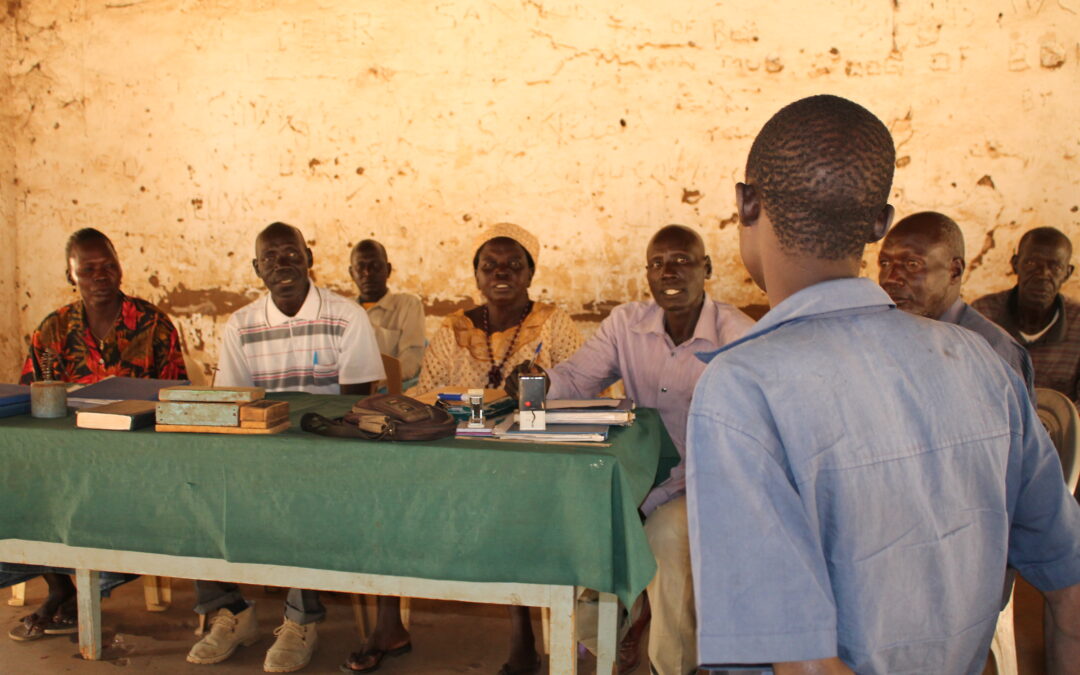
- Photo: “Traditional leaders preside over a case in B-Court, Nyang Payam, Torit County, South Sudan”
- Photo Credit: UNDP South Sudan2016Angelique Reid ©2016 United Nations
Nov 23, 2017 | Agendas, Events, News
The ICJ delivers today and tomorrow a training for judges on asylum, migration and international human rights law, including non-discrimination, organised by OSCE and the Judicial Academy.
The training, that takes place in the capital Belgrade, will be delivered to judges of all level of jurisdiction of Serbian courts.
It will focus on human rights law related to the entry of migrants, including refugees, to the territory of a State, to the State’s obligations on international protection, the rules applicable to detention of foreign national and their rights, and the prohibition of non-discrimination.
Serbia-Training-MIgrationAsylum-OSCEJA-2017-eng (download the agenda in English)

Nov 20, 2017 | Advocacy
The ICJ, with 35 other human rights organizations, today called on members and observers of the UN Human Rights Council to convene a special session on the deteriorating human rights situation in Myanmar.
In open letter to member and observer States of the Human Rights Council, delegations are urged to support holding a special session of the Council against the backdrop of serious reports of human rights violations, including crimes against humanity, committed by Myanmar security forces in northern Rakhine state.
The letter also sets out key elements that should be included in the text of a resolution adopted by the Human Rights Council at such a session, considering action that should be taken by the Government of Myanmar, as well as by neighbouring and other States and by human rights mechanisms.
The ICJ on the same day released a briefing note, entitled Questions & Answers on Human Rights Law in Rakhine State, clarifying national and international law and standards applicable to the crisis.
Myanmar Joint Civil Society Letter 20 November 2017 (download open letter in PDF format)
For a copy of the ICJ’s Q&A briefing, go to ‘Myanmar: rule of law must drive responses to Rohingya crisis’