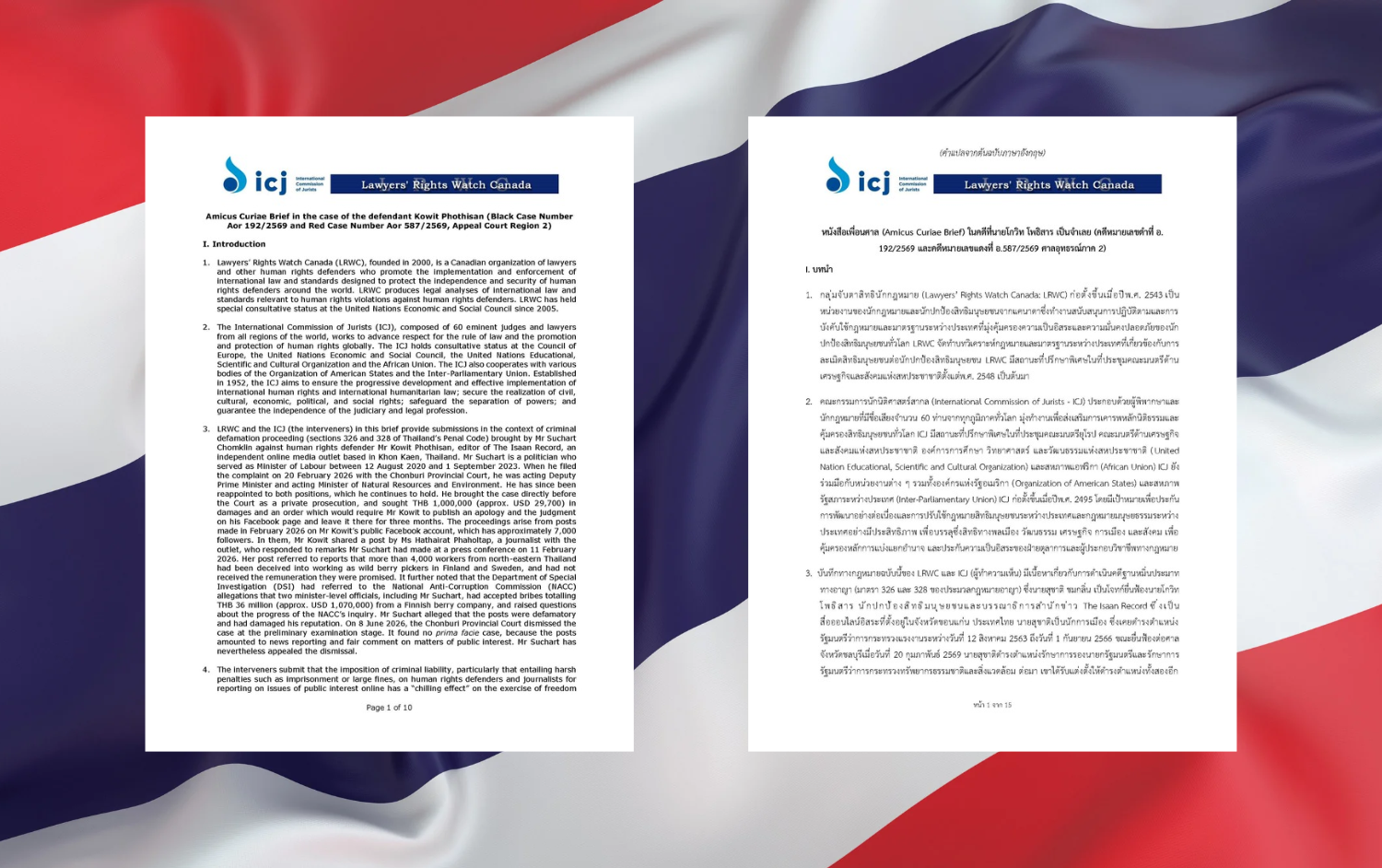
On 20 November 2026, the International Commission of Jurists (ICJ) and Lawyers’ Rights Watch Canada (LRWC) submitted a joint legal brief (amicus curiae) to the Appeal Court Region 2. The brief addresses critical issues concerning freedom of expression in a criminal defamation case against Kowit Phothisan, a human rights defender and editor of The Isaan Record, an independent online media outlet based in Khon Kaen.
The criminal case was brought by Suchart Chomklin, Deputy Prime Minister and Minister of Natural Resources and Environment, under sections 326 and 328 of Thailand’s Penal Code. Minister Suchart sought THB 1,000,000 (approx. USD 29,700) in damages. He also asked the court to order Kowit Phothisan to publish an apology and the judgment on his Facebook page for three months.
The complaint concerns posts made in February 2026 on Kowit’s public Facebook account, in which he shared a post by Hathairat Phaholtap, a journalist with The Isaan Record. Her post responded to remarks Minister Suchart had made at a press conference. It referred to reports alleging that more than 4,000 workers from north-eastern Thailand had been deceived into picking wild berries in Finland and Sweden and had not received the pay they were promised. It also noted that the Department of Special Investigation (DSI) had referred allegations of bribery involving two minister-level officials, including Minister Suchart, to the National Anti-Corruption Commission (NACC), and raised questions about the progress of the NACC’s inquiry.
On 8 June 2026, the Chonburi Provincial Court dismissed the case at the preliminary examination stage. It found that the posts amounted to news reporting and fair comment on matters of public interest. Minister Suchart is appealing the dismissal and the ICJ and LRWC amicus are aimed a critical legal issue that is a subject of the appeal.
The ICJ and LRWC brief submits that, irrespective of whether or not any kind of defamation could be established, criminal sanctions for defamation are incompatible with the right to freedom of expression protected under article 19 of the International Covenant on Civil and Political Rights (ICCPR), to which Thailand acceded in 1996. Imposing criminal liability on human rights defenders and journalists for reporting on matters of public interest necessarily has a “chilling effect” on freedom of expression. The brief recalls that the UN Human Rights Committee has called on States Parties to the ICCPR to decriminalize defamation and has stressed that imprisonment is never an appropriate penalty for it. The Committee has also affirmed that public figures are legitimately subject to criticism, and that a public interest defence should be recognized.
The brief further submits that the criminal defamation provisions (Sections 326 and 328) are vague and overbroad, and that they impose disproportionately harsh penalties of up to two years’ imprisonment and a fine of up to THB 200,000.
The brief also notes that, in April 2025, Thailand joined the consensus on UN Human Rights Council resolution 58/23. The resolution expresses concern at the misuse of defamation laws against human rights defenders and at the rise of strategic lawsuits against public participation (SLAPP), and urges States to create a safe and enabling environment for defenders both online and offline.
The ICJ and LRWC called on the Appeal Court to interpret Thai law in line with Thailand’s international human rights obligations. They also called for human rights defenders, including journalists reporting on human rights issues, to be protected from litigation aimed at curbing their freedom of expression.
Download
The joint legal brief (amicus curiae) is available for download in English and Thai.
Background
In 2017, the UN Human Rights Committee expressed concern about criminal defamation charges brought against human rights defenders, activists, and journalists in Thailand. It recommended that Thailand consider decriminalizing defamation and refrain from using criminal provisions to suppress critical and dissenting opinions.
The ICJ has previously analysed Thailand’s existing anti-SLAPP framework and advocated for its reform.
Further reading
Thailand: Three draft anti-SLAPP laws must deliver comprehensive protection
Thailand: ICJ Co-Hosts Parliamentary Seminar on Anti-SLAPP Reform
Thailand: Supreme Court’s Guidance on bad faith cases welcome, despite significant gaps
Thailand: New law protecting SLAPPs marks progress but much more is needed
Contact
Sanhawan Srisod, Senior Legal Adviser, ICJ Asia-Pacific Programme, e: sanhawan.srisod@icj.org
Saovanee Kaewjullakarn, Associate Legal Adviser, ICJ Asia and the Pacific Programme, e: saovanee.kaewjullakarn@icj.org