By Reed Brody
I just learned the sad news of the death of Nicolas Tiangaye, former Prime Minister of the Central African Republic. It took me back 36 years, to October 1990, when the International Commission of Jurists sent me to Bangui to observe the disciplinary trial of this uncompromising, idealistic young lawyer fighting for the right to practise his profession.
Tiangaye’s offence was a speech. Defending two army officers who had spent 18 months in prison largely on the strength of letters from an informer with apparent ethnic motives, he had turned to the military judges and asked: “Où est l’honneur de l’armée ? Où est votre honneur ?” (“Where is the honour of the army? Where is your honour?”)
The tribunal acquitted his clients of the main charge. No objection was raised to his remarks during the hearing. But within days, the government sought to have Tiangaye disbarred.
The real reason was political. In requesting the disciplinary proceedings, a government minister noted that Tiangaye’s affiliation with the opposition “no longer leaves any doubt.” The CAR was then a one-party state. Tiangaye was the spokesman for a movement demanding a national conference and a multiparty system. The authorities had already dismissed or arrested other members of that movement.
The day before the Tiangaye’s disciplinary trial, I met with the Minister of Justice and the Prosecutor General. That night, local radio announced that the trial would be held behind closed doors and that there was no point in the public coming. Hundreds came anyway. Soldiers surrounded the Palais de Justice to keep them away. The mood was electric.
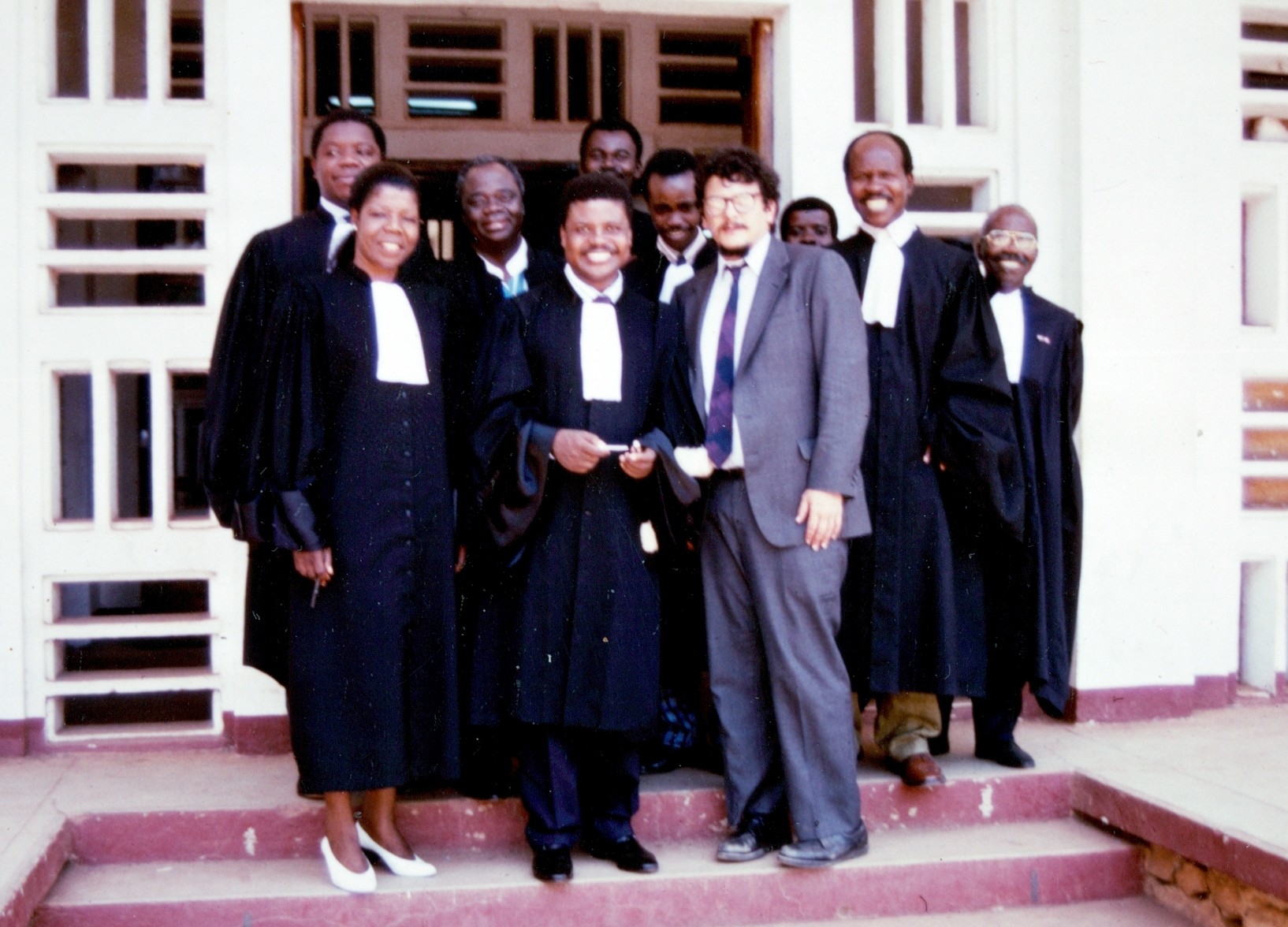
Inside, there was an extraordinary display of professional solidarity. Fifteen of the country’s seventeen lawyers had signed on to defend Tiangaye, joined by colleagues from Brazzaville, Libreville, Douala and Paris. I was there as Director of the ICJ’s Centre for the Independence of Judges and Lawyers, alongside observers from the Union Internationale des Avocats and the Paris Bar.
One of the most moving moments came when Pierre Hirsch, the 86-year-old dean of Central African lawyers, slowly approached the judges, leaning on their desk for support. His voice was so faint that we all had to move closer to hear him. He reminded the judges that they, too, were being judged: “C’est aussi le procès de la justice et de son indépendance.” This was also a trial of justice itself and its independence.
Our presence seemed to make a difference. The Prosecutor General began his closing argument by declaring that the observers’ presence demonstrated the “maturity” of Central African justice. He nevertheless asked the court to free Tiangaye “from the straitjacket of the profession and send him back to politics.” Nearly every defence lawyer referred to the international observers. At the end, the presiding judge thanked us for coming and, borrowing a defence lawyer’s phrase, promised that the court would deliver ‘un arrêt, pas un service’ — a judgment, not a favour.
On October 30, three weeks later, the Court declared the disciplinary proceedings inadmissible on technical grounds.
In my report, I concluded that our presence had not been in vain. It had, I believed, strengthened the judges’ determination to resist pressure. It showed that what happened in that courtroom mattered far beyond Bangui.
Tiangaye went on to become president of the National Transitional Council, helping to shape the country’s 2004 Constitution. In 2013, he briefly became Prime Minister, serving during one of the most tragic periods in the country’s history. He continued to defend the law and challenge abuses of power throughout his life.
Rereading my report and looking at the old photographs, I remember that extraordinary moment in the lives of two young lawyers. For Tiangaye, the trial was a test of his right to speak out against injustice. For me, it was a lesson in the power of international solidarity.
Nicolas Tiangaye had asked a military court where its honour was. He would spend the rest of his life asking that same question, in different ways, of those in power.
Rest in peace, cher confrère.
ICJ trial observation report by Reed Brody (in French).
“Où est l’honneur?”: Le procès disciplinaire de Maître Nicolas Tiangaye (1990)