
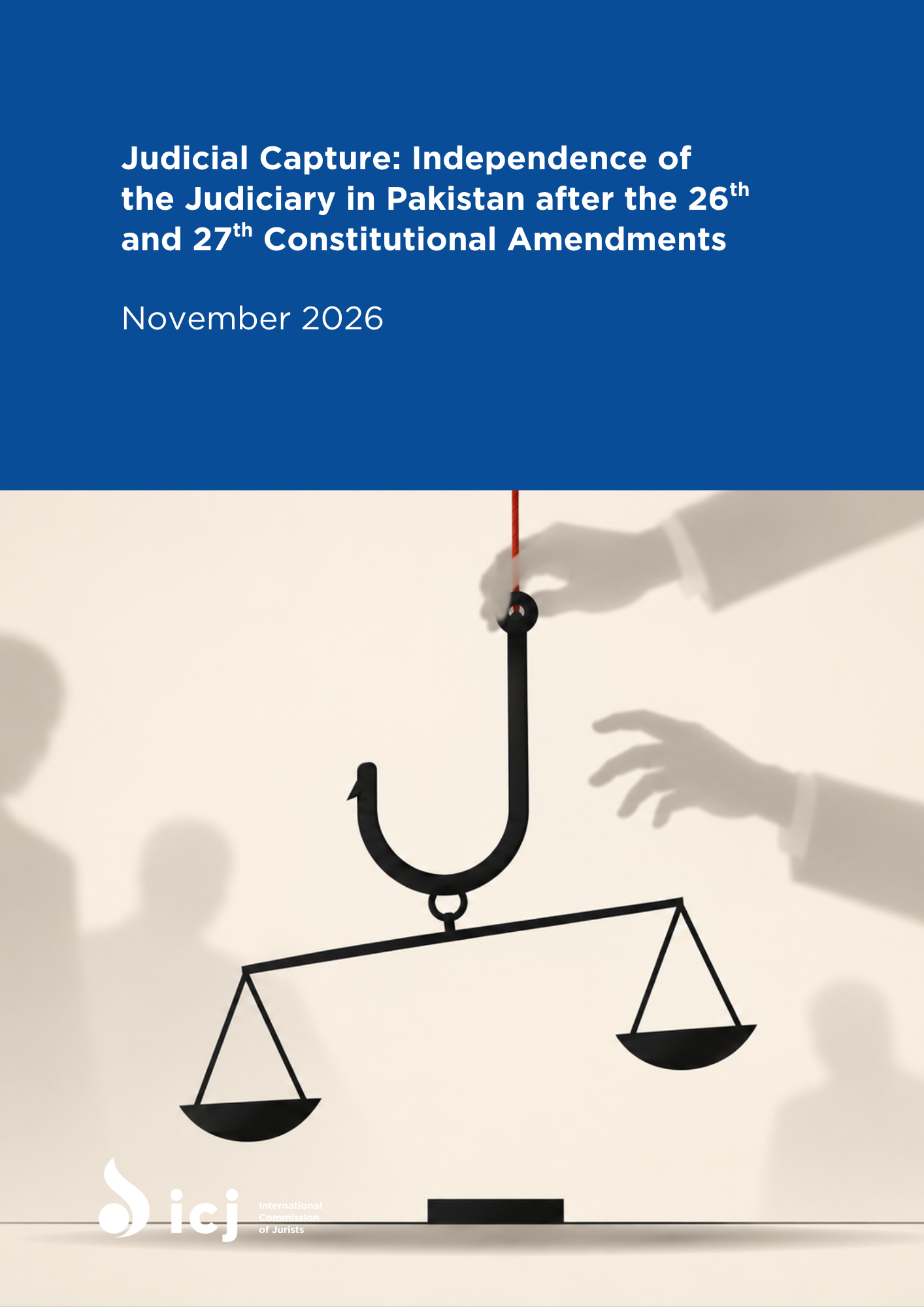
The systemic undermining of judicial independence in Pakistan through a series of constitutional and legislative changes has effectively resulted in judicial capture by the political branches of the State, and has gravely impaired the judiciary’s capacity to act as an effective check on the Government and to provide effective remedies for violations of human rights, concludes the International Commission of Jurists (ICJ) in a report published today.
“The 26th and 27th amendments have done exactly what we feared: they have placed Pakistan’s highest courts under the control of the executive. When the courts are captured, no one is left to hold the government to account, and victims of human rights violations have nowhere to turn,” said Santiago Canton, ICJ’s Secretary-General.
The report, “Judicial Capture: Independence of the Judiciary in Pakistan after the 26th and 27th Constitutional Amendments”, analyses the institutional framework governing the High Courts, the Supreme Court, and the Federal Constitutional Court in light of Pakistan’s obligations under international law a year after the 27th amendment was passed in November 2025, and two years after the 26th amendment was passed in October 2024.
The ICJ finds the cumulative effect of the amendments and of the manner of their implementation is that the highest courts of Pakistan no longer enjoy the institutional guarantees of independence required by Article 14 of the ICCPR and the UN Basic Principles on the Independence of the Judiciary, among other international standards.
The rapid erosion of the independence of the judiciary in Pakistan has happened alongside a backsliding of democracy and the protection of human rights in the country. This has impaired the right of victims of human rights violations to an effective remedy, guaranteed under Article 2(3) of the International Covenant on Civil and Political Rights (ICCPR), to which Pakistan is a party, as well as Pakistan’s domestic law.
The ICJ has long advocated for reforms to make the judiciary in Pakistan more independent and accountable, including through an appointment process that is transparent and inclusive. The ICJ has also raised concern about judicial overreach and encroachment into the domains of Parliament and other institutions.
“Pakistan’s judiciary needed reform. Judges were appointed without transparency, and at times the courts overstepped into the domain of other institutions. None of these problems have been fixed. Instead, the Government used people’s legitimate frustration with the courts as a pretext to bring them under its full control,” added Santiago Canton.
The structural problems identified in this report require substantial constitutional and statutory amendments, and the ICJ recommends revision or repeal of provisions in the 26th and 27th amendments that are inconsistent with international law and standards on the independence of the judiciary.
Download
The report “Judicial Capture: Independence of the Judiciary in Pakistan after the 26th and 27th Constitutional Amendments” is available for download here.
Contact:
Santiago Canton, ICJ’s Secretary General, e: santiago.canton@icj.org