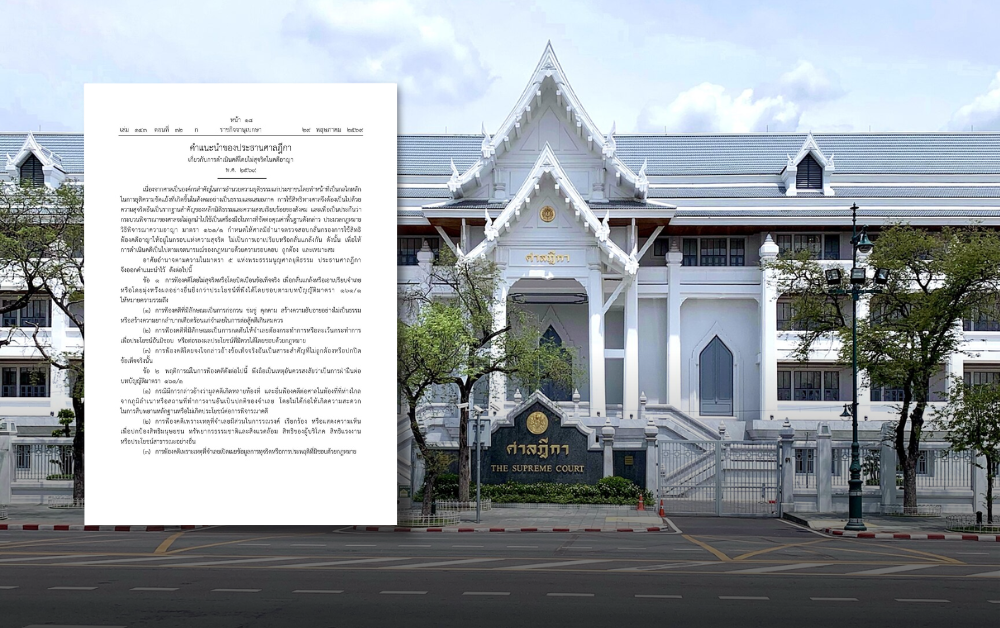
The International Commission of Jurists (ICJ) welcomes the President of the Thai Supreme Court’s Recommendations, published in the Government Gazette on 29 May 2026, on the adjudication of cases filed in bad faith. The Recommendations address the longstanding vagueness of Section 161/1 of the Code of Criminal Procedure, one of Thailand’s main legal provisions against the abuse of the judicial process targeting human rights defenders (HRDs) and others speaking out on matters of public interest. Section 161/1 is one of the primary legal tools to combat so-called strategic lawsuits against public participation (SLAPPs).
“After years of advocacy by civil society organizations, including the ICJ, and by SLAPP victims themselves, the Thai Supreme Court has finally issued guidance seeking to clarify Section 161/1 of the Code of Criminal Procedure. We hope this will bring some relief to those who have suffered solely for their legitimate exercise of their rights and for speaking out on matters of public concern,” said Mandira Sharma, ICJ Regional Director for Asia and the Pacific.
Section 161/1 of the Code of Criminal Procedure empowers courts to dismiss a case and prohibit its refiling where a private complainant has filed the case in bad faith, distorted facts to harass or take undue advantage of a defendant or sought a benefit to which they are not legally entitled. Despite being in force since 2019, owing to the vagueness of the term “not in good faith”, the uncertainty over the legal procedure and standing to bring a request to have the case struck out, as well as lack of clarity as to whether an inquiry is required or left to judicial discretion, and the absence of any timeframe for the court to act, Section 161/1 has rarely been applied to strike out SLAPP cases. The Recommendations seek to address most of these shortcomings by clarifying the meaning of a prosecution in “bad faith” and identifying specific conduct falling short of Section 161/1. In those circumstances, the Recommendations effectively empower the courts to dismiss such cases at any stage of proceedings.
“While this development is welcome, it is not enough. The Recommendations apply only to private criminal complaints—an inherent limitation of Section 161/1 itself—and not to civil complaints or public prosecutions. As a result, once a case proceeds to trial, defendants in those types of cases have no protection against an abuse of the justice process, which in itself can last for years,” said Sharma.
While the President of the Supreme Court’s Recommendations mark a meaningful step forward, they do not mandatorily apply to all legal complaints and leave a significant portion of defendants in SLAPP cases—particularly those brought through public prosecutions and civil proceedings—without concrete protection.
A significant proportion of SLAPP cases in Thailand is brought through public prosecutions. Where a prosecutor does not decline to prosecute or fails to invoke Article 21 of the Public Prosecution Organ and Public Prosecutors Act—which allows the Attorney-General to issue a non-prosecution order where a case is not in the public interest—the case runs its full course to judgment, as Thai courts have traditionally not conducted preliminary hearings in such cases. In almost none of the cases monitored by the ICJ, did the Attorney-General issue a non-prosecution order under Article 21 of the Public Prosecution Organ and Public Prosecutors Act.
In light of this, and following the Supreme Court’s lead, the ICJ calls on the Office of the Attorney-General to make meaningful use of this power, and equally calls on the Royal Thai Police, whose inquiry officers may make recommendations on prosecution orders, to play an active role in filtering out abusive cases at the earliest stage and to issue clear guidance to officers on handling SLAPP cases.
The Recommendations state that, in “other criminal proceedings beyond these Recommendations”—which should be understood to include at least criminal cases brought by public prosecutors – judges should “adhere to the principles of good faith and proportionality when exercising judicial discretion under the law.” This language appears to leave open the possibility that the Recommendations’ principles may apply to public prosecution cases; however, it falls short of an explicit guarantee that their protections will extend to the categories currently excluded.
“SLAPPs will not end if their root causes are not addressed. Laws that fall short of human rights standards continue to be weaponized to suppress letitimate expression. Thailand should decriminalize defamation — one of the most commonly used provisions in SLAPP cases — and reform other laws to prevent their misuse, including the Computer Crimes Act and the Public Assembly Act,” said Sharma.
In addition, given the gaps identified above and the limited legal force of the Recommendations, the ICJ further urges Thailand to accelerate the passage of comprehensive anti-SLAPP legislation and to address the root causes that enable SLAPPs to persist.
Background
The Recommendations define a prosecution in “bad faith” as one including:
- conduct of a harassing, threatening, or oppressive character disproportionate to the circumstances;
- use of proceedings to coerce a party for an unlawful benefit; and
- the knowing use of false or concealed material facts.
The Recommendations further identify specific conduct failing short of what Section 161/1 requires, such as filing:
- before a court far from the defendant’s domicile or workplace without benefit for the adjudication of the case;
- because the defendant participated in campaigns, advocacy, or expressions of opinion to protect human rights, natural resources, the environment, consumer rights, labour rights, or other public interests;
- in response to the defendant’s disclosure of corruption;
- multiple cases arising from the same facts to burden the opposing party; and
- because the defendant exercised rights or performed duties under the law, where the complaint does not demonstrate that the defendant acted in bad faith or in a clearly unlawful manner.
Where the court finds that the specific conduct at issue fails short of what Section 161/1 requires, it may dismiss the case at the complaint examination stage, simultaneously with the preliminary inquiry, or as a representative of Thailand’s Court of Justice–the body responsible for managing the administrative and technical affairs of Thai courts—clarified during a public event co-hosted by the ICJ at the Thai Parliament—at any stage at which such suspicion arises.
Thailand’s Ministry of Justice is developing specific anti-SLAPP legislation empowering investigators, prosecutors, and courts to dismiss both criminal and civil cases where defendants have exercised constitutionally protected rights in the public interest; the legislation would also allow the courts to order damages, thus deterring repeat filings. This legislation would address the gaps the Recommendations cannot close—namely, their limited scope covering only private criminal complaints and their limited legal force. However, following a public hearing in March–April 2025, no further progress on the elaboration of this specific anti-SLAPP legislation has been publicly announced.
On 5 March 2025, Parliament adopted amendments to the Organic Act on Anti-Corruption protecting individuals who in good faith provide information or testimony to the National Anti-Corruption Commission (NACC) from civil, criminal, and disciplinary liability. This protection remains limited to NACC-related cases and does not address the broader misuse of judicial processes to silence civic engagement.
Download
Translation of the Supreme Court’s Recommendations here
The Presser is also available in Thai.
Further reading
Dictating the Internet: Curtailing Free Expression and Information Online in Thailand
Thailand: New law protecting SLAPPs marks progress but much more is needed
Contacts
Sanhawan Srisod, Senior Legal Adviser, Legal and Policy Office, e: sanhawan.srisod@icj.org
Saovanee Kaewjullakarn, Associate Legal Adviser, ICJ Asia and the Pacific Programme, e: saovanee.kaewjullakarn@icj.org