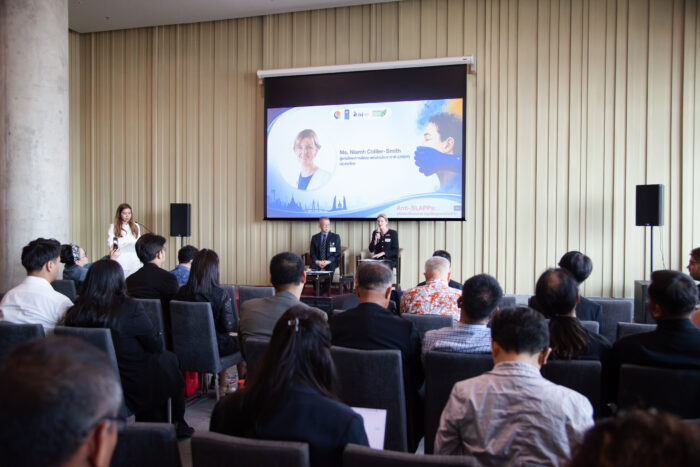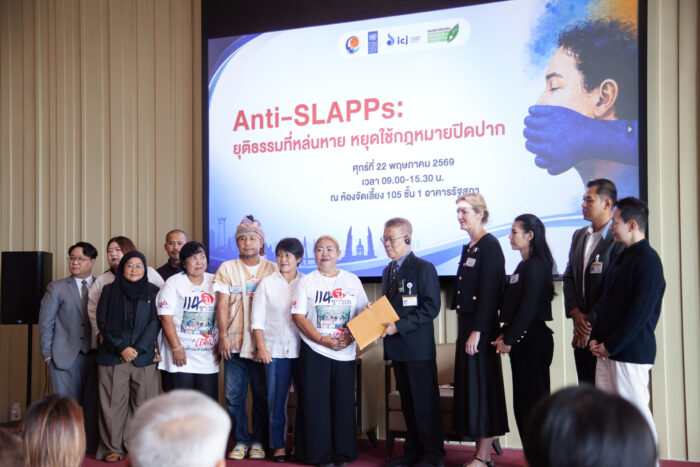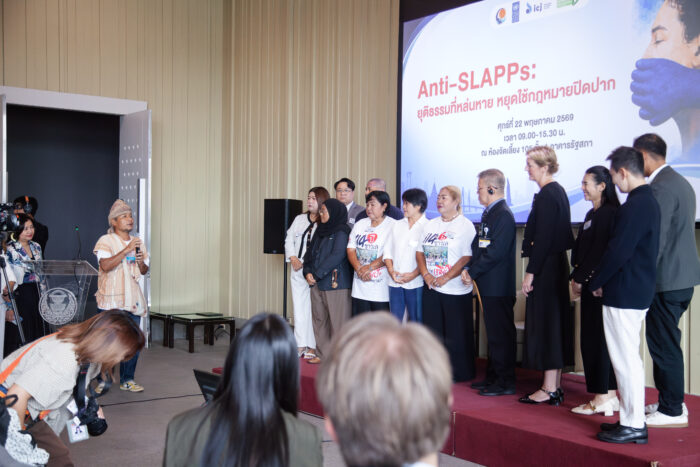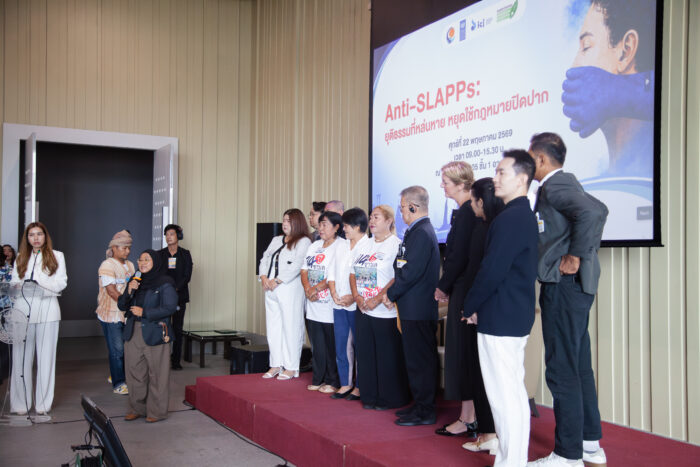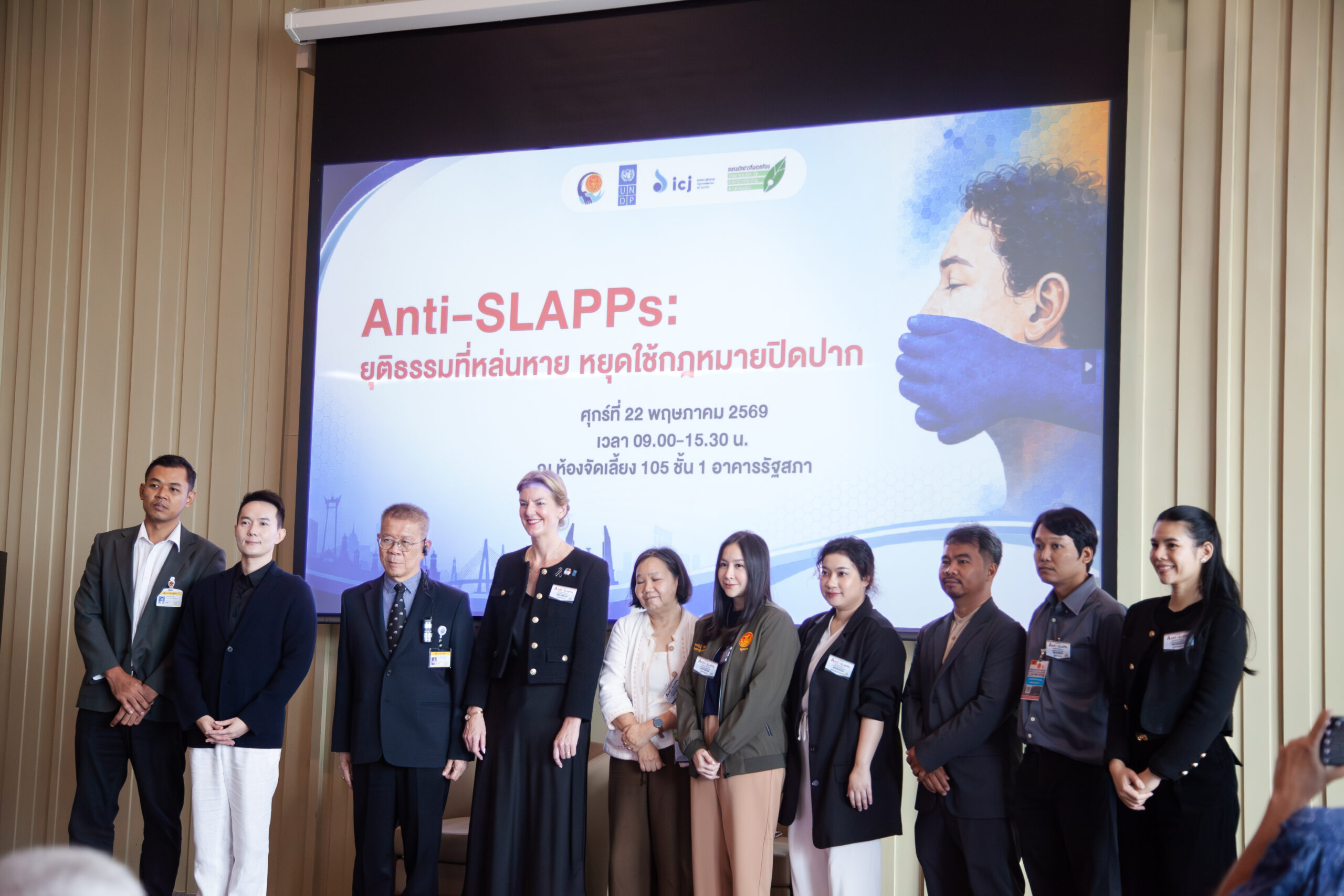
On 22 May 2026, the International Commission of Jurists (ICJ)—together with the Senate Committee on Political Development, Public Participation, Human Rights, Freedoms and Consumer Protection; UNDP Thailand; and GreenNews (Thai Society of Environmental Journalists)—co-hosted a seminar titled “Anti-SLAPPs: Justice Lost—Stop Using Laws to Silence” at the Parliament Building in Bangkok to discuss reforms necessary to counter so-called strategic lawsuits against public participation (SLAPPs).
Attended by approximately 100 participants—including senators, members of parliament, civil society representatives, justice sector actors, and individuals targeted by SLAPPs—the seminar comprised a morning session amplifying the voices of those targeted by strategic lawsuits, and an afternoon session examining the role of the justice system in bringing SLAPPs to an end.
The morning session featured SLAPP victims as panelists, with further testimonies by participants from the floor. Speakers described the mounting burdens of facing this kind of lawsuit, including: the way proceedings divert attention from the very issues victims had originally sought to raise; the financial and time costs imposed by cases filed in distant courts, particularly where the underlying conduct took place online; and the absence of accessible legal and financial support for individuals targeted simply for speaking out.
During the event, several victims submitted a formal letter of complaint to the Senate Committee with the ICJ’s assistance, calling on the Senate Committee to identify concrete measures to end the use of SLAPPs.
The afternoon session brought together representatives from the Court of Justice, the Office of the Attorney-General (OAG), the Human Rights Lawyers Association (HRLA), and the Ministry of Justice to explore practical solutions to end SLAPPs.
A representative of the Court of Justice affirmed that courts must not be used as instruments to suppress the voice of those who speak out in the public interest, and announced that the President of the Supreme Court would soon issue recommendations providing clearer criteria for applying Section 161/1 of the Code of Criminal Procedure—which is widely recognised as a key tool to address SLAPPs—including the possibility of dismissing cases at any stage of proceedings.
The OAG representative highlighted a structural gap: as Thailand separates police and prosecutorial powers, prosecutors must rely solely on the case file compiled by investigating officers and cannot factor in evidence obtained outside that process. Since evidence favourable to the defendant is rarely included from the outset, prosecutors are frequently left with no choice but to proceed—even if they may be aware that new evidence undermining the prosecution case and exonerating the defendant is likely to emerge in the run up to and at trial. The OAG noted that addressing this gap would also require additional engagement with the Royal Thai Police.
The HRLA representative reported that the Association has filed dismissal motions in more than 30 SLAPP cases involving journalists and activists, but that courts routinely decide to proceed as long as the “basic elements of an offence” are present. The court’s reticence in dismissing such cases is largely due to the absence of a legal definition of SLAPPs. The Association called on the President of the Supreme Court and the Attorney-General to issue clear and binding rules, and for the establishment of a formal protection system for activists and human rights defenders.
The Ministry of Justice representative reported that a draft anti-SLAPP law—developed in collaboration with Thammasat University’s Faculty of Law since 2024 —completed public consultation in 2025. The next steps, following the general legislative process, would involve submission to the Ministry’s internal committee, the Cabinet, the Council of State, and Parliament to follow.
The seminar was livestreamed on the Thai Senate Facebook page.
Background
Section 161/1 of the Code of Criminal Procedure empowers courts to dismiss a case and prohibit refiling where a private complainant has filed in bad faith, distorted facts to harass or take undue advantage of a defendant, or sought a benefit to which they are not legally entitled.
Despite being in force since 2019, Section 161/1 has rarely been applied to strike out SLAPP litigation—owing to the vagueness of the term “not in good faith”, the uncertainty over the legal procedure and standing to bring a request to have the case struck out, as well as lack of clarity as to whether an inquiry is required or left to judicial discretion, and the absence of any timeframe for the court to act.
Thailand’s Ministry of Justice is developing a dedicated anti-SLAPP law that would empower investigators, prosecutors, and courts to dismiss both criminal and civil cases where defendants have exercised constitutionally protected rights in the public interest and would allow courts to order damages and deter repeat filings. This legislation would address several of the noted gaps. However, following a public hearing in March–April 2025, no further progress has been publicly announced.
On 5 March 2025, Parliament adopted amendments to the Organic Act on Anti-Corruption protecting individuals who in good faith provide information or testimony to the National Anti-Corruption Commission (NACC) from civil, criminal, and disciplinary liability. This protection remains limited to NACC-related cases and does not address the broader misuse of judicial processes to silence civic engagement.
Speakers
- Jeeranan Premchaiporn, Constitutional Campaign Network (CALL)
- Kovit Photisan, Editor of The Isaan Record
- Thanarat Kaewwattanaphan, Software Specialist
- Sumet Rianphongsnam, human rights defender
- Wannapat Jenruamchit, Thai Lawyers for Human Rights (TLHR)
- Sanhawan Srisod, ICJ
- Woramol Ramangkura, Office of the President of the Supreme Court
- Bawon Boonlop, Office of the Attorney-General
- Natthasiri Bergman, Human Rights Lawyers Association
- Nareeluc Pairchaiyapoom, Department of Rights and Liberties Protection, Ministry of Justice.
Further reading
Dictating the Internet: Curtailing Free Expression and Information Online in Thailand
Thailand: New law protecting SLAPPs marks progress but much more is needed
Contacts
Sanhawan Srisod, Senior Legal Adviser, Legal and Policy Office, e: sanhawan.srisod@icj.org
Saovanee Kaewjullakarn, Associate Legal Adviser, ICJ Asia and the Pacific Programme, e: saovanee.kaewjullakarn@icj.org