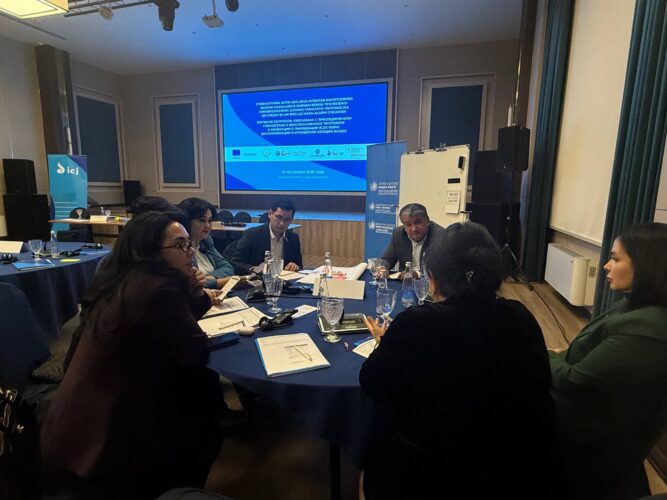
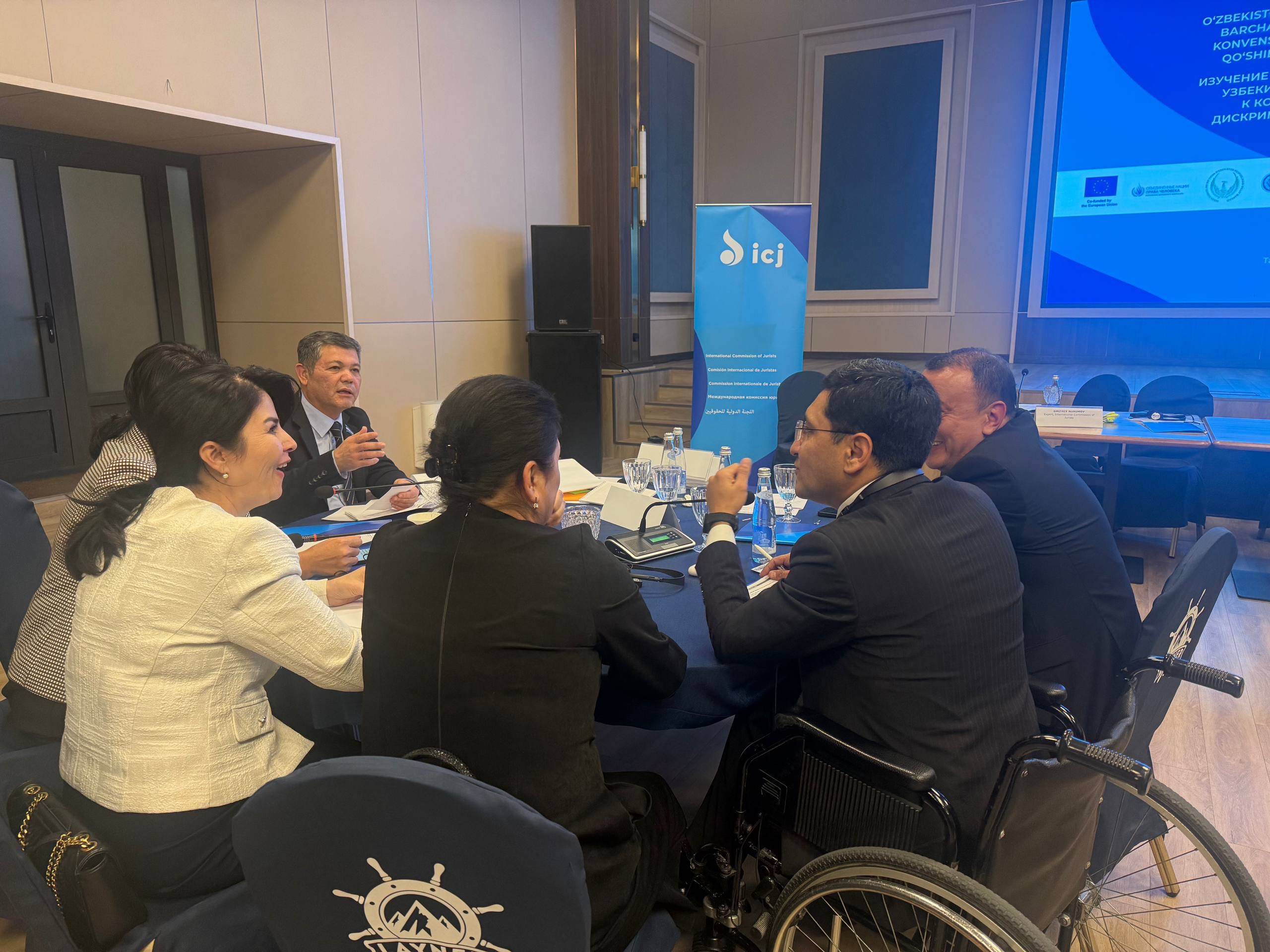
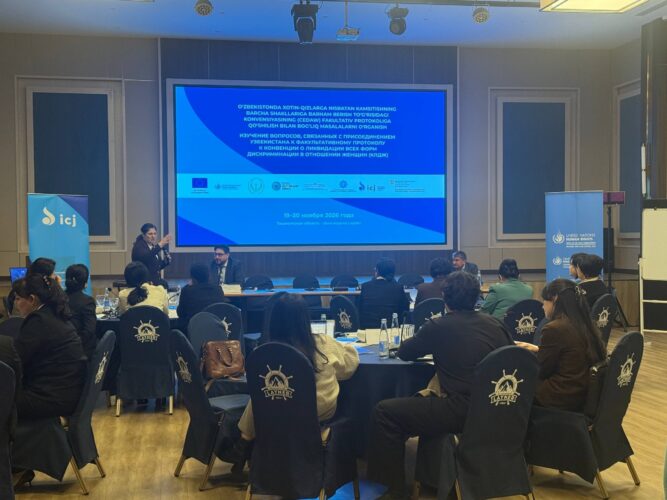
On 19 and 20 November 2026, the International Commission of Jurists (ICJ), together with the UN Office of the High Commissioner for Human Rights (OHCHR) Regional Office for Central Asia (ROCA) , the National Human Rights Centre of the Republic of Uzbekistan, both chambers of the Parliament, is holding a seminar on Uzbekistan’s accession to the Optional Protocol to the Convention on the Elimination of All Forms of Discrimination against Women (CEDAW). The seminar examines the individual communications procedure under the Optional Protocol and the legal and institutional steps that accession would require.
The first day addresses the guarantees of the Convention and the obligations of States parties, including the principle of non-discrimination, the obligation under Article 5 of the Convention to eliminate gender stereotyping, and the duty of the State to protect women from discrimination and violence, including by private actors. Participants also consider the practice of the CEDAW Committee, including its 2022 Concluding Observations on Uzbekistan.
Particular attention is given to the individual communications procedure including the submission of communications, the admissibility criteria, the observations of the State party, the Views of the Committee and the follow-up to them.
On the second day, participants will discuss how the procedure relates to national legislation, State institutions and domestic remedies. They will also identify the preparatory steps that accession would require, including further legal analysis and consultations among State bodies and other stakeholders.
The seminar takes place days after the President of Uzbekistan signed, on 13 November 2026, a law amending the Labour Code to prohibit sexual harassment in employment and to require employers to take measures to prevent it. It also follows the launch by the CEDAW Committee, on 23 October 2026, of its General Recommendation No. 41 on gender stereotypes.
The event is the first public consideration by the authorities of Uzbekistan of accession to the Optional Protocol. Accession would enable women under the jurisdiction of Uzbekistan to bring communications before the CEDAW Committee where domestic remedies have been exhausted.
Background
Uzbekistan acceded to CEDAW in 1995. It is not yet a party to the Optional Protocol, which entered into force on 22 December 2000 and establishes an individual communications procedure and an inquiry procedure before the CEDAW Committee.
The seminar builds on earlier work of the ICJ and its partners in Uzbekistan on the protection of women from discrimination and violence. In June 2023, following the adoption of legislation criminalizing domestic violence and establishing administrative liability for sexual harassment, the ICJ, the Nationwide Movement “Yuksalish” and OHCHR ROCA convened an international expert discussion, “From Legislation to Action: Effective Measures for Protecting Women and Children from Violence in Uzbekistan”. The ICJ subsequently published a briefing paper on the protection of women and children from violence in Uzbekistan.
In September and December 2025, under the EU-funded Strengthening Human Rights Implementation, Education and Legal Development (SHIELD) project, the ICJ and its partners held a round table on the implementation of the Views of UN Treaty Bodies and an expert discussion on the implementation of international human rights law and standards under CEDAW, the Convention on the Rights of the Child and the Convention on the Rights of Persons with Disabilities.
On 16 and 17 November 2026, the ICJ and OHCHR ROCA conducted trainings in Tashkent for lawyers and judges on combating discrimination and gender stereotypes in legal and judicial practice.
This event was organized under the SHIELD Project, funded by the European Union.
Contact: Sitora Rakhimova, Legal Adviser, ICJ Europe and Central Asia Programme: sitora.raximova@icj.org
For more information:
Agenda of the seminar: English, Russian, Uzbek