Three legislative proposals to counter strategic lawsuits against public participation (SLAPPs) are now under consideration in Thailand. The International Commission of Jurists (ICJ) welcomes this progress, but urges the Thai authorities to ensure that any anti-SLAPP law ultimately adopted is consistent with Thailand’s obligations under international human rights law and covers SLAPP cases in all the forms they take in practice.
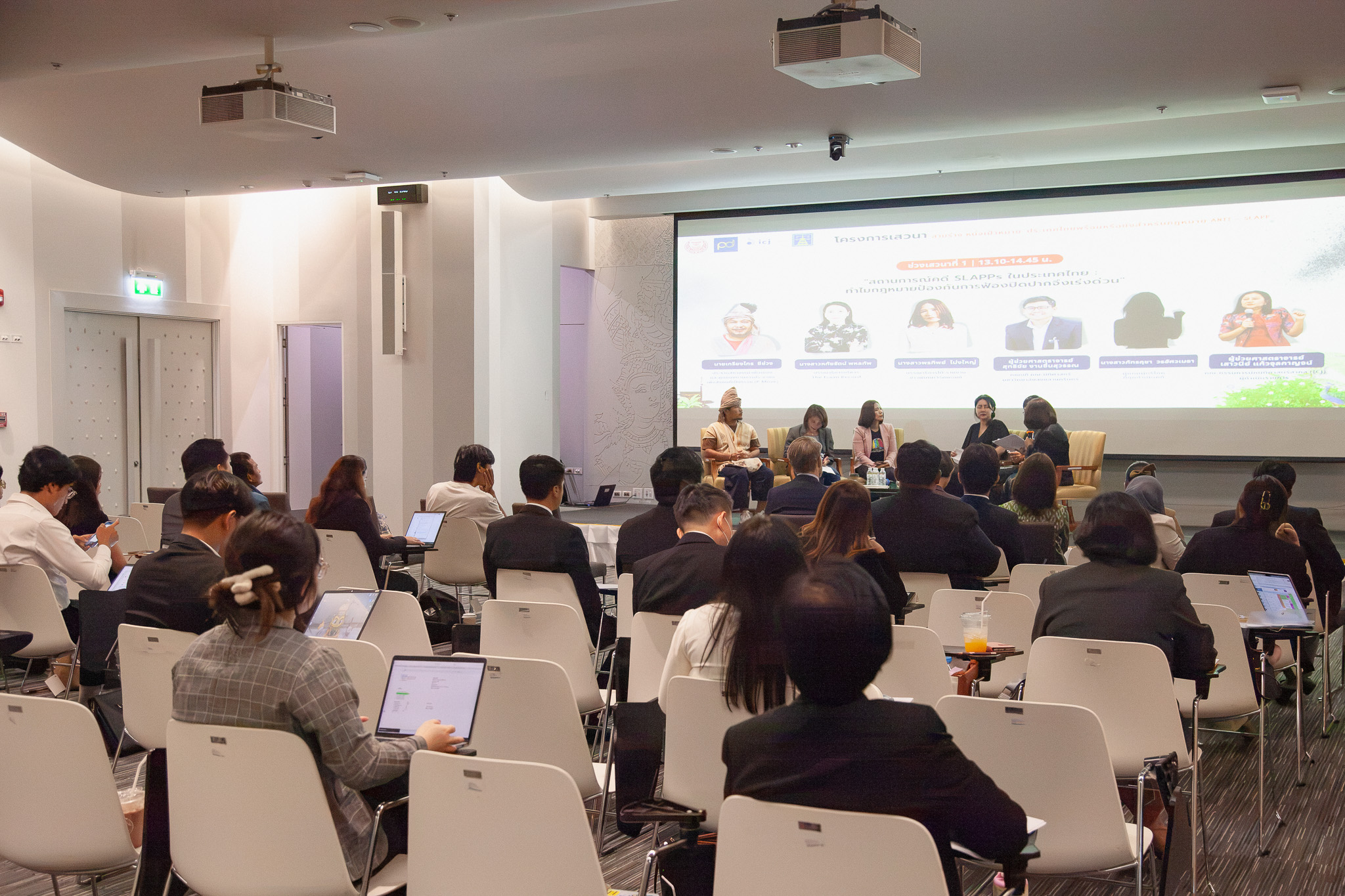
The three proposals were examined at a panel discussion titled Three Drafts, One Goal: Is Thailand Ready for Anti-SLAPP Legislation?, held at the Parliament in Bangkok on 27 August 2026. The event was co-hosted by the International Commission of Jurists), the Rights and Liberties Protection Department (RLPD) of the Ministry of Justice, and the House of Representatives’ Committee on Political Development, Mass Communications and Public Participation. Some 87 participants attended, including members of parliament, civil society representatives, justice sector actors, members of the diplomatic community, and individuals who have been targeted by SLAPP cases.
Voices of those targeted
The first session, facilitated by ICJ Associate Legal Adviser Saovanee Kaewjullakarn, heard from individuals targeted by SLAPP cases. They included human rights defender Kriangkrai Chichuang, sued for taking part in peaceful assemblies calling for respect for the rights of Indigenous Peoples to their ancestral lands; journalists Hathairat Phaholtap and Pornthip Muangyai, targeted for their investigative reporting on human rights issues; and Phattharawicha Wora-asawametha, a consumer sued for posting about her experience with a house she had bought. Speakers described how the resulting “chilling effect” deterred not only themselves, but also others in their communities and professions, from exercising their rights to freedom of expression and peaceful assembly, and to take part in public affairs.
Suttichai Ngamchuensuwan, Dean of the Faculty of Law at Prince of Songkla University, also observed a growing trend of human rights defenders and activists being targeted for lawsuit, even for taking part in academic events on university premises. He said this showed that universities were no longer safe spaces for human rights discussion, and that it had contributed to growing self-censorship among academics and students, particularly in the Southern Border Provinces.
The three drafts
Opening the second session, ICJ Senior Legal Adviser Sanhawan Srisod set out the main elements that the ICJ and other civil society organizations have called for in an effective anti-SLAPP law. These included early screening and dismissal of cases, and a clear legal definition of SLAPP cases or a clear scope of protected conduct to guide justice sector actors. Such a law should also provide for effective remedies for those targeted, including free legal aid, and effective protection for justice sector actors who discontinue SLAPP cases, so that they do not themselves become targets of legal action.
She noted that existing legal tools fell short. Judicial screening under Section 161/1 of the Criminal Procedure Code, including under the newly adopted Recommendations of the President of the Supreme Court, is presently available only where a private complainant filed a case directly with the court, and its effectiveness had so far been limited. The ICJ and partner organizations had rarely observed the discontinuance of cases brought through the police and public prosecutors. Civil law, meanwhile, offered no explicit or adequate protection.
Nareeluc Pairchaiyapoom, Director of the RLPD’s International Human Rights Division, presented the Ministry of Justice draft, which is awaiting internal approval before submission to the Cabinet. The draft covers both criminal and civil cases. It would empower the police, prosecutors, and courts to terminate SLAPP cases at the earliest stage of proceedings, where defendants have exercised constitutionally protected rights in the public interest. It also includes compensation for those targeted, bail without security, and protection for justice sector actors who dismiss such cases.
She stressed that such legislation is also important for Thailand’s international credibility and commitments, including under the UN Human Rights Council’s Universal Periodic Review, in ongoing free trade negotiations with several countries in which anti-SLAPP legislation had been raised, and in Thailand’s accession process to the Organisation for Economic Co-operation and Development (OECD).
Anusorn Kaewwichian, a Member of Parliament from the People’s Party, presented his party’s draft, which has been submitted to the House of Representatives and is awaiting placement on its agenda. He acknowledged that the draft had been inspired by the Ministry of Justice version and shared much of its language and model. Among other changes, it would replace imprisonment for defamation with non-criminal fines. He noted civil society’s call for the bill to go further and fully decriminalize defamation. The ICJ recalls that under international standards, criminal imprisonment should never be a penalty for defamation.
Rewadee Khwanthongyim, Director of Social Welfare Law at the Office of the Council of State, presented proposed amendments to the Civil Procedure Code addressing the bad-faith exercise of rights in civil proceedings. Although limited to civil cases, the amendments would require courts to dismiss such cases expeditiously, enable defendants to claim compensation within the same proceedings, and impose fines payable to the State. Following public consultation, the proposal is under review and will be submitted to the Cabinet.
The ICJ calls on the Thai authorities to ensure that any anti-SLAPP legislation covers all SLAPP cases, whether criminal or civil, and whether brought by private complainants or through the police and public prosecutors and provides for effective early dismissal and remedies for those targeted. The ICJ also calls for criminal defamation — one of the most common bases for SLAPP cases — to be eliminated as a sanction under law. It further calls for substantial amendments to other laws that constitute root causes of SLAPP cases, including the Public Assembly Act, the Computer-Related Crime Act, and other criminal and civil law provisions.
Background
The 27 August panel built on a seminar co-hosted by the ICJ and the Senate Committee in May 2026, which had focused on gaps in the existing legal framework.
Thailand’s National Action Plan on Business and Human Rights Phase 2 (2023–2027) tasks the Office of the Attorney General with reviewing, amending, developing, and implementing preventive measures to provide effective safeguards against SLAPP cases.
Section 161/1 of the Criminal Procedure Code was introduced in 2019 as an anti-SLAPP tool. It empowers courts to dismiss a case where a private complainant has filed it in bad faith, distorted facts to harass or take undue advantage of a defendant, or sought a benefit to which they are not legally entitled. However, Section 161/1 has rarely been applied to strike out SLAPP litigation. This is owing to, among other things, the vagueness of what constitutes “bad faith”, uncertainty over the procedure and standing to request that a case be struck out, and the absence of any timeframe for the court to act.
To address these gaps, the President of the Supreme Court issued Recommendations on the adjudication of criminal cases filed in bad faith, published in the Government Gazette on 29 May 2026. The Recommendations clarify what constitutes a bad-faith case and standardize court procedure. However, like Section 161/1, they apply only to cases brought directly by private complainants.
On 5 March 2025, Parliament adopted amendments to the Organic Act on Anti-Corruption. These protect individuals who, in good faith, provide information or testimony to the National Anti-Corruption Commission (NACC) from civil, criminal, and disciplinary liability. This protection, however, remains limited to NACC-related cases and does not address the broader misuse of judicial processes to silence civic engagement.
Speakers
- Anusorn Kaewwichian, Member of Parliament, People’s Party
- Hathairat Phaholtap, Executive Editor, The Isaan Record
- Kriangkrai Chichuang, President, Council of Indigenous Peoples / People’s Movement for a Just Society (P-Move)
- Nareeluc Pairchaiyapoom, Director, International Human Rights Division, RLPD, Ministry of Justice
- Phattharawicha Wora-asawametha, consumer targeted by a SLAPP case
- Pornthip Mongyai, former journalist, Workpoint News
- Rewadee Khwanthongyim, Director of Social Welfare Law, Office of the Council of State
- Sanhawan Srisod, Senior Legal Adviser, ICJ
- Suttichai Ngamchuensuwan, Dean, Faculty of Law, Prince of Songkla University
Further reading
- Thailand: ICJ co-hosts parliamentary seminar on anti-SLAPP reform
- Thailand: New law protecting SLAPPs marks progress but much more is needed
Contacts
Sanhawan Srisod, Senior Legal Adviser, Legal and Policy Office, e: sanhawan.srisod@icj.org
Saovanee Kaewjullakarn, Associate Legal Adviser, ICJ Asia and the Pacific Programme, e: saovanee.kaewjullakarn@icj.org