Nov 28, 2018 | News
The Egyptian authorities must drop the charges against nine detainees arrested on 1 November 2018 and immediately and unconditionally release them and at least 31 others arrested and in some cases “disappeared” since late October 2018, or otherwise charge them with a recognizable crime consistent with international law, the ICJ said today.
Those arrested in the present sweeps include human rights defenders (HRDs), lawyers, and political activists and persons otherwise providing support to political detainees. Reports indicate that at least some of those detained are connected to the Muslim Brotherhood. The ICJ is concerned that many if not all of these detainees are being held solely for political reasons.
On Wednesday 21 November, nine detainees held since 1 November 2018—Hoda Abdel Moneim, Mohamed Abu Hurayra, Bahaa Auda, Aisha Al Shater, Ahmed El Hodeiby, Mohamed El Hodeiby, Somaya Nassef, Marwa Madbouly and Ibrahim Atta—were interrogated by the State Security Prosecution, who ordered they be held in pre-trial detention for 15 days.
According to information available to the ICJ, the prosecution charged the nine with joining and funding a terrorist organization and incitement to harm the national economy under Egypt’s Counter-Terrorism Law No. 94/2015 (Case No. 1552/ 2018).
Lawyers representing the detainees were not permitted to access the case files, nor were they allowed to speak with the defendants in private. One of the detainees interrogated on 21 November was also interrogated on 19 November 2018 without the presence of a lawyer. It is unclear when the State Security Prosecution ordered their pre-trial detention.
At least three other detainees also appear to have been interrogated on 24 November 2018, including Ahmed Saad, Ahmed Ma’touk and Sahar Hathout. No information is known about whether an order for their pre-trial detention has been issued.
“These arbitrary arrests and trumped up charges are yet another example of the relentless assault by the military and government on the exercise of the rights to freedom of expression and association and to take part in political activity,” said Said Benarbia, ICJ’s MENA Programme Director. “Targeting anyone having any connection to opposition groups under the government’s ‘war on terrorism’ erodes the rule of law in Egypt, undermines human rights, and means there’s now very little, if any, room to carry out human rights work.”
According to public reports, at least 31 others were arrested by Egyptian authorities in raids in late October or early November 2018. Despite repeated calls on the authorities to provide information regarding their location, their whereabouts remain unknown, raising serious concerns for their health and safety. After human rights lawyer Hoda Abdel Moneim—one of the nine now charged—was held incommunicado for 21 days, her family issued a statement expressing concern about her “dire [physical and psychological] health condition.”
It is well established that the Egyptian authorities engage in the widespread and systematic use of torture. Although Egypt’s Constitution, Criminal Procedure Code and Penal Code require that detainees be held in official places of detention with judicial oversight and prohibit torture and other mistreatment, these safeguards have proven ineffective in practice.
The United Nations Committee Against Torture previously reported on the torture of hundreds of people disappeared by the Egyptian authorities. The ICJ is concerned about the high probability that these detainees have been tortured.
“The authorities should unconditionally and immediately release those arrested solely for exercising their human rights and fundamental freedoms, bring any others immediately before a judge to review whether there is any lawful basis for their detention and for any charges brought, and ensure that all those deprived of their liberty are protected against torture and other ill-treatment,” said Said Benarbia.
Contact:
Said Benarbia, Director of the ICJ Middle East and North Africa Programme, t: +41-22-979-3817; e: said.benarbia(a)icj.org
Background
Among those arrested in late October and early November 2018 were human rights lawyer and former spokesperson of the ECRF, Mohammed Abu Hureira, and his wife, Aisha al-Shater, daughter of imprisoned deputy chairman of the Muslim Brotherhood, Khairat al-Shater, as well as human rights lawyer Hoda Abdelmoniem, a former member of the National Council for Human Rights, who was arrested at her home after it was raided without warrant. At least eight of the 40 arrested are women. Reports from local human rights lawyers and organizations suggest that the number of persons arrested and arbitrarily detained could be higher.
The arrests are part of Egypt’s orchestrated crackdown on human rights work, in which human rights defenders and critics are arbitrarily arrested and detained, subjected to enforced disappearance, prosecuted in unfair trials, and sometimes sentenced to death. Two other members of the ECRF, including its Executive Director, were arrested in March 2018 and forcibly disappeared in September after an Egyptian Court ordered their release. Following the latest arrests, the ECRF—which documents enforced disappearances and Egypt’s increasing application of the death penalty—suspended its operations in protest.
On 10 September 2018, the Cairo Criminal Court convicted 739 defendants for their participation in the Raba’a Al Adaweyya square protests in August 2013 after a grossly unfair trial, sentencing 75 defendants to death and 658 defendants to life or five to 15 years’ imprisonment.
On 24 April 2018, following an unfair trial, the Cairo military court convicted former judge and former head of the Central Auditing Authority, Hisham Geneina, to five years in prison for “publishing false information harmful to the national security.”
The arrests place Egypt in breach of its international legal obligations, including under the International Convention on Civil and Political Rights (ICCPR). Article 9 of the ICCPR protects freedom from arbitrary arrest and detention and imposes an obligation on States to ensure a number of protections in respect of detention.
These include the requirement that detainees be brought promptly before a judge so their detention can be reviewed; have the right independently to challenge the lawfulness of their detention; and have the right to access legal counsel. Article 14 of the ICCPR also requires states to ensure detainees have access to legal counsel. Judicial oversight of detention is particularly necessary to protect detainees from torture and cruel, inhumane and degrading treatment.
Articles 19, 22 and 25 of the ICCPR also protect the rights to freedom of expression, to freedom of association and to participate in public affairs. Articles 5-8 of the United Nations Declaration on Human Rights Defenders similarly protects such rights exercised by HRDs and Article 12 requires states to protect HRDs from violence, threats, retaliation, de facto or de jure adverse discrimination, pressure or any other arbitrary action for the lawful exercise of such rights.
Under Egyptian Law, Article 56 of the Constitution and Articles 41-42 of the Criminal Procedure Code require that detainees be held in official places of detention and subject to judicial supervision, including judicial power to inspect places of detention and review each detainee’s case. Articles 51-52 and 55 of the Constitution, Article 40 of the Criminal Procedure Code and Article 126 of the Penal Code prohibit torture and other mistreatment.
In June 2018, the ICJ expressed its concerns about Egypt’s repeated renewals of the State of Emergency since April 2017, and the use of the state of emergency to suppress the activities of and persecute students, human rights defenders, political activists, union members and those suspected of opposing the government.
Egypt-November Arrests-News-Web Story-2018-ARA (PDF in Arabic)
Nov 25, 2018 | News
The International Commission of Jurists (ICJ) welcomes the formal declaration of the Gambia to allow individuals and certain non-governmental organizations with observer status access to complain of human rights violations against the Gambian State at the African Court on Human and Peoples Rights.
Gambia became the ninth African State to make the declaration to allow individual access the African Court on Human and Peoples Rights. The ICJ called on other States to follow suit rapidly.
“The Gambian government should be applauded, but more African States need to step up to reinforce their international human rights obligations by allowing victims of violations direct access to the Court and to empower the African Human Rights Court to do the work for which it was set up.” said Arnold Tsunga, Director of the ICJ African Regional Progamme. “It is only through extensive depositing of article 34(6) by the majority of African states that the court can be truly an African Court”.
In addition to granting access to individuals, the Declaration made under article 34(6) of the Protocol to the African Charter on Human and Peoples’ Rights triggers the courts jurisdictional competency under article 5(3) to allow for a limited number of NGOS access.
“The promise of human rights protection under the African human rights system can only be realized when political leaders match rhetoric with such action as allowing individuals to seek an effective remedy by direct access to regional human rights mechanisms like the African Court,” added Arnold Tsunga.
The ICJ emphasized that despite the significant human and material resources invested in the Court since its establishment in 2006, the African Court has been unavailable to great majority of Africans, since very few States had so far entered the declaration recognizing its competency.
Other States that have previously made declarations include Benin, Burkina Faso, Côte d´Ivoire, Ghana, Malawi, Mali, Tanzania and Tunisia.
Although, complaints of human rights violation can only be brought directly before the Court against the nine States that have made the declaration, victims of human rights violation of almost all African States can already bring claims against other states through the non-judicial communication procedure available at the African Commission on Human and Peoples´ Rights.
The ICJ stressed while access to the Commission’s procedures is important, it was not an adequate substitute for the kind of binding legal remedy that can be only ordered by a Court. The ICJ noted poor rate of compliance with decisions of the African Commission.
Contacts:
Arnold Tsunga, Director of the Africa Regional Programme, International Commission of Jurists C: +263 77 728 3248, E: arnold.tsunga(a)icj.org
Solomon Ebobrah, Senior Legal Advisor, Africa Regional Programme, International Commission of Jurists.C: +234 803492 7549, E: solomon.ebobrah(a)icj.org
Oct 30, 2018 | News
The ICJ today called upon the Government of Sri Lanka to abide by the Constitution and its international obligations in peacefully resolving the current political crisis, and for all political leaders to commit to respect for human rights and the rule of law.
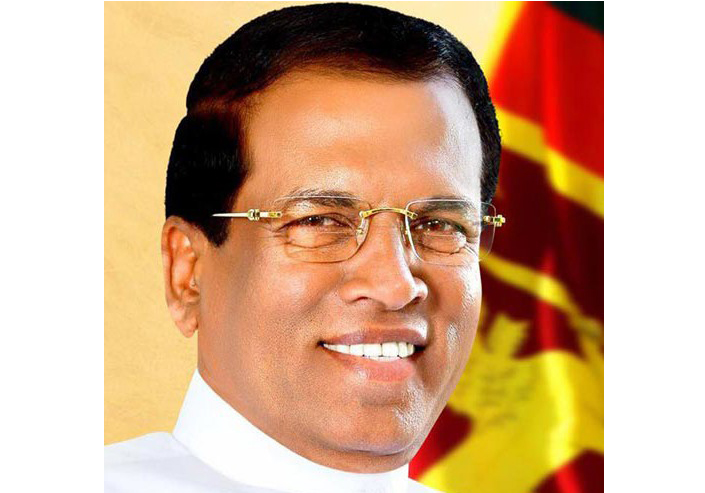
To this end, President Maithripala Sirisena (photo) should reconvene Parliament to end the constitutional crisis in line with the rule of law and democratic norms.
The ICJ urged the Government to deliver on its commitment to the transitional justice process, including by holding those responsible for human rights violations and abuses accountable, and complying with the obligations set out in United Nations Human Rights Council Resolutions 30/1 and 34/1.
It is with grave concern that the ICJ has observed the unfolding of events in Sri Lanka since the evening of October 26, 2018.
Following the withdrawal of the United People’s Freedom Alliance from the National Unity Government, President Maithripala Sirisena, in an unexpected move, appointed Former President and Member of Parliament Mahinda Rajapaksa as the Prime Minister of Sri Lanka.
These actions have transpired in disregard of safeguards set out in the 19th Amendment to the Constitution, which limit the power of the President to remove the Prime Minister at will.
The Amendment spells out specific instances during which the Prime Minister of Sri Lanka ceases to hold office under the law.
The ICJ is concerned at the President’s move to prorogue Parliament until 16 November in what appears to be an effort to avoid parliamentary scrutiny of his actions. The move has exacerbated political tensions.
“The ICJ is alarmed that Mahinda Rajapaksa, who has yet to be held accountable for the well-documented human rights violations committed during his previous tenure, has been appointed Prime Minister – in apparent violation of the Constitution,” said Frederick Rawski, Asia Pacific Director for the ICJ.
Incidents of violence and the takeover of government-controlled media by supporters of Mahinda Rajapaksa raise fears of an imminent return to the human rights violations and abusive practices which were widespread during his term.
ICJ also noted with concern ongoing crackdowns on the media and other attacks on human rights and fundamental freedoms.
The ICJ stressed that the removal of the Prime Minister in violation of the law or constitutional provisions would constitute a violation of Sri Lanka’s commitments to the international community, set out in UN Human Rights Council resolutions in 2015 and 2017, to strengthen good governance and protect democratic institutions.
The ICJ also expressed concern that political instability, or the return of an unrepentant and unaccountable Mahinda Rajakpaksa to political power, would endanger progress made on fulfilling Sri Lanka’s commitments to press forward with transitional justice processes, and its legal obligations to ensure accountability for past human rights violations and abuses, as set out in both resolutions.
“The failure to address past abuses, and to fully implement UN Human Rights Council Resolutions 30/1 and 34/1, has helped set the stage for the current political turmoil, and the possible return of an authoritarian figure who has proven his disrespect for human rights and the rule of law over and over,” said Frederick Rawski.
“The Human Rights Council will be watching closely to assess whether Sri Lanka is in breach of its commitments. Any serious threat to progress on human rights accountability will compel the establishment of an independent accountability mechanism,” he added.
Contact
Frederick Rawski, ICJ’s Asia Pacific Regional Director, t: +66 2 619 84 77 ; e: frederick.rawski(a)icj.org
Oct 26, 2018 | News
At a media event in Bangkok, Thailand, today, the ICJ reiterated its call for Turkey to work with the United Nations to establish a special independent mechanism to carry out an investigation into the killing of Khashoggi with a view to identifying the perpetrators.
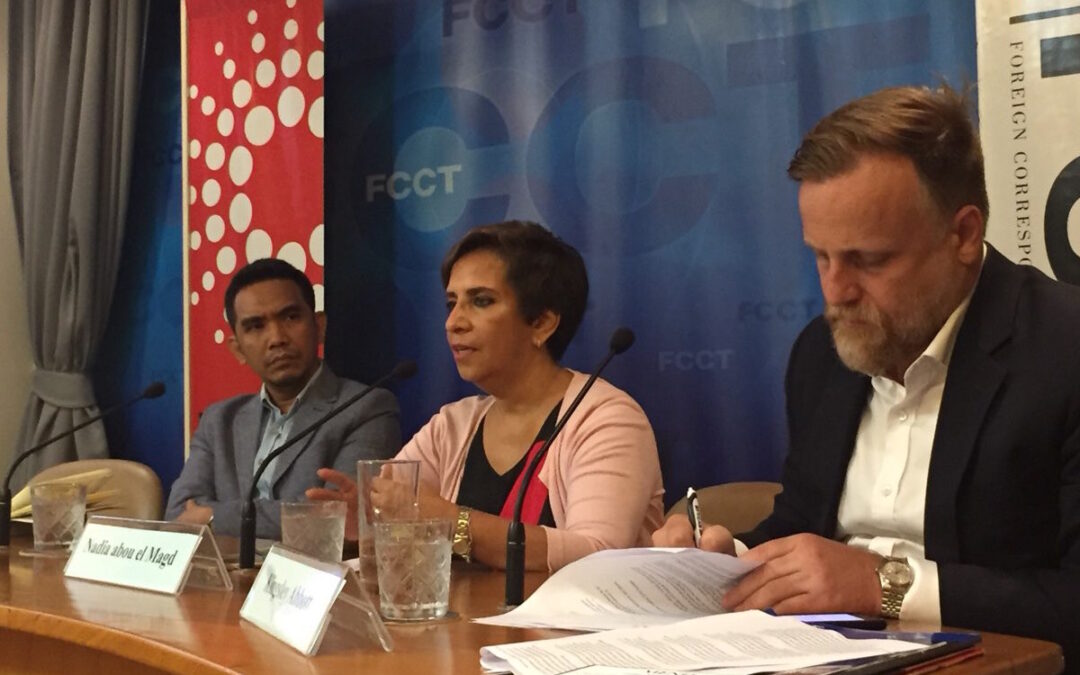
The Foreign Correspondents Club of Thailand (FFCT) in Bangkok hosted a special panel discussion entitled Death of a journalist – Fallout from the killing of Jamal Khashoggi, which was attended by approximately eighty journalists, diplomats and club members.
On the panel, Kingsley Abbott, ICJ Senior Legal Advisor for Global Accountability, began by making two positive observations, namely that there exists a clear international legal framework which applies to cases of suspected unlawful deaths including extra-judicial executions and enforced disappearance; and that a considerable amount of information about Khashoggi’s fate appears to be available.
He set out the international legal framework that applies to violations of the right to life noting the state duty to conduct a prompt independent, impartial, effective and transparent investigation consistent with the UN Principles on the Effective Prevention and Investigation of Extra-legal, Arbitrary and Summary Executions and the revised 2016 Minnesota Protocol on the Investigation of Potentially Unlawful Death.
Kingsley Abbott noted that in nearly all cases where there is reasonable suspicion of unlawful death, an autopsy should be performed and called for Khashoggi’s body or remains to be produced.
Kate Vigneswaran, ICJ Senior Legal Adviser, Middle East and North Africa (MENA) Programme, discussed options for accountability in the MENA region, in particular in Saudi Arabia, Turkey, Egypt and the United Arab Emirates.
She noted that Saudi Arabia provided little to no opportunity for meaningful justice given executive and Royal Court control over the judiciary and prosecutors. She further highlighted Saudi Arabia’s targeting of critics exercising their right to freedom of expression through criminal prosecutions, abductions and enforced disappearances, and egregious fair trial rights violations in the criminal justice system. She went on to state that similar human rights violations in Egypt and the United Arab Emirates make them unlikely credible options for accountability.
She also noted some concerns about aspects of the justice system in Turkey and in that regard said it was too early to determine whether the conduct of investigation and prosecution of the perpetrators in that country would meet international standards.
Other speakers included Nadia abou el Magd, who has 30 years’ experience as a journalist and commentator covering the Middle East, working mainly for the Associated Press, and Dr. Muhammad Ilyas Yahprung from the Faculty of Political Science, Ramkhamheang University, who focuses on Muslim World Issues.
The panel was moderated by Anneliese Mcauliffe who has worked as a journalist across Asia and the Middle East for over two decades.
Contact:
Kingsley Abbott
Kate Vigneswaran
Senior Legal Adviser
Middle East and North Africa Programme
Phone: +31624894664
Email: kate.vigneswaran(a)icj.org
Twitter: @KateVigneswaran
Oct 24, 2018 | News
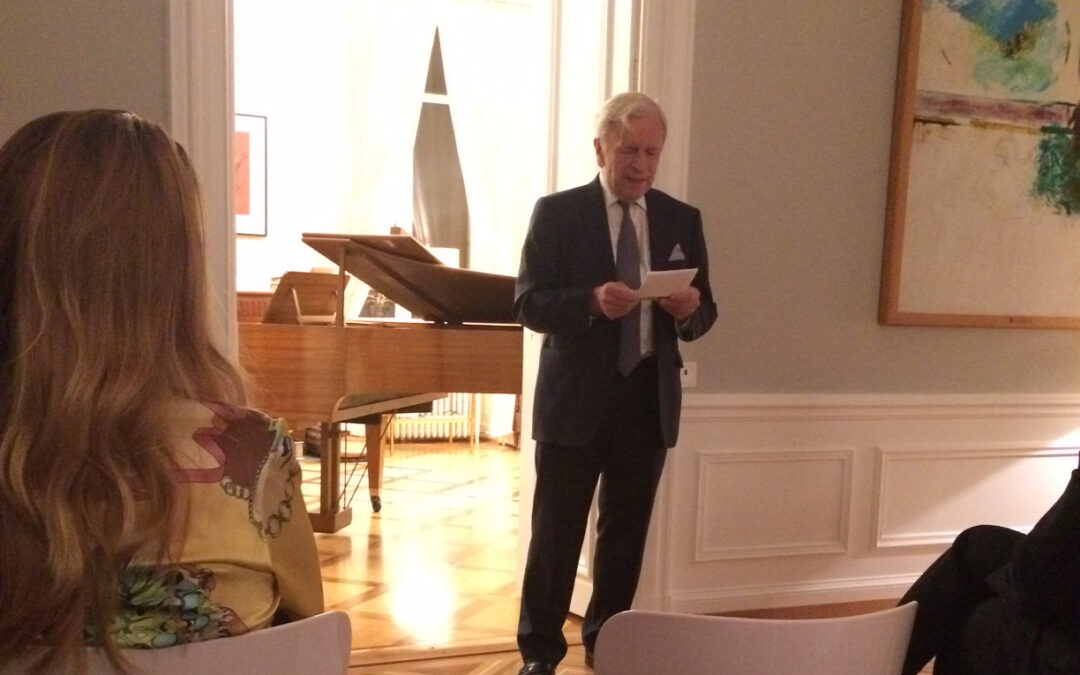
The ICJ started its 60th anniversary in Geneva with an evening gala hosted by Ambassador Julian Braithwaite, at his residence on 18 October 2018. A moving speech by Sir Nicolas Bratza (photo), ICJ Commissioner and Executive Committee member, on the importance of the defence of the rule of law opened the evening.
It was followed by a magnificent concert by Menuhin Academy virtuoso, violinist Vasyl Zatsikha. A magical evening.
The speech of Sir Nicolas Bratza
“I feel very privileged to have been asked to say a few words by way of introduction to the speech of the Secretary General of the ICJ.
May I begin by expressing on behalf of us all the warmest thanks to the British Ambassador for hosting this very special celebration of the 60th anniversary of the ICJ in its home in Geneva.
Anniversaries are always important occasions and never more so than when they mark a milestone in the life of a remarkable organization that has throughout its existence worked tirelessly to safeguard the rule of law and human rights and that has done so, in particular, by protecting and defending the independence of judges and lawyers.
My association with the ICJ has been relatively brief but for many years I have admired its work from afar, as a member of the European Commission of Human Rights for five years and as a judge of the Strasbourg Court, for fourteen.
The Court and the ICJ share the common purpose – to protect the fundamental principles of democracy, the rule of law and human rights.
Without the independent and impartiality of judges, both national and international, those principles would be meaningless and might as well have been written on water.
With the alarming growth of populism in countries across the world, the threats to the independence of the judiciary are regrettably as real today as they have been at any time.
In the international Court of which I was a member, judges are nominated by the States from which they are drawn.
But they are in no sense representatives of those States and are not infrequently faced with having to decide cases, sometimes cases of acute sensitivity, against their own countries.
The pressures on judges of the Court are often intense and there are notorious examples where the courage shown by a judge in maintaining his or her rigorous independence has come at a cost, the judge being punished by not being renominated by the State, by returning to the country at the end of their mandate without employment or means of livelihood, or by being unable to return safely to their home at all.
But if the position of the international judge is difficult enough, that of the national judge in certain States, including member States of the Council of Europe, is far worse, their independence and security, both physical and professional, being under constant threat.
In the 1990s and in the early years of this century, the signs were promising. One was able to witness a slow but steady improvement in adherence to the rule of law on the part of new democracies.
This was in no small measure due to the work of organizations such as the ICJ which, through its writings, seminars and training of judges and lawyers worldwide, did so much to strengthen and support judicial independence and to expose the most flagrant examples of abuse and undermining of that independence.
I regret to say that in more recent years the landscape has become much darker, with open and insidious attacks on members of the judiciary, the arbitrary removal of judges from their posts and measures taken to curtail the powers of judges and courts or to undermine their authority and independence.
In my official visits to member States as President of the Strasbourg Court, I met several judges who voiced their deep concern about the steps being taken both by the legislature and the executive to compromise their independence and to diminish their authority. It is not only in the new democracies that such a phenomenon has become apparent.
There has been a growing trend in many parts of Europe to undermine the standing and authority of the judiciary by outspoken attacks on judges for unpopular decisions, by members of the executive, by parliamentarians and by the media.
It is these challenges to judicial independence and to the rule of law that make the role of the ICJ and the continued support of the diplomatic community not only more relevant but more vital than they have ever been.
It is with pride and pleasure that I wish the ICJ a very happy anniversary on this its first 60 years of life in this great city.
But I combine this with a fervent hope that, with the support of us all, the ICJ is able to continue its extraordinary work for the next 60 years and far beyond. The protection of the rule of law and human rights depend on it.”