Apr 11, 2019 | Advocacy
Today the ICJ joined twenty organizations in calling for Myanmar’s new Constitutional Amendment Committee to fully protect the right to freedom of expression in the Constitution, in line with international law and standards including Article 19 of the International Covenant on Civil and Political Rights.
The statement reads:
“20 expert organisations urge Myanmar to fully guarantee the internationally protected right to freedom of expression in the Constitution
11 April 2019 — A new parliamentary committee tasked with reviewing Myanmar’s constitution is an opportunity for the government to guarantee the democratic rights to free expression, media freedom, and access to information.
We welcome the government’s creation of the Constitutional Amendment Committee, established to review and propose amendments that will support Myanmar’s transition to democracy.
Myanmar’s 2008 Constitution does not include the guarantees required in a democracy to protect freedom of expression. Those that it does include do not meet relevant international human rights standards. This threatens the transition to and quality of Myanmar’s democracy as can be seen for example in the wide range of laws used to prosecute journalists and human rights defenders.
We call on the Constitutional Amendment Committee to recommend:
- Replacement of the current heavily prescribed guarantee for freedom of expression in Articles 354(a) and 365 with a single article that guarantees the right to freedom of expression in accordance with international standards, so that it fully reflects the requirements of Article 19 of the International Covenant on Civil and Political Rights.
- A new separate article guaranteeing the right to access information held by public authorities.
- A new separate article guaranteeing media freedom, which should prohibit prior censorship of the media or licensing of the print media and individual journalists, and should protect journalism as well as the independence of the Myanmar Press Council, Myanmar Broadcasting Council, and any future public service media.
- Each guarantee should include only those limitations that are provided by law and are necessary for the respect of the rights or reputations of others, or for the protection of national security or of public order, or of public health or morals.
We are committed to supporting Myanmar’s transition to democracy and would be happy to provide further information and guidance as the Committee conducts its review.”
Signed by 20 organizations with the support of 13 other organizations.
Full statement and list of organizations available in English and Burmese here: Myanmar-Joint Statement on FoE and Const Ref-Advocacy-2019-BUR

Apr 4, 2019 | News
Today, the ICJ urged Singapore’s Parliament not to pass the Protection from Online Falsehoods and Manipulation Bill 2019 (‘Online Falsehoods Bill’), which was tabled on Monday, 1 April.
The ICJ said that the bill, if passed into law, would result in far-reaching limitations on freedom of expression, opinion and information in Singapore, and could be wielded to curtail important discussion of matters of public interest, including content critical of the government.
“This bill, if passed, would make the government the sole arbiter of what information is permissible online and what is not, creating a real risk that the law will be misused to clamp down on opinions or information critical of the government,” said Frederick Rawski, ICJ Director for Asia and the Pacific.
The bill authorizes ministers to direct individuals, owners or operators of online platforms, digital advertising and internet intermediaries to remove, make corrections to, disable or block access to a “false statement of fact”, if such action is deemed to be “in the public interest”. Such ministerial directions can be made even if a false statement “has been amended or has ceased to be communicated in Singapore”.
The bill does not provide any real definition of “false statement of fact” and does not clarify what constitutes “public interest”. The bill also fails to provide for exceptions or defences such as honest mistake, parody, artistic merit, or public interest. Executive discretion is also not subject to judicial review or oversight under its provisions.
Criminal penalties for non-compliance with the law are severe, and include hefty fines and up to ten years’ imprisonment for violations.
These may be imposed on individuals and/or owners or operators of online platforms, as well as intermediaries who facilitate the communication of such statements, including social networking services, search engine services, internet-based messaging services and video-sharing services.
The bill is also clear that communications through SMS (Short Message Service) and MMS (Multimedia Messaging Service) fall under its remit.
“The spread of misinformation online is a complex problem that cannot be effectively addressed by simply granting broad discretion to government officials to censor online expression,” said Rawski.
“A multi-pronged approach that protects the rights to free expression, opinion and information is required, beginning with better media literacy education and free access to information, including to opinions critical of the government,” he added.
Contact
Frederick Rawski, ICJ Asia Pacific Regional Director (Bangkok), e: frederick.rawski(a)icj.org
Singapore-fake news bill-News-web story-2019-ENG (full story with additional information, in PDF)
Mar 28, 2019 | Events, News
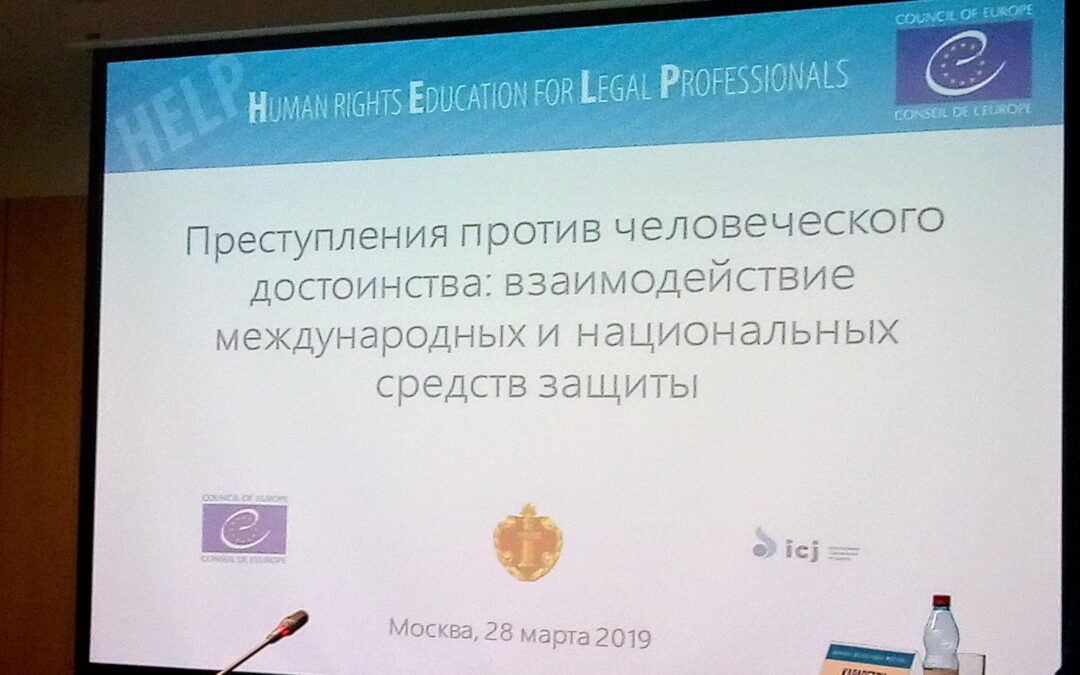
The ICJ is co-operating in a conference organized by the Council of Europe and the Federal Bar Association of Russia on “Crimes against Human Dignity: Interaction of International and National Remedies”, which will take place today, 28 March 2019 in Moscow.
The Conference will address crimes that affect physical and moral integrity of a person, notably through ill- treatment, domestic violence, trafficking in human beings and other forms of modern slavery. The core provisions of the European Convention on Human Rights and the related case-law of the European Court of Human Rights are of particular relevance in combatting these phenomena. The Conference will address national and international remedies against such crimes and serve for exchange of good legal practices in that regard.
Mikhail Lobov, Head of Human Rights Policy and Co-operation Department of the Council of Europe, Yuriy Pilipenko, President of the Federal Bar Association, Denis Novak, Vice-Minister of Justice of the Russian Federation, Radmila Dragichevich Dichich, Vice-President of the International Commission of Jurists, Judge of the Supreme Court of Serbia, Ilya Subbotin, Deputy Director of the Depratment of Paneuropean Co-operation of the Russian Foreign Ministry and Petr Sich, Head of Council of Europe Programme Office in the Russian Federation will open the Conference.
The Conference will give an overview of identification and qualification of crimes against human dignity, as well as of assessment of evidence and investigation of such violations. Special attention will be paid to such questions as professional training of practicing lawyers as a factor of strengthening of remedies’ efficiency and, in more general terms, the role of advocates in the framework of the Council of Europe conventions.
The event will take place on 28 March 2019 at 09.30 a.m., in Moscow, Hotel “Azimut Smolenskaya”, Smolenskaya street, 8.
The agenda for the conference is available here
Feb 13, 2019 | Advocacy, Non-legal submissions
The ICJ has opened a call for written submissions on the misuse of criminal law in the areas of sexuality, reproduction, drug use and HIV.
In 2016 the UN Secretary General called for the removal of punitive laws, policies and practices that violate human rights, stating that the misuse of criminal law often negatively impacts on health and human rights, particularly in areas of sexuality, reproduction, sex work, drug use and HIV.
Recognizing a need for greater guidance to achieve such law reform, ICJ is seeking inputs for the development of principles to address the detrimental impact on health, equality and human rights of criminalization with a focus on sexuality, reproduction, drug use and HIV.
This is an important opportunity for civil society, academics, law makers, human rights experts, community groups and persons affected by the relevant criminal laws, to provide input, including on the effect of such criminal laws, when and how criminal law should be used, what reforms are needed and what role criminal law should play in the relevant areas.
A background paper providing further information is annexed to the call for written submissions.
The deadline for submissions is the 31st of March 2019.
These submissions will feed into the development of a set of principles to address the detrimental impact on health, equality and human rights of criminalization with a focus on select conduct in the areas of sexuality, reproduction, drug use and HIV.
Please send your submissions, as well as any questions or clarifications, to decrimconsultation@icj.org
CallforSubmission-DecriminalizationProject-ICJ-2019-2-eng (download the call in English)
CallforSubmission-DecriminalizationProject-ICJ-2019-2-fra (download the call in French)
CallforSubmission-DecriminalizationProject-ICJ-2019-2-esp (download the call in Spanish)
CallforSubmission-DecriminalizationProject-ICJ-2019-2-rus (download the call in Russian)
Jan 25, 2019 | Advocacy, Legal submissions
Today, the ICJ and Lawyers Rights Watch Canada (LRWC) submitted a joint amicus curiae in criminal defamation proceedings against human rights defenders Nan Win and Sutharee Wannasiri for bringing to light alleged labor rights violations at Thammakaset Company Limited.
The defamation charges relate to a 107-second film, produced by the non-governmental organization Fortify Rights, which documents previous defamation complaints brought by Thammakaset against 14 of its former migrant workers from Myanmar.
Nan Win was one of the migrant workers featured in the film. Sutharee Wannasiri, former Human Rights Specialist with Fortify Rights, was charged in connection with making three Twitter posts relating to the film.
The brief aims to clarify the nature and scope of Thailand’s international legal obligations relating to the right to freedom of expression and points out that the imposition of harsh penalties such as imprisonment or large fines on a human rights defender risks having a ‘chilling effect’ on the exercise of freedom of expression, which Thailand is bound to protect pursuant to its international legal obligations.
The preliminary examinations of Nan Win and Sutharee Wannasiri will begin on 4 February and 11 March 2019, respectively.
During the preliminary examination hearing, is the Court will consider the case before it to determine if it is a prima facie case.
The preliminary examination hearing is a mandatory proceeding in matters involving prosecution claims brought by private individuals or entities, such as in the case of Nan Win and Sutharee Wannasiri.
If the preliminary examination finds that the cases are prima facie, the court will admit to trial only the charges relating to the counts deemed prima facie.
If the court finds no prima facie case, it can rule that the charges be dismissed.
Read also:
Thailand: Drop defamation complaints against human rights defenders Nan Win and Sutharee Wannasiri (3 December 2018)
Download:
Thailand-Nan Win Kratik_Amicus-Advocacy-legal submission-2019-ENG (full amicus in PDF, English)
Thailand-Nan Win Kratik_Amicus-Advocacy-legal submission-2019-THA (full amicus in PDF, Thai)