Oct 23, 2018 | Multimedia items, News, Video clips
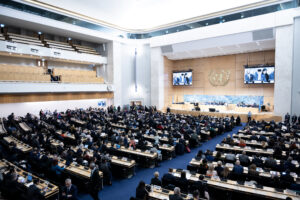
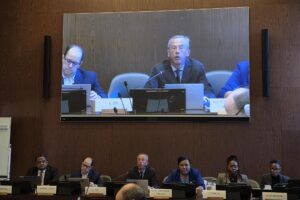
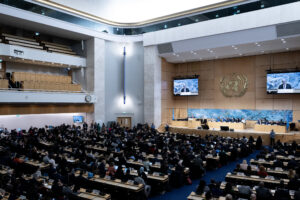
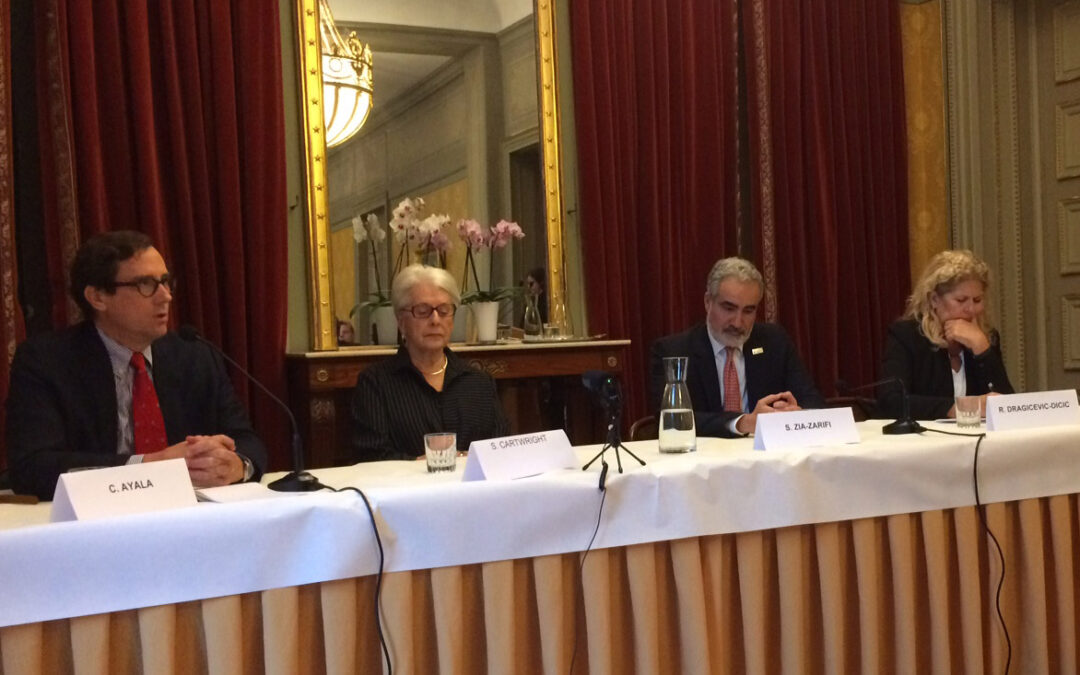
At an event at the city’s Palais Eynard, prominent ICJ Commissioners discussed the supremacy of the Rule of Law and also why it is important to be in Geneva. Watch the video.
The Executive Committee (ExCo), representing the whole Commission of Jurists, participated in the event.
Sam Zarifi, ICJ Secretary General, opened the event by reiterating the importance for the ICJ to be headquartered in Geneva, not only for the UN and international community but also for the city’s and canton’s legal and human rights community.
“It is absolutely clear that we live at a moment in the world when lawyers, judges, jurists are under attack and it is important for the legal community across the world, regardless of borders, regardless of languages, regardless of legal systems, to come together to defend the notion of the rule of law and defend the security and well-being of lawyers and jurists around the world.”
Carlos Ayala, ICJ’s Vice-President, said the ICJ was a unique organization working in the field of the Rule of Law, not as an isolated notion but within the framework of Human Rights and democracy.
He explained how the ICJ is structured and working around the world and insisted on the impact the ICJ is having through its activities.
He said that the organization’s legal outputs were used to have an impact on the overall human rights situations, cases, court decisions, and in training judges, lawyers, prosecutors and others.
Radmila Dragicevic-Dicic, also ICJ’s Vice-President, insisted on how it is important to share experiences about human rights issues and finding solutions to protect different rights.
She gave her personal example of being a judge in former Yugoslavia and Serbia to show how with tenacity and courage one can help establish an independent judiciary even in some of the hardest situations.
She testified how she was helped by the ICJ and Switzerland in her fight for justice.
“If you fight for independence of judges and lawyers in your country, you fight for judges and lawyers everywhere,” she added.
Dame Silvia Cartwright, ICJ Commissioner and ExCo member from New Zealand, was the first woman appointed to the High Court in New Zealand and she was also Governor General of New Zealand.
She said that she was privileged to come from a country that has always promoted and protected the Rule of Law but that unfortunately many recent examples showed that this endorsement could change overnight.
Very active in the fight for women’s rights she said how through her professional work she realized the terrible impact that the Khmer Rouge’s regime in Cambodia and civil war in Sri Lanka had on women.
“Generally speaking I’m quite pessimistic because I think we have reached another stage of the cycle that seems to occur every couple of generations where we are heading towards a more fascist world. So this is the time when human rights must be protected when we must fight to maintain the norms we have struggled for so long,” she said.
Watch the full event here:
https://www.facebook.com/ridhglobal/videos/335212527229422/
Oct 23, 2018 | News
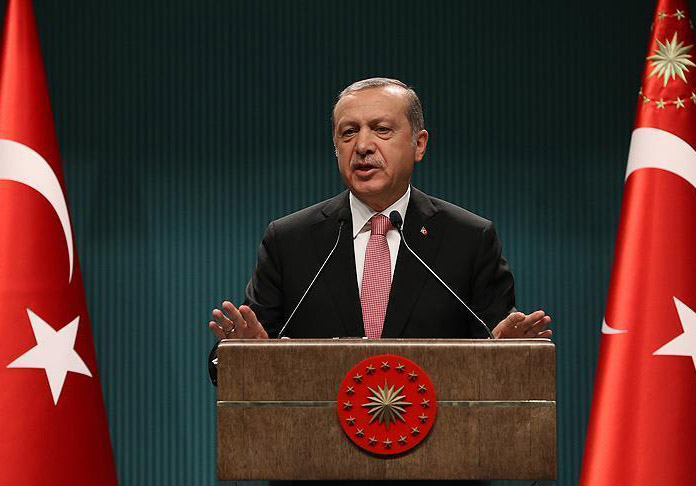
In light of new information released by Turkish President Recep Tayyip Erdogan about the apparent murder of prominent Saudi journalist Jamal Khashoggi, the Turkish government should seek cooperation from independent and impartial international investigators into the apparent extrajudicial killing of prominent Saudi journalist Jamal Khashoggi in the Saudi Arabian Consulate in Istanbul, the ICJ urged today.
Turkish President Recep Tayyib Erdogan today told the Turkish Parliament that investigations suggested that Saudi officials had planned to kill Khashoggi and he called for all those responsible for the killing to be punished regardless of rank.
“Given the highly political nature of this case and its emblematic impact for journalists and dissidents around the world, Turkey should work with the United Nations to establish a special independent mechanism to carry out the investigation with a view to identifying the perpetrators and prescribing recommendations for appropriate accountability measures,” said Said Benarbia, ICJ’s MENA Programme Director.
“Alternatively, the investigation should be conducted by competent Turkish authorities, given that Turkey already has jurisdiction and an obligation to carry out an investigation,” he added.
Investigations by Turkey to date suggest that the crime was planned, at least in part, in Saudi Arabia, and that perpetrators, evidence and witnesses are located in at least two countries.
Turkish Foreign Minister, Mevlut Cavusoglu, stated today that Turkey is ready to cooperate with an international investigation into Jamal Khashoggi’s death.
“Given the gravity of the crime and the fact that evidence and perpetrators are located outside Turkey, Saudi Arabia and other States should cooperate with an international investigation and waive any diplomatic protections and immunities that may apply to State officials and premises. They should also hand over all forensic, video, audio and other evidence, facilitate investigators’ access to State territory and witnesses, including State officials, and provide the necessary support to locate, retrieve and identify other evidence such as human remains and trace evidence and to carry out an autopsy on Khashoggi’s remains,” Benarbia said.
The ICJ dismissed statements by Saudi Arabia that it would carry out an independent, impartial investigation of the apparent murder.
On 20 October 2018, after initially denying any involvement in Jamal Khashoggi’s enforced disappearance, the Saudi Ministry of Foreign Affairs issued a statement claiming Khashoggi died when a “fight broke out” in discussions with Saudi officials at the consulate.
“Saudi Arabia has provided no evidence to support its incredible claim two weeks on that Jamal Khashoggi died after a fight broke out. Their investigation into his death lacks transparency and independence. Given Saudi Arabia’s past record in countenancing complete impunity for officials involved in serious human rights violations, it is reasonable to expect that this investigation and will result in a cover-up in which those most responsible avoid accountability,” Benarbia added.
Saudi Arabia’s repeated denials that it had any knowledge of the fate of Khashoggi, followed by its claims that “rogue” State operatives were responsible for his death, indicate that any Turkish investigation will be unlikely to elicit any meaningful cooperation from Saudi authorities.
“The denials, obfuscation and scapegoating by Saudi Arabia reveals a contempt for human rights that’s indicative of its modus operandi,” Benarbia said.
“Saudi authorities have repeatedly failed to carry out independent and impartial investigations into allegations that State officials have engaged in widespread arbitrary arrested and detention, torture and other ill-treatment and enforced disappearances, including of journalists, human rights defenders and critics of the government. Since Crown Prince Mohammad bin Salman was appointed in June 2017, repression of the exercise of human rights for political reasons has increased. Those convicted for exercising their lawful rights to freedom of expression, assembly and association face lengthy prison terms or the death penalty, after trials marred by fair trial rights violations,” he added.
Saudi Arabia-Khashoggi intl investigation-News-press releases-2018-ENG (full story with additional background, in PDF)
Oct 21, 2018 | News
On 21 October, the ICJ, together with Cross Cultural Foundation (CrCF), organized a lawyers’ meeting in Bangkok on the admissibility of evidence in the context of application of special security laws in Thailand.
Attendees included 30 human rights lawyers, paralegal officers, documentation officers, human rights defenders and journalists from Bangkok and other regions in Thailand.
The objectives of the meeting were:
- To discuss about the challenges that lawyers currently face regarding the admissibility of evidence in criminal proceedings, both in law and in practice, in the context of existing special security laws. These laws include the Martial Law, Emergency Decree, and the Internal Security Act that are applied in the southern border provinces, and certain repressive National Council for Peace and Order (NCPO) Orders that are applied nationwide;
- To discuss how to address the adverse effects on human rights and the administration of justice as a consequence of the implementation of these laws and how lawyers, members of civil society, and other stakeholders, at national and international levels, may work together to address such challenges; and
- To gather recommendations from participants and discuss future advocacy strategies to tackle identified challenges.
The ICJ’s Legal Memorandum on Hearsay Evidence and International Fair Trial Standards was used as one of the main reference materials during the meeting.
A main recommendation of the Workshop, echoed the ICJ’s assessment in the Legal Memorandum, namely that Thailand should review existing standards in all special security laws and relevant articles in the Criminal Procedure Code regarding the admissibility of evidence that are not compatible with international fair trial standards to ensure safeguards required to protect individuals from unfair trials.
Read also
Thailand : legal memorandum – hearsay evidence and international fair trial standards
Oct 5, 2018 | News
2018 marks the 60th anniversary of the ICJ’s move to Geneva thanks to the great Swiss jurist Jean-Flavien Lalive, who was ICJ’s Secretary General in 1958.
This makes the ICJ one of the earliest international organizations to establish its headquarters in Geneva.
At the 1959 ICJ Congress in New Delhi, Dr. Lalive helped breathe new life into the rule of law and human rights.
The Delhi Declaration is, to date, a fundamental instrument interpreting the rule of law as a living concept, and underscoring the primary role of lawyers in its safeguard and in the advancement of human rights.
The ICJ plays a unique and preeminent role as a non-governmental organization seeking to defend human rights and the rule of law worldwide.
The ICJ will mark this event with two major initiatives:
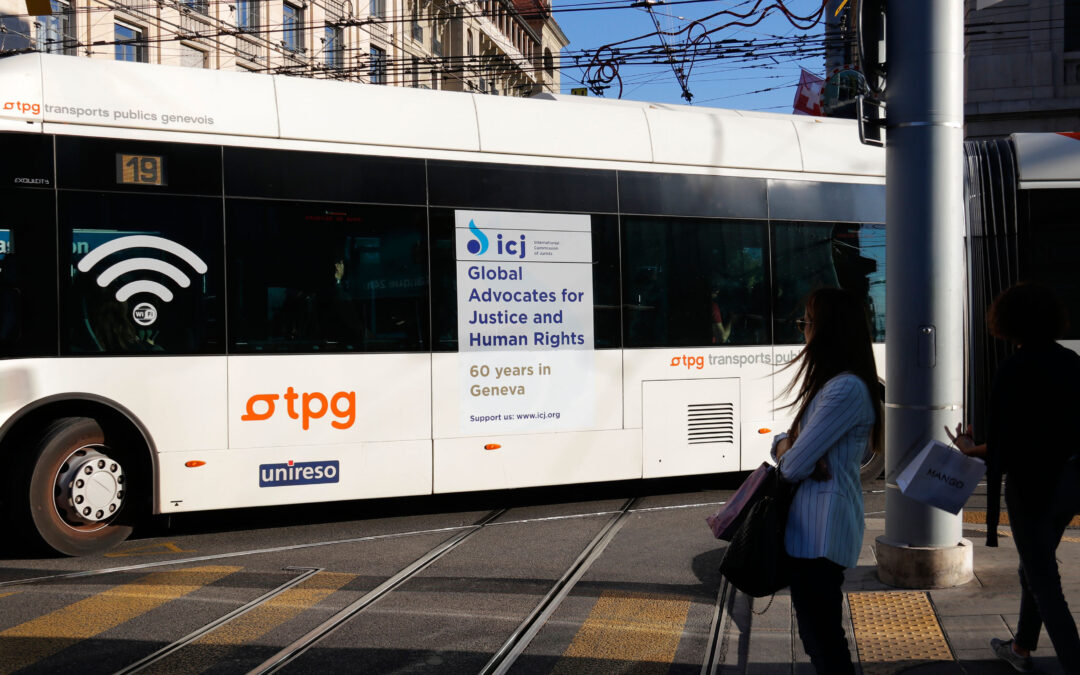
- A visibility campaign from 26th September to 9th October: the TV screens on the Geneva public transport network and five vehicles will carry the slogan “Global Advocates for Justice and Human Rights – 60 years in Geneva”
- The launch of the “60th Anniversary Appeal” to all lawyers in the Republic and canton of Geneva to support the ICJ and, in turn, their less privileged colleagues, victims of persecution on five continents.
“Geneva can be proud of its image as the world human rights capital. It is a beacon for justice advocates around the world. We must continue to make it shine,” said Sam Zarifi, Secretary General of the ICJ.
“Through its 60-year history, the ICJ has contributed significantly to Geneva’s human rights record: the campaigns that led to the creation of the post of UN High Commissioner for Human Rights in 1993 and the UN Human Rights Council in 2006, as well as the adoption of the United Nations Convention against Torture in 1984 are some emblematic examples,” said Olivier Coutau, Head of La Genève Internationale.
“In the face of repeated attacks on human rights, the world needs, more than ever the ICJ’s competent, rigorous and effective defense of the rule of law,” Sam Zarifi added.
The Republic and canton of Geneva support the ICJ 60th Anniversary Appeal.
Additional information
The international reputation of the ICJ rests on these pillars:
- 60 Commissioners – eminent judges and lawyers – from all regions of the world and all legal systems – with unparalleled knowledge of the law and human rights;
- Cooperating with governments committed to improving their human rights performance;
- Effective balance of diplomacy, constructive criticism, capacity building, and if necessary, ‘naming and shaming’;
- Unmatched direct access to national judiciaries, implementing international standards and improved legislation impacting millions;
- Guiding, training and protecting judges and lawyers worldwide to uphold and implement international standards;
- Working for access to justice for victims, survivors and human rights defenders, in particular from marginalized communities;
- Following a strict result based management in project delivery.
In recognition of this effective approach, the ICJ has been awarded, during its long history, some of the most prestigious international awards: the Council of Europe Human Rights Prize, the United Nations Award for Human Rights, Erasmus Prize, Carnegie Foundation Wateler Peace Prize.
In 2018, the ICJ provided local trainings on five continents to assist 4,300 judges, lawyers and prosecutors strengthen their ability to protect and promote fundamental rights.
The ICJ has consultative status with the United Nations Economic and Social Council, UNESCO, the Council of Europe and the African Union.
Contact :
Michaël W. Sombart, Director Philanthropy & Strategic Partnerships, t: +41 22 979 38 31 ; m: +41 77 965 98 45 ; e: michael.sombart(a)icj.org
Sep 21, 2018 | Advocacy, News, Non-legal submissions
The ICJ wrote today to the Council of Europe’s Commissioner for Human Rights, Dunja Mijatović, to request action against the decision by Turkish authorities to ban entrance to Galatasaray square in Istanbul (Turkey) to a collective of mothers of disappeared persons called “Saturday Mothers”.
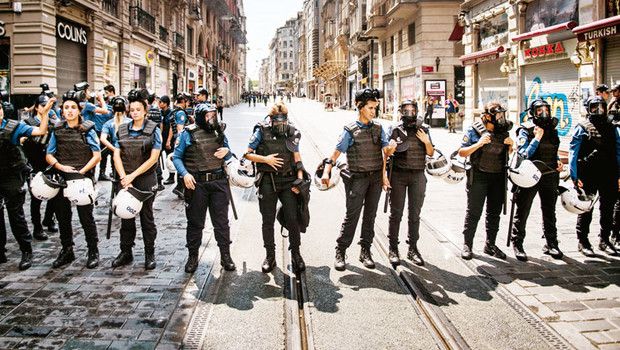
On 25 August 2018 , the Sub-Governorship of Beyoğlu District of İstanbul announced the prohibition of gatherings for assembly of any type of demonstrations in Galatasaray Square in Istanbul, the square where the Saturday Mothers have gathered every Saturday since 1995 to 1998 and since 2009 until 2018.
On the 700th week of their peaceful protests, the Saturday Mothers and their supporters congregated in Galatasaray Square at midday to once again raise awareness of the need for those responsible to be held accountable for the extrajudicial killings and enforced disappearances following their time in State custody in the 1990s. The police used tear gas to stop the protest and arrested 47 people. All were released by Saturday evening.
Senior officers of the Turkish authorities have even issued statements accusing the Saturday Mothers of being abused by or in collusion with terrorist organisations.
The ICJ wrote to the European Commissioner for Human Rights, that it “considers this situation to be at odds with Turkey’s obligations under international human rights law, in particular of the right to peaceful assembly under article 11 of the European Convention on Human Rights and article 21 of the International Covenant on Civil and Political Rights.”
The ICJ further added that “given the consistent record and presence of the Saturday Mothers in Galatasaray Square throughout the years, it is hard to see how the restriction on their right to peaceful assembly could in any way be necessary and proportionate to a legitimate purpose. It is clear that no prior warning for the gathering was needed for security reasons in light of its regular occurrence at least since its resumption in 2009, i.e. nine years ago. Furthermore, the demonstration took place on a pedestrian area where cars are not allowed.”
ICJ-Letter-SaturdayMothers-CoEComm-Turkey-2018-ENG (download the letter)