
Venezuela: Introduction
Venezuela is a party to many international and regional human rights treaties. However, in September 2012 Venezuela gave notice of its denunciation of the American Convention on Human Rights, effective from 10 September 2013. Judicial independence is enshrined in the...
Venezuela
Venezuela is a party to many international and regional human rights treaties. However, in September 2012 Venezuela gave notice of its denunciation of the American Convention on Human Rights, effective from 10 September 2013. Judicial independence is enshrined in the...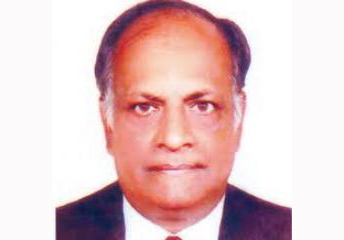
ICJ urges Bangladesh to act on long-overdue investigation into alleged attacks on lawyer
Bangladesh must immediately launch a thorough investigation into alleged attacks on a prominent human rights lawyer, the ICJ said today. The government appears to have taken no real action in the year since the events.
Rabindra Ghosh (photo), advocate at the Supreme Court of Bangladesh and President of the non-governmental organization Bangladesh Minority Watch, has made credible allegations that he was subjected to acts of violence, intimidation and other interference with his functioning as a lawyer.
”The authorities in Bangladesh seem not to have taken Rabindra Ghosh’s allegations seriously, in breach of international standards,” said Matt Pollard, head of ICJ’s Centre for the Independence of Judges and Lawyers. “In addition to his complaints, our own letters to the authorities simply went unanswered.”
Rabindra Ghosh, among other incidents, alleges that he was physically attacked by six of his peers on 25 November 2013, while he was at work in the Gopalgonj District Court.
He further alleges that on 14 January 2014 he was subjected to physical violence, threats, and verbal abuse at the hands of police officers.
He reports that there has been no substantive investigation of his complaints and that he has received no response from the responsible authorities.
“Lawyers play an essential role in protecting human rights and the proper administration of justice,” Pollard added. “International standards require State authorities to prevent attacks and harassment of lawyers and to take effective measures to protect their security.”
The ICJ requested the Prime Minister, the Ministry of Law, Justice and Parliamentary Affairs, the Ministry of Home Affairs and the President of the Bar Association to provide further information and a response to these allegations, but has received no response.
In addition to its call on the authorities of Bangladesh to immediately launch a thorough and independent investigation of the allegations made by Rabindra Ghosh, the ICJ calls on the authorities to take concrete measures to ensure that he and other lawyers are able to discharge their professional duties without any interference or intimidation of any kind. If the investigation confirms the allegations, those responsible must be held accountable.
“The ICJ has observed a general erosion of the rule of law and respect for the ability of lawyers to carry out their duties in Bangladesh,” said Pollard. “Lawyers play a crucial role in ensuring that people whose rights have been violated can demand their right to a remedy. When lawyers themselves become victims simply for carrying out their work, it signals a serious problem for the legal system.”
Rabindra Ghosh’s allegations come against the backdrop of a series of recent attacks on human rights defenders in Bangladesh, including among others the harassment of human rights defenders including Adilur Rahman Khan, secretary of Odhikar; the promulgation of a constitutional amendment that empowers the Parliament to impeach Supreme Court judges; and the amendment of the Information and Communication Technology Act, which is being used to assault freedom of expression and freedom from arbitrary detention.
Contact:
Matt Pollard, ICJ Senior Legal Adviser, +41 22 979 3812, matt.pollard(a)icj.org
A brief background note on the case is available here in PDF:

Bulgaria: ICJ observer at Todorova appeal hearing
A trial observer from the ICJ Centre for the Independence of Judges and Lawyers will observe today the hearing of an appeal of disciplinary sanctions imposed on Bulgarian judge Miroslava Todorova.
The proceedings against Judge Todorova related to alleged faults associated with delays in delivering judgment in several cases. The alleged faults occured some nine years ago.
In an initial ruling in July 2012, the Supreme Judicial Council (SJC) sought to dismiss Judge Todorova from judicial service. Following judicial reviews and appeals, this was reduced at first to demotion for a period of two years, and then subsequently was reduced further to demotion for a period of one year. Both Judge Todorova and the disciplinary authority are challenging the one-year sanction in today’s hearing at the Supreme Administrative Council (SAC).
Whereas she had previously served on the Sofia City Court, during this two-year period she is permitted to work only in the lower level Sofia District Court. According to Bulgarian law, demotion is the second-most serious disciplinary sanction for a judge, one step less serious than dismissal.
ICJ has previously expressed concerns that the proceedings and sanctions against Judge Todorova may not be compatible with international standards for independence of the judiciary.
The proceedings today will also be attended by observers from Judges for Judges and MEDEL.
Recent News
 Rule of Law Under Strain in Eswatini: A Submission on Judicial Independence and Civic Space13 Apr 2026
 Tunisia: Quash sham conviction and sentence of judges’ association President, Anas Hmedi06 Apr 2026
 The UN Human Rights Council makes significant but limited progress in addressing human rights around the world, as atrocities multiply in the Middle East and elsewhere02 Apr 2026
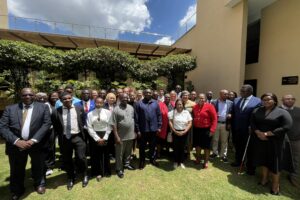 ICJ hosts an African Regional Convening in Kenya on Transformative Equality Jurisprudence31 Mar 2026