

Swaziland: ICJ concerned at detention of human rights lawyer and journalist
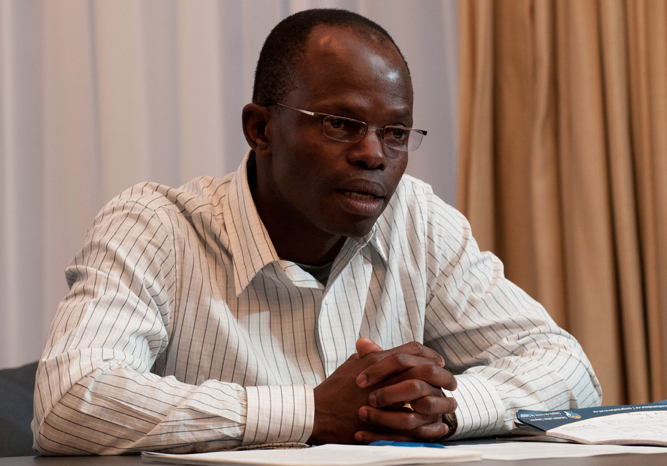
The ICJ today condemned the arrest and detention on 17 March of prominent human rights lawyer, Thulani Maseko and Nation Magazine editor, Bheki Makhubu.
The ICJ is concerned that Thulani Maseko is being subject to persecution for the legitimate exercise of his professional functions as a lawyer, and that both men appear to be detained for exercising their right to freedom of expression.
The men were arrested after Chief Justice Ramodibedi had issued a warrant for their arrest on charges of “scandalizing the judiciary” and contempt of court.
The charges arise from articles allegedly written by Thulani Maseko and Bheki Makhubu in February and March 2014, in which they questioned circumstances surrounding the arrest of government vehicle inspector, Vincent Gwebu.
The vehicle inspector had been arrested and charged with contempt of court after he had arrested the driver of a High Court Judge.
Thulani Maseko and Makhubu, were jointly charged on 18 March 2014 and remanded to appear on 24 March for a bail hearing.
Their lawyer was not allowed to appear on their behalf, in contravention of international and African regional law and standards guaranteeing the right to be represented by a lawyer in legal proceedings.
The ICJ is also concerned that the accused did not appear in open court, but instead in the Chief Justice’s chamber and were not allowed to apply immediately for bail, also in contravention of international and African regional standards.
The ICJ calls upon the Swazi immediately to release the two men. For as long as they are in detention they must be given access to their lawyers.
For further information contact:
Arnold Tsunga, Arnold.tsunga(a)icj.org, Director, ICJ Africa Regional Programme
Or
Martin Okumu-Masiga, Martin.okumu-masiga(a)icj.org, Deputy Director.
Myanmar: Independence of the legal profession
In order for legal assistance to be effective, it must be carried out independently.{{88}} To this end, international law establishes safeguards aimed at ensuring the independence of the individual lawyer, as well as the profession as a whole. The UN Basic Principles...
Myanmar: Financial independence of the judiciary
At the institutional level, international standards make clear that it is the duty of the State to provide adequate resources to enable the judiciary to properly perform its functions.{{52}} As a safeguard of judicial independence, the courts’ budget shall be prepared...
Myanmar: Appointment and promotion of judges; Security of tenure
To safeguard the independence of the judiciary and the rights to equality before the law and equal access to the profession, international standards clarify that judges should be appointed though an open process on the basis of prescribed criteria based on merit and...Recent News
 More than fifty years on: enforced disappearance, the families who named it, and the reframing of international protection26 Aug 2026
 Türkiye: Osman Kavala must be immediately released following European Court order to quash his conviction25 Aug 2026
 Sudan: ICJ joins call to extend UN Fact-Finding Mission and strengthen accountability21 Aug 2026
 ICJ hosts Johannesburg roundtable on the draft Crimes Against Humanity Treaty with the Malala Fund and other civil society actors17 Aug 2026