
Oct 5, 2013 | News
During a one-week mission that concluded on 4 October, the ICJ received information on the tense situation faced by the Supreme Court’s Constitutional Chamber, whose independence has been subjected to political influence for more than a year.
The ICJ is concerned about a complaint filed with the Legislative Assembly which requests a provisional judgment against four judges of the Constitutional Chamber for alleged prevarication, abuse of power and disobedience. This could result in their removal from the Court.
The ICJ wishes to reiterate that, in accordance with international standards, the judiciary must be protected from any restrictions, improper influences, inducements, pressures, threats or interferences, direct or indirect, including from legislative or executive authorities.
The mission, led by a high-level ICJ delegation that included ICJ Commissioners Justice Philippe Texier and Professor Rodrigo Uprimny, focused on access to justice and legal remedies for victims of violations of economic, social and cultural rights.
It engaged in discussions with members of the legal profession, civil society and various authorities including the public prosecutor office (the Procuradoria General de la Republica and the Procuradoria para la Defensa de los Derechos Humanos), as well as with the Constitutional Chamber.
Oct 4, 2013 | News
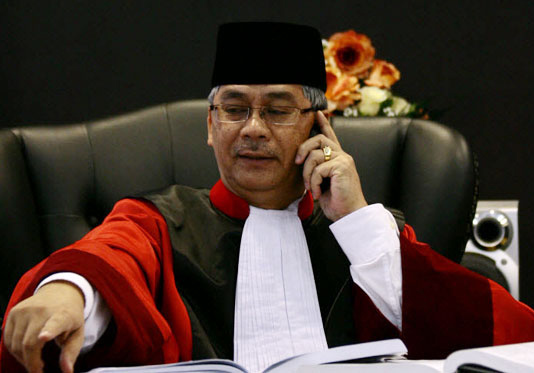
The ICJ is calling on the Indonesian authorities to ensure that the proceedings against Justice Akil Mochtar fully comply with international law and standards on fair trial and the independence and impartiality of the judiciary.
Justice Mochtar, Chief Justice of Indonesia’s Constitutional Court (photo), is accused of taking a bribe to issue a favourable verdict in an election dispute.
Justice Mochtar was arrested on 2 October 2013 and remains in custody. According to a spokesperson for the Corruption Eradication Commission, he is alleged to have received a bribe, through several intermediaries, from Hambit Binti, a district chief whose re-election was contested.
The Constitutional Court has sole jurisdiction over disputes contesting the conduct or results of elections.
The ICJ calls for a prompt, thorough and impartial investigation of these serious allegations.
The impartiality of the judiciary is an essential condition for respect for the rule of law, and is undermined when judicial decisions are made on the basis of financial inducements rather than solely according to evidence and the law.
Integrity is vital to the proper discharge of judicial office, and any judge must ensure that his or her conduct is above reproach, maintaining and enhancing the confidence of the public in the impartiality of both the individual judge and the judiciary as a whole.
According to the Beijing Statement of Principles on Independence of the Judiciary in the LAWASIA Region, signed by 32 judicial heads of Asia Pacific States, including the Chief Justice of Indonesia, “Judges shall uphold the integrity and independence of the judiciary by avoiding impropriety and the appearance of impropriety in all their activities.”
At the same time, the ICJ stresses that any eventual criminal or disciplinary proceedings, should those be warranted, must respect the independence of the judiciary and Justice Mochtar’s right to a fair trial.
Judges charged with a criminal offence, like all other persons, have the right to a fair trial by a competent, independent and impartial tribunal established by law.
The right to a fair trial in criminal cases as recognized in Indonesia and under international law and standards, including Article 14(3) of the International Covenant on Civil and Political Rights, comprises a series of procedural and substantive safeguards that must be respected during the pre-trial and trial phases.
Contact
Sam Zarifi, ICJ Asia-Pacific Regional Director, Bangkok, tel. no. +66 8078 19002 or sam.zarifi(a)icj.org
Laurens Hueting, ICJ Associate Legal Adviser (International Law and Protection Programme), Geneva, tel. no. +41 22 979 3848 or laurens.hueting(a)icj.org

Oct 4, 2013 | News, Publications, Reports, Trial observation reports
In a report published today, the ICJ details a catalogue of violations of fair trial rights and other serious human rights violations committed against those detained in the context of the UAE 94 trial.
The report, Mass convictions following an unfair trial: The UAE 94 case, comes amidst a crackdown on individuals calling for peaceful political reform, who continue to be arrested, detained, prosecuted and convicted for the lawful exercise of their rights to freedom of expression, association and assembly.
The UAE authorities must end this crackdown and ensure the immediate and unconditional release of those convicted in the UAE 94 trial, the ICJ says.
“The UAE 94 trial has been marred with a litany of violations of fair trial rights. The convictions of 69 individuals following this trial must be quashed and those imprisoned must be immediately and unconditionally released”, said Said Benarbia, senior legal adviser of the ICJ Middle East and North Africa Programme.
Those convicted on 2 July 2013 were found guilty of “establishing, founding and administering an organization, with the aim of challenging the basic principles upon which the government of the State is based, taking control of the government and establishing a secret structure for the organization”.
Fifty-six of them were sentenced to ten years’ imprisonment, five of them to seven years’ imprisonment and eight others, who were tried in absentia, to fifteen years’ imprisonment. The remaining 25 accused were acquitted.
The ICJ notes that, since 31 July 2013, many of the prisoners convicted in the UAE 94 case have begun a hunger strike to protest against the conditions of their detention.
They have reportedly been subjected to various forms of ill-treatment, including beatings by prison guards and light depravation.
The authorities have failed to investigate the many human rights abuses alleged to have been committed against those detained in the context of the UAE 94 case, the ICJ says.
Instead, the UAE authorities have continued their crackdown on political activists and government critics, including those that have publicly spoken out in support of the UAE 94 or against the conditions of detention of those imprisoned.
“Rather than live up to the commitment made by the UAE to the Human Rights Council to “place human rights at the top of its priorities”, the UAE authorities have embarked on a sustained campaign to suppress any form of peaceful dissent and all calls for political reform,” Benarbia added. “They must comply with their obligations under international law and bring an end to this cycle of arbitrary arrest, detention, prosecution and unfair trials against of all those that dare to speak out.”
Key findings of the report:
- Most of the detainees were not informed of the reasons for their arrest and promptly notified of the charges against them.
- They were denied their right to prompt access to a lawyer, including during interrogation and were not brought before a judge or a judicial authority within 48 hours of their arrest.
- Most of the detainees were held in incommunicado detention and in secret and unofficial detention centres.
- They were also held in prolonged solitary confinement, which in some cases lasted more than 236 days.
- Most of the detainees were reportedly subjected to torture or other ill treatment by the authorities, including severe beatings, pulling out detainees’ hair, sleep deprivation, exposure to extreme light during the day and night, death threats and other threats and verbal abuse, as well as prolonged incommunicado detention and solitary confinement.
- The Court failed to investigate or order the investigation of such allegations.
- To the contrary, statements and “confessions” alleged to have been obtained as a result of torture or other ill-treatment were admitted as evidence by the court.
Contact :
Said Benarbia, ICJ Senior Legal Adviser of the Middle East and North Africa Programme, tel: 41 22 979 38 17, e-mail: said.benarbia(a)icj.org
UAE-Violations at UAE 94 Trial-Publications-Reports-2013 (full text in pdf)

Oct 2, 2013 | News
The ICJ said the conviction today of Le Quoc Quan, a lawyer and human rights defender in Vietnam, violated international standards governing the right to a fair trial.
Judge Le Thi Hop of the People’s Court of Hanoi convicted and sentenced Le Quoc Quan to 30 months imprisonment with time served since late December 2012 to be taken into account.
His company was ordered to pay the unpaid tax amount of 645 million VND (approximately USD 30,000) and fine of 1.3 billion VND (approximately USD 60,000) for the offence of tax evasion under section 161 of the Vietnamese Penal Code.
One of Le Quoc Quan’s accountants, Phuong, was sentenced to eight months imprisonment.
Edmund Bon, a prominent Malaysian attorney and the ICJ’s appointed trial observer, was denied entry into court.
Police barricaded the courthouse to keep out hundreds of demonstrators protesting the perceived harassment of Le Quoc Quan.
“The court did not dispel the widespread belief that this case is political in nature and intended to silence a government critic,” Edmund Bon said. “The verdict was delivered after a 30-minute deliberation and the judge took about an hour to read the written grounds of judgment.”
The hearing was originally scheduled for 9 July 2013, but was postponed at the very last minute due to the judge’s illness.
On 17 September 2013, the court issued a notification informing that the trial had been rescheduled to 2 October 2013 and that the trial would be a public one.
Nevertheless, on the day of trial, only a handful of foreign diplomats who had obtained an invitation and pass from the Ministry of Foreign Affairs were allowed to enter a room to observe the proceedings through a television screen.
Le Quoc Quan’s wife was the only family member who was permitted to observe the trial.
No independent journalists were allowed to enter the courtroom except for a reporter with the police and government media personnel.
The trial before a judge and two jurors started at 8.00am and ended at 2.30pm with a 15-minute recess in between. Six witnesses gave evidence. Counsel for the prosecution and defence took approximately one hour to make legal submissions.
“Le Quoc Quan’s trial and verdict raise serious questions regarding Vietnam’s commitment to ensure fair criminal trials that are to be open to public scrutiny, as it required to do as a party to the International Covenant on Civil and Political Rights,” said Edmund Bon.
The ICJ also notes that the court had breached Le Quoc Quan’s right to a speedy trial.
Section 194 of the Vietnamese Criminal Procedure Code specifically provides that, upon a postponement, courts that hear first-instance trials have to set a new hearing date within 30 days.
Here, the court took almost two months to do so.
“The court’s failure to reschedule the case within a timely manner is a clear violation of Le Quoc Quan’s rights to be tried within a reasonable time and without undue delay, as stipulated under articles 9 and 14 of the ICCPR respectively,” Bon added.
Since his arrest on 27 December last year, Le Quoc Quan has already spent a total of more than nine months in prison, awaiting trial.
“Le Quoc Quan should have instead been granted bail when his wife had filed an application for his release as there was no reason to believe that he would have had absconded the country,” said Edmund Bon.
The lawyers of Le Quoc Quan are expected to appeal the court’s decision within 15 days.
Contact
Sam Zarifi, ICJ Asia-Pacific Regional Director, Bangkok, tel. no. +66 8078 19002 or sam.zarifi(a)icj.org

Oct 2, 2013 | Events
The ICJ today welcomed the launch of the OSCE/FBA Handbook for Monitoring Administrative Justice as a tool able to contribute to the open administration of justice.
Noting that trends throughout the world see administrative cases dealt with in a manner that lacks transparency and fails to comport with the open administration of justice, the ICJ expressed the hope that the tool will be used by practitioners and officials to make an impact on the ground. The ICJ pointed to several reasons why the open administration of justice, in all forms of proceedings, is important to human rights and the rule of law:
- As a starting point, it is widely recognised, including by the UN Human Rights Committee in its General Comment on the right to a fair trial, that the open and transparent administration of justice is an important safeguard for the interests of both the individual and society at large.
- The conduct of administrative and other proceeds in an open and transparent manner helps to ensure the integrity of such proceedings and protect against potential abuse.
- Publicly accessible documentation, including timely and reasoned decisions, protects individuals from being subject to arbitrary decisions.
- Transparency and openness contributes to accountability by enabling parties to determine the viability of any appeal or review, including the possibility of taking a case to regional or international mechanisms.
- In all these ways, the open administration of justice also helps guarantee the right of individuals and society to access justice, including remedies and reparation.
The Handbook is a publication arising from a joint initiative of the Folke Bernadotte Academy (FBA) Rule of Law Unit and the OSCE Office for Democratic Institutions and Human Rights. Work began on the Handbook in May 2011. The ICJ participated in expert meetings on the development of the Handbook in 2011 and 2012.
OSCE/FBA Handbook for Monitoring Administrative Justice