Feb 25, 2020 | Advocacy, Non-legal submissions
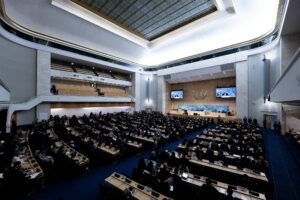
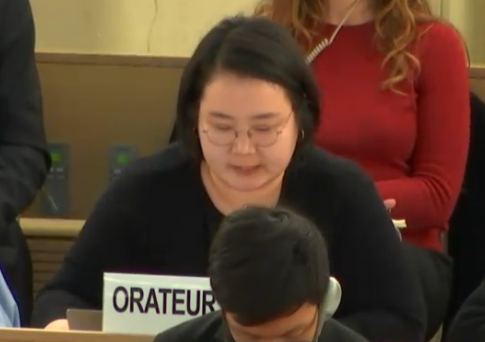
The ICJ today spoke at the UN Human Rights Council in Geneva, highlighting issues of access to justice for women in the context of religious and customary law.
The statement, delivered during a High Level Panel discussion commemorating the twenty-fifth anniversary of the Beijing Declaration and Platform for Action adopted at the Fourth World Conference on Women, read as follows:
“The International Commission of Jurists (ICJ) welcomes this opportunity to celebrate the progress made in the implementation of the Beijing Declaration and Platform for Action 25 years after its adoption and to address the remaining challenges to gender equality and women’s empowerment.
We have indeed seen an expansion in many countries of women’s legal entitlements and protection of their rights. However, there is also a growing trend to push these advances back and violate women’s human rights, invoking as justification religion, tradition, culture, and custom. This came out clearly when ICJ, UN Women and the OHCHR hosted a consultation for the UN Special Rapporteur on freedom of religion or belief last year, where women human rights defenders from all over Asia raised concerns about the resurgence of intersecting forms of discrimination by religion and culture based on patriarchal attitudes. They specifically narrated how women and girls were denied their sexual and reproductive rights.
Recalling the vision of the Beijing Declaration and Platform for Action, we reiterate the obligation of States not to invoke, “any custom, tradition or religious consideration”, to avoid their obligations to combat gender-based violence and discrimination against women. The Human Rights Committee also provides that “State parties should ensure that traditional, historical, religious or cultural attitudes are not used to justify violations of women’s right to equality before the law and to equal enjoyment of [ICCPR] rights[1].”
We therefore urge the Council to foster an open and inclusive discourse with Member States on the regressive interpretations of religious and customary laws that discriminate against women, and to acknowledge the voices and the diversity of women in that process. We urge States to ensure the full implementation of the human rights of women as an inalienable part of all fundamental freedoms.”
[1] Para 5, CCPR/C/21/Rev.1/Add.10
Feb 17, 2020 | Advocacy, Non-legal submissions
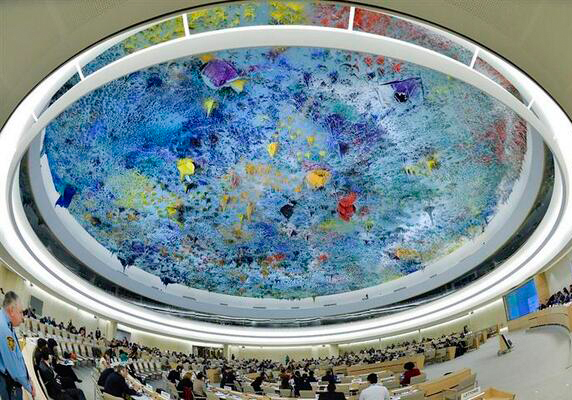
The ICJ has urged expert members of the UN Human Rights Council Advisory Committee to focus on the most direct and acute human rights issues, including a human-rights based approach to victims of terrorism, as the Committee prepares a report on “effects of terrorism on all human rights”.
In an oral statement to the Advisory Committee’s ongoing 24th session in Geneva, the ICJ expressed grave concern about the content of the latest draft of the report, and the potential negative consequences for human rights protection of the report in its current form, and urged the Advisory Committee:
- To substantially revise and refocus the report to include a clear recommendation to the Council that the exclusive focus of the Council’s work should remain on the most acute issues from a human rights perspective: violations in countering terrorism and a human-rights based approach to victims of terrorism, along the lines already established by successive holders of the Special Rapporteur mandate.
- To recommend against the Council entering into more diffuse macroeconomic issues such as diverting foreign direct investment, reducing capital inflows, destroying infrastructure, limiting foreign trade, disturbing financial markets, and negatively affecting certain economic sectors and impeding economic growth.
- To avoid making recommendations that simply repeat already-existing obligations or commitments to counter terrorism under various UN or other instruments.
- To affirm that the existing and longstanding normative and institutional framework on counter-terrorism and human rights is already sufficient to address relevant impacts of terrorism from a human rights perspective.
Prior to the session, the ICJ together with other NGOs had filed a written statement alerting the Advisory Committee to the highly sensitive context into which its report would be delivered at the Council, and urging the Committee to guard against its work being instrumentalized by Egypt and other States who seek to distort, distract and divert the limited resources and attention of the Council and its Special Rapporteur, away from the longstanding focus, achieved by years of Mexican leadership with consensus support of the Council, on human rights in countering terrorism, and the human rights of victims of terrorism.
The Advisory Committee’s report was requested by a 2017 resolution led by Egypt, which was not a matter of consensus, and is being drafted by a former Ambassador of Egypt who is now a member of the Committee.
Earlier at the session, several States including the EU, Switzerland, and Mexico had expressed concern or otherwise questioned particular aspects of the current draft of the report, and urged the Committee to substantially review and revise the draft. Egypt, China, Russia and several other States expressed satisfaction with the draft and urged the Committee to quickly finalize the report and send it to the Council.
The Advisory Committee report is due to be presented to and considered at the September 2020 session of the Human Rights Council, although some Committee members expressed the wish to finalize the report at the current Committee session.
Feb 6, 2020 | Advocacy, News, Non-legal submissions
The ICJ has made a submission to the UN Human Rights Committee in advance of its forthcoming examination of Tunisia’s sixth periodic report under the International Covenant on Civil and Political Rights (ICCPR).
In its submission, the ICJ highlights a number of ongoing concerns with respect to the country’s implementation of and compliance with the provisions of the ICCPR, including in relation to:
- Tunisian authorities’ implementation of the transitional justice law, particularly on issues pertaining to criminal accountability for gross human rights violations;
- Judicial independence and accountability, particularly on issues pertaining to the development of a Judicial Code of Ethics, and
- Tunisia’s failure to establish a Constitutional Court.
The submission is relevant for the Committee’s evaluation of Tunisia’s implementation of the State’s obligations and related Covenant rights under articles 2, 3, 6, 7, 9, 14, 15, 16, 18, 19, 21, 22 and 26 of the ICCPR.
The Human Rights Committee will examine Tunisia’s sixth periodic report during its 128th session, which will be held in Geneva from 2 March to 27 March 2020.
Tunisia submitted its sixth periodic report to the Committee in June 2019 according to the approved simplified reporting procedure and in response to the list of issues identified by the UN Human Rights Committee in April 2018. Among these issues, the Committee requested Tunisia to provide information in relation to: the Constitutional and legal framework within which the Covenant is implemented; transitional justice; and the independence and impartiality of the judiciary.
Download
Tunisia-ICJ-Submission-UNHRC-Advocacy-Non-Legal-Submissions-2020-ENG (full submission, in PDF)
Jan 16, 2020 | Advocacy, Non-legal submissions
The ICJ has submitted information and recommendations for the upcoming review of the UN Global Counter-Terrorism Strategy, emphasising the need to strengthen the role of human rights in the framework and implementation of the strategy.
The submission was prepared in response to a call for civil society input, from the UN Office of Counter-Terrorism (UNOCT).
It summarizes recent ICJ activities relevant to implementation of the strategy, and urges among other things:
- removal of impediments to civil society participation in certain UN or other global policy-making processes;
- recognition that not only is violation of human rights in the context of countering terrorism, whether through arbitrary application or deliberate abuse, in itself unlawful and unacceptable, it also undermines the credibility and effectiveness of the struggle against terrorism;
- better recognition and implementation of the human rights of victims of terrorism;
- mainstreaming of human rights throughout the text and implementation measures for the Strategy as a whole;
- establishment of an independent human rights oversight entity within the UN counter-terrorism architecture;
- creation of a Civil Society Unit within UNOCT;
- increased resources for the UN Special Rapporteur on the promotion and protection of human rights and fundamental freedoms while countering terrorism;
- increased engagement of the UN counter-terrorism architecture with OHCHR and with other UN Special Procedures;
- benchmarks and indicators for assessing States’ compliance with human rights obligations in implementation of the GCTS.
The complete submission can be downloaded in PDF format here: UN-Advocacy-GCTStrategy-2019
For more information contact un(a)icj.org

Dec 15, 2019 | Advocacy, Non-legal submissions
The ICJ has urged the UN Special Rapporteur on Independence of Judges and Lawyers to ensure that his upcoming report on challenges to the independence of prosecutors, fully addresses abuse of prosecution powers to target human rights defenders, political opponents or others, or giving rise to a more general and systemic lack of fair trial for accused persons, or entrenching impunity of State perpetrators of human rights violations, as among the dominant contemporary challenges to prosecutorial independence globally from a human rights perspective.
The Special Rapporteur has made clear his intention to address challenges to prosecutorial independence arising from transnational corruption and organized crime. While the ICJ certainly agrees that such interference can and does have impacts on human rights, to varying extents around the world, the ICJ submission also highlights and documents that threats to prosecutorial independence emanating from the prosecutor’s own Executive government should be seen to be of at least equal concern from a human rights perspective, globally, and should be fully addressed in any report on “contemporary challenges of prosecutorial independence” from a human rights perspective.
The ICJ’s submission can be downloaded in PDF format here: UN-Advocacy-SRIJLProsecutors-2019