Jun 25, 2019 | Advocacy, Non-legal submissions
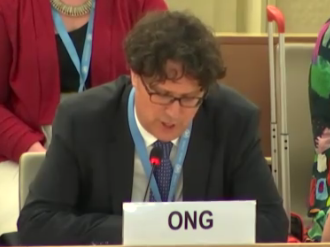
Speaking at the UN Human Rights Council in a general debate on the oral update of the High Commissioner for Human Rights, the ICJ addressed issues around “foreign fighters”, criminalisation of solidarity with migrants, and the need for international investigation of violations in the Philippines.
The statement was as follows (check against delivery):
“The International Commission of Jurists (ICJ) thanks the High Commissioner for her oral update.
The ICJ agrees that accountability for crimes under international law committed by foreign fighters is essential; equally, it must be ensured through fair procedures. Where children are concerned, their best interests must be the guiding principle. [To the extent foreign fighters are addressed in relation to counter-terrorism measures, ICJ emphasizes that not only is disregard for human rights in countering terrorism wrong and unlawful in itself, it is also ineffective and indeed itself conducive to terrorism.]
The ICJ is also concerned at the criminalisation of solidarity with migrants in Europe and elsewhere. No one should be penalised for supporting human rights, including those that States fail to uphold. On Thursday, together with the OHCHR and the Geneva Bar Association, ICJ will screen a documentary in Room XIV, the UN Cinema, showing the impact of criminalization of solidarity.
The ICJ supports calls by the High Commissioner and Special Procedures for urgent action by the Human Rights Council on the Philippines. Adoption of a resolution at the current session to establish an independent international investigation is essential.
The huge number of killings in the name of countering drugs is part of a broader pattern of impunity. For instance, at least 39 lawyers have also been killed under the current administration, some of whom were representing victims of human rights violations. A fully independent national commission of inquiry and measures actually to bring perpetrators to justice are also needed to end the pervasive culture of impunity.”
Jun 24, 2019 | Advocacy, Non-legal submissions
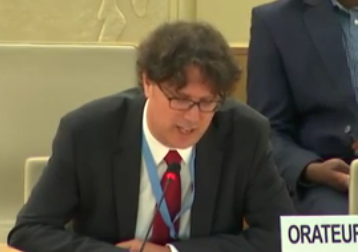
At the UN, the ICJ today highlighted the rights and duties of judges and prosecutors to exercise their freedoms of expression, assembly and association to defend the rule of law and human rights.
The oral statement was delivered in a Clustered Interactive Dialogue with the Independent Expert on Sexual Orientation and Gender Identity and the Special Rapporteur on the Independence of Judges and Lawyers, at the UN Human Rights Council in Geneva.
It read as follows:
“The International Commission of Jurists (ICJ) welcomes the report of the Special Rapporteur on the Independence of Judges and Lawyers on freedom of expression, association and peaceful assembly of judges and prosecutors.[1]
As the report acknowledges, exercise of these rights can be subject to restrictions arising from the fundamental need for judges and prosecutors to be perceived as independent and impartial. At the same time, as the report also emphasizes, any such restrictions must be provided by law and be demonstrably necessary to such legitimate aims, which in turn crucially requires proportionality.[2] These standards have been recognized both globally and in all regions of the world.[3] Any such restrictions on judges should be adopted and enforced by the judiciary itself.
We particularly welcome the recognition in the report that in situations where democracy and the rule of law are under threat, judges and prosecutors have not only the right, but potentially a duty, to speak out and organize in defence of democracy, the rule of law, and human rights, and that this can include participating in peaceful public demonstrations.[4]
Far too often in the ICJ’s work around the world, we see Executive and Legislative bodies, as well as compromised judicial hierarchies, arbitrarily or selectively targeting judges and prosecutors for removal, demotion or other disciplinary measures, precisely for exercising these rights to defend against threats to the rule of law. Examples highlighted in our submission to your study included Egypt, Morocco, Honduras, Hungary and Bulgaria.[5]
Mr. Rapporteur, how can judiciaries, governments, and civil society organisations (including international or regional legal professional associations) act internationally to support judges and prosecutors who are facing such abuse in another country?
The ICJ also welcomes the reports of the Independent Expert on protection against violence and discrimination based on sexual orientation and gender identity. We urge all States to strongly support the renewal of this essential mandate at the current session.
Thank you.”
[1] ICJ’s detailed submission to the Special Rapporteur’s consultation is available at: https://www.icj.org/judgesexpression2019/
[2] Paragraphs 39, 45, 46, 89.
[3] In addition to the global and European, Asian, and American standards cited in the report, see the African Commission on Human and Peoples’ Rights, Principles and Guidelines on the Right to a Fair Trial and Legal Assistance in Africa (2005), paras A(4)(s) and (t), and F(d) and (e).
[4] Paragraphs 61, 69, 90, 102.
[5] See for further information: https://www.icj.org/judgesexpression2019/
Jun 23, 2019 | Events, News
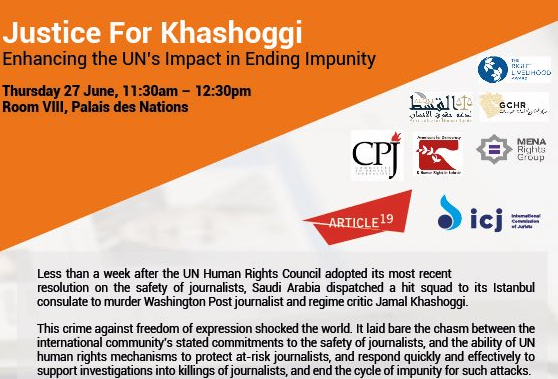
The ICJ joins other NGOs and UN experts in presenting a side event to the UN Human Rights Council, Thursday 27 June, 11:30am – 12:30pm, in Room VIII, Palais des Nations
Less than a week after the UN Human Rights Council adopted its most recent resolution on the safety of journalists, Saudi Arabia dispatched a hit squad to its Istanbul consulate to murder Washington Post journalist and regime critic Jamal Khashoggi.
This crime against freedom of expression shocked the world. It laid bare the chasm between the international community’s stated commitments to the safety of journalists, and the ability of UN human rights mechanisms to protect at-risk journalists, and respond quickly and effectively to support investigations into killings of journalists, and end the cycle of impunity for such attacks.
This human rights crisis is not limited to autocratic countries or nascent democracies – after several years in decline, the number of killings of journalists worldwide spiked in 2018, whilst impunity for historic cases remains troublingly high, fueling further violence. In Malta, a report by PACE Special Rapporteur Pieter Omtzigt into the killing of Daphne Caruana Galizia more than 18 months ago, highlighted serious concerns over national investigations, pointing to systemic rule of law failings in the country.
As the UN Special Rapporteur on extrajudicial, arbitrary or summary executions, Dr. Agnès Callamard, presents the findings of her independent investigation into the killing of Jamal Khashoggi to the 41st Session of the UN Human Rights Council, join us to discuss what recent attacks on journalists have taught us about gaps in prevention, protection and prosecution, and how to enhance the UN’s response to impunity.
| Panelists |
Dr. Agnès Callamard |
UN Special Rapporteur on extrajudicial, summary or arbitrary executions |
|
David Kaye |
UN Special Rapporteur on freedom of opinion and expression |
|
Hatice Cengiz |
Fiancée of Jamal Khashoggi |
|
Pieter Omtzigt |
Special Rapporteur, Council of Europe |
|
Rob Mahoney |
Deputy Executive Director, Committee to Protect Journalists |
|
Yahya Assiri |
Founder and Director, ALQST |
| Moderator |
Thomas Hughes |
Executive Director, ARTICLE 19 |
Jun 23, 2019 | Events, News
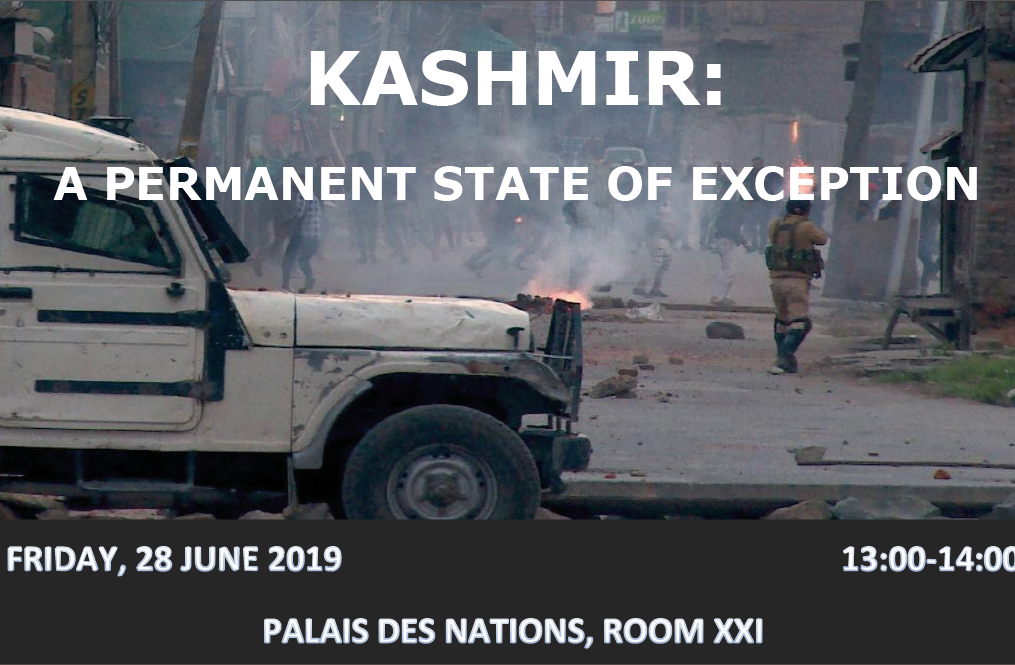
This side event will take place on Friday 28 June 2019, from 13:00-14:00, in Room XXI, at the Palais des Nations.
There has been an increase in serious human rights violations in Kashmir, particularly since 2016. This has coincided with shrinking space for human rights reporting and advocacy at the national level, with human rights defenders facing unprecedented threats and reprisals.
The escalating violence, coupled with systemic impunity for perpetrators, has made it imperative for the human rights situation in Kashmir to be highlighted at the international level, including at the UN.
This event aims to bring to the forefront the human rights aspect of the conflict and discuss possible strategies through which the international community can play a more effective role in ensuring the promotion and protection of human rights in the region.
Keynote Address
Hon. Judge Navanethem Pillay: Former UN High Commissioner for Human Rights (2008-2014)
Moderator
Sam Zarifi: ICJ Secretary General
Speakers
Juliette Rousselot: Program Officer for South Asia, International Federation for Human Rights (FIDH)
Gerard Staberock: Secretary General, World Organization Against Torture (OMCT)
Dr. Angana Chatterji: Co-chair, Initiative on Political Conflict, Gender and People’s Rights, Center for Race and Gender, University of California, Berkeley
Kashmir-HRC-Event-2019-ENG (Flyer in PDF)
May 19, 2019 | News
Ahead of the 2020 review of the human rights treaty body system, the ICJ, together with a number of NGO partners, have made a joint submission to the UN Secretary-General ahead of his third and last biennial report to the UN General Assembly later this year on the status of the human rights treaty body system and the progress achieved in realising greater efficiency and effectiveness in the work of the treaty bodies.
The joint NGO submission focuses on:
- the objectives and principles for the 2020 review;
- visibility and accessibility;
- membership;
- working methods and inter-committee coordination; and
- the growth of the treaty body system and adequate funding.
The full submission is available
here.